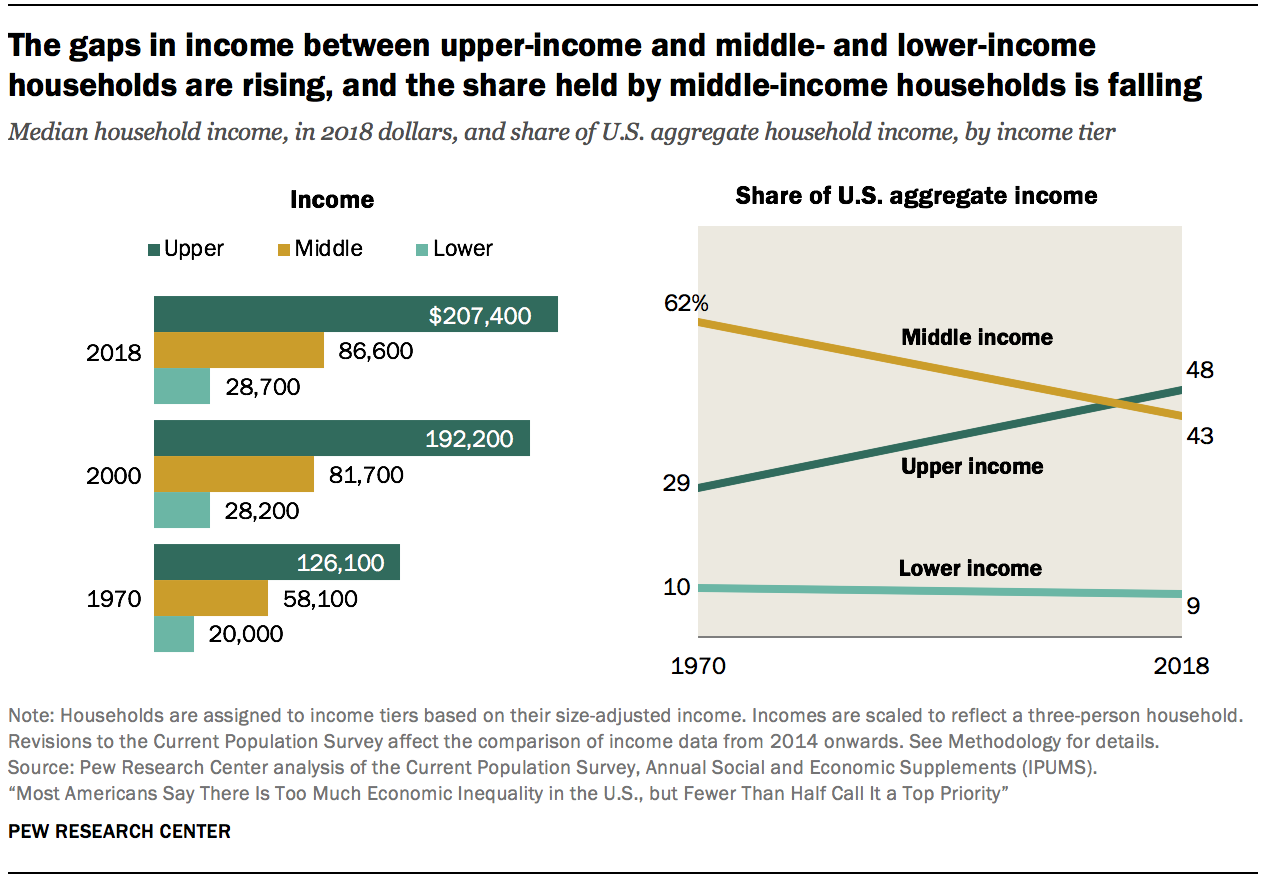
But then there's this overall trend of stagnating wages for everyone except owners of capital. Industries become more and more concentrated. Billionaires get richer. We have trillion dollar companies, while inflation is increasing.
We're told "Don't be a hater, let billionaires do their thing!" But then they don't pay taxes and they spend their money on space bullshit. The world they are trying to create is not a better one. They are a hog on resources and the human race is right to be sick of it.
Fuck them, they should pay taxes and everyone should stop worshipping them like some kind of golden calf. It's not about being a hater, it's about stopping an economic tumor from getting any bigger.
I don’t think this tells the full story. I know I have somewhat esoteric views about finance, but I believe that wages in terms of what they can buy have in fact been increasing faster than you’d expect just based off of the dollar amount of wages. Even though minimum and average wages have increased more slowly, the buying power hasn’t decreased (and maybe even increased).
This is based on the rate of technological progress causing massive deflation in prices of things that can be made more efficiently by said technology. Our lives have also become more convenient in the last 20-ish years, with a significant chunk of inflation being caused by people actually buying more expensive versions of things.
Think of a 2005 cell phone. Motorola Razr era. Those things cost a few hundred dollars. You could buy something with comparable (or likely even better) capability today for pennies, or even find one for free. Which means massive deflation of comparable goods. You can get full-blown smartphones now for $50 total (budget android phones). Same thing applies to lots of products.
But our lifestyles have also gotten much more expensive — it’s fairly normal to spend 2-3x what we would’ve spent on the fancy Razr phone, or even more, because we want the latest and best. If we lag behind the cutting-edge with our purchases, we’ll find that we are spending less each year on comparable products.
Look through some of these[0] inflation charts — I tried apparel and bananas for example, but it looks like inflation has been extremely low on some standard household items (trying to ignore things that people are buying more luxury versions of these days).
All this to say — yes, income inequality is worth keeping an eye on. And yes, our tax system needs to be massively simplified to prevent loopholes. But some level of wealth inequality isn’t necessarily bad, it seems to be a pretty natural behavior that some small number of people hyper-optimize for some successful path & win — in all sorts of activities, not just wealth-building.
And, even though wages haven’t gone up a ton recently, neither have prices. People spend so much more of their money on luxuries now that it seems that cost of living has gone up, though. (Housing is an exception here that definitely has gone up)
You don't live in a Razr. Purchasing a house is outside of the realm of possibilities for most people under 30. Rent does keep growing too, and guess what, your wages don't follow.
I don't put a Razr in my gas tank, but the price keeps skyrocketing.
You're just not looking at what people _need_. Nobody gives a shit about having an Alexa in their homes, that's just a bonus.
> some level of wealth inequality isn’t necessarily bad,
If I was born in 0 BC, and worked every day of the year until today with my current salary, I would be 8% of the way to being a billionaire. This isn't "some level of inequality". It's theft and is actively damaging for society.
It's gone up so much as to eat all those cost savings, where it's only the rich benefitting from the cheaper phone. They're just as unapproachable because people have less to spend after rent
But while I'm happy to dedicate mental-space to that question, I see no advantage in dedicating that mental space on hating billionaires, nor in dedicating mental space to what the Kardashians are doing. This stuff is hero-vs-villains thinking, grounded in a comic-book like view of the universe.
For sure. Let's not kick the can down the road, let's solve it now.
> I see no advantage in dedicating that mental space on hating billionaires, nor in dedicating mental space to what the Kardashians are doing. This stuff is hero-vs-villains thinking, grounded in a comic-book like view of the universe.
See, you think this is a systems problem rather than a people problem and I am saying it is both. This system is created and supported by people, it makes sense to address those specific people. This is not a "comic book like view of the universe". Billionaires should pay more taxes and people shouldn't fall for their self congratulatory bullshit hogging a news cycle.
So people should better buy some capital!
Also the lament about stagnating wages glosses over the amount of people that have been added to the workforce. The average wage per person may have stagnated, but the sum of wages that are being paid out has increased a lot.
I think it is not a small achievement to provide jobs for so many more people.
Anger and resentment are highly charged emotions, and so they make people click, like, retweet and subscribe. So it's unsurprising that those takes are highlighted and encouraged by the social networks.
Not to say that we shouldn't fight for a better world, but we lost our way when we started attempting to do so through anger.
I've started to think the most dangerous parts of social media are the things which we agree with the most, whatever side of politics you're on.
In the case of Bezos, Musk and Branson, I think it's a case of hate the game, not the player. There are plenty more low-profile billionaires exploiting workers and using their gains for worse things than going to space (like lobbying), but we rarely talk about them because they're not in the news. Instead of hating on specific people as if their disappearance would solve the problem, we could be channeling that energy into changing the system to be fairer for all.
Castigating people for negative thoughts and how they "ruin" ingenuity is ultimately a self-defeating argument.
Does that happen? I think most people that criticize a billionaire don't dwell on it and are onto something else five minutes later. Voicing your opinion is quick and easy, and even if it changes nothing, it's too little to ruin your day.
Only a psychopath would devote that much brainpower to issues out of their control.
Also, there's a lot of context missing from your analysis. Many people find Elon Musk annoying, even a dick, but his space company has done genuinely innovative stuff and is reliably doing commercial deliveries. Bezos is an even more successful businessman, but he's also almost cartoonishly self-absorbed and increasingly looks like a guy with more money than sense. You could see everyone around him cringing today when he was 'thanking' Amazon customers and employees for paying for his Very Big Adventure.
millions of average persons dedicating 2 or 3h of their 16h/day budget on negative thoughts about other people's lives
Calling bullshit on bullshit isn't dedicating hours to negative thoughts. People dislike Jeff Bezos because his company does things like putting anti-union posters on the insides of employee toilet stalls so people can't have even a moment of privacy at work.
Maybe they made some useful advancements (any examples?), but overall this feels like saying a complicated tax code shouldn't be hated on, because it keeps accountants sharp and full of new knowledge.
I think a lot more human ingenuity-capacity is wasted in jealousy and resentment of others, than what these billionaires may be spending on their hobbies.
* * *
I think the Blue Origin/Virgin Galactic "buy a tourist flight to space" is not my cup of tea, and I'd rather they were doing actually useful industrious space exploration stuff. But I think their puerile vanity hobbies are also not bad for technological advancements. The engineers working on this are going to develop more skills and knowledge, and that will not be lost. It'd be better if it was to do science or some industry, but it's not a net negative either.