This is painting a bit too broadly - a degree still shows that you can jump through pointless hoops which is valuable to employers and some degrees are valuable in and off themselves because they gate professions that are necessary for society (medicine/engineering). I’d also point out that colleges historically ignored large pools of candidates from certain demographics for political reasons. I suppose there is probably some learning that manages to happen once in a while too, which is worth something if not the cost to society of fueling the higher ed apparatus.
Agreed that these are important factors in success, but in practice they don't seem to be equivalent in importance.
An unsuccessful person who lacks intelligence or conscientiousness but was born into affluence in the US is more likely to remain higher on the socioeconomic ladder than a successful person who has both intelligence and conscientiousness but was born poor.
That said, I believe that with hard work and intelligence it is possible for someone to move up no matter their starting point and we should celebrate the famous outliers who lept up the ladder. But it's also responsible to acknowledge that they are famous because they are outliers and that most people seem to end up within a rung or two of their parents.
Are you using the same scales here? If the affluent person was 1% you should take a top 1% person in terms of intelligence or grit. If the affluent person was top 25% in intelligence then the other person should be in a top 25% income family. (top 25% intelligence isn't even 110 IQ, so not high at all)
It isn't fair to take a bottom 10% person with top 2% intelligence and compare that to a top 0.1% in terms of wealth and top 25% in terms of intelligence, but that is the kind of argument people usually makes.
But another way of thinking about it is to look at the research on economic mobility. [1] For example, someone whose parents were in the top quintile is more likely to end up in the top quintile than anywhere else, followed by the next-highest quintile, etc and is much less likely to end up in the bottom quintile. Whereas someone born in the bottom quintile is more likely to remain in the bottom quintile, followed by the next-lowest, etc and is much less likely to end up in the top quintile.
One way to interpret that data is through the lens of the just-world hypothesis. This assumes that the United States is a meritocracy and that people will eventually end up at the correct quintile based on their personal effort and characteristics. And if there happens to be generational social stratification then it's probably due to intelligence and grit being hereditary.
Another way to interpret it is that the people with resources have instituted rules and systems that increase socioeconomic inertia so that they can pass as much of their status on to their children as they can while still allowing for enough mobility to prevent a revolution.
Having met, worked with, and taught people in the top and bottom quintiles, I do not find the first hypothesis compelling. That's not to say there is no movement, and those people I have met who have climbed the furthest are also some of the most intelligent, hard-working people I know. But telling them fairy-tales about meritocracies is not helpful -- they need to be prepared to fight long odds and work significantly harder to climb up than someone who is basically already there.
[1] https://www.heritage.org/sites/default/files/~/media/images/...
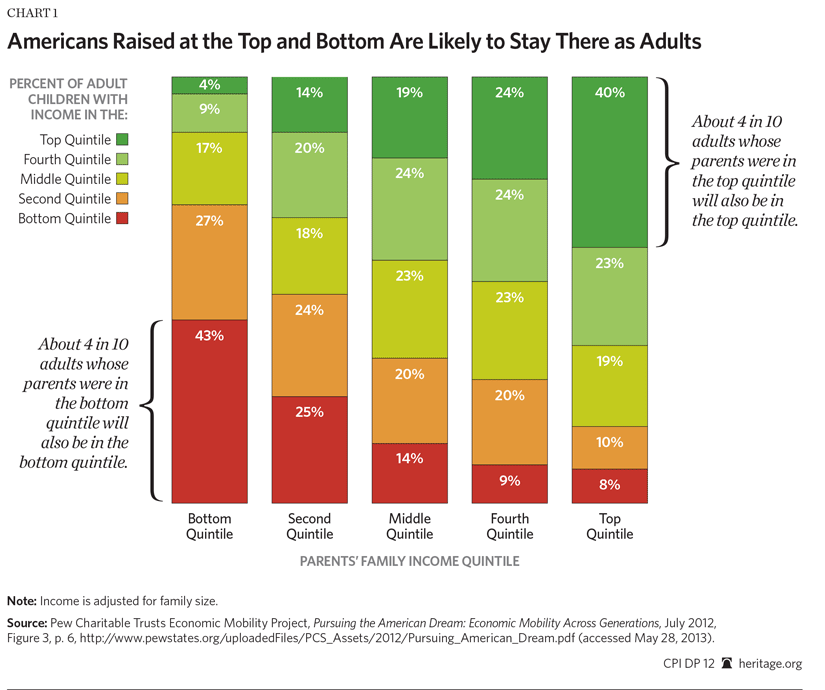
Are we talking status relative to others or relative to the starting position?
There will always be the deadbeat child of someone wealthy who's still wealthier than you but all the "doers" I know have climbed the socioeconomic ladder at least a couple rungs in their adult lives.
I agree that relative movement is possible and I also know a lot of extremely hard-working people (both rich and poor) who have been successful and climbed a rung or two in their lives.
My point was more that the average wealthy person I know doesn't seem to have a particularly greater or lesser "ability to do things" compared to the poor people I know. Whereas if the "ability to do things" was really a substantial socioeconomic equalizer then I would have expected that DO-ers would be over-represented the higher up the socioeconomic ladder you climb instead of evenly distributed at each level. Perhaps it's different at the very top and the very bottom?
(As a contrast, in the military I found a positive correlation between an officer's rank and their ability to do things. Most of the colonels I worked with had an impressive intellect and drive, and even moreso with the generals I met.)
starting point + (hard work * ability * luck)
(where any one of those may be positive or negative)
I don't know what the next societal band-aid will be, but it probably won't get us any closer to actual equality of opportunity. Still doesn't mean we shouldn't try.
And what of it? There has never been a time in human history where starting position has mattered less. NONE!
Don't just take my word for it https://www.youtube.com/watch?v=kOiQgleiRtU
Also - think of what a better place it would be if that Don Lemon who was tired of race bating had survived and had got his wish? How sad we are where we are today - and ironically he's one of the front line contributors to it too!
Class still exists with its advantages, from BS (e.g. who you know) to real (e.g. security to invest in yourself long-term).
https://www.cnbc.com/2019/09/26/majority-of-the-worlds-riche...
Maybe you don't trust this source but there are many others like it.
This bizarre push to make everyone think that there's no meritocracy, which I guess goes hand in hand with the fashionableness of being a victim, is cynical poison being driven by people with radical political agendas.
His point was that there are plenty of people that don’t become wealthy even though they work hard and have hustle. And there are plenty of wealthy people that didn’t need to work hard to get it.
Looking at the self-made wealthy will select for people that “do”, but that does not imply that “do” makes you wealthy.
I have depressed friends that I believe can’t reasonably be expected to just decide to “do”, and I have other friends that seem to naturally have an abundance of “do”.
Yes, we can learn the skill, or we can be taught the skill, but otherwise your statement seems unrealistic to me.
For example, it may take somebody who's depressed the same amount of "do" to get out of bed and eat a yogurt as it takes a go-getter, "neurotypical" [0] person to get up, cook a healthy breakfast, go to the gym, take a shower, get to work, and get through their first couple tasks of the day.
[0]: I put "neurotypical" in scare quotes because I'm not sure neurotypical is even really a thing, it's just the term we use for people whose mental makeup fits well into our society and work culture.
>>> His point was that there are plenty of people that don’t become wealthy even though they work hard and have hustle. And there are plenty of wealthy people that didn’t need to work hard to get it.
is a trivially correct, banal point. The parent comment was implying with his "I know even more people who are rich and lazy" comment something that, while it may be true for the people he encounters, is not true for society at large.
Do you have a source for that?
No one here has said that. More importantly, your link doesn't dispute that either. It simply says that billionaires, who are on the extreme, don't inherit most of their wealth -- despite the fact that 45% of them at least partially did so.
I've long argued that until we send all kids, rich and poor, to academies at birth with no further contact or tracing to their parents, we won't really understand the full impact of advantages bestowed by wealthy parents.
I think perhaps we're talking about different things? I don't think it's fashionable to be a victim or that people have no control over their fate. Hard work (along with intellect and luck) generally helps people move up in life, and the people I know who have moved up the most in their lives are generally also the smartest and hardest working, so it would make logical sense that most people at the very top have worked hard to get there. After all, not many people out there can fall down a couple rungs and still be at the top of the ladder, right?
But beyond those extreme outliers, most people in the US (which ranks 27th in social mobility according to the world economic forum[1]) seem to end up within a rung or two of where they were born. So I suppose how "meritocratic" the US is probably depends on what you mean by the word.
[1] http://reports.weforum.org/social-mobility-report-2020/socia...
From your link: "“As our society has become more meritocratic, we’ve simply replaced an aristocracy based on title, class, race and gender with a new and equally persistent aristocracy based on genes, education and parenting,” Pearlstein continued. “Unless we are prepared to engage in extensive genetic reengineering, or require that all children be brought up in state-run boarding schools, we must acknowledge that we can never achieve full equality of opportunity.”"
But at least from my personal network developed from growing up in a working-class town and eventually living in extremely wealthy neighborhoods in extremely wealthy cities I have not noticed a strong relationship between "the ability to DO THINGS" and someone's social or economic status.
I've known working class people who grew up poor and who had amazing hustle and through a combination of intelligence, luck, and hard work they clawed their way into the lower-middle class and set up their kids for even further success. I know even more rich people who inherited companies that they weren't interested or competent enough to run, or who got positions that didn't really require much DO-ing on their part by leveraging family connections. So when I picture someone with no real skills or ambition ambition I usually imagine a neighbor who grew up in the "owner class" and when I picture a "do-er" I always picture someone who grew up "working class".