“Sex” could be interpreted to mean a statement about chromosomes, in which case there are more than two variants.
Or it could be interpreted to be a statement about reproductive potential, in which case the “two sexes” model is a better fit, because there’s no intermediate gamete between sperm and egg. Do intersex conditions break this model? Almost always not: the variations of sex development are variations on the male pattern and the female pattern. Are there exceptionally rare individuals that defy categorisation? Surely there are, but the existence of extreme, rare outliers doesn’t invalidate the model.
Which definition is most useful? In the context of women’s rights, it’s clearly the latter. Women suffer discrimination based on their reproductive biology, not based on their chromosomes. It’s also the model that the vast majority of people use as their everyday working definition of sex.
So I think anyone who wants to claim there are more than two sexes must accept the responsibility to qualify their terminology.
Yes, it could - by people who don't know what the word "sex" means. Sex isn't about chromosomes, it's about gametes, and sex chromosome variants aren't separate sexes. For example, people with Klinefelter Syndrome (XXY) are male. This isn't hard.
https://colinwright.substack.com/p/sex-chromosome-variants-a...
> What’s important to note is that the presence of a Y chromosome, or two, or three, etc., all result in the development of testes and therefore these individuals are biologically male. Likewise, individuals with additional or fewer X chromosomes, in the absence of a Y, all develop ovaries and are therefore biologically female.
Looking at things like testes and ovaries is only one part of things, and not some universal definition scientists accept. The author even admits in the comment some people may have both. We also know that some people make have one of these but appear oppositely on the inside/outside.
> This isn't hard.
From my experience, it is deeply complex.
> Effectively regulating sports divisions based on sex using science is impossible. There are no singular or combinations of objective criteria that can define each sex. Prior attempts to govern sports eligibility based on sex using existing testing methods have failed to provide a workable solution based on chromosome composition, physical exam, etc. In other words: we have no way to consistently differentiate male from female and we have never possessed the ability to do so. Gender and sex are not the same thing. Sex is typically assigned at birth based the appearance on appearance of external genitalia and or chromosomal makeup, whereas gender is socially constructed and may vary from culture to culture and/or change over time. However, sex is difficult to dichotomize into two binary divisions because there are a number of different chromosome compositions consistent with either male or female phenotypes. The phrase “biological sex” is meaningless and is ill-advised.
From https://www.barbellmedicine.com/blog/shades-of-gray-sex-gend...
https://static.scientificamerican.com/sciam/assets/File/051_...
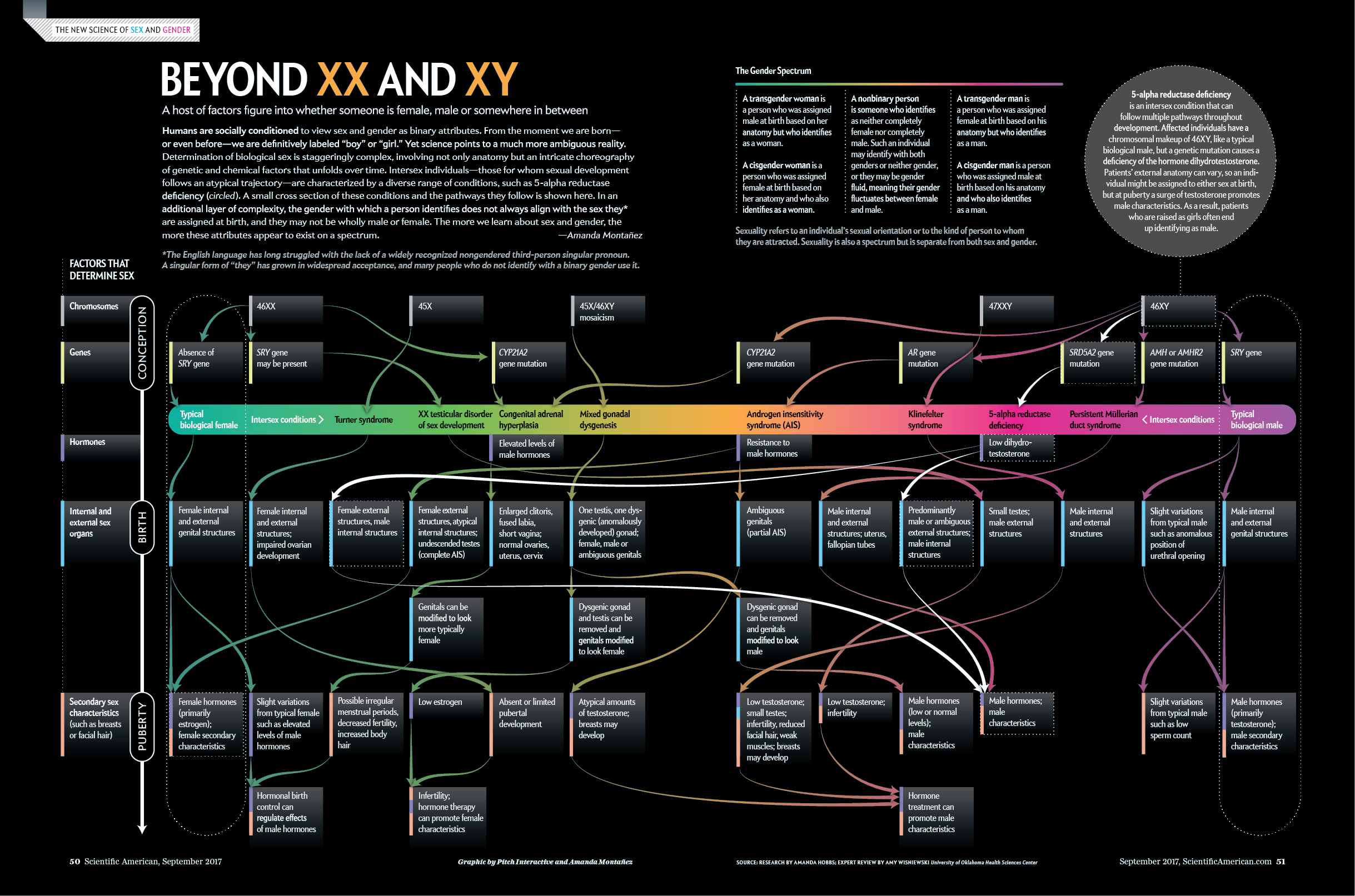
https://blogs.scientificamerican.com/sa-visual/visualizing-s...
Most (but not every) step on that continuum are known as diseases of sexual development [0].
These arguments often come up in discussions around trans issues, but its a trick of misdirection, although the DSD community does have a higher incident of gender identity issues (which is what you'd expect), around 5%, 1% that actively changed their gender, the lack of transition within the DSD community seems to suggest DSD and gender dysphoria are not related phenomenon.
The idea that sex is a continuum, based on known disorders, is like saying human bipedalism is a continuum due to people being born with less than 2 full legs, or more than 2 legs (extra toes), or losing them in later life. Although technically correct the observation does not really change the conversation.
[0] https://en.wikipedia.org/wiki/Disorders_of_sex_development
[1] https://pubmed.ncbi.nlm.nih.gov/29606626/
[edited for clarity] added: the lack of transition within the DSD community
Re intersex; congenital anomalies do not define a category (if the term congenital anomaly offends you, I am using the WHO definition). Just like if we would say "humans have one head" we would be excluding congenital twins, or with "five fingers" we would be excluding polydactyly.
Also: people with Klinefelter Syndrome are male.
And before you say "this is purely hypothetical, these sorts of conditions would never affect the practical sorts of discussions we are having here about olympic games", no, it is not: https://en.wikipedia.org/wiki/Foekje_Dillema.
> the gametes are eggs or sperm ... there is no law of nature that ... there aren't intermediate states for any specific dimension
Sorry for butchering your sentence but wanted to respond very specifically.
Sex, which is by far not exclusive to humans, has one primary purpose and that is sexual reproduction. And quite a lot there is governed by laws of nature. There are 2 sexes and not 1 or 3; 1 means cloning yourself and that does not introduce sufficient variance to fight against environmental change, 3 partners are combinatorially more difficult than 2 to bring together. Why gametes are dimorphic; sexual reproduction only needs exchange of genetic material, but the initial cell needs tons of other organelles to bootstrap. A process where either gamete can bring any of the organelles is exponentially more error prone and difficult to coordinate. Hence the small gamete having the bare bones mobility machinery to bring the genetic material to the heavier gamete.
There is no gamete that's between sperm or egg. Even in super rare species where an individual can change sex (some fish does this) they switch to their sex matching gamete entirely, and don't produce an inbetweener.
We can talk about continuity among secondary manifestations of sex, we can talk about fluidity of gender roles etc. and all would be fair game. But we can't call sex anything other than a discrete, binary category without destroying its scientific, cross-species, cross-millions-of-years, universal definition.
At a bare minimum, you would have to make an allowance for the "third sex" (as you define it) of those who do not produce any gametes. Remember, we are talking about sex in humans, not sex in human gametes. I do not dispute that human gametes are strictly binary; the question is about classifying individuals, for which the binary classification is obviously not absolute, even on the question of gamete production.
I was with you until this statement. Sex is a millions-of-years-old discrete variable; it depends on whether you could produce the bigger gamete (called egg) or the smaller one (sperm). Gender is a continuous variable with a strongly bimodal distribution.