With current technology, nuclear is significantly less efficient than solar and wind in one very important metric: cost. Or to put it another way, a dollar invested in solar or wind will produce more energy and offset more carbon emissions more quickly than if that dollar was invested in nuclear.
This may change when we're chasing after the last 10-20% of grid emissions, but for now there's still a lot of low-hanging fruit.
And once you install enough storage to make the 9's comparable, the solar/wind is quite a bit more expensive than the nuclear.
https://www.energy-storage.news/news/developer-8minute-says-...
https://www.energy.gov/ne/articles/nuclear-power-most-reliab...
Building nuclear in 2021 is like buying UltraSPARC in 2021. Sure, it's more reliable than a single PC, but a cluster of PC's is way cheaper and more reliable in aggregate.
As an example, the large solar facility in Arizona produces 15% of the power in January, as it does in June. The batteries or overbuild needed to compensate for this tremendous imbalance in power production can only be offset with absolutely staggering scaled batteries.
...something that never seems to be modeled in the articles pushing renewables.
Rolling blackouts are incredibly abnormal, but would be extremely common with solar/wind based power.
A diversified power grid would still be subject to weather - which is common across the entire local grid.
This is not at all clear, especially going forward. The key is to shave off the last 10% or so with hydrogen and combined cycle, not batteries.
https://model.energy/ for actual model results
But power stations are contracted/paid on the basis of the energy (ie MWh) they generate. And solar and wind can produce each MWh significantly cheaper than new-build nuclear can.
But will they be continue to be paid by the solidified alumunium smelter and the gunged-up paper mill the week after the cloudy weather?
That said, in interesting innovation that may deal with dispatch-ratio limitations of renewable energy has become popular here in Africa for domestic lighting.
As you know, we have 'moved on' from electricity to candles and bush-fires for reasons relating to what is euphemistically called a skills-shortage.
Many of us are now using LED light bulbs with batteries in them. They charge when the power is available (Deo Volente) and offer ~4 hours light.
And we get to see the stars now.
How long do you think it takes to "recycle" a nuclear power plant after it finishes operation? Decommissioning an old nuclear power plant can take more than 100 years and costs billions.
Decommissioning and clean-up of the UK's fleet of 17 retired Magnox reactors, built between the 1950s and 1970s, is estimated to cost in excess of £100 billion, and will still be ongoing well into the 22nd century:
https://www.world-nuclear-news.org/WR-UK-nuclear-clean-up-co...
Is it really fair for us to keep offloading these costs and problems onto future generations?
Have a look at France - they get over 70% of their electricity from nuclear just fine. And it is much cleaner and cheaper than in Germany which opts for Russian gas instead.
That either means a gargantuan cost to build new plants (making germany's recent renewables building spree look cheap) or trying to make a plant that was designed for 80 years last 100 with all of the exciting safety concerns which go with it.
Even France has cooled on nuclear due to the high costs involved. As old reactors are decommissioned, they plan to replace them mainly with renewables:
https://www.power-technology.com/comment/renewable-energy-to...
That's like saying "solar is vastly more efficient than hydropower because it requires less water, concrete, and river space."
Neither nuclear nor renewables are limited by those things, compared to things like cost, regulatory hurdles, political factors, fossil fuel lobbies, etc. Then there's the actual specific hurdles per energy type, like limited storage/battery tech/lithium/cobalt for solar, volatility for wind, nuclear waste and long-term capital risk for nuclear, etc.
gas/oil combined cycle power plant - $1000/kW (2019)[9]
combustion turbine - $710/kW (2020)[9]
onshore wind - $1600/kW (2019)[9]
offshore wind - $6500/kW (2019)[9]
solar PV (fixed) - $1060/kW (utility),[10] $1800/kW (2019)[9]
solar PV (tracking)- $1130/kW (utility)[10] $2000/kW (2019)[9]
battery storage power - $1380/kW (2020)[9]
conventional hydropower - $2752/kW (2020)[9]
geothermal - $2800/kW (2019)[9]
coal (with SO2 and NOx controls)- $3500–3800/kW[11]
fuel cells - $7200/kW (2019)[9]
-- https://en.m.wikipedia.org/wiki/Cost_of_electricity_by_sourc...
It sure is expensive for something so efficient.
You shouldn't compare energy sources based on capital costs alone. For that, your link references LCOE [1], which is essentially (total cost) / (total energy produced).
Your link further has a "Global Studies" section [2], which references numerous studies that compare LCOE by power source, worldwide, and a "Regional Studies" section [3] which does the same for specific regions.
If you look at the relevant sections from your own link instead of cherrypicking irrelevant data that suit your position, you'll see that nuclear isn't so clearly uncompetitive. Whether it's cost-effective or not seems fairly contentious.
[0]: https://en.wikipedia.org/wiki/Cost_of_electricity_by_source#...
[1]: https://en.wikipedia.org/wiki/Cost_of_electricity_by_source#...
[2]: https://en.wikipedia.org/wiki/Cost_of_electricity_by_source#...
[3]: https://en.wikipedia.org/wiki/Cost_of_electricity_by_source#...
Solar : $36 / MwH
Onshore wind : $40 / MwH
Nuclear : $164 / MwH
It's pretty much in line with the capital costs.
If you look at the figures provided by the Nuclear Energy Agency nuclear is very competitive though.
That said, solar and wind are still considerably cheaper than nuclear when the per-MWh prices are compared. Large (multi GW) off-shore wind farms are now being contracted in Europe for less than half the cost of new-build nuclear.
still quite a bit below $6,000
Batteries will get cheaper faster than nuclear, and can be built faster with very little regulatory requirements.
https://iea-pvps.org/key-topics/human-health-risk-assessment...
Specifically, this report presents an analysis of potential human health risks associated with non-sanitary landfill disposal for three PV technologies, focusing on release of the highest-prioritized chemical element for each: lead (Pb) in crystalline-silicon (c-Si) PV modules, cadmium (Cd) in thin film cadmium telluride (CdTe) PV modules, and selenium (Se) in thin film copper indium selenide (CIS) PV modules. The prioritization of these chemical elements for analysis is based on stakeholder interest. Because the methodology is chemical-specific, the risk assessment results for these chemicals cannot be directly generalized to other chemicals, although the risk assessment methodology can be applied to other chemicals. If the chemicals chosen are indeed the ones presenting greatest risk, then the results herein should represent the upper bound of health risk from exposure to a single constituent.
Panels are safely recycled today: https://www.veolia.com/en/newsroom/news/recycling-photovolta...
As are batteries: https://spectrum.ieee.org/energy/batteries-storage/lithiumio...
As are wind turbines: https://www.utilitydive.com/news/ge-announces-first-us-wind-...
Tell that to the Finns or French.
You're linking me "can do" articles. The industry itself states there's not enough data:
https://iea-pvps.org/key-topics/lci-of-current-european-pv-r...
Solar photovoltaic (PV) installations must be properly dismantled and any waste treated and disposed at the end of project life. However, because most of the world’s nearly 400 GW of PV systems have been built in the past decade – each expected to operate for between 20 and 30 years – current PV module waste volumes do not yet justify widespread operation of PV recycling facilities.
It is indeed an unfair comparison, because there's not enough data to compare.
I don't see anywhere where the cost of all of this is factored into solar/wind. Neither can you, because probably no one knows at this point.
One of the largest negatives of nuclear is it's cost efficiency, namely it being pretty bad and not dropping, compared to renewables
> no technology exists at scale, particularly nothing that could be massively available and producing in the next couple of decade
P2G? Hydrogen can be produced, stored and given back to the grid at scale. Do also keep in mind that it currently take decades before new nuclear power plants go from beginning the planning phase to producing energy (at least in the west), so it may be even worse for nuclear power
Regarding germany's Energiewende: A large part is that the EEG-Umlage is very expensive while not helping much in the last decade. If you look at the increase in wind & solar, it has pretty much stagnated the last few years while costs didn't. It's just not a very good instrument. Additionally, new rules (at least for wind) decimated available land and the "Ausbaukorridor" (added in 2013) also ensured that there couldn't be much growth for renewables.
Nuclear usually requires vast subsidies to operate and imposes costs that go on for decades or more in waste management. And according to this data, all the nuclear energy output reduced in Germany has already been more than made up for with non-hydro renewables, which are getting cheaper and cheaper all the time:
https://energytransition.org/wp-content/uploads/2018/04/non-...
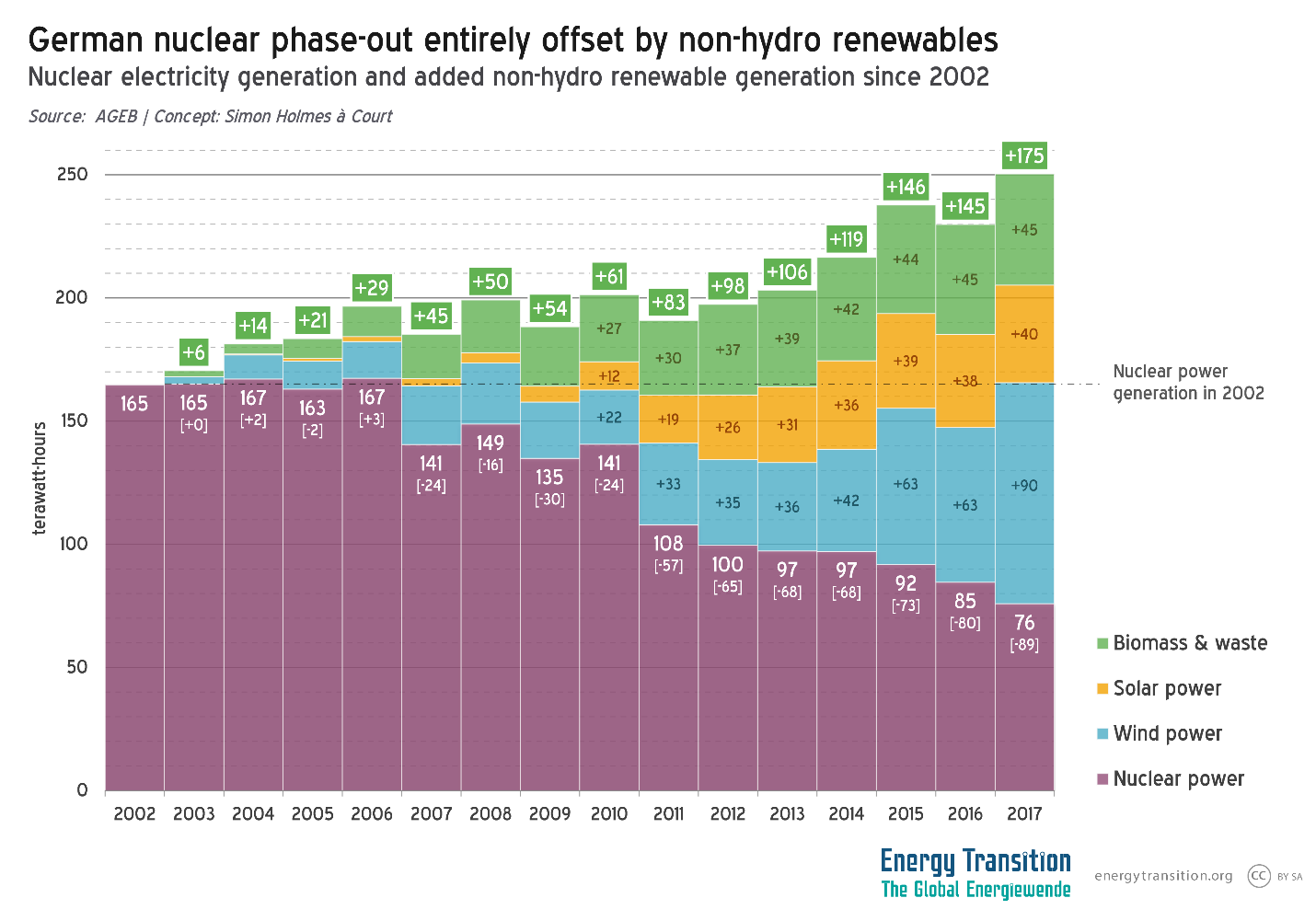
Which means despite all the efforts and billions spent the renewables have helped zero in reducing carbon emissions, because they were used to replace nuclear rather than coal.
> Nuclear usually requires vast subsidies to operate
This is not true, notably unlike non-hydro renewables.
I'm not in principle against nuclear, but it's just not economically feasible to run on full nuclear, not when renewables are much cheaper.
Hinkley Point C is estimated to cost $32.5 bn and is expected to take 18y from go-ahead till operation. You'd need 15 NPPs of the same class to satisfy the UK's electricity demand at close to 100% utilization ratio. That's $4.9tn or 150% of the UK's GDP, just in capex. And there's no way EDF could simply build 15 of the things till 2030 or 2050 or whatever our climate goals for decarbonisation demand.
And please don't reply with "it's getting a lot cheaper if we build more" - that has never really worked for nuclear.
Our whole discussion, you are not ONCE acknowledging I just MIGHT have a point or countering them, you are constantly moving the goalposts or deflecting. And with that kind of bad faith discussion style, count me out. Good day to you, Sir.
What about it?
[1] https://www.fws.gov/birds/bird-enthusiasts/threats-to-birds/....
[2] https://audubonportland.org/our-work/rehabilitate-wildlife/b....
>[2] https://audubonportland.org/our-work/rehabilitate-wildlife/b....
That seems like a very high bound. Another source says there are 7.2B birds in US and canada[1], so 1B birds would be 14% of all birds, which is really high. I also feel like 7.2B dead birds would be very noticeable in the form of dead birds on sidewalks, which I'm not seeing.
[1] https://www.denverpost.com/2019/09/20/bird-population-decrea...
(Not that it matters, birds are a pretext, nobody really cares about birds, otherwise outdoor cats as pets would not be a thing.)
But yes, it would be nice with building codes requiring to either have solar or green roofs. That would certainly help drive down costs, and in the case of green roofs, reduce cooling demands as well as providing (depending on what you plant, granted) a haven for biodiversity.
Also the grid is really not designed for large amounts of decentralized power generation. While modifying the grid is probably easier than replacing roofs en masse, it's still expensive. Dedicated solar plants can take advantage of economies of scale.
Dams have a species eradicating impact on Salmonoids. There would be no Salmon left on the west-coast if we didn't specifically breed and plant them.
Wind turbines don't equally affect all species. Raptors are much more vulnerable to them than are other birds in the area.
When raptors are hunting they are looking down to spot prey, and they have an eye ridge and feathers that try to block out other directions (to keep the sun out so as to not interfere with spotting small prey down below). This means that they have trouble seeing what is in front of them, reducing their chances of noticing that they are going to fly right into something.
Some wind farms are trying to address this by having spotters that keep a watch and when they see a raptor approaching shut down the section of the wind farm the bird is hunting in.
There's a company that has a system for automating this, using cameras and computer vision software to spot the approaching raptors [1].
[1] https://electrek.co/2021/01/29/wind-farm-eagle-deaths-cut-by...
It can be further decreased by painting one of the blades in black (https://tethys.pnnl.gov/sites/default/files/publications/May...) and in any case they are way less lethal than domestic / feral cats.
> Solar fields do disrupt habitats, but less so then other commercial uses of the same land.
We could use the south facing windows of sky scrapers, the roofs of parking or other already industrialised locales.
If planting in the countryside, it can be used for growing stuff in the shade depending on the installation height, or feeding sheep.
Does this include long-term storage of the waste products?
That's why Germany's Energiewende is going into the wall: it's already much more expensive than planned, and will require humongous additional investment, so far for very limited impact on absolute emissions. Remember that what counts for the climate are absolute emissions, not relative proportions of low-carbon and high-carbon production!