News for hackers. Stuff that matters.
Re:A review of correlations between big five personality typ... by paulpauper on Sunday May 09, 2021 @01:38PM (#27097910)
not personality trait obviously, but in terms of success IQ probably matters more than big 5. I think personality can be improved or changed though effort but intelligence cannot. Someone who is introverted can make an effort to be extroverted in situations where it matters.
Re:A review of correlations between big five personality typ... by jcims on Sunday May 09, 2021 @01:56PM (#27098075)
I’m just amazed that we’re still happy to condense one of the most complex phenomena, if not *the* most complex phenomenon that we were aware of into a single scalar performance value.
Re:A review of correlations between big five personality typ... by sokoloff on Sunday May 09, 2021 @02:29PM (#27098387)
It seems a convenient shorthand. Intelligence is surely a multi-dimensional vector, but it’s convenient in a lot of circumstances to talk about its magnitude.

“All models are wrong; some models are useful.”

Re:A review of correlations between big five personality typ... by orthoxerox on Sunday May 09, 2021 @03:35PM (#27098994)
> Intelligence is surely a multi-dimensional vector

There's a single component responsible for almost half of the difference: https://en.m.wikipedia.org/wiki/G_factor_(psychometrics)

Re:A review of correlations between big five personality typ... by jcims on Sunday May 09, 2021 @06:03PM (#27100250)
This is just another layer of aggregation, emphasis mine:

>It is a variable that summarizes positive correlations among different cognitive tasks, reflecting the fact that an individual's performance on one type of cognitive task tends to be comparable to that person's performance on other kinds of cognitive tasks.

Re:A review of correlations between big five personality typ... by HPsquared on Sunday May 09, 2021 @02:22PM (#27098327)
Money is another scalar value which matters a lot.
Re:A review of correlations between big five personality typ... by SneakyTornado29 on Sunday May 09, 2021 @08:53PM (#27101467)
It is valid to make this judgement about IQ itself as in the test itself. However, I think that when most people refer to IQ, they just mean the general notion of intelligence.
Re:A review of correlations between big five personality typ... by fighterpilot on Sunday May 09, 2021 @05:12PM (#27099804)
IQ tests don't do that. They give you different scores for verbal etc.

It's useful to put it into one dimension though because all those different scores are quite correlated. A well functioning brain is usually generally just good at many different things.

Re:A review of correlations between big five personality typ... by michaelcampbell on Sunday May 09, 2021 @01:49PM (#27097999)
Many recent studies related to "grit", determination, practice and effort vs "talent" seem to refute this entirely.

They could just be out to sell books though, too; I don't have a strong opinion either way.

Re:A review of correlations between big five personality typ... by bloqs on Monday May 10, 2021 @03:45AM (#27103660)
No, concienciousness is more indicative than IQ, then the rest of the factors follow IQ. Openness is highly correlated with IQ as well.
Re:A review of correlations between big five personality typ... by austincheney on Sunday May 09, 2021 @01:46PM (#27097967)
Is there data on that?

Perceptions of intelligence are variable to practice and preparation if the measure is nonrandomized convergent standardized tests, which is not IQ but is the more accepted assessment of intelligence. IQ only seems to matter up to 135 after which other factors become more dominant in determining success.

Re:A review of correlations between big five personality typ... by im3w1l on Sunday May 09, 2021 @02:06PM (#27098172)
Here's a thought. When you reach IQ 135 you start becoming "io-bound". But this is a function of the complexity of our society. As our society and technology gets more complicated the "skillcap" will shift upwards, and a higher IQ will be needed for full performance.
Re:A review of correlations between big five personality typ... by epivosism on Sunday May 09, 2021 @02:25PM (#27098355)
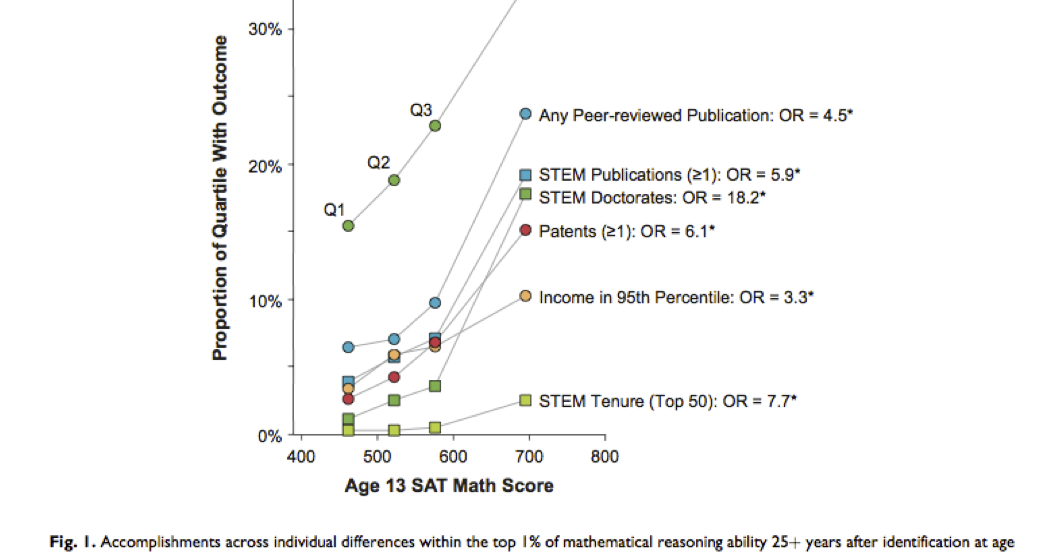
Check out SMPY - here's an image of their results showing that academic output, patents, tenure, income continues to increase well beyond IQ 135. Details in the later links.

https://4.bp.blogspot.com/-4b8ThyfDgzs/U29nQEBAQTI/AAAAAAAAE...
https://en.wikipedia.org/wiki/Study_of_Mathematically_Precoc...

https://my.vanderbilt.edu/smpy/

The obvious question is, if IQ (or whatever SAT is measuring) is irrelevant, why is it so predictive of lifetime academic output?

Also, people try to attack the SAT as nothing more than test prep - but I don't think that argument works well because it supposes you can produce kids who score 700 on the math SAT before age 13; such a training program has never been observed.

Re:A review of correlations between big five personality typ... by sokoloff on Sunday May 09, 2021 @02:35PM (#27098445)
Some amount of test prep is surely helpful in terms of understanding the test format and strategies, but it does seem (almost?) obvious that the SAT is actually measuring something other than test prep.

NB: SMPY qualifications for at least the early cohorts of the study are “before 13” (so, 12 or younger).

Re:A review of correlations between big five personality typ... by barry-cotter on Sunday May 09, 2021 @10:38PM (#27102136)
More IQ is better at all levels. There’s no evidence of a threshold effect.

> Can You Ever Be Too Smart for Your Own Good? Comparing Linear and Nonlinear Effects of Cognitive Ability on Life Outcomes

> Despite a long-standing expert consensus about the importance of cognitive ability for life outcomes, contrary views continue to proliferate in scholarly and popular literature. This divergence of beliefs presents an obstacle for evidence- based policymaking and decision-making in a variety of settings. One commonly held idea is that greater cognitive ability does not matter or is actually harmful beyond a certain point (sometimes stated as > 100 or 120 IQ points). We empirically tested these notions using data from four longitudinal, representative cohort studies comprising 48,558 participants in the United States and United Kingdom from 1957 to the present. We found that ability measured in youth has a positive association with most occupational, educational, health, and social outcomes later in life. Most effects were characterized by a moderate to strong linear trend or a practically null effect (mean R2 range = .002–.256). Nearly all nonlinear effects were practically insignificant in magnitude (mean incremental R2 = .001) or were not replicated across cohorts or survey waves. We found no support for any downside to higher ability and no evidence for a threshold beyond which greater scores cease to be beneficial. Thus, greater cognitive ability is generally advantageous—and virtually never detrimental.

https://www.gwern.net/docs/iq/2021-brown.pdf

Re:A review of correlations between big five personality typ... by paulpauper on Sunday May 09, 2021 @02:02PM (#27098124)
https://www.vox.com/2016/5/25/11683192/iq-testing-intelligen...

I look at it like this, for creative, intellectually demanding work IQ is a necessary but perhaps insufficient condition. You need to be smart to achieve success cause you are competing with other people, so smarter people will have an edge. Google is not hiring people with 90-110 iqs. So having a high IQ is needed to at least be sufficiently proficient in coding, to be considered for a good paying job, but not guarantee you will be hired, but being smart sure helps.

Re:A review of correlations between big five personality typ... by the_dune_13 on Sunday May 09, 2021 @02:12PM (#27098221)
> high IQ is needed to at least be sufficiently proficient in coding,

Should I even bother on what's the source of this claim?

Re:A review of correlations between big five personality typ... by rkk3 on Sunday May 09, 2021 @03:10PM (#27098748)
Google hires no one within 1SD of the Avg IQ? This I find hard to believe.
Re:A review of correlations between big five personality typ... by paulpauper on Sunday May 09, 2021 @03:15PM (#27098810)
for technical postitions, i am sure IQs cluser around 125-140
Re:A review of correlations between big five personality typ... by austincheney on Sunday May 09, 2021 @05:19PM (#27099861)
I find it interesting that people are willing to invent data on the spot to qualify a bias.
Re:A review of correlations between big five personality typ... by barry-cotter on Sunday May 09, 2021 @10:48PM (#27102187)
Or they could know something about the intelligence literature. There are very few people in professional careers, lawyers, doctors, engineers etc. with measured IQ below 115. It’s close to impossible. The demands are just too high.
Re:A review of correlations between big five personality typ... by rkk3 on Sunday May 09, 2021 @11:43PM (#27102480)
I doubt it, less than 115 is 85% of people. Aside from the low end IQ really isn't that predictive.
Re:A review of correlations between big five personality typ... by barry-cotter on Monday May 10, 2021 @03:43AM (#27103649)
81%. Yes, a large majority of people are incapable of becoming lawyers, doctors or engineers. IQ is predictive at the low, middle and high end. There is no evidence of a threshold at which more ceases to be better. Emphasis below not in originalz

> Can You Ever Be Too Smart for Your Own Good? Comparing Linear and Nonlinear Effects of Cognitive Ability on Life Outcomes > Despite a long-standing expert consensus about the importance of cognitive ability for life outcomes, contrary views continue to proliferate in scholarly and popular literature. This divergence of beliefs presents an obstacle for evidence- based policymaking and decision-making in a variety of settings. One commonly held idea is that greater cognitive ability does not matter or is actually harmful beyond a certain point (sometimes stated as > 100 or 120 IQ points). We empirically tested these notions using data from four longitudinal, representative cohort studies comprising 48,558 participants in the United States and United Kingdom from 1957 to the present. We found that ability measured in youth has a positive association with most occupational, educational, health, and social outcomes later in life. Most effects were characterized by a moderate to strong linear trend or a practically null effect (mean R2 range = .002–.256). Nearly all nonlinear effects were practically insignificant in magnitude (mean incremental R2 = .001) or were not replicated across cohorts or survey waves. We found no support for any downside to higher ability and no evidence for a threshold beyond which greater scores cease to be beneficial. Thus, greater cognitive ability is generally advantageous—and virtually never detrimental. https://www.gwern.net/docs/iq/2021-brown.pdf

Re:A review of correlations between big five personality typ... by rkk3 on Monday May 10, 2021 @12:42PM (#27107961)
Pr(X ≤ μ + 1σ) is closer to 84% but sure I was rounding up...

It is most explanatory at the low end; Cognitively Challenged. Elsewhere it has a correlation it is just not as significant, which is not in conflict with your link.

If you tested all the Children in the US you aren't going to be able to accurately rule out 84% of them from professional careers by IQ.

Re:A review of correlations between big five personality typ... by rkk3 on Sunday May 09, 2021 @05:28PM (#27099974)
Top 2-3% of IQ seems very high... Remember everyone with IQ above 100 is above average and like you said in your other post, it is for the most part a threshold/satisfying criteria.
Re:A review of correlations between big five personality typ... by dandanua on Sunday May 09, 2021 @01:56PM (#27098073)
I would say it's the opposite – intellect can be trained by practice and hard work, tough it's unlikely that you'll become a genius. But changing your personal temperament looks impossible to me. It's like changing software vs hardware, the latter is obviously harder.

Sure, a smart introvert can learn how to act like an extrovert. But this will never be natural to him and will cause an additional cognitive load.