It's not entirely accurate, but it's good enough. Within a few hours you can have a pretty large dataset of whatever you want, really. (Yay for massive dataset plus user tags.)
You can snag a copy from my server, if you want. (Warning: It's a direct link to a 54GB json file.) https://battle.shawwn.com/sdc/f100m/yfcc100m_dataset.json
I have a script called "janky-image-search" that returns random results from searching this dataset. Here are a few random hits for `janky-image-search ceiling`:
https://www.flickr.com/photos/35981213@N00/9374577304
https://farm3.staticflickr.com/2084/2513539756_7a768de44c.jp...
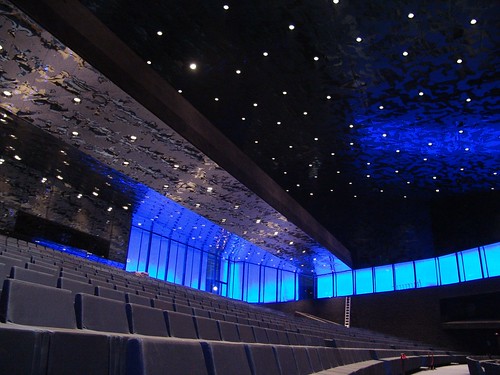
http://www.flickr.com/photos/96453841@N00/7077625757/
https://www.flickr.com/photos/28742299@N04/4683245369/
etc.
The quality is hit or miss, but it seems better than 70%.
EDIT: Here's a gallery of the first 100 hits for "ceiling": https://cdn.gather.town/storage.googleapis.com/gather-town.a...
But as you can see, it's not effortless. Most of those ceilings are old. So it depends what you want. It's why labeled data is worth billions of dollars (scale.ai et al).
(Small detail: the first 100 hits for ceilings are all _interesting_ ceilings? Nothing like the kind of ceilings usually encountered on a video chat app?)
If you ended up using the ceilings uploaded to your app directly from your users, it might be possible that there wasn't any better solution than the one you came up with.
What is a good tool to search it without 64gb of free memory?
  tag="${1}"
  shift 1
  curl -fsSL https://battle.shawwn.com/sdc/f100m/yfcc100m_dataset.json | jq '{user_tags, machine_tags, description, title, item_download_url, item_url}' -c | egrep -i "\"($tag)\"" "$@"
Here's curl -fsSL https://battle.shawwn.com/sdc/f100m/yfcc100m_dataset.json | head -n 1, which should give you all the info about the structure. Or most of it.
{"date_taken": "2013-08-10 11:05:54.0", "item_farm_identifier": 3, "item_url": "http://www.flickr.com/photos/9315487@N04/9497940823/", "user_tags": [], "title": "IMG_7216", "item_extension_original": "jpg", "latitude": null, "user_nickname": "meowelk", "date_uploaded": 1376370010, "accuracy": null, "machine_tags": [], "item_server_identifier": 2856, "description": null, "item_secret_original": "15f4257122", "user_nsid": "9315487@N04", "license_name": "Attribution-NonCommercial-ShareAlike License", "capture_device": "Canon EOS 7D", "item_marker": false, "item_id": 9497940823, "longitude": null, "item_download_url": "http://farm3.staticflickr.com/2856/9497940823_0c0d854111.jpg", "license_url": "http://creativecommons.org/licenses/by-nc-sa/2.0/", "item_secret": "0c0d854111"}
FWIW, the full ceiling search finished with 9,325 results. Here's the first 1k.
https://cdn.gather.town/storage.googleapis.com/gather-town.a...
We downloaded a subset of 3 million images, which is apparently 379.77 GiB. So a linear extrapolation would be (100/3*379.77) = ~12,659 GiB for the full 100m images.
12TB really isn't too bad. It's massive, yes, but imagenet 21k is 1.2TB.
Ceilings often have lightings! Lightings (either on and off) vary between geography and culture! (They do! Extreme variations!) Lightings, if on, will cause flares! We just sampled from actual distribution (privacy policy included we can monitor connection for anti-abuse and we can use data for research and development of anti-abuse), but dataset collected with care will be valuable. I am sure actually doing this will reveal other considerations, and even just with points I mentioned, it should be good enough for a paper, if not for PhD.
The main question people ask when considering reading a paper is "So what??"
This long penis is A. This short penis is A. This cat is B. This dog is B. Now, what is this ceiling?
The model, looking at the ceiling, discovers a long fluorescent tube. It is long! Neither cat nor dog is long (The model is yet to discover longcat), and while penis comes in long and short variety, all penises seem long-ish. The ceiling is A.
Adding common inputs to the training (or at least validation and test) sets is a good solution. Its hard data work, but will pay off. There are some techniques outside of closed-set classification that can help reduce the problems, or make the process of improving it more effective:
- Couple the classifier with a out-of-distribution (novelty/anomaly) detector. Samples that score high are considered "Unknown" and can be flagged for review. - Learn a distance metric for "nudity" instead of a classifier, potentially with unsupervised or self-supervised learning (no labels needed). This has higher chance of doing well on novel examples, but it still needs to be validated/monitored. - Use one-class classifier, trained only on positive samples of nudity. This has the disadvantage that novel nudity is very likely to be classified as "not nudity", which could be an issue.
If you are using random images from the web, there is a decent chance that you will get a result like this.
https://www.theguardian.com/commentisfree/2021/feb/03/what-a...
The Guardian labels it sexist. I assumed that it was because the majority of young attractive women on the internet are posting bikini pictures.
They're both true at the same time, which is exactly the point. The people in the article in the paper weren't trying to teach their neural net that men usually wear suits and women usually wear bikinis, but they did. They only noticed because the failure mode was really obvious. In some other situation, the exact same kind of sexist bias might exist in the data -- and important decisions, affecting people's lives, may be made -- without anybody noticing first.
Is there a mobile video frames dataset for labeling ceilings? Why not? I can't believe I am the only one who experienced this. Why is not a ceiling dataset worthy of, say, CVPR? It will improve mobile video on-device deep learning more than most of CVPR papers. This is a serious problem.
Edit: I understand why niche datasets remain in industry and not academia. Public datasets are better if they are of general interest. But ceiling dataset is of general interest to anyone who wants to process video frames originating from blocked or misdirected camera aka smartphones, and it's hard to imagine topics of more general interest once you have obvious things like face.