News for hackers. Stuff that matters.
Re:KDE vs. Gnome Design Philosophies (2017) by billfruit on Thursday March 25, 2021 @11:32AM (#26581495)
Anyone think that ubuntu around 2011, final days of Gnome 2, really had perfected the desktop UI experience, before all the forays into wanton novelty for noveltys sake made it the confusing mess it became later?

To think that a linux distro had the almost ideal desktop UI realised and then squandered it all away, seems puzzling now.

Re:KDE vs. Gnome Design Philosophies (2017) by gh-throw on Thursday March 25, 2021 @11:50AM (#26581763)
I thought they started going to hell when they had that botched too-early integration of (resource-sucking, to add insult to injury) PulseAudio, in... '08? '09? I remember it was back when Flash was still big, and opening Flash content on that Ubuntu release would, IIRC, crash X, reliably, because of PulseAudio, in addition to its general bugginess, lots of audio stuff that had "just worked" for years suddenly being fiddly and broken, and absurd levels of memory & processor cycle use for PA (I'm not sure whether PulseAudio ever got those under control, or we just started using faster computers so no-one cares about the audio subsystem sucking up tens of MB of memory while idle, anymore).

Flash was still big enough that there's no possible way they didn't know they were crashing with it. Zero chance no-one at Canonical had tried it, and discovered the problem. Released it anyway.

Re:KDE vs. Gnome Design Philosophies (2017) by prewett on Thursday March 25, 2021 @11:53AM (#26581810)
PulseAudio was the last straw that pushed me to get a Mac. When I switched to Ubuntu, wifi worked, sleep (and more to the point, wake) on my T42 worked, and audio worked. Each release after that something would break, and but you couldn't really work around PulseAudio very well.
Re:KDE vs. Gnome Design Philosophies (2017) by gh-throw on Thursday March 25, 2021 @11:58AM (#26581879)
Yeah, I had no idea PA was even a thing (and I guess it kinda wasn't yet, which is part of why the release was so rough) so that was a rude surprise when my whole system just... broke, on upgrade, in a ton of ways that they had to have known about. Especially when it was over audio, which was the one part of Linux that hadn't given me any trouble whatsoever since like 2002. I still kinda hold a grudge against Ubuntu and PA over that (in the case of PA it's also because, I'm pretty sure between that and SystemD, Poettering and I have very different ideas of what an appropriate level of engineering design-quality is for fundamental system components, and what quality design looks like—in fact I'd say he's the main reason I've become more distant from Linux over the last ~decade)
Re:KDE vs. Gnome Design Philosophies (2017) by ip34162 on Thursday March 25, 2021 @12:03PM (#26581933)
PipeWire (from the guy behind Gstreamer) is coming. Seems like it won't be anything like PulseAudio. The future seems exciting.

https://en.wikipedia.org/wiki/PipeWire

Re:KDE vs. Gnome Design Philosophies (2017) by majewsky on Thursday March 25, 2021 @06:02PM (#26586060)
There was an LWN article about PipeWire [1] a while back. Among the interesting parts of the article was an explanation for the PulseAudio debacle, and why PipeWire likely doesn't have the same problem. Basically, PulseAudio exercised several kernel APIs that had existed in ALSA for a long time, but had not been used widely. Hence it uncovered a ton of bugs in device drivers that were not tested against applications using these function calls before. By now, all those bugs are fixed because PulseAudio is widely used. PipeWire is using mostly the same APIs as PulseAudio and Jack, so it's not going to have the same troubles as PulseAudio.

[1] https://news.ycombinator.com/item?id=26327779

Re:KDE vs. Gnome Design Philosophies (2017) by bscphil on Thursday March 25, 2021 @07:48PM (#26587138)
Eh. PulseAudio is nothing like PulseAudio. People hated PA when it was forced into distros before it was ready, and still had many bugs. That PA doesn't exist any more and most of the issues have been ironed out for years. PulseAudio can do a lot more things than ALSA ever could.

(Yes, obviously at least one person reading this will still have intractable issues with PulseAudio, but there are exceptions to every rule. By and large it just works and has been a great solution for Linux for close to a decade now.)

Re:KDE vs. Gnome Design Philosophies (2017) by benttoothpaste on Thursday March 25, 2021 @09:09PM (#26587753)
My introduction to PA was a bit funny. After the fateful Ubuntu upgrade the sound was there but it was also interspersed with regular periods of silence. In other words, it was pulsing. Since the cause of this behavior was called Pulse Audio I really thought this is intentional and not a bug...
Re:KDE vs. Gnome Design Philosophies (2017) by garaetjjte on Thursday March 25, 2021 @04:29PM (#26584991)
>To think that a linux distro had the almost ideal desktop UI realised and then squandered it all away, seems puzzling now.

Hard to say how much truth is in this story, but there was some speculation that this was caused by Microsoft. They started to make some noise about Linux desktop infringing their patents, and while Novell (who was contributing to KDE) signed patent-sharing deal, neither Red Hat nor Canonical (big contributors to GNOME) did, presumably choosing redesign instead.

https://www.theregister.com/2013/06/03/thank_microsoft_for_l...

Re:KDE vs. Gnome Design Philosophies (2017) by toyg on Friday March 26, 2021 @12:31AM (#26588765)
Considering how KDE largely kept chugging at the traditional metaphor, I find it hard to believe.
Re:KDE vs. Gnome Design Philosophies (2017) by phendrenad2 on Friday March 26, 2021 @09:54PM (#26599142)
So why don't they go back? How many patents have expired in 10 years?
Re:KDE vs. Gnome Design Philosophies (2017) by bscphil on Thursday March 25, 2021 @08:04PM (#26587293)
One of the things I really like about modern KDE is that I'm able to recreate exactly that experience in an updated desktop environment with an excellent compositor. Only two differences in my case:

1. I've forgone the bottom bar entirely in favor of merging everything into an icon-only taskbar at the top. But it's still got all the same features as the traditional Gnome 2 desktop (including the iconic 4-panel workspace indicator).

2. I have an "expose" feature at the top left of the screen which imitates the one really nice to have feature from modern Gnome. By hitting the hot corner with my cursor, I can show all the windows on my desktop, allowing easy switching. KDE can do this out of the box.

Re:KDE vs. Gnome Design Philosophies (2017) by o-__-o on Thursday March 25, 2021 @09:55PM (#26588020)
YUGE problem 3. KDE dynamically generates desktop configuration, making it extremely difficult to modify programatically. If I want to configure all of these settings by default (say on new user login), I have to parse the existing config and use those settings to extend my desktop.

D-bus may solve this but it is a headache

Example: https://github.com/ryanpcmcquen/linuxTweaks/blob/master/.kde...

Re:KDE vs. Gnome Design Philosophies (2017) by ptsneves on Thursday March 25, 2021 @11:51AM (#26581785)
I disagree. Gnome3 for me is perfect. I think tastes are tastes but gnome 3 gives me the function as well aesthetics.

The zoom out functionality to show all windows open is essential given i have a lot of windows open at the same time. Alt-tab icons are a huge cognitive load.

Re:KDE vs. Gnome Design Philosophies (2017) by dorfsmay on Thursday March 25, 2021 @03:46PM (#26584534)
I agree. GNOME 3 stays out of my way.

Good dynamic virtual desktop.

Windows key (or Alt-F1) to see all open windows.

Windows keys + typing to start an app.

I don't understand why Tweaks is not part of GNOME vanilla, but it's easy enough to install.

I have to work on Windows and Mac OS when working for some customers and that is an absolutely miserable experience for me.

Re:KDE vs. Gnome Design Philosophies (2017) by BiteCode_dev on Thursday March 25, 2021 @03:21PM (#26584293)
We had all this with Gnome 2, although you had to apt-get install it.
Re:KDE vs. Gnome Design Philosophies (2017) by mixmastamyk on Thursday March 25, 2021 @05:28PM (#26585629)
A lot of the compiz stuff still blows things away today. But truthfully, while I liked it, I didn't need it.
Re:KDE vs. Gnome Design Philosophies (2017) by BiteCode_dev on Friday March 26, 2021 @01:00PM (#26594370)
The cube was over the top, but I did install it every time :)
Re:KDE vs. Gnome Design Philosophies (2017) by ip34162 on Thursday March 25, 2021 @11:55AM (#26581840)
Ubuntu MATE has the GNOME 2 look. Linux Mint has a mate flavor too I think.
Re:KDE vs. Gnome Design Philosophies (2017) by throwaway8581 on Thursday March 25, 2021 @11:52AM (#26581791)
If I recall correctly it didn't have a dock. Everyone seems to have settled on the dock being the best paradigm for managing open apps, and launching favorites, for most users. You might disagree, but the ux people at Apple, Microsoft, Google, Gnome, and KDE seem to think it's the best approach for the vast majority of users.
Re:KDE vs. Gnome Design Philosophies (2017) by bscphil on Thursday March 25, 2021 @07:56PM (#26587217)
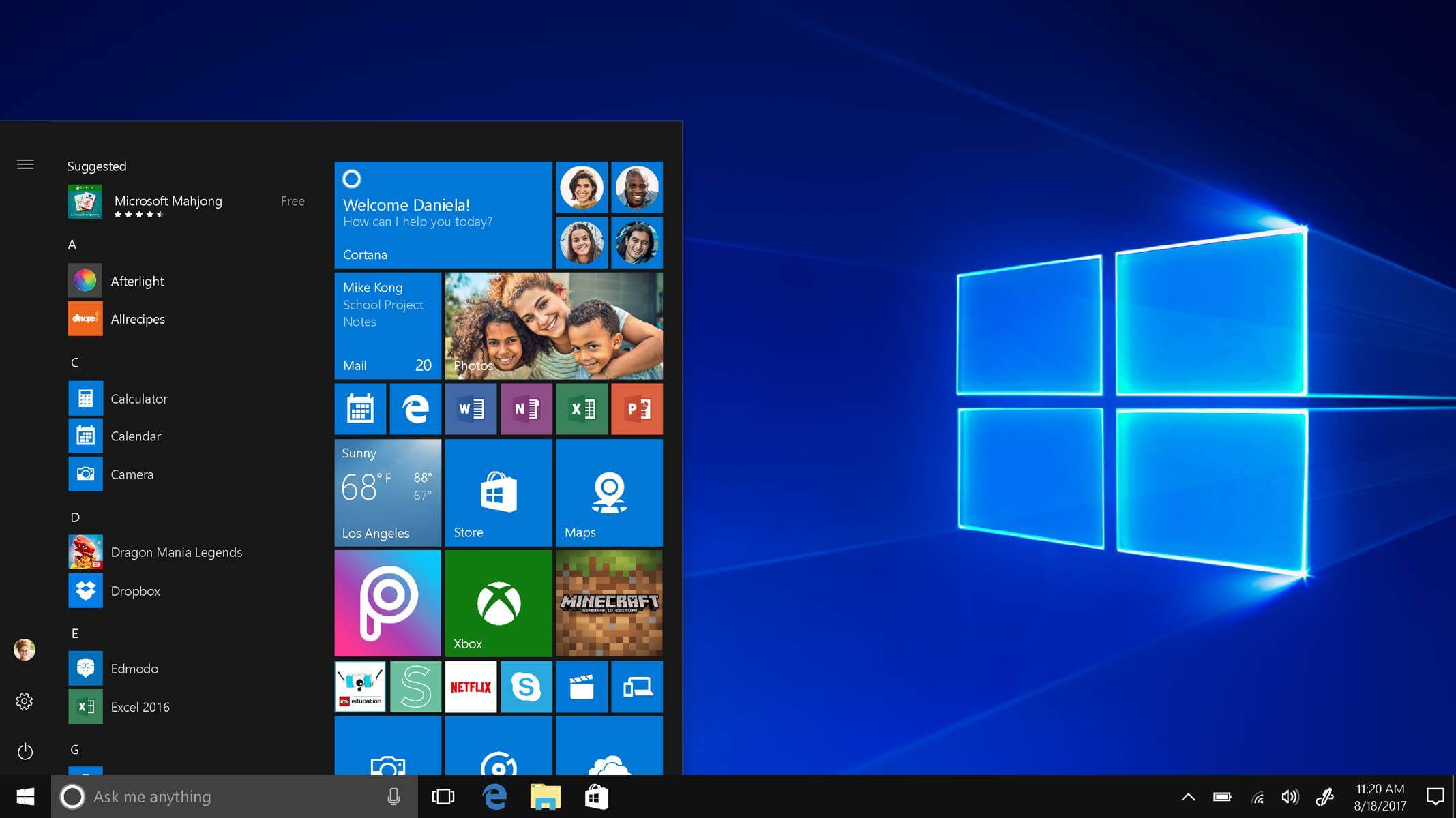
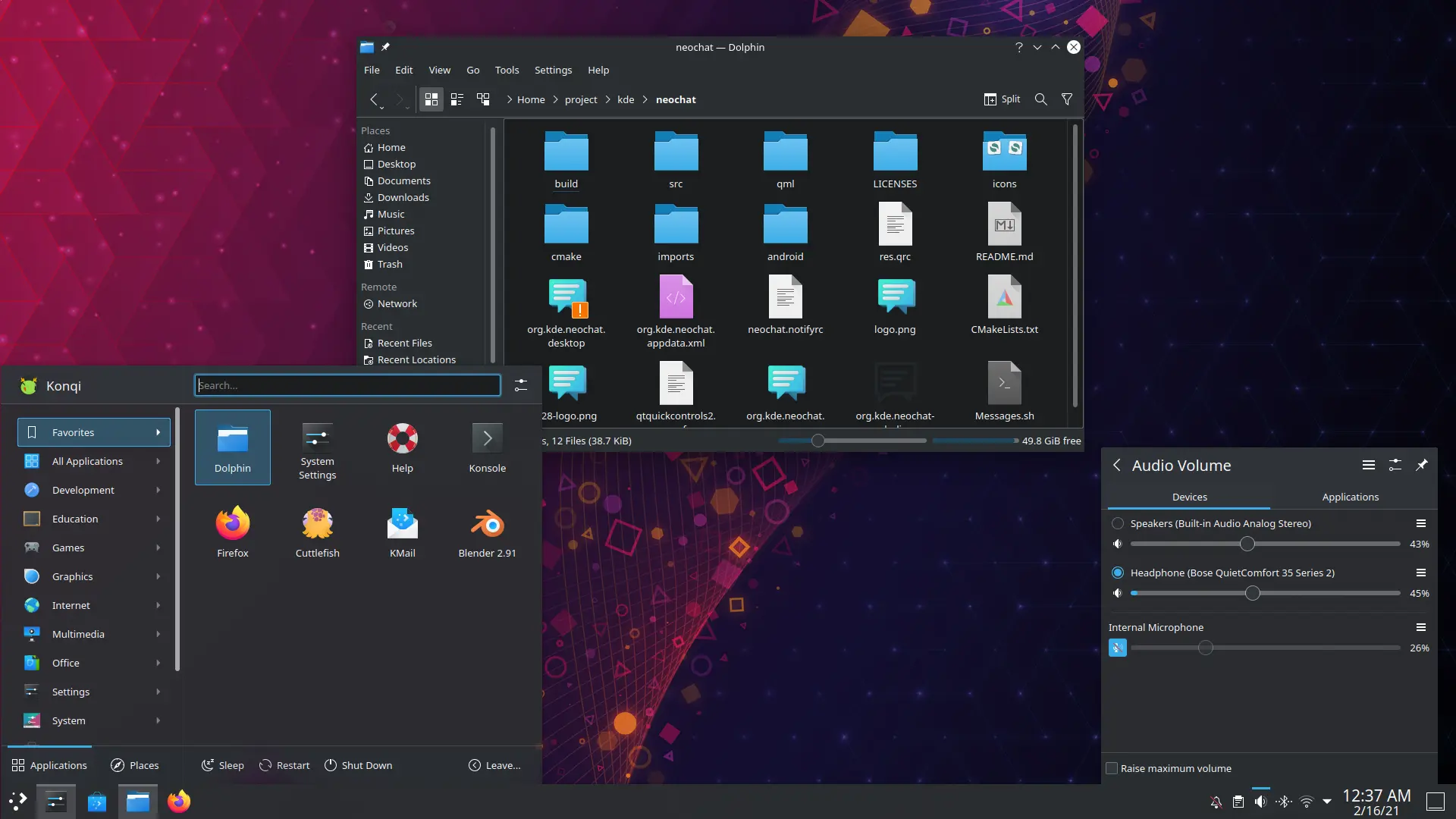
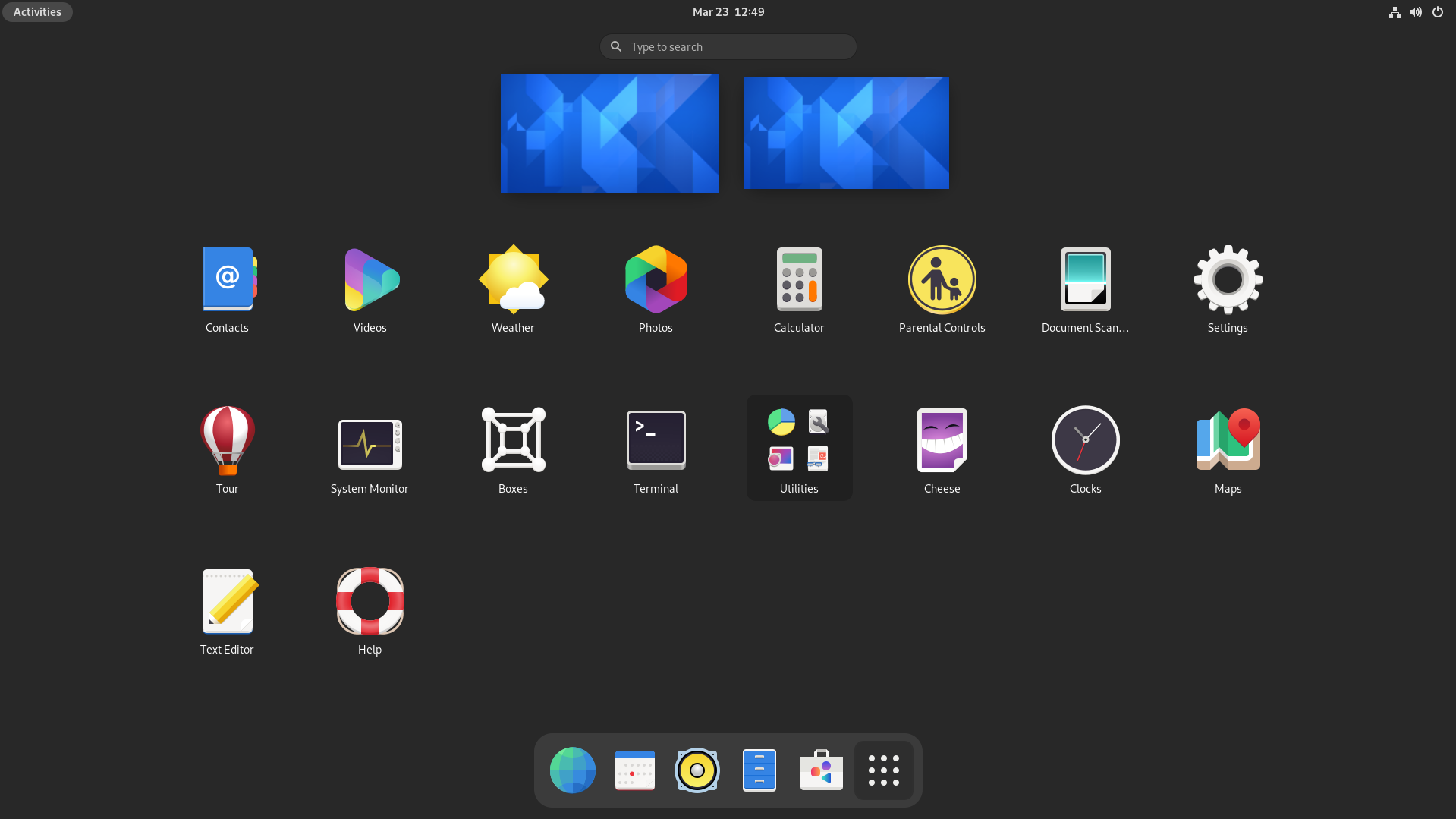
Not Microsoft[1], not KDE[2], and not Google [3]. Gnome's "dock" is only visible when you go into the "expose" mode at the top left corner [4], making its behavior very different from an Apple style dock. To be honest I have no idea what you're talking about. The only org that has "settled" on a dock being the best paradigm is Apple, and that's simply what they've done for decades. It's hard to imagine them reconsidering their ways.

Perhaps by "dock" you are referring to using an icon-based taskbar rather than one that also contains the window title? That's not what most people mean by a dock.

[1] https://cdn.windowsreport.com/wp-content/uploads/2018/11/win...
[2] https://kde.org/announcements/plasma/5/5.21.0/plasma-dark.we...
[3] I don't think it would be fair at all to call ChromeOS's taskbar a dock. The icons are centered like a dock, but they're in a full-width bar that also contains many other buttons and indicators. https://upload.wikimedia.org/wikipedia/en/c/c9/A_screenshot_...

[4] https://www.gnome.org/wp-content/uploads/2021/03/overview.pn...
Re:KDE vs. Gnome Design Philosophies (2017) by throwaway8581 on Thursday March 25, 2021 @08:37PM (#26587548)
Read my other comment in this thread. The Windows taskbar he almost the exact same behavior as the Mac OS dock.
Re:KDE vs. Gnome Design Philosophies (2017) by bscphil on Thursday March 25, 2021 @08:53PM (#26587661)
Windows invented the taskbar, so far as I know, and their initial implementation only showed the icons: https://upload.wikimedia.org/wikipedia/en/8/88/Windows_1_Bar...

The macOS dock distinguishes itself aesthetically precisely by not being a taskbar with other functions and features. Every other taskbar implementation, even the ones that use icons (an approach that predates the Apple dock), sees it as important to not waste space and provide indicators and useful widgets on the same bar.

The "dock" approach is distinct in that it contains only large friendly application buttons, and doesn't use the full width of the screen. The thin taskbars common to other operating systems which also frequently use icons to switch applications shouldn't be considered docks, if for no other reason than that they predate Apple's approach. As you pointed out in your other comment, clicking on one of the icons doesn't even do the same thing in Windows as on macOS, and the task switcher part of the taskbar is the most comparable thing between taskbars and Apple's dock.

Re:KDE vs. Gnome Design Philosophies (2017) by throwaway8581 on Thursday March 25, 2021 @10:59PM (#26588344)
Yes but the Windows 7 taskbar became very similar in function to the Mac OS dock. The behavior in previous versions was different, showing each window as a separate entry and not merging the app switching and quick launch mechanisms.

It’s true the Windows taskbar also does other things. But that’s not really my point. Gnome 2 didn’t have a component that acted like a dock.

Re:KDE vs. Gnome Design Philosophies (2017) by dragonwriter on Thursday March 25, 2021 @09:07PM (#26587742)
> Windows invented the taskbar

Maybe, though it was probably inspired by a merger of the dock, which was not introduced by Apple but by NeXT in NeXTstep 1.0 (well, before 1.0, really), and the graphical shell menu/status bar in MacOS which MacOS had long before it had a dock, which it didn't get until OSX; the Windows task bar approximately merges those functions (but doesn't also serve as an application menu bar the way the MacOS one does.)

Re:KDE vs. Gnome Design Philosophies (2017) by prewett on Thursday March 25, 2021 @12:02PM (#26581923)
Microsoft doesn't have a dock does it? It's not in my Windows 10 installation, which has this weird combo of Awesome Bar + lag and Start Menu. Unless maybe it's an option I'm not aware of (as I actively try to avoid time in Windows)

I don't really trust GNOME and KDE to have done actual UI research. Maybe Google did, but given the Android experience, I strongly doubt it.

So that leaves Apple as believing in the dock, Microsoft with their task bar thing they've had ever since Win95, and everyone else copying Apple. So it might be the settled approach, but "best" seems like it is really overselling it. It seems to me everyone beside Microsoft thinks that Apple's approach is good enough that they can't think of a better one. (Which is fine by me, I like the dock as long as it hides properly)

Re:KDE vs. Gnome Design Philosophies (2017) by wayneftw on Thursday March 25, 2021 @01:52PM (#26583286)
The Microsoft taskbar has always had the most prominent feature of the dock: Allowing you to organize and launch apps from a bar on the left/right/bottom of your screen. Prior to Windows 7 though, you could only add shortcuts to the taskbar and when you launched an app from that shortcut a wholly separate taskbar button would appear.

Starting with Windows 7, Microsoft merged the functionality of launching apps into the taskbar buttons. This way, when you "pin" an app to the taskbar and then click on the pinned item, the pinned item became the taskbar button which represented the running app. This is how the Mac dock works. I think that the only major feature of the Mac dock that Microsoft doesn't offer is "recent apps" but I could be forgetting something since I haven't used Windows for work in a while.

In the end, as per usual, Microsoft lets you have it both ways. If you want a dock you can leave the taskbar configured as default (grouping taskbar buttons and collapsing them into a single button) or you can turn that off and have the original taskbar functionality. If you add something like 7+ Taskbar Tweaker you can even ungroup them, drag and drop taskbar buttons to re-organize them and enable "middle click" to close the window represented by the taskbar buttons like you would with browser tabs.

When I moved my workstations/work laptop all to Manjaro/XFCE I was happily surprised to find that XFCE taskbar has all the features of 7+ Taskbar Tweaker. I don't know what XFCE's design philosophy is, but if I had to guess it's "Implement all the desirable features of Windows in a minimalist fashion and add features for power users."

Re:KDE vs. Gnome Design Philosophies (2017) by throwaway8581 on Thursday March 25, 2021 @01:33PM (#26583059)
The Windows task bar these days behaves almost exactly like the Mac OS dock and has since Windows 7. The main difference is if you click on an application with multiple windows open, it pops up a window selector (tip, ctrl+click to cycle through the windows instead) instead of whatever Mac OS does (some combo of bring up the main/latest-used window of the application). You can enable the Vista and earlier behavior—listing all open windows and not grouping by application—but I imagine very few people do.
Re:KDE vs. Gnome Design Philosophies (2017) by fomine3 on Friday March 26, 2021 @04:29AM (#26589901)
Well. I believe Windows Taskbar is most sophisticated Dock implementation.
Re:KDE vs. Gnome Design Philosophies (2017) by ip34162 on Thursday March 25, 2021 @12:09PM (#26582011)
Ubuntu MATE, which looks like GNOME 2, has option to enable dock.

https://ubuntu-mate.org/features/panel/

Linux Mint has a MATE flavor, so it too might have it.

Re:KDE vs. Gnome Design Philosophies (2017) by BiteCode_dev on Thursday March 25, 2021 @03:23PM (#26584311)
I'm still on Unity, and will probably delay update for a long time because I just cause use Gnome 3.

It's not for lack of trying, but it requires to many plugins to be just usable, and then they break, some features is missing in nautilus or other shit.

I don't want to fight with my desktop manager. I have work to do.

Re:KDE vs. Gnome Design Philosophies (2017) by Darmody on Friday March 26, 2021 @10:09AM (#26592334)
I was in the same place as you but I broke my 16.04 and I was "forced" to upgrade.

Now I use Pop_OS with dash panel and it does the job. I use it on the bottom you can put it on the left side to imitate Unity. It's not the same but it's usable.

Now I can't recommend linux to anyone, though. I'm not going to explain everyone that they're going to install some extensions that may crash after an update if they want to be able to, let's say, see a bar with all your opened applications, which you can't do in Gnome.

Re:KDE vs. Gnome Design Philosophies (2017) by pantalaimon on Thursday March 25, 2021 @12:00PM (#26581896)
Gnome 2 got forked as Mate, you can still have that very same Desktop Experience in 2021, complete with Compiz.
Re:KDE vs. Gnome Design Philosophies (2017) by dTal on Sunday March 28, 2021 @11:47AM (#26611296)
It really was the heyday of Linux on the desktop. Maybe it's just my friend group, but I had several less-nerdy friends running Ubuntu around that time. They're all on Windows/Mac now.
Re:KDE vs. Gnome Design Philosophies (2017) by mixmastamyk on Thursday March 25, 2021 @05:31PM (#26585669)
Yes, at that point it was approaching Windows 2000 with a much better terminal experience. A "workstation" experience. We all know how things went after tablet mania took over.

I still use Ubuntu Mate today, closest I've found to the earlier peak and still supported.

Re:KDE vs. Gnome Design Philosophies (2017) by rodelrod on Thursday March 25, 2021 @11:57AM (#26581856)
I agree that was a local maximum, but I'd say peak Linux-on-Desktop was Ubuntu 16.04 with Unity 7. I'm hoping that Gnome 3 + Pop Shell will take us to the next peak, but except for the awesome tiling we're still below the 2 previous maximums in the "everything-just-works" department.
Re:KDE vs. Gnome Design Philosophies (2017) by nycticorax on Thursday March 25, 2021 @11:43AM (#26581661)
This. One million times this.
Re:KDE vs. Gnome Design Philosophies (2017) by blackrock on Friday March 26, 2021 @01:50AM (#26589114)
Exactly. Modern Gnome interface on Ubuntu is complete junk.

Is my laptop a wannabe tablet or something?

I thought Windows 10 desktop was bad. But then, there’s Gnome that is worse.