> How much land solar and wind farms use seems kind of minuscule next to all these efforts. And given how urgent the climate disaster is, complaining about land use from solar farms seems like a distraction.
No, it's part of the equation for picking energy sources. Solar and wind both work better in some areas than others, and none of the equipment maintains itself. The 100 acre solar farm you build instead of a 1 acre Nuclear plant is going to have its' own environmental and maintenance challenges. It's not clear why it is a priority to limit roads through wildlife, but not apply the same principles to energy policy.
> Given the timescale we have to react to and reverse the climate crisis the best technology that we have right now is wind and solar.
What are you basing this on? Nuclear technology is being held back by regulation and economics, not by engineering or technology.
What specific environmental and maintenance challenges? Solar farms are incredibly low maintenance. The land is graded before construction if it is not flat enough and besides that the only maintenance required is:
- Cleaning the panels periodically
- Replacing broken equipment
Top tier panels can come with 25yr manufacturer warranties, and inverters can come with 12yr warranties.
Grading the land destroys the existing ecosystem, and putting panels on top of the ground will obviously have an impact on that area of the biome. Deserts are important ecosystems, and if we thoughtlessly destroy them to build solar farms, we'll have to deal with the consequences 30 years down the road. I'm not against solar farms, I'm just not religious about them. They have downsides and there is a lot of money to be made, so it's worth being weary of magic bullets.
You miss the part where nuclear fuel needs to be enriched. You don't just dig ore out of the ground and put it into a reactor. You need to enrich the fuel which means that much more ore needs to come out of the ground and be processed than the fuel end product.
It's purely a political problem.
I think that you'll find the comparison in fuel densities between nuclear and solar/wind does not show nuclear in a good light.
Since nuclear fuel doesn't get converted into energy on its own, you had better also include the reactor, turbines, and cooling system if you are going to talk about comparisons of density.
And once those get factored in, nuclear plants are found to be absolutely massive, with nuclear and the fuel-less solar and wind needing the same order of magnitude of mass to generate electricity.
> What are you basing this on? Nuclear technology is being held back by regulation and economics, not by engineering or technology.
The bad economics are driven by the engineering and technology. And the regulations are also driven by the very nature of the technology. It's not great technology for the modern world.
Even if Wind/Solar-only was viable (it's not), available everywhere (it's not), and substantially cheaper over the lifetime of the plants (it's competitive) it would not make sense to rely only on wind and solar. Besides the intermittency, it still takes 3.125MM solar panels for a 1GW plant according to the USDOE. By my math, that requires 1,400 acres of land just for the space the panels cover. Even if you improve on that, you are still talking about ~1,000 acres. And we'd need to build over-capacity to charge the batteries (more mining-intensive materials) for when power generation is low, it would require 2-4x the land.
That's a LOT of land! It would still make sense to me to replace NatGas with cheap, carbon-free nuclear power and it's small physical footprint.
There are numerous viable storage alternatives; the only open question is which will turn out to be cheapest. Underground compressed air is interesting because it can use otherwise-mothballed turbines. Gravity storage, in the form of a 20,000 ton weight raised and lowered, is low tech. Ammonia and hydrogen are marketable or even directly useful on their own, when tankage is full.
Rooftop and parking lot solar are not nearly enough to meet our energy needs. 1,400 acres per GW! Are there fully-functional farms that can operate on 1,400 covered acres?
Is there a functional gravity storage system on the market today that can store the output of a 1GW plant (besides existing dams, obviously)? Storing hydrogen is a nightmare, and neither Haber-Bosch, Sabatier, nor electrolysis are free.
It's dishonest to hand-wave away the obvious flaws of a technology. It's useful, and we should use it. It's not a panacea.
It's not. It can be stored underground. This is a demonstrated technology, little different from how natural gas is stored.
So is storing enriched uranium. Again this is not a point in favor of nuclear.
Ordinary aluminum contains hydrogen without incident. And, as noted on Wikipedia, "coal gas, 50% hydrogen, was carried in cast iron pipes for a half century without any embrittlement problems".
Carried and stored are different things, tho I'm not an expert on either. I'm getting my info from the US Department of Energy, who reports "Durability of hydrogen storage systems is inadequate. Materials and components are needed that allow hydrogen storage systems with a lifetime of 1500 cycles.". I'm not saying there aren't situations where hydrogen is valuable, but you still haven't demonstrated that we can go carbon-free without nuclear. No one has, because the math doesn't add up, at least not so far.
https://www.energy.gov/eere/fuelcells/hydrogen-storage-chall....
"Benefit from partial shade" means exactly that. Any 2800-acre farm that welcomes 50% shade, or any four such 700-acre farms, can. But there has thus far been no demand for the technique, because there is in fact no shortage yet of land for 100% coverage. I have personally seen a large number of fully shaded parking lots; I daresay you have, too.
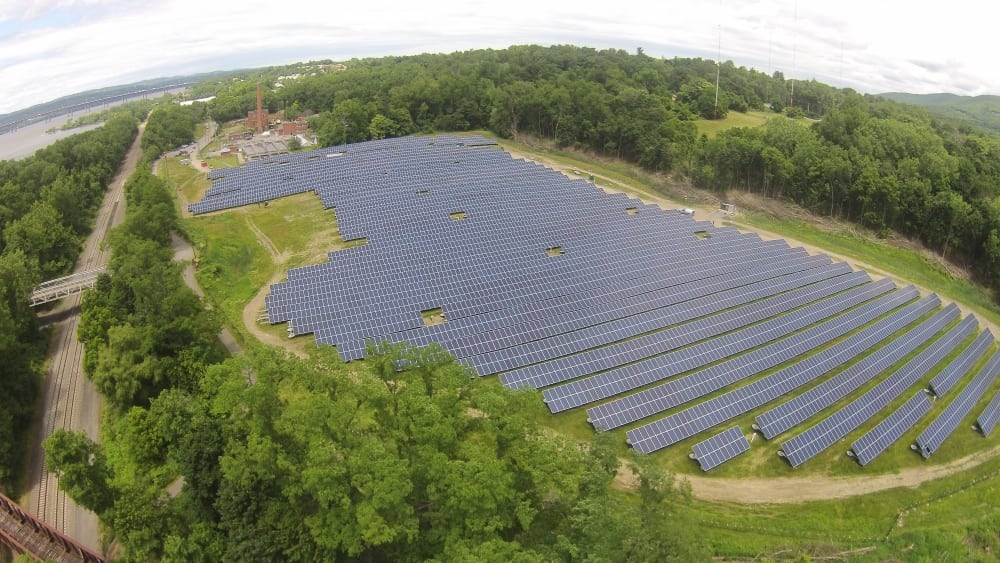
Solar farms do not need 1400 connected acres. Fourteen 100-acre solar farms are more useful, producing a peak 71 MW each. In my immediate area, just recently, a decommissioned 20-acre landfill ("It’s not exactly a tourist area") was turned into a solar farm, producing useful power the very same year as it began construction. <https://highlandscurrent.org/wp-content/uploads/2018/06/Sunl...>
Canals in India are being roofed over with solar panels, reducing evaporation loss. <https://en.wikipedia.org/wiki/Canal_Solar_Power_Project> Panels are being floated on hydroelectric dam reservoirs, all over the world, for the same benefit, with easy access to the power grid. Los Angeles could float 175 acres of panels over its municipal reservoir, replacing the black plastic balls it floats today to absorb sunlight that would produce bromates. <https://www.sciencealert.com/here-s-what-s-really-going-on-w...>
Railroad rights-of-way are similarly available.
A large fraction of carbon-neutral power comes from wind turbines, which also have encountered no difficulty locating space to operate, already often shared with existing farms and ranches.
Air compression is familiar tech.
So, the only remaining question is which of the others will turn out to be cheaper than air. Hydrogen is essential feedstock in many industries, where storage and handling have long since been worked out, so synergy may push H2 over the line, particularly once it becomes the dominant aviation fuel. There is of course no difficulty with storing or using ammonia, and similar synergies apply. Modern catalytic methods are much more efficient than traditional Haber-Bosch, Sabatier, or electrolysis processes, so costs are plummeting, and the ultimate winner, if there is only one, is unpredictable. In other words, they are all viable, and getting better.
In all cases the costs are still in free fall, so nukes, as already mature tech, fall progressively farther behind.
Uranium is rare and very unconcentrated so huge amounts of mining is required to get sufficient quantities. This is what a uranium mine looks like: https://en.wikipedia.org/wiki/Uranium_mining#/media/File:Ara...

This is an interesting thread but not applying the principle of charity to the person you're in discussion with, when they've done nothing worthy of putting charity aside, really lowers the tone.
There are a lot of other ways to put your riposte without questioning the motives of those responding to you simply because they or - even just a point they've made - disagrees with you.
Because Uranium is much much much much more dense in terms of energy than anything used to make solar panels. That's why mining uranium does not even register in the equation.
Surely by the time we come up with the technology to harvest uranium from seawater, nuclear fission technology will be rendered obsolete as storing power from solar will be much much cheaper with lithium-ion batteries harvested from the same oceans, but with 100 times more efficiency.
1: https://en.wikipedia.org/wiki/Uranium_mining#Seawater_recove...
No need to mine or bury it. Burn it!
It would be if it wasn't for the fact that nuclear power is incredibly energy dense so mining requirements for Uranium or Thorium or whatever iteration of nuclear we have, are not even in the same universe as what we will need to scale solar and wind.
> But these include better recycling of existing minerals (this includes solar panels)
I don't know what to say to that. Solar panels are not recyclable. Neither are wind mills. Both are high-tech devices. They may never be recyclable. Also recycling, especially recycling of high-tech devices, is not free as it tends to be incredibly energy intensive. In most situations it's more efficient to just bury the darn thing.
>better forest management, better land use for food production, more careful road design that doesn’t fragment the wildlife, etc. A
The problem is that by going with solar and wind you're compounding all these problems, and the general problem of ecosystem collapse.
>Given the timescale we have to react to and reverse the climate crisis the best technology that we have right now is wind and solar.
That's not true. It's where the mindshare inertia is (notice the deployment of wind and solar is pathetically low on a global scale), but if we truly internalized the danger of not just global warming but environmental collapse, we could pivot on a dime and we could expand our nuclear infrastructure probably in around two decades (we already lost 50 years by the way). It's like what happened with this pandemic. It takes a decade or more to roll out a new vaccine, unless a global pandemic shuts down the global economy and kills millions of people. Under those constrains, it turns out you can develop a vaccine in a year, and take another year to roll it out.
The other aspect is that there are no technical or engineering barriers to nuclear deployment. It's solely regulations and cost (though not prohibitively impossible costs. I'm willing to concede that nuclear is more expensive than things like natural gas). Wind and solar, on the other hand, still have unsolved technical challenges. You can't will those into existence.
But again, we haven't really internalized the dangerous of global warming and ecosystem collapse, so we're dicking around with wind and solar because it feels right.
I don’t understand why you say that. If a wind mill blade is made out of aluminium, it can be recycled as aluminium after it has been decommissioned. It being used in a high tech device doesn’t change that fact. Same if solar cells are primarily made out of glass and silicon, both could be recycled into anything else that requires glass or silicon.
I also don’t understand how you are so willing to give existing challenges of nuclear a break because “regulation and cost” are preventing it from being realized, but you are not willing to give recycling solar cells and wind mill parts the same break. Arguably the only hindrance to recycling high tech devises is economic and the economy of recycling could just as easily—and arguably more easily—be regulated and subsidized such that recycling high tech devises becomes a viable option.
But I feel like we are dancing around the issues here. There are plenty of things we are doing wrong as inhabitants of the planet, inefficient land use is one of these. In many cases we would only need to initiate trivial changes which would result in us keeping our standard of living while stopping doing sustained damage to the ecosystem. I honestly think that renewable energy infrastructure is one of these things. We could (and should) do it in a more sustainable way. Abandoning it in favor of nuclear because we cannot do it 100% sustainable is just silly (especially since neither can we do nuclear 100% sustainable).
EDIT: I honestly don’t know anything about solar cell technology (it being made out of glass and silicon is a guess). So I opened Wikipedia and found this[1].
> Most parts of a solar module can be recycled including up to 95% of certain semiconductor materials or the glass as well as large amounts of ferrous and non-ferrous metals.
EDIT 2: As children have clarified wind mill blades are mostly made out of fiberglass and not recyclable. This doesn’t though void my point as there is a lot we could do to make our impact more sustainable, including making wind turbines out of recyclable materials or finding ways to reuse fiberglass blades in new wind mills, etc. Most parts of a nuclear power plant aren’t easy to recycle either, so in either case complaining about the sustainability of wind turbines but not nuclear power plant is disingenuous.
Most wind turbine blades are fiberglass, which isn't really recyclable.
A nuclear power plant is compact compared to the energy produced, and has an exceptionally long lifetime in comparison to current "renewables".
The components of a solar panel are individually recyclable, but that doesn't mean that anyone has really figured out how to recycle the actual finished panels in any kind of significant energy/resource saving way.
Similarly, the amount of fuel needed to be mined for nuclear energy is trivial, especially if one allows reprocessing.
https://web.archive.org/web/20110722031413/http://www.nuclea...
At 2500kg/m^3 of concrete, and excluding the rebar, that's roughly 4.5W/kg of material. For Sizewell B, than's 0.9W/kg.
Meanwhile, a 300W solar panel weighs ~40 pounds, and even if it has massive mounting structures that weigh twice as much as the panel itself, that's 5-10W/kg.
A nuclear powerplant has a lifetime of 40-60 years. Solar panels have warranties of 25 years, but often operate a decade or more longer. Nuclear does not have an "exceptionally long lifetime" in comparison.
That doesn't mean we have to still build them. Technology marches on - we have improved designs. Micro-reactors solve a lot of issues - including transmission loss/electrical grid fragility/diversification of generation.
I'd be ecstatic if someone figures out how to change the ROI on nuclear, but I'm no longer optimistic about it. Just saying the words "small modular reactors" isn't a solution.
Someone's forgetting capacity factor-- 10 to 30%.
I also don't think looking at mass-- and primarily concrete-- is the best way to measure resource usage.
> A nuclear powerplant has a lifetime of 40-60 years. Solar panels have warranties of 25 years, but often operate a decade or more longer. Nuclear does not have an "exceptionally long lifetime" in comparison.
A nuclear powerplant might have a design lifetime of 40 years, but we're finding that there is little issue with operating them to 80 years and beyond with maintenance and retrofit programs.
Which puts solar and nuclear on completely the same scale...
If you don't think mass is a good way to compare, and you're concerned about resources, please suggest the metric that will somehow make nuclear look good. Because that concrete is not very recyclable. So the 95% recyclability of solar panels is making them look a looooot better than nuclear once we move beyond mass to something more nuanced.
PV capacity factor is typically 16%-28% [1], which adjusting the W/kg, gives us:
Solar PV: 0.8W/kg - 2.8W/kg, capacity factor adjusted (with supporting infrastructure weighing 2x the panels, a total spitball)
Nuclear: 0.8W/kg - 4.5W/kg, capacity factor adjusted, two different modern reactor designs, concrete only.
With this ratio, higher numbers mean better power densities, and the ranges completely overlap between nuclear and solar PV. Nuclear isn't achieving orders of magnitude better power density over solar.
No one claimed an order of magnitude better. Nuclear looks somewhat more sustainable than renewable, and it can do some things renewables can't.
We should be doing both.
How can one even imagine a space-faring civilization powered by wind mills?
GP was complaining about the fact nuclear would be a better overall option because of sustainability issues that renewables have. I believe GP was being disingenuous and says so in bad faith. The fact is that we as a species have a terrible track record in unsustainable behavior. Renewables are not exempt from this. We can (and should) do better (including subsidizing e-waste recycling; putting tariffs on—or taxing—new aluminum that underbids recycled; etc.).
Not doing renewables because of this unsustainable track record is just plain silly, and arguing for such is probably done in bad faith, especially if nuclear is not held to the same standards.
Sure the supply chain to support the infrastructure required for 10 billion people is a lot on the environment, and we certainly could do a lot better. But these include better recycling of existing minerals (this includes solar panels), better forest management, better land use for food production, more careful road design that doesn’t fragment the wildlife, etc. And of course (most important of all) stop emitting greenhouse gases into the atmosphere and stop warming the planet.
How much land solar and wind farms use seems kind of minuscule next to all these efforts. And given how urgent the climate disaster is, complaining about land use from solar farms seems like a distraction.
Given the timescale we have to react to and reverse the climate crisis the best technology that we have right now is wind and solar. We don’t have the technology nor infrastructure anywhere in the world to replace the fossil fuel plants with new nuclear plants in anywhere close to the timescale needed. Our best bet today is wind and solar (and geothermal and hydro where applicable) even with existing battery technology, it is still a better bet then new nuclear. This thread will tell you why.