No, they don't. There is a lot of empty land in the world that isn't useful for people to live in or to grow crops due to lack of rainfall, which also makes those sites more valuable for solar energy.
We'd consider a utility-scale solar array that's a couple square miles to be absolutely huge, but plotted on a map of, say, the United States it would be a barely visible dot in a massive sea of land-that-isn't-devoted-to-solar-power. The Earth is very big, and when you get outside the areas where people congregate there's a lot of wide open spaces.
This says that US electricity consumption was 3.9 trillion killowatt-hours in 2019:
https://www.eia.gov/energyexplained/electricity/use-of-elect...
39 quadrillion watt hours divided by (36524) gives us average power consumption in watts.
Let's say a pretty good solar panel gets 100 watts per square meter, then reduce that to 30 to account for night-time. If we divide average power consumption by 30 watts per meter and divide by 1,000,000 to convert to square kilometers, we get:
Prelude> (((3.9 1000 * 1000 * 1000 * 1000 * 1000) / (36524)) / 30) / (1000 1000) 14840.182648401827
So, about 15,000 square kilometers of solar panels would satisfy current US electrical needs. Let's double that to be conservative, that's 30,000 square kilometers. Sounds like a lot, right? That's a rectangle 100 km by 300 km. It's slightly more than 10% of the land area of Nevada. Definitely big, but attainable. Compared to the land we use for farming, it's barely anything (and it can be done in places that we don't farm). And in practice it would be spread out, not just in one place. And it also assumes we get 100% of our power from solar, which we wouldn't.
There is no such thing as 'empty land'. Every square meter of Earth is part of some ecosystem that is under stress due to human activity. Solar and wind compound this problem.
>then reduce that to 30 to account for night-time
How about reduce that to 0 for night-time? I have yet to see a solar panel that works at night, or works well in cloud weather, or when covered by a layer of snow.
>Sounds like a lot, right? That's a rectangle 100 km by 300 km.
You missed some detail of land-use requirements in calculations. Like accounting for the battery technology that doesn't exist in order to bridge the intermittency of solar and wind. Also, even if this mythical battery technology existed, you would need to over-build wind and solar because after all, when the sun is shining you need to collect enough energy for right now + enough energy to save for later. Given that estimates say that we would need a minimum of few day (but more likely few weeks) of stored energy, for each day of power you generate, you need to over-generate a few days (or weeks) extra to store for later. Also, the population is growing. Our per-captia energy use is growing.
But let's set that aside. That is a lot of land. How can you say it's not!!!?? Every single one of those panels will be land-filled and replaced continually ... forever. So you have 100km x 300km (+ whatever materials you need to support and maintain those panels) of shit going to landfills that then you will need to subsequently dig up again to replace ... forever. And that's just one country. Our ecosystem is already stressed!
If you are honestly worried about this, compare the amount of material that goes into a solar panel to the quantity of fuel needed to generate an equivalent amount of energy in that panels lifetime. Yet the damage we complain about with fossil fuels is not the mining damage, it's the change to the atmosphere. If this amount of material is really so stressful to you, compare the amount of material we use to just build the housing necessary for the world, to the amount of material needed to provide their energy needs. A typical single family roof has more than enough square footage to fully provide for all the energy needs of a household, now think of the orders of magnitude more material that are below that roof than the solar panels consist of.
However far more of the panels are recyclable, and valuable enough to be recycled. There's aluminum, glass, etc.
Solar also really works very well dual purposed with other land uses. Whether that's farming, or over parking lots, or on roofs. For dual purposing solar and farming on the same land, each use loses less than 50% productivity.
Land use and pane waste are complete red herrings that don't pass a sniff test. They persist because there are powerful forces that keep on repeating these concerns, but to be truly concerned about them, one should be far far far more concerned about every single aspect of modern life. Since I never hear the people bemoaning solar pane waste also advocate for banning single family homes and more than 30 m^2 of living space per person, I'm not sure these complaints can be taken as good faith.
No, GP is averaging out across the whole day. If you get 100W during daylight and 0W during night, you can average to 50W for an entire 24-hour period. GP took 30W as a conservative estimate, which is entirely reasonable.
And on top of that were are you getting the additional batteries to provide extra capacities for when the sun is shining at less than 100% of optimal?
And then where are you getting all the materials for those batteries? And what are you doing with all the waste from those batteries once they end their serviceable lifespan?
If you seriously are concerned about the latent costs with nuclear power plants then you should do more than gloss over the storage issues with solar.
And many of your concerns about nuclear fall apart if you don't assume we would continue to build reactors with the issues you point out. There are new designs like micro molten salt reactors that address in pretty signifiant ways the concerns you note. A lot fewer construction materials, greatly simplified designs and designs that don't rely on active cooling to prevent a meltdown. Designs that if the reactor systems are interrupted, the reactors coast to a shutdown naturally.
It's not science fiction - its proven technology we've had since the 50's that was refined in the 70's but squashed because of politics and fear mongering.
Maybe after China starts eating our lunch we'll take it seriously? Ha - probably not even then, unfortunately.
Hi from Australia.
We have huge unpopulated deserts and humans aren't really causing any stress on their ecosystems outside climate change.
We are about to take a tiny, tiny part, put some solar panels on it and send the electricity to power Singapore.
https://www.theguardian.com/environment/2020/oct/21/australi...
> Every single one of those panels will be land-filled and replaced continually ... forever. So you have 100km x 300km (+ whatever materials you need to support and maintain those panels) of shit going to landfills that then you will need to subsequently dig up again to replace ... forever.
Solar panels are already over 90% recyclable, with some processes recycling up to 99%: https://www.newenergysolar.com.au/renewable-insights/renewab...
Unpopulated by humans you mean.
>humans aren't really causing any stress on their ecosystems
If you place tens of millions of solar panels in a region you will destroy the ecosystem of that region, and yes, deserts are ecosystems too. Maybe you feel that is a fair trade and we will need to make these kinds of trade-offs ... but what if there was an alternative that used 100 times less land area for the same amount of power generated and works at night too? Would you still make the trade?
Also, there is this weird assumption made by proponents that only deserts or 'undesirable' land is going to be used for renewable deployment. That's not true today, and it will not be true in the future as we scale up the renewable infrastructure.
Sure. This was in response to this: Every square meter of Earth is part of some ecosystem that is under stress due to human activity.
> If you place tens of millions of solar panels in a region you will destroy the ecosystem of that region, and yes, deserts are ecosystems too.
This is untrue. This solar farm will take up 120 sq km (out of the 10,000 sq km cattle property), and is unlikely to cause any environmental issues from the panels themselves, since they'll just shade some areas of sand.
> There is no such thing as 'empty land'.
Can't help but be reminded of this classic skit.
"The ship was towed outside the environment."
"...Into another environment."
"No no, it's been towed beyond the environment."
After that you can move on to reducing the amount of space we have devoted to suburbs; the amount of water, sand, and metal we use; the amount of plastic we dump into the ocean; the infrastructure and energy required for our transportation networks; etc.
Cutting down on space for solar panels is way way way down the list.
Agriculture is a problem. If you add renewables, you now have TWO problems. And funny you should mention agriculture because one of the proposed solutions to get around renewable intermittency problem is to burn bio-fuels or bio-mass. This means we would be using land not just for agriculture for human consumption, but also to grow corn or trees or whatever to burn to support the renewable infrastructure. Here's a pellet advocacy group (https://www.youtube.com/watch?v=bOzj-d83kFM) touting how green Denmark is because it burns wooden pellets! This is the technology of future: growing trees to burn. I'm not against this by the way, and it's a nice way to reuse discarded saw dust, but we also live in a world with little renewable deployment. When we scale up renewable infrastructure there will be dedicated land to just growing bio-mass to support renewables.
Anyway, the general problem is that renewables compound every other problem we need to solve around ecosystem collapse.
Somehow nuclear waste is a huge problem, but waste from silicon production and decomissioning of solar panels isn't waste.
Roof-solar is probably okay, but replacing baseload with batteries is so far-fetched, I'll believe it when i see it.
Windmills impact microclimate as well, kill off birds by millions - everyone ignores that.
Why is it ok for windmills to destroy climate and life? Since when that became the preferred way to destroy ecosystems?
This is not to say we shouldn’t strive for sustainability (we should), it is to say that discounting renewables on grounds of non-sustainability is illogical, or done in bad faith.
Domestic cats kill billions of birds every year.
I'm sure many birds are killed by wind turbines (estimates I can find in a quick search indicate 100–300k per year), and by all means we should try to site wind farms away from migration routes and take whatever steps we can to make the turbines themselves safer for birds, and possibly even retrofit or decommission wind farms in sites which turn out to be especially deadly.
However, it is not reasonable to look at this problem in isolation. If wind farms can drive coal power out of business faster, on net that is saving a huge number of birds and other wildlife.
Ultimately global climate change is going to lead to mass extinction if our current trajectory is not altered very quickly. Wind power is one way to significantly reduce greenhouse gas emissions.
Unfortunately, you don't need the energy where people do not live, and transporting energy has a efficiency cost as well. In other words, it's massively more efficient to produce energy where you use it.
Yes, I grew up near a lot of that land. Unfortunately that land is also far, far away from most of the population in the US and thus where energy is needed.
You do realize transmission loss is a thing, right? And then what do you do when the sun isn't shining? We still consume power at night.
If this was such a trivial problem we wouldn't still be talking about it, no?
Sure the supply chain to support the infrastructure required for 10 billion people is a lot on the environment, and we certainly could do a lot better. But these include better recycling of existing minerals (this includes solar panels), better forest management, better land use for food production, more careful road design that doesn’t fragment the wildlife, etc. And of course (most important of all) stop emitting greenhouse gases into the atmosphere and stop warming the planet.
How much land solar and wind farms use seems kind of minuscule next to all these efforts. And given how urgent the climate disaster is, complaining about land use from solar farms seems like a distraction.
Given the timescale we have to react to and reverse the climate crisis the best technology that we have right now is wind and solar. We don’t have the technology nor infrastructure anywhere in the world to replace the fossil fuel plants with new nuclear plants in anywhere close to the timescale needed. Our best bet today is wind and solar (and geothermal and hydro where applicable) even with existing battery technology, it is still a better bet then new nuclear. This thread will tell you why.
> How much land solar and wind farms use seems kind of minuscule next to all these efforts. And given how urgent the climate disaster is, complaining about land use from solar farms seems like a distraction.
No, it's part of the equation for picking energy sources. Solar and wind both work better in some areas than others, and none of the equipment maintains itself. The 100 acre solar farm you build instead of a 1 acre Nuclear plant is going to have its' own environmental and maintenance challenges. It's not clear why it is a priority to limit roads through wildlife, but not apply the same principles to energy policy.
> Given the timescale we have to react to and reverse the climate crisis the best technology that we have right now is wind and solar.
What are you basing this on? Nuclear technology is being held back by regulation and economics, not by engineering or technology.
What specific environmental and maintenance challenges? Solar farms are incredibly low maintenance. The land is graded before construction if it is not flat enough and besides that the only maintenance required is:
- Cleaning the panels periodically
- Replacing broken equipment
Top tier panels can come with 25yr manufacturer warranties, and inverters can come with 12yr warranties.
Grading the land destroys the existing ecosystem, and putting panels on top of the ground will obviously have an impact on that area of the biome. Deserts are important ecosystems, and if we thoughtlessly destroy them to build solar farms, we'll have to deal with the consequences 30 years down the road. I'm not against solar farms, I'm just not religious about them. They have downsides and there is a lot of money to be made, so it's worth being weary of magic bullets.
You miss the part where nuclear fuel needs to be enriched. You don't just dig ore out of the ground and put it into a reactor. You need to enrich the fuel which means that much more ore needs to come out of the ground and be processed than the fuel end product.
It's purely a political problem.
I think that you'll find the comparison in fuel densities between nuclear and solar/wind does not show nuclear in a good light.
Since nuclear fuel doesn't get converted into energy on its own, you had better also include the reactor, turbines, and cooling system if you are going to talk about comparisons of density.
And once those get factored in, nuclear plants are found to be absolutely massive, with nuclear and the fuel-less solar and wind needing the same order of magnitude of mass to generate electricity.
> What are you basing this on? Nuclear technology is being held back by regulation and economics, not by engineering or technology.
The bad economics are driven by the engineering and technology. And the regulations are also driven by the very nature of the technology. It's not great technology for the modern world.
Even if Wind/Solar-only was viable (it's not), available everywhere (it's not), and substantially cheaper over the lifetime of the plants (it's competitive) it would not make sense to rely only on wind and solar. Besides the intermittency, it still takes 3.125MM solar panels for a 1GW plant according to the USDOE. By my math, that requires 1,400 acres of land just for the space the panels cover. Even if you improve on that, you are still talking about ~1,000 acres. And we'd need to build over-capacity to charge the batteries (more mining-intensive materials) for when power generation is low, it would require 2-4x the land.
That's a LOT of land! It would still make sense to me to replace NatGas with cheap, carbon-free nuclear power and it's small physical footprint.
There are numerous viable storage alternatives; the only open question is which will turn out to be cheapest. Underground compressed air is interesting because it can use otherwise-mothballed turbines. Gravity storage, in the form of a 20,000 ton weight raised and lowered, is low tech. Ammonia and hydrogen are marketable or even directly useful on their own, when tankage is full.
Rooftop and parking lot solar are not nearly enough to meet our energy needs. 1,400 acres per GW! Are there fully-functional farms that can operate on 1,400 covered acres?
Is there a functional gravity storage system on the market today that can store the output of a 1GW plant (besides existing dams, obviously)? Storing hydrogen is a nightmare, and neither Haber-Bosch, Sabatier, nor electrolysis are free.
It's dishonest to hand-wave away the obvious flaws of a technology. It's useful, and we should use it. It's not a panacea.
It's not. It can be stored underground. This is a demonstrated technology, little different from how natural gas is stored.
So is storing enriched uranium. Again this is not a point in favor of nuclear.
Ordinary aluminum contains hydrogen without incident. And, as noted on Wikipedia, "coal gas, 50% hydrogen, was carried in cast iron pipes for a half century without any embrittlement problems".
Carried and stored are different things, tho I'm not an expert on either. I'm getting my info from the US Department of Energy, who reports "Durability of hydrogen storage systems is inadequate. Materials and components are needed that allow hydrogen storage systems with a lifetime of 1500 cycles.". I'm not saying there aren't situations where hydrogen is valuable, but you still haven't demonstrated that we can go carbon-free without nuclear. No one has, because the math doesn't add up, at least not so far.
https://www.energy.gov/eere/fuelcells/hydrogen-storage-chall....
"Benefit from partial shade" means exactly that. Any 2800-acre farm that welcomes 50% shade, or any four such 700-acre farms, can. But there has thus far been no demand for the technique, because there is in fact no shortage yet of land for 100% coverage. I have personally seen a large number of fully shaded parking lots; I daresay you have, too.
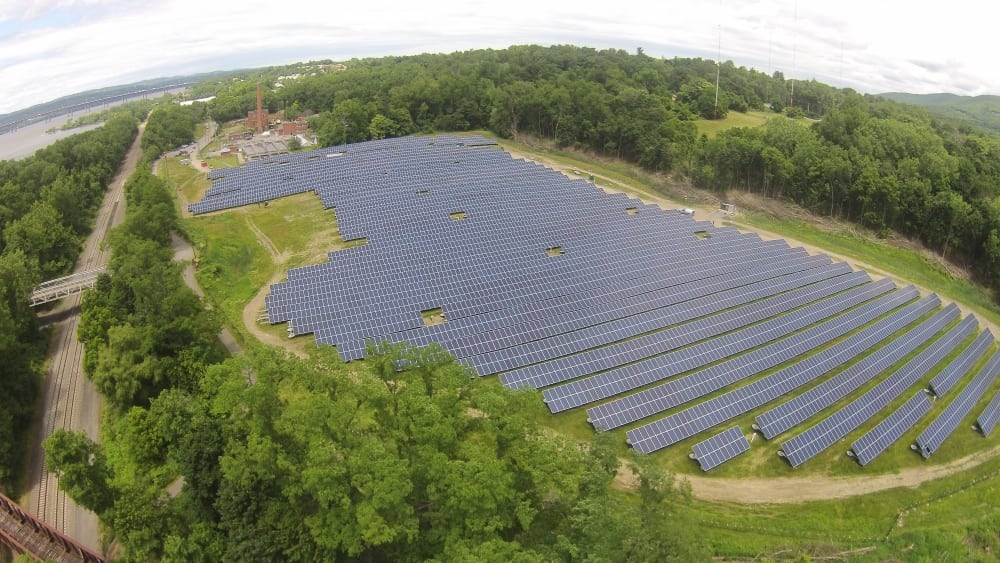
Solar farms do not need 1400 connected acres. Fourteen 100-acre solar farms are more useful, producing a peak 71 MW each. In my immediate area, just recently, a decommissioned 20-acre landfill ("It’s not exactly a tourist area") was turned into a solar farm, producing useful power the very same year as it began construction. <https://highlandscurrent.org/wp-content/uploads/2018/06/Sunl...>
Canals in India are being roofed over with solar panels, reducing evaporation loss. <https://en.wikipedia.org/wiki/Canal_Solar_Power_Project> Panels are being floated on hydroelectric dam reservoirs, all over the world, for the same benefit, with easy access to the power grid. Los Angeles could float 175 acres of panels over its municipal reservoir, replacing the black plastic balls it floats today to absorb sunlight that would produce bromates. <https://www.sciencealert.com/here-s-what-s-really-going-on-w...>
Railroad rights-of-way are similarly available.
A large fraction of carbon-neutral power comes from wind turbines, which also have encountered no difficulty locating space to operate, already often shared with existing farms and ranches.
Air compression is familiar tech.
So, the only remaining question is which of the others will turn out to be cheaper than air. Hydrogen is essential feedstock in many industries, where storage and handling have long since been worked out, so synergy may push H2 over the line, particularly once it becomes the dominant aviation fuel. There is of course no difficulty with storing or using ammonia, and similar synergies apply. Modern catalytic methods are much more efficient than traditional Haber-Bosch, Sabatier, or electrolysis processes, so costs are plummeting, and the ultimate winner, if there is only one, is unpredictable. In other words, they are all viable, and getting better.
In all cases the costs are still in free fall, so nukes, as already mature tech, fall progressively farther behind.
Uranium is rare and very unconcentrated so huge amounts of mining is required to get sufficient quantities. This is what a uranium mine looks like: https://en.wikipedia.org/wiki/Uranium_mining#/media/File:Ara...

This is an interesting thread but not applying the principle of charity to the person you're in discussion with, when they've done nothing worthy of putting charity aside, really lowers the tone.
There are a lot of other ways to put your riposte without questioning the motives of those responding to you simply because they or - even just a point they've made - disagrees with you.
Because Uranium is much much much much more dense in terms of energy than anything used to make solar panels. That's why mining uranium does not even register in the equation.
Surely by the time we come up with the technology to harvest uranium from seawater, nuclear fission technology will be rendered obsolete as storing power from solar will be much much cheaper with lithium-ion batteries harvested from the same oceans, but with 100 times more efficiency.
1: https://en.wikipedia.org/wiki/Uranium_mining#Seawater_recove...
No need to mine or bury it. Burn it!
It would be if it wasn't for the fact that nuclear power is incredibly energy dense so mining requirements for Uranium or Thorium or whatever iteration of nuclear we have, are not even in the same universe as what we will need to scale solar and wind.
> But these include better recycling of existing minerals (this includes solar panels)
I don't know what to say to that. Solar panels are not recyclable. Neither are wind mills. Both are high-tech devices. They may never be recyclable. Also recycling, especially recycling of high-tech devices, is not free as it tends to be incredibly energy intensive. In most situations it's more efficient to just bury the darn thing.
>better forest management, better land use for food production, more careful road design that doesn’t fragment the wildlife, etc. A
The problem is that by going with solar and wind you're compounding all these problems, and the general problem of ecosystem collapse.
>Given the timescale we have to react to and reverse the climate crisis the best technology that we have right now is wind and solar.
That's not true. It's where the mindshare inertia is (notice the deployment of wind and solar is pathetically low on a global scale), but if we truly internalized the danger of not just global warming but environmental collapse, we could pivot on a dime and we could expand our nuclear infrastructure probably in around two decades (we already lost 50 years by the way). It's like what happened with this pandemic. It takes a decade or more to roll out a new vaccine, unless a global pandemic shuts down the global economy and kills millions of people. Under those constrains, it turns out you can develop a vaccine in a year, and take another year to roll it out.
The other aspect is that there are no technical or engineering barriers to nuclear deployment. It's solely regulations and cost (though not prohibitively impossible costs. I'm willing to concede that nuclear is more expensive than things like natural gas). Wind and solar, on the other hand, still have unsolved technical challenges. You can't will those into existence.
But again, we haven't really internalized the dangerous of global warming and ecosystem collapse, so we're dicking around with wind and solar because it feels right.
I don’t understand why you say that. If a wind mill blade is made out of aluminium, it can be recycled as aluminium after it has been decommissioned. It being used in a high tech device doesn’t change that fact. Same if solar cells are primarily made out of glass and silicon, both could be recycled into anything else that requires glass or silicon.
I also don’t understand how you are so willing to give existing challenges of nuclear a break because “regulation and cost” are preventing it from being realized, but you are not willing to give recycling solar cells and wind mill parts the same break. Arguably the only hindrance to recycling high tech devises is economic and the economy of recycling could just as easily—and arguably more easily—be regulated and subsidized such that recycling high tech devises becomes a viable option.
But I feel like we are dancing around the issues here. There are plenty of things we are doing wrong as inhabitants of the planet, inefficient land use is one of these. In many cases we would only need to initiate trivial changes which would result in us keeping our standard of living while stopping doing sustained damage to the ecosystem. I honestly think that renewable energy infrastructure is one of these things. We could (and should) do it in a more sustainable way. Abandoning it in favor of nuclear because we cannot do it 100% sustainable is just silly (especially since neither can we do nuclear 100% sustainable).
EDIT: I honestly don’t know anything about solar cell technology (it being made out of glass and silicon is a guess). So I opened Wikipedia and found this[1].
> Most parts of a solar module can be recycled including up to 95% of certain semiconductor materials or the glass as well as large amounts of ferrous and non-ferrous metals.
EDIT 2: As children have clarified wind mill blades are mostly made out of fiberglass and not recyclable. This doesn’t though void my point as there is a lot we could do to make our impact more sustainable, including making wind turbines out of recyclable materials or finding ways to reuse fiberglass blades in new wind mills, etc. Most parts of a nuclear power plant aren’t easy to recycle either, so in either case complaining about the sustainability of wind turbines but not nuclear power plant is disingenuous.
Most wind turbine blades are fiberglass, which isn't really recyclable.
A nuclear power plant is compact compared to the energy produced, and has an exceptionally long lifetime in comparison to current "renewables".
The components of a solar panel are individually recyclable, but that doesn't mean that anyone has really figured out how to recycle the actual finished panels in any kind of significant energy/resource saving way.
Similarly, the amount of fuel needed to be mined for nuclear energy is trivial, especially if one allows reprocessing.
https://web.archive.org/web/20110722031413/http://www.nuclea...
At 2500kg/m^3 of concrete, and excluding the rebar, that's roughly 4.5W/kg of material. For Sizewell B, than's 0.9W/kg.
Meanwhile, a 300W solar panel weighs ~40 pounds, and even if it has massive mounting structures that weigh twice as much as the panel itself, that's 5-10W/kg.
A nuclear powerplant has a lifetime of 40-60 years. Solar panels have warranties of 25 years, but often operate a decade or more longer. Nuclear does not have an "exceptionally long lifetime" in comparison.
That doesn't mean we have to still build them. Technology marches on - we have improved designs. Micro-reactors solve a lot of issues - including transmission loss/electrical grid fragility/diversification of generation.
I'd be ecstatic if someone figures out how to change the ROI on nuclear, but I'm no longer optimistic about it. Just saying the words "small modular reactors" isn't a solution.
Someone's forgetting capacity factor-- 10 to 30%.
I also don't think looking at mass-- and primarily concrete-- is the best way to measure resource usage.
> A nuclear powerplant has a lifetime of 40-60 years. Solar panels have warranties of 25 years, but often operate a decade or more longer. Nuclear does not have an "exceptionally long lifetime" in comparison.
A nuclear powerplant might have a design lifetime of 40 years, but we're finding that there is little issue with operating them to 80 years and beyond with maintenance and retrofit programs.
Which puts solar and nuclear on completely the same scale...
If you don't think mass is a good way to compare, and you're concerned about resources, please suggest the metric that will somehow make nuclear look good. Because that concrete is not very recyclable. So the 95% recyclability of solar panels is making them look a looooot better than nuclear once we move beyond mass to something more nuanced.
PV capacity factor is typically 16%-28% [1], which adjusting the W/kg, gives us:
Solar PV: 0.8W/kg - 2.8W/kg, capacity factor adjusted (with supporting infrastructure weighing 2x the panels, a total spitball)
Nuclear: 0.8W/kg - 4.5W/kg, capacity factor adjusted, two different modern reactor designs, concrete only.
With this ratio, higher numbers mean better power densities, and the ranges completely overlap between nuclear and solar PV. Nuclear isn't achieving orders of magnitude better power density over solar.
No one claimed an order of magnitude better. Nuclear looks somewhat more sustainable than renewable, and it can do some things renewables can't.
We should be doing both.
How can one even imagine a space-faring civilization powered by wind mills?
GP was complaining about the fact nuclear would be a better overall option because of sustainability issues that renewables have. I believe GP was being disingenuous and says so in bad faith. The fact is that we as a species have a terrible track record in unsustainable behavior. Renewables are not exempt from this. We can (and should) do better (including subsidizing e-waste recycling; putting tariffs on—or taxing—new aluminum that underbids recycled; etc.).
Not doing renewables because of this unsustainable track record is just plain silly, and arguing for such is probably done in bad faith, especially if nuclear is not held to the same standards.
IMO the model used for parking at Lego Land looks like the ideal approach for solar expansion to me.
That's not enough. Rooftop solar panels on a single family home roof cannot provide adequate power for even that family (forget even trying to use appliances like washer/dryer/stove when on solar, much less charging your electric car). And if they cannot do that, then how the hell are they going to provide power to even moderate-density housing (e.g. a small apartment building), much less high-density buildings and housing (like office buildings), or heavy industry and transportation (from electric cars, to buses, to trains).
Solar and wind are diffuse energy sources. That will never change. So you will always have to have a large number of collectors. Our population will continue to go up for a few more decades. Our per capita energy use will also keep going up for a few more decades.
So you're going to have to build huge solar and wind farms and place them somewhere. You're going to have to mine necessary minerals to build those farms from somewhere. You're going to have to landfill the collectors somewhere.
ever since putting panels on my roof a few years ago I've got kinda slack about consumption (I got a second fridge, and I now run aircon whenever I feel like it) while still producing ~2x my needs. My home has a pool pump and a very busy washing machine.
Solar panels on my roof provide so much excess power that when my family next buys a car, we'll be able to power it too.
lots of homes in my neighbourhood have same, and I see big banks of panels on churches, schools and shopping centres.
solar is totally up for it. Yes there are plans in my region to build large plants, but that's more about capitalising on new abundant cheap energy than your false claim of rooftop shortfall.
Come on. Don't be disingenuous. What do you do in the evening? at night? on cloudy days? Just not use electricity?
I'm not against solar, nor wind and I'm happy you're happy with your rooftop solar deployment. Both have their niches. But I don't see renewables powering a modern economy.
Out bush, I ignore the grid and run a couple of small batteries to keep the fridge going and the lights and wifi on. In town, I'll get the home battery set up once that's cost effective (I'm guessing this will be about the time we get the electric car)
this isn't niche: this config is pretty common both in the suburb where I live and in the rural area where I have my weekend hideaway, and its the way my whole region is quickly heading. Our governments are planning new solar + battery plants that can provide our current energy demands many times over. This is the shape of a modern economy.
Wind power can share land with other uses.
There is a staggering amount of land out there that's not suitable for even grazing but will support utility scale solar.
No I didn't.
A typical solar panel weighs around 40 pounds. All that material has to be mined from somewhere, then transported, then processed. Some of that material are rare earth minerals that have an outsized mining requirement (like for every 1 pound, you need to turn over 1000 pounds or 10000 pounds of earth). All of that material will need to be landfilled at some point in the future as well, no matter how recyclable the solar and wind collectors are (and today, they aren't recyclable at all).
>Wind power can share land with other uses.
Sure. I didn't say it couldn't or it won't. I'm saying that you will need vast new tracks of land regardless of that fact. Why? Because you need to scale wind and solar collector deployments by several orders of magnitude.
>There is a staggering amount of land out there that's not suitable for even grazing but will support utility scale solar.
I have no idea why you think only 'grazing' areas are the only ecosystems we need to protect.
Every square meter of Earth is part of some ecosystem that is already under tremendous stress due to human activity - that includes areas like deserts, mountains, ocean floors.
Yes. You did. Solar panels do not use rare earth minerals. Go google it.
Rare earth magnets are used in some wind turbines, but alternatives exist there. That does change the cost calculations a touch, but not enough to invalidate the viability of a renewables + storage solution.
> I'm saying that you will need vast new tracks of land regardless of that fact.
People have done the math. Land availability is not a bottleneck on this.
> I have no idea why you think only 'grazing' areas are the only ecosystems we need to protect.
Because I didn't.
The big picture environmental imperative is to decarbonize as fast as possible. Nuclear is not competitive vs that goal due to the very high capital costs, garbage ROI, and very long time scales compared to renewables. This is the cold hard dollars math that you see regardless of politics, as the same economics are showing up in authoritarian states.
If nuclear was the slam dunk you're assuming, China would just do it. And originally that was looking like the outcome of their "build everything then decarbonize after building the economy" long term energy strategy. But now they're pulling back from their original scale goals for nuclear. Even though they're building more plants than anyone now, they've consistently reduced the number in the long term plan, to the extent that they likely won't be starting projects that aren't already in motion.
China is planning to double their nuclear generation capacity. It is staggering to think they have 11 1000 MW plants under construction and plans to build another 36. The USA has lost the ability to build even 1 plant economically. I think China is “just doing it” when it comes to nuclear, as much as they can, which is a lot.
In comparison usa has 95 plants for 98,000 MW and has shut down 34 plants.
I'm sorry but people have done the maths and consider land availability to be a major bottleneck for solar and wind (with the fact that it is intermittent). That's like one of the first point put forward in the Bill Gates'book everyone seems to be talking about nowadays. Offshore capacity means it's harder to estimate the ceiling for wind production but it doesn't seem to be the slam dunk you would like it to be especially when you consider that the world consumption will likely keep rising for decades as population grows and more and more get access to electricity.
> If nuclear was the slam dunk you're assuming, China would just do it.
China has scaled down its nuclear investment under the dual pressure of significant public opposition after the Fukushima disaster and a need to tighten its investments (China's debt situation is tricky to manage and the CCP absolutely wants to avoid a situation comparable to what happened to Japan in the 90s).
China isn't the be all end all regarding energy policies.
World marketed energy consumption is 18 terawatts. Terrestrial insolation is 127 petawatts (below the atmosphere. Also my earlier figure here of 41 was incorrect.) Common PV solar panels are 16–24% efficient, so the total PV resource is 20–30 petawatts, 1000–1500 times larger. Utility-scale PV capacity factors (relative to the nominal 1000 W/m² peak insolation) in polar countries like Germany and the Netherlands are around 10%, which is abysmal, but in California they average 29%, and in more equatorial countries with less clouds they're presumably higher (I'd be grateful for more data here but I've only found what look like trustworthy, transparent operational reports containing this data from the US, Germany, and the Netherlands).
Let's look at three cases here: a worst case, a best case, and a plausible case.
In the worst case, all our solar panels are in terrible places like Germany with a 10% capacity factor, and they're all cheap 16%-efficient panels, and also the world marketed energy consumption doubles to 36 terawatts. In that case they take up 2.3 million square kilometers, a circle of 850 km radius. This is about 13% of the area of Russia or 17% of the area of Siberia.
    You have: double 18 TW / 10% / (1000 W/m^2) / 16%
    You want: km^2
            * 2250000
            / 4.4444444e-07
    You have: double 18 TW / 10% / (1000 W/m^2) / 16%
    You want: circlearea
            846284.38 m
    You have: double 18 TW / 10% / (1000 W/m^2) / 16%
    You want: 17125191 km^2
            * 0.1313854
            / 7.611196
    You have: 16 TW / 35% / (1000 W/m^2) / 24%
    You want: km^2
            * 190476.19
            / 5.25e-06
    You have: 16 TW / 35% / (1000 W/m^2) / 24%
    You want: circlearea
            246232.52 m
    You have: 16 TW / 35% / (1000 W/m^2) / 24%
    You want: 527968 km^2
            * 0.36077223
            / 2.771832
    You have: 22 TW / 25% / (1000 W/m^2) / 16%
    You want: km^2
            * 550000
            / 1.8181818e-06
    You have: 22 TW / 25% / (1000 W/m^2) / 16%
    You want: circlearea
            418414.19 m
    You have: 22 TW / 25% / (1000 W/m^2) / 16%
    You want: 695662 km^2
            * 0.79061383
            / 1.26484
So, no, land availability is not a bottleneck on this.
I'd like to challenge you all collectively to step up your epistemological game a bit from the profoundly disappointing "I'm sorry but" level you seem to be stuck at. It's just not that hard. There's a lot of concrete, verifiable information out there, and it's easy to do the calculations. Then if you're wrong you'll change your mind to agree with the people who were right, and if you were right the other people who will wrong will change their minds to agree with you. Either way you won't have anything to fight about. Unless they're just looking for an excuse to be vicious.
You should be ashamed of yourselves. You do not become a hacker by attacking people and repeating talking points you don't understand. You become a hacker by figuring things out.
Calculemus.
Lacking a correct understanding of even the most basic facts of the situation, we cannot hope to reason about the consequences of possible courses of action.
As you can see above and elsethread, I've spent some time and effort to try to figure out some of the basic facts of the situation. I'm certainly no expert — for example, I only found out this year that solar panels include screen-printed silver paste, which accounts for on the order of 10% of the cost of photovoltaic modules and on the order of 10% of global silver production — and so I'd appreciate some help.
I responded to so many messages and I tried my best to always refer to 'solar and wind' in tandem (because without wind as a kind of a complement, solar is completely not feasible), and the one message where I got sloppy and referenced only solar panel with a passing reference to 'rare earth minerals' and that's the only aspect that is picked up. OK. Let's move past this. Let's say neither windmills nor solar panels use any rare earth minerals, just for argument's sake. That's not really true, certainly not for windmills, but let's say that it's true ... because that's not the salient point here.
Re: your calculations. You forgot that Solar and Wind need to be overprovisioned because they not only need to collect enough energy for right now, but also enough to store to bridge the daily, seasonal and inter-annual intermittency. There are no batteries capable of that, but if there were, you have to add that in there somewhere as well because that road leads to more land-use and more ecosystem stress.
>This is 550 thousand km², a circle of 420 km radius (groovy, mang!), about 80% of the area of Texas
That is an insane amount of land - I don't understand why so many are so flippant on this point. After all, you're placing high-tech devices in that area. Devices that need maintenance. Devices that break-down. Devices that need to be decommissioned and landfilled and then replaced. If you're covering an area of 550 thousand km² with panels, there is an equivalent volume that you need to dig up somewhere else, ship and process, and of course you then have to landfill, and you have to do that every few decades forever. Right? Are we OK with that? Is the environment OK with that? After all, this is on top of everything thing else we will be doing, like agriculture and transportation.
And this is for TODAY. The world is projected to grow to around 10-12 billion. At the same time, per capita energy use will continue to increase.
>You should be ashamed of yourselves
This kind of emotional appeal is not conducive to good discourse. I made an argument how I see things today. For all the talk about wind and solar being the energy of the future, I don't actually see where solar and wind are actually powering a modern economy. I see a lot hope and handwaving. I see Germany building pipelines to ship natural from Russia and signing multi-decade contracts with that nation while being held up as a model nation. Why not invest in solar and wind deployment instead, especially since Russia is a geopolitical adversary in many ways?
I don't understand how the intermittency gap is bridged given that there is no battery technology capable of storing excess generation enough to last a minimum of a a few days, but more likely several weeks. And finally, I see a world that while growing in population to around 10-12 billion, will exponentially increase per capita energy requirements at the same time. I look at all that, I shudder at the amount of solar and wind collectors that will be required to manufacture and deploy and the stress it will put on existing ecosystems. I don't understand why so many pretend this is a solved-problem, especially since we have an energy-dense alternative, with no engineering challenges to solve and with decades of experience.
> That is an insane amount of land
If any of Texas, Thailand, or Botswana can singlehandedly power the entire planet's marketed energy consumption, which is what that "insane amount of land" adds up to, there's no land shortage for solar.
> If you're covering an area of 550 thousand km² with panels, there is an equivalent volume that you need to dig up somewhere else
550 thousand km² times "40 pounds" per m² is only ten billion tonnes, which is the weight of a 1-kilometer-radius sphere of rock. Botev Peak in Bulgaria, say, or the Matterhorn, although of course in practice you'd want to use ten or twenty billion tonnes of sand and bauxite that don't require climbing mountains to get them. Please do the math yourself before bringing up irrelevant trivialities like this.
> For all the talk about wind and solar being the energy of the future, I don't actually see where solar and wind are actually powering a modern economy.
Well, it's possible you're unaware of the relevant facts, so I'll explain.
Until four years ago, solar energy was more expensive than other sources of energy, so modern economies were built on those other sources of energy. Until about seven years ago, solar was much more expensive. Now, solar energy is cheaper. But most power plants are more than four years old; I think the median age is something like 15 years old, 30 years for nuclear plants, 40 years for both US nuclear plants and US coal plants. Typically planning and building a power plant is a process that takes a few years, too, and utilities and regulators are justifiably cautious about innovations.
So let's look at new installations rather than installed capacity.
For example, China built 38.4 GW of coal capacity last year https://www.reuters.com/article/us-china-coal-idUSKBN2A308U and 71.7 GW of wind capacity and 48.2 GW of solar capacity https://www.reuters.com/article/us-china-energy-climatechang.... Taking into account typical capacity factors of 40% for wind, 25% for solar, and 60% for coal, that adds up to 23 GW average new coal, 29 GW average new wind, and 12 GW average new solar. That last number doubles about once every three years. So I think it's fair to say that, even in the coal-heaviest country in the world, the transition to solar (and, I grudgingly admit, even more toward wind) is quite clear: the great majority of new power plants are running on renewable energy.
You may not be aware of this, but Peabody Energy, the world's largest coal company, went bankrupt in 02016. They've emerged from bankruptcy but their latest annual report says they lost US$211 million in 02019, after turning a profit briefly the year before — but nothing compared to how they lost US$2 billion in 02015.
https://www.sec.gov/ix?doc=/Archives/edgar/data/1064728/0001...
Their latest quarterly report from 02020 has them losing US$1.6 billion in 9 months.
One of the factors in Peabody's problems is that in the Southwest of the USA, where some of their major customers are, continuing to operate already built coal power plants like the San Juan Generating Plant and the now-defunct Navajo Generating Station is no longer economic; solar energy has driven down prices (averaging US$26.58/MWh at the Palo Verde trading hub in 02019 according to this article) well below the coal plants' operating expenses (for example, US$44.90/MWh at the San Juan Generating Plant).
https://pv-magazine-usa.com/2020/05/28/record-low-solar-ppas...
> I see Germany building pipelines to ship natural[sic] from Russia and signing multi-decade contracts with that nation while being held up as a model nation. Why not invest in solar and wind deployment instead,
This is another question I answered in the comment you are purportedly responding to: Germany's solar capacity factor is an abysmal 10%.
Let's unpack what that means. A 280Wp solar panel module in California with a 28.1% capacity factor produces 79 watts average (690 kWh/year, worth about US$28 at a wholesale price of US$40/MWh); the same module in Germany produces about 28 watts (245 kWh/year, worth about US$9.80 at wholesale). But the module costs about US$50 wholesale in both places, or US$300 if you buy it on Amazon. So, absent subsidies, a solar plant is a much worse investment in Germany than in, say, Qatar.
Why is Germany often held up as a model nation? Germany was an early pioneer in a variety of energy reforms (the "Energiewende"), including massive investment in utility-scale solar, rooftop solar, and utility-scale wind, as well as energy-efficiency programs like Passivhaus. Still, in Germany it's still cheaper to run existing coal and gas plants than to build new solar plants, so Germany is no longer a leader in this field; the leaders are now countries like China, India, Qatar, and Chile.
Also, I didn't mention this, but Germany uses about 80 gigawatts in only 357 thousand km² of land, largely due to its high population density of 230 people per km². By contrast, the world has about 50 people per km², using 18 terawatts in 150 million km². So Germany, despite its high efficiency, uses about 0.2 W/m², almost twice as high as the world's 0.12 W/m².
So, in summary, Germany has a higher energy demand, higher competition for land, and a terrible solar resource, so it's one of the last places in the world you'd expect solar to be cost-competitive.
> I look at all that, I shudder at the amount of solar and wind collectors that will be required to manufacture and deploy and the stress it will put on existing ecosystems.
If you were to chop down a forest to build a PV farm, it would put stress on an existing ecosystem, but in a desert it will provide shade and windbreaks, and in arable land it will return cultivated land to being a habitat usable by native plants and animals. And those are typically much cheaper than chopping down forests. (They also don't concrete over the site anymore. Too expensive.) And, as outlined above, the mining and manufacturing are of a trivial scale compared to the deployment. So there is no reason to suspect that the environmental effect of solar energy will be net negative in the next couple of decades, even if compared to a nuclear alternative.
It's likely that in 20–50 years, as solar energy production vastly exceeds current world energy production, that it will become environmentally devastating, as people desperately seek to cover any scrap of land or ocean with increasingly efficient solar panels to harness every last little bit of terrestrial insolation. Unless we have greener ways of making such decisions by then.
> we have an energy-dense alternative, with no engineering challenges to solve and with decades of experience
Now that solar is so cheap, the alternatives are too expensive except for niche uses, and most of the alternatives are also wrecking the climate — nuclear, hydro, and geothermal being the exceptions. Even in the 1970s, before Three Mile Island, nuclear power plants cost over US$1 per average watt, which is about twice what PV plants in favorable locations cost now.
> This kind of emotional appeal is not conducive to good discourse
You know what's conducive to good discourse? Basing your discourse on easily verifiable facts instead of easily falsified nonsense is conducive to good discourse. Rigorous arguments based on specific, easily checkable calculations are conducive to good discourse. Responding point by point to what other people have actually said, instead of baselessly accusing them of "forgetting about" one of the primary topics of their comments, is conducive to good discourse. Trying to inundate careful consideration of relevant points with piles of nonsense you haven't done the most basic consistency checks on, thus challenging others to do your homework for you if they want to disagree — that is not conducive to good discourse.
And that is what you were doing.
I don't know how to appeal to you to step up your game, if not emotionally. It looks to me like you're trying to monkeywrench good discourse and prevent it from happening, and you're immune to appeals to your shame.
And thank you for providing the context for CA's rolling blackouts.
Drive base load generation off the market for the current darling "renewables", then when the renewables that ARE NOT predictable or consistent do the inevitable and fluctuate, the base load plants are no longer available to fill the gap.
I'd be right there with you celebrating the solar win if solar was able to 100% replace the functionality of those plants. But it can't!
Eliminate the plants but don't replace the functionality and what do you get? Rolling blackouts. A common occurrence in CA. Why visit the 3rd wold when you can just bring it home?!?
The California rolling blackouts were back in the summer, when solar energy production is highest. If reliance on solar were the whole story, those blackouts would have gotten worse and worse from summer through fall and winter. Instead, they only lasted a total of about three hours over two days.
https://www.latimes.com/environment/story/2020-10-06/califor...
> Officials have consistently said that intermittent power sources such as solar panels and wind turbines didn’t cause the rolling blackouts.
> Energy providers collectively under-scheduled the amount of electricity they expected to need. That allowed power plant operators to sell their juice to customers in other states, resulting in thousands of megawatts being exported even as the Independent System Operator warned that rolling blackouts were imminent.
But "officials" turned out to be wrong. Intermittent power sources did cause the rolling blackouts — though they weren't alone.
https://www.utilitydive.com/news/california-releases-final-r...
http://www.caiso.com/Documents/Final-Root-Cause-Analysis-Mid...
> the three major causal factors contributing to the August outages were related to extreme weather conditions, resource adequacy and planning processes, and market practices. In summary, these factors were the following:
> 1. The climate change-induced extreme heat wave across the western United States resulted in demand for electricity exceeding existing electricity resource adequacy (RA) and planning targets.
> 2. In transitioning to a reliable, clean, and affordable resource mix, resource planning targets have not kept pace to ensure sufficient resources that can be relied upon to meet demand in the early evening hours. This made balancing demand and supply more challenging during the extreme heat wave.
> 3. Some practices in the day-ahead energy market exacerbated the supply challenges under highly stressed conditions.
If I'm reading this report right, the immediately precipitating event was that the Blythe Energy Center, a gas plant, went down, so when solar generation had declined enough at 18:38 on August 14, there wasn't enough reserve power, so they started rolling blackouts on half a million people until 20:38, when solar generation was just about at 0.
Then, the next day, storm clouds and lowered winds reduced the power generation available throughout the peak-usage afternoon hours, until the CAISO scheduling coordinator erroneously ordered the Panoche Energy Center (another gas plant) to ramp down generation. So at 18:28 they started rolling blackouts, which lasted 20 minutes until 18:48.
The Governor appealing to people to conserve electric power, and no more big gas generating stations failing, allowed them to avoid rolling blackouts in the following days.
So it sounds like they need more batteries. Two more hours of batteries would have been sufficient in this case (for about 5% of their 45 GW load, about 2500 MW: 5000 MWh, or 16 TJ in SI units), but ultimately you'll need a few days of batteries, over a million MWh for California, about 3 or 4 PJ. (Pessimistically assuming there's no demand response or other storage.)
At the US$111/kWh cost for lithium-ion batteries cited in https://dercuano.github.io/notes/energy-storage-efficiency.h... this means about they would have needed US$555M in batteries in this case, or probably about a billion dollars for the whole facility, and a million MWh of batteries to move California entirely to solar would of course be US$111B of batteries, which could be invested US$11B per year over the next ten years. This is a significant investment, but hardly unaffordable — PG&E, for example, has about US$17B in yearly revenues, and Southern California Edison US$12M, so even the financial savings from switching to cheaper solar energy are likely enough to pay for storage. Presumably as battery prices come down these numbers will shrink further, and there will probably be substantial demand response due to the residential TOU migration described at greater length below.
Part of the problem is that their planning process was structured around peak demand, which is the hardest thing to handle with baseload-type plants like coal and nuclear; but, in this case they handled peak demand fine, even in the face of higher-than-usual loads! The problem was after the peak-demand hour: demand declined, but solar generation declined even faster, which was a thing they hadn't taken into account in capacity planning!
Another aspect of the problem was that the gas plants they were relying on for peaking couldn't operate at their normal capacity at such high outdoor temperatures, so the very heat wave they were struggling to survive in was also impairing their generation capacity.
With respect to the potential impact of things like the Navajo Generating Station and the San Juan Generating Plant, they California's imports were limited not by available generation capacity but by available transmission capacity:
> The imports category includes both non-resource-specific resources as well as resource- specific imports like those from Hoover Dam and Palo Verde Nuclear Generating Station. Total import bids received in the day-ahead market were between 2,600 MW and 3,400 MW (40-50%) higher than the August shown RA requirements from imports. Despite this robust level of import bids, transmission constraints ultimately limited the amount of physical transfer capability into the CAISO footprint.
So, for the reduction in coal generation in New Mexico or Arizona specifically to be a causative factor in California's blackouts, someone would have had to build more transmission lines from Arizona. But the transition to renewables in general, that was a causative factor.
(However, it's not entirely clear to me that all the transmission lines were operating at capacity — they emphasize the California–Oregon lines.)
One of the big things they're doing in response is moving residential customers to time-of-use rates, which means that they'll be able to save money on your electrical bill by using energy during the day instead of at night. That should make it possible to sell appliances that save money by, for example, freezing ice during the day and using it for cooling in the afternoon and at night.
It's hard to tell through the insane level of CYA bureaucratese in this report but it looks like they're also installing more battery capacity.
Have you seen any numbers for the life expectancy of grid connected batteries? I heard A solar project in Hawaii expects to replace the batteries every 5 years with daily cycles. So for California it would be $111 million /yr in battery costs. Manageable, but not a trivial amount to be factoring in to the cost of firming up the capacity of wind/solar.
The life expectancy is a really important point, and one I hadn't taken into account in my calculations! The thread at https://news.ycombinator.com/item?id=26231021 talks a bit about this. Laptop Li-ion batteries typically last only a few hundred cycles, but presumably you can do better than that if that's what you're optimizing for; Sir Bearington claims 1500 to 2000 discharge cycles, which sounds vaguely plausible and matches the 5 years you're suggesting, but I'd be interested in a deeper dive. Do you know the name of the Hawai‘i project?
I think US$111 billion over 5 years works out to US$22 billion per year, not US$111 million per year, which is probably just past the "manageable but not trivial" level.
I mean, suppose California needs 45 GW of power at the worst moments, as the CAISO report linked above suggests, and you want to provide that with nuclear power at a ballpark 01970s figure of US$1.50/watt (rather than the current contentious figures of around US$7/watt). Further, let's suppose that USA nuclear power's typical 90% capacity factor https://en.wikipedia.org/wiki/Capacity_factor#Nuclear_power_... is not something you can control (for example by scheduling refuelings to not coincide with summer) and that opex is zero. So you need 50 GWe of nameplate capacity, which hypothetically costs US$75B using 01970s practices and wages. If we simply divide by 30 years (rather than using debt financing and calculating an IRR) we get US$2.5 billion per year. At modern USA nuclear construction costs of US$7 per peak electric watt we end up with US$17.5 billion per year, which would still be less than the US$22 billion cost of replacing US$111 billion of batteries every 5 years. Debt financing makes these numbers a little better, but not a lot, and it reduces the cost of short-term projects like 5-year batteries a lot more than it reduces the cost of medium-term projects like 30-year nuclear plants.
(Does that seem backwards? At 5% interest, an infinite-lifetime annuity can be purchased for 21 years of its yearly earnings. If the annuity expires after 30 years, like a nuclear plant, the NPV is reduced to 16 years' worth of earnings, and if it expires after 5 years, like a battery, it's worth 4.5 years of earnings. So if you debt-finance your nuclear plants you end up paying 46% of your money to the bank and only 54% to GE or whoever builds the plants, while if you debt-finance your 5-year-lifetime batteries you pay 91% of your money to Panasonic and only 9% to the bank. So a 5% yearly discount rate drops the value of nuclear-plant joules by about 40% because most of them are so far in the future.)
Right now, batteries and other storage are only used a couple of hours a day at most, rather than the 22 hours or so that add up to my "million MWh" figure, so the battery price is actually an order of magnitude lower. (And we can expect that when we're just paying the cost of recycling old batteries into new batteries, rather than the cost of mining all that lithium, the price will go down.) So, right now, Li-ion batteries are far more economical than nuclear plants, but to bear the base load over days of low sun, either:
· Li-ion batteries will have to get substantially cheaper;
· wind, other forms of generation, or other storage technologies like lead-acid and compressed-air storage would have to be able to supply most of the load, as gas and coal do at present;
· some of the batteries would have to be borrowed from other uses (such as electric vehicles) that pay for most of their cost;
· demand response and efficiency improvements will have to be able to cut demand by a factor of two or three; or
· some combination of these.
For example, you could very plausibly imagine a conjunction of Li-ion batteries getting 25% cheaper than the US$111/kWh (US$31/MJ) price cited above, down to US$83/kWh (US$23/MJ); wind supplying 25% of power demand when the sun is down or clouded; drawing on an additional 30% "spinning reserve" of parked Teslas feeding energy back to the grid; and demand response reducing off-peak power usage by 25%. So our 45 GW of power demand drops to 33.8 GW from demand response; parked Teslas supply 23% of that, and wind supplies another 25% of it; and so the demand on the utility-scale storage plants is only 18 GW. 24 hours at 18 GW is 430 GWh, which costs only US$36 billion rather than the US$111 billion cited above.
We can hope to do a lot better than that, but it seems like an eminently achievable set of improvements.
> without wind as a kind of a complement, solar is completely not feasible
This is not correct, and there is no reason to even suspect it might be true.
> the one message where I got sloppy and referenced only solar panel[sic] with a passing reference to 'rare earth minerals'
It wasn't a passing reference; it accounted for the vast majority (99.9% to 99.99%) of the resource and environmental impact you attributed to "a typical solar panel":
> A typical solar panel weighs around 40 pounds. All that material has to be mined from somewhere, then transported, then processed. Some of that material are rare earth minerals that have an outsized mining requirement (like for every 1 pound, you need to turn over 1000 pounds or 10000 pounds of earth). All of that material will need to be landfilled at some point in the future as well, no matter how recyclable the solar and wind collectors are (and today, they aren't recyclable at all).
Your describing it as "a passing reference" reinforces the impression that you have no interest in what might or might not be true, only in finding excuses to attack people. The question of whether making a 40-pound solar panel requires 30 kg of rock or 20 000 kg of rock is absolutely central to your purported primary concern here: the environmental impact of mining and waste management. Yet you dismiss this as "a passing reference"? How is it of no consequence to you whatever if a problem you are concerned about is literally a thousand times less serious than you had thought?
The only correct thing in your paragraph quoted above is that a typical solar panel weighs around 40 pounds (18 kg in non-medieval units), and that materials cannot be incorporated into a panel without being mined, transported, and processed. (And some stuff about wind generators I'm not even going to address.) As you can easily verify, a square meter of 100-μm-thick silicon wafer only accounts for 230 grams of that; the other 98% of the weight is mostly glass, aluminum, silver, and copper, which are extremely recyclable and have been thoroughly recycled since their discovery — centuries at least, millennia in some cases.
It's true that nobody's recycling the silicon at present, but that's not because it's difficult — it's that there isn't enough scrap solar-grade silicon out there to recycle, because the vast majority of the panels ever made are still being used, not scrapped.
> You forgot that Solar[sic] and Wind[sic] need to be overprovisioned
I did no such thing. I referred to PV capacity factors explicitly in about half a dozen places in the comment you are responding to. Depending on how you count, about a third of the text in the comment to which you are responding, saying that it "forgot that solar...need[s] to be overprovisioned" is specifically about capacity factors; that is to say, it is specifically addressing the fact that solar needs to be overprovisioned, and calculating by roughly how much. I could not be further from forgetting that solar needs to be overprovisioned.
As for wind, my comment didn't mention wind at all.
My notes on batteries are in https://dercuano.github.io/notes/lithium-supplies.html.
> also enough to store to bridge the daily, seasonal and inter-annual intermittency
No, that is a bad idea. You may need to store energy to bridge daily intermittency, but for seasonal and interannual intermittency you need to overprovision. (Except in the Arctic and Antarctic, where you should probably just get fuel or electricity shipped to you.) Where do you think the seasonal and interannual intermittency problem is worst, and how bad is it? Then we can calculate by how much extra we need to overprovision to handle it, or how far we need to run transmission lines to avoid it. Please stop this vague gesturing at potential problems and provide specific, verifiable data and careful reasoning, as I have done.
> you're placing high-tech devices in that area. Devices that need maintenance. Devices that break-down. Devices that need to be decommissioned
Solar panels do not need maintenance, although they are more efficient if you dust them occasionally. Some of them do break down, but this is unusual, usually due to design or manufacturing defects or very extreme weather. They generally do not need to be decommissioned. Typically they have a design lifetime of 25 years but continue to produce slightly reduced amounts of power for decades after that. https://www.nrel.gov/state-local-tribal/blog/posts/stat-faqs... https://www.nrel.gov/pv/lifetime.html Silicon solar cells haven't existed for long enough for us to see how long they last naturally; the first ones manufactured 60 years ago are still working.
Inverters and charge controllers do break down and need to be replaced every ten years or so, but there are many fewer of those; the maintenance load is similar to that of any other kind of power plant serving the same load.
(continued...)
And the greatest intermittency is nighttime. Happens every day. Chemical batteries are not cost effective even if we had the resources.
But sure, continue to just hand wave that off.
Indeed, if the prices of modules and power electronics keep dropping as they have been, there's a point where it becomes uneconomic for most energy users to pay for offsite generation, transmission, distribution, and billing; around 02013 there was a lot of talk about the risk of a "utility death spiral" as more and more grid users deserted the grid for their own private PV farms, leaving the remaining grid users (steel mills, diamond foundries, Bitcoin mines, and the like) to pay higher and higher prices to maintain the stranded infrastructure. So far this has not materialized and probably will not.
However, of those 18 terawatts, about a third are transport fuels, mostly gasoline for cars and diesel for land shipping, but also passenger trains, bunker fuel for cargo ships, and jet fuel for airliners and air shipping. Although ships can plausibly tow their own PV rafts, the others will probably be the last strongholds of fossil fuels due to the low efficiencies of electrolysis (typically around 60%) and the Fischer–Tropsch process (typically 50%), which adds up to "transmission losses" of around 70%, relative to how they're measured in the IEA's report today. And if you're doing this to power your Antarctic research base's electrical needs, you lose another 60% (total losses: 88%) to Carnot.
The good news there, though, is that the electrical part of the equation gets a "Carnot boost": a kilojoule of coal or gas burned to generate electricity only yields 400 J of electrical energy. So we only need 400 W of PV generation to replace each kilowatt of coal mining for electricity!
Okay, I've answered three of your questions. Now it's your turn. How much are current transmission losses typically, and in maximal and minimal cases? How are they affected by transmission-line distance, and how much does the step-up and step-down equipment cost for different voltages? How does HVDC help? Are there better alternatives to water electrolysis followed by Fischer–Tropsch? How does the global distribution of current human energy use relate to the distribution of solar resource?
Some new designs do call for hafnium
yes, but how much of that land is also near where the energy is needed??
Transmission loss is a thing. Also how are you handling the whole "sun doesn't shine at night" thing? We still have no economical ways of storing vast quantities of electrical energy.
Cost of storage has been falling dramatically. Lazard has slide decks that summarize the economics as levelized costs. I'd suggest browsing through them, as you've gotten the wrong impression of the real economics. We're crossing the threshold where renewables + storage is economically viable. That's not to say it'll be trivial to scale up the industry, but it's not the economic impossibility you're assuming.
Note that there's a very intense and effective PR campaign around this stuff intended to convince you that the economics are impossible.
>Honestly ... it isn't just about cost. Nuclear is expensive but it isn't prohibitively expensive. The big picture is we know that nuclear can power an economy, it does not emit global warming gasses, and also places a tiny footprint on the surrounding ecosystem.
What do you call prohibitively expensive? It's expensive enough that it's essentially uneconomical to build any new plants by a large margin and that margin is increasing compared to wind and solar.
>Solar and wind cannot power an economy. That's not true, they can using a sufficiently large grid and overprovisioning.
>But let's pretend they can so as to not get bogged down on this point. Let's also pretend they are non-trivially cheaper than nuclear. Even under those assumptions nuclear still wins in my eyes.
>Global warming is only one environmental problem we have to solve and it may not be the most important one either. The other one is regular environmental collapse due to needing to support 7-10 billion people. In this context, solar and wind are atrocious and a total disaster because they have massive land-use requirements (land-use around mining for necessary materials, deployment and maintenance of the collectors, and finally land-fill once out of use). And they will always have those horrendous land-use requirements because solar and wind are diffuse energy sources. Worse, we're going to need to increase solar and wind collector production by several orders of magnitude (and come up with a battery technology that doesn't exist today) to fully support a fossil fuel transition. What cost do you think the environment will bear for that compared to nuclear infrastructure?
So you're including mining for solar/wind but not nuclear? Also you're talking about that we need to increase solar and wind production by several orders of magnitude, well we would need to do that with nuclear as well. And you conveniently ignore the fact that uranium is a limited resource. Also regarding your space requirements, it's true that nuclear power plants have a relatively small footprint, however we are limited to where we can build them and the footprint for power distribution is considerable. That is one of the big plus points of decentralized power sources you can produce the power were you need it (which also significantly reduces additional space requirements). Let's not even talk about the energy loss from long distance distribution.
We have hundreds of years of "waste" that could be burned before we would ever need to mine anything. Only thing stopping it is a gross combination of politics and fear :p
Honestly ... it isn't just about cost. Nuclear is expensive but it isn't prohibitively expensive. The big picture is we know that nuclear can power an economy, it does not emit global warming gasses, and also places a tiny footprint on the surrounding ecosystem.
Solar and wind cannot power an economy. But let's pretend they can so as to not get bogged down on this point. Let's also pretend they are non-trivially cheaper than nuclear. Even under those assumptions nuclear still wins in my eyes.
Global warming is only one environmental problem we have to solve and it may not be the most important one either. The other one is regular environmental collapse due to needing to support 7-10 billion people. In this context, solar and wind are atrocious and a total disaster because they have massive land-use requirements (land-use around mining for necessary materials, deployment and maintenance of the collectors, and finally land-fill once out of use). And they will always have those horrendous land-use requirements because solar and wind are diffuse energy sources. Worse, we're going to need to increase solar and wind collector production by several orders of magnitude (and come up with a battery technology that doesn't exist today) to fully support a fossil fuel transition. What cost do you think the environment will bear for that compared to nuclear infrastructure?