On the flip side I want me email client, my desktop authoring tools and admin tools to all look and act the same.
(The blue/grey theme that came later was far less performant; I mean the original dark green/black theme.)
And WinAmp would open & play literally any format under the sun. WMP was limited to something like MP3 and WMA. (And maybe WAV.)
That's how VLC became so popular. They realized "sorry, you don't have that codec" is only a bureaucrat's idea of good UX so they shipped every codec in software.
Well, yes and no. Remember, Windows Media player used to be this:
https://www.windows-media-player.com/wp-content/uploads/2019...
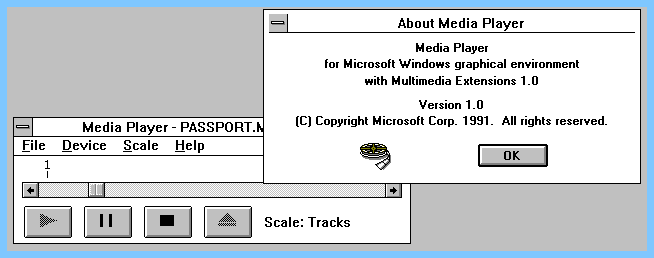
and without system-installed codecs, which were hard to come by for something like MP3 files, it was basically useless; you could play MIDI files through your shitty OPL-3 FM synth and that's about it.
Winamp came with a remarkable set of capabilities: - A bunch of useful codecs out of the box - An extensible plugin system, with input, output, general, and visualization plugins - Skinnable UI
The secret sauce was the extensibility, really. You could kill hours just tweaking your Winamp, installing crazy audio effect plugins, and so forth. It was really a new breed of application for most users who were used to really business-like apps.
https://i.imgur.com/DuxpATX.gif

It's what started my desire for better sound quality, pursuing better equipment and assembling my own crazy dsp stacks in order to... well, enhance sound quality, which I do to this day!
Dealing with equalizers, dynamics processors, crossover, convolvers/IR, applying hrtf/hrir found on the net, using room eq wizard to try and improve speaker/room response, buying a damn binaural microphone so I could make my own ears impulse responses... I ended up learning a lot about the subject, form such a tiny "seed"
Now that screen resolutions vary quite a bit I suppose it wouldn't work as well as when all monitors were mediocre 800x600 or glorious high res 1024x768. Ah, the nostalgia.
I disagree rather strongly with this. You should use the UI elements that make sense. It doesn't make sense for Maya or Blender or Photoshop to constrain themselves to whatever Microsoft picked out for them to use. The palette of native widgets and native UX methods is woeful across all systems. It's constrained to the set of generic elements which are applicable to some theoretical business application, like Word or Excel (which, I must point out, could neither be implemented fully in terms of native UI widgets alone).
> If an app can't survive on its usefulness alone, it probably shouldn't exist.
Form follows function. And I would argue the opposite of the point you're making: if an app can exist purely in terms of native UI widgets, does it even need to exist? I can think of almost no useful apps outside of basic utility apps (file copying, patching, app installers, etc.) that are useful and fully native UI.
> You should use the UI elements that make sense. It doesn't make sense for Maya or Blender or Photoshop to constrain themselves to whatever Microsoft picked out for them to use.
The nuance in my beliefs is that if UI elements aren't available for the function, then apps should absolutely build custom UI. I agree with you there.
It's when you have a basic app that can entirely use native controls and chooses to forego them to do everything custom that I have a problem with.
For my particular example, we were building a cryptocurrency wallet for a new blockchain. It was simple enough to use entirely native controls but definitely didn't need a custom UI.
http://wp.xin.at/wp-content/uploads/2017/08/photoshop-cs6-fu...

That said, I'm not entirely sure Photoshop makes a strong point for making custom UI controls, since besides the primary interaction of pointing and clicking on an image, everything else is either dialogs, menus, and toolbars --- all of which are available in the native UI.
If an app can't survive on its usefulness alone, it probably shouldn't exist.
As a user, if an app doesn't have a native UI, I disregard it unless I need it for a specific and mandatory use.