News for hackers. Stuff that matters.
Re:The Laptev Sea hasn't frozen by CivBase on Thursday October 29, 2020 @02:35PM (#24933813)
> but I suspect we'll see, like many climate estimates, that number ends up being a bit too conservative.

Good.

When scientists and politicians publicize scary, doomsday numbers that aren't ever realized, the public's natural response is to be more critical of the things those people say in the future. That sort of thing results in climate deniers, anti-vaxers, anti-maskers, and a whole slew of conspiracy theories.

If you want people to take climate change seriously, you need to publish conservative numbers and ring the bell when things end up worse than you predicted. Include a word of caution that things could be worse when you publish the conservative numbers, but don't start out with the worst-case scenario if you want to be taken seriously in the future.

Of course you can be too conservative with your predictions, but I don't see a lot of that except as a knee-jerk reaction to the overly-alarmist predictions.

Re:The Laptev Sea hasn't frozen by bambataa on Thursday October 29, 2020 @03:08PM (#24934312)
...So what climate scientists have been doing for decades? Yet they were still ignored. So people state more alarming predictions and get told “if only you’d been more moderate and reasonable”.

The truth is that most (Western) people simply don’t care that much.

Re:The Laptev Sea hasn't frozen by CivBase on Thursday October 29, 2020 @03:15PM (#24934415)
> So what climate scientists have been doing for decades?

https://en.wikipedia.org/wiki/Arctic_sea_ice_decline#Ice-fre...

> Many scientists have attempted to estimate when the Arctic will be "ice-free". Professor Peter Wadhams of the University of Cambridge is among these scientists; Wadhams in 2014 predicted that by 2020 "summer sea ice to disappear," Wadhams and several others have noted that climate model predictions have been overly conservative regarding sea ice decline. A 2013 paper suggested that models commonly underestimate the solar radiation absorption characteristics of wildfire soot. In 2007, Professor Wieslaw Maslowski from the Naval Postgraduate School, California, predicted removal of summer ice by 2013; subsequently, in 2013, Maslowski predicted 2016 ±3 years.

Looks to me like there have been plenty of overly-alarming predictions about a Blue Ocean Event over the last two decades.

Re:The Laptev Sea hasn't frozen by burade on Thursday October 29, 2020 @06:34PM (#24936917)
Are you serious right now? Do you realize how hard it is to predict this stuff?

You actually expect them to nail it down to the year? lol

Re:The Laptev Sea hasn't frozen by algorias on Thursday October 29, 2020 @08:25PM (#24937774)
Well, if someone is predicting an event 3 years into the future, then... yeah!
Re:The Laptev Sea hasn't frozen by CivBase on Thursday October 29, 2020 @09:14PM (#24938099)
What makes you think I expect them to make an accurate prediction down to the year?

The last prediction from that quote was made in 2013 and predicted 2016 +/- 3 years.

Inaccuracies aren't the issue here. The problem is that well-intentioned scientists and politicians are making overly-alarming predictions that keep eroding the populations trust when they keep failing to come true. How do you convince someone to believe you when you say climate change is a real, serious, and immediate threat when they have been lied to about the subject over and over again?

Re:The Laptev Sea hasn't frozen by moultano on Thursday October 29, 2020 @09:33PM (#24938196)
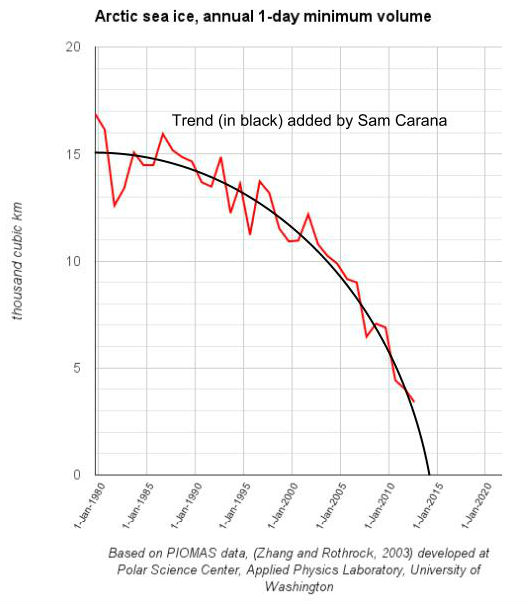
The context of that prediction were the extreme records set by sea ice in 2012, when it did almost disappear. That made some scientists think that we were seeing a nonlinear phase shift and that it would not recover. It did recover, and resumed its linear downward trajectory.

But if your takeaway from that is that scientists are overconfident and wrong, that is insane, because the important thing to know about sea ice is that at its yearly minimum, its volume is a third of what it was in 1980. No matter how you cut it, it's almost gone.

https://twitter.com/ZLabe/status/1314620374601003008?s=19

Re:The Laptev Sea hasn't frozen by NateEag on Friday October 30, 2020 @09:57AM (#24942218)
He did not say the scientists are overconfident and wrong.

He said they hurt the public trust in climate science when their predictions do not reliably come true.

Re:The Laptev Sea hasn't frozen by moultano on Friday October 30, 2020 @10:24AM (#24942516)
What hurts public trust in climate science is primarily a massive and well funded propaganda campaign that's been going on for 50 years.

Some scientists are going to sometimes be wrong about things. It is impossible for them to be scientists otherwise.

Re:The Laptev Sea hasn't frozen by NateEag on Friday October 30, 2020 @04:21PM (#24946492)
Neither of us denied any of that.

OP just said that conservative predictions are better than aggressive ones, as they're more likely to come true and thus build trust.

Re:The Laptev Sea hasn't frozen by moultano on Friday October 30, 2020 @05:24PM (#24947043)
Do you see any evidence that the consistent under-shooting of IPCC consensus predictions has built trust?

It is not possible to have an accurate mean prediction, and also to have no predictions above the mean.

Re:The Laptev Sea hasn't frozen by NateEag on Friday October 30, 2020 @05:55PM (#24947243)
I never said they did, or that they should focus on trustbuilding instead of aiming for accuracy.

I just pointed out that you were arguing with something other than what OP said.

Re:The Laptev Sea hasn't frozen by LoSboccacc on Friday October 30, 2020 @04:01AM (#24940068)
> But if your takeaway from that is that scientists are overconfident and wrong

my takeaway is that every years hundred models are given birth, every year later the model fitting the data best survive, and two year later when that last model prediction fail, a new model from the previous that that predicted the change better replaces it, in a never ending cycle of bullshit.

the models go both way: without a predictive model that can hold water, how do you know which parameter to tune to resolve the climate crisis?
Re:The Laptev Sea hasn't frozen by op00to on Friday October 30, 2020 @04:58AM (#24940392)
You’re describing how models improve over time with additional data and better knowledge about the atmosphere.
Re:The Laptev Sea hasn't frozen by jimmydorry on Friday October 30, 2020 @08:16AM (#24941423)
Or models over fitted to past data with 0 predictive capability that need to be re-tuned every year or two.
Re:The Laptev Sea hasn't frozen by LoSboccacc on Friday October 30, 2020 @03:56AM (#24940044)
from 1970 to 2050±20? no. from 2013 to 2016±3? I absolutely expect it to be within the given error range
Re:The Laptev Sea hasn't frozen by tshaddox on Thursday October 29, 2020 @09:21PM (#24938139)
I would expect them to be aware of and communicate their uncertainty.
Re:The Laptev Sea hasn't frozen by Daishiman on Thursday October 29, 2020 @04:12PM (#24935179)
That's not overly-alarmy; it's a demonstration of the astounding capabilities of climate models to describe incomprehensibly complex phenomena to a remarkable degree.
Re:The Laptev Sea hasn't frozen by CivBase on Thursday October 29, 2020 @05:09PM (#24935937)
I think that's a very forgiving take. I recognize that climate change is extremely complex and it's a huge accomplishment for our models to be as accurate as they are. However, they are clearly not accurate enough to be making statements like "2016 ±3 years". Statements like that are easy ammunition for climate change denial.
Re:The Laptev Sea hasn't frozen by BlueTemplar on Friday October 30, 2020 @05:39AM (#24940589)
It was probably this graph - you can understand how it looked very bad at the time ? http://2.bp.blogspot.com/-Mnr3XCiELco/UFxdVV5QMfI/AAAAAAAAFC...
Re:The Laptev Sea hasn't frozen by julienb_sea on Thursday October 29, 2020 @04:31PM (#24935397)
Given the references in the comment you are replying to, I think more people might interpret as a demonstration of the astounding degree that climate models can totally miss the mark. And calls into question the degree to which we should base policy decisions - with major negative consequences - on those models.
Re:The Laptev Sea hasn't frozen by sdenton4 on Thursday October 29, 2020 @05:29PM (#24936156)
The wikipedia 'graph talks about one scientist who made an over-aggressive estimate... And then lays out the more 'conservative' estimates, placing the BOE sometime between 2022 and the 2030's or 2040's. That sounds like the process working, to me; there's a range of estimates, and it's foolish to disregard honestly-obtained outliers just because they are on the outside.

As it is, I don't think even the over-aggressive calls have "totally missed the mark"; what we're seeing now says maybe they were off by a few years. In terms of global risk analysis around climate change, that error doesn't really matter all that much. Calling to address a major tipping point a few years early is arguably a feature, even.

Re:The Laptev Sea hasn't frozen by JauntTrooper on Thursday October 29, 2020 @05:26PM (#24936125)
I think the reason they're being ignored is because the required solution is now political, and our governing institutions are inadequate and unable to address the problem.
Re:The Laptev Sea hasn't frozen by bamboozled on Thursday October 29, 2020 @05:29PM (#24936160)
They're just changing I feel.

Maybe it's too slow but the end is near for fossil fuels, it's either because humans will end up extinct if we keep burning it at the current rate or because it's not economically competitive anymore.

As corrupt and as rotten as politics is, there is a limit to how far you can push for coal and fracking before it just becomes silly.

Re:The Laptev Sea hasn't frozen by tomp on Thursday October 29, 2020 @06:03PM (#24936630)
The proposed solutions are political. When someone tells me I need to stop eating meat, pave forests with solar panels and stop flying, I know they're talking politics, not climate change. I hate ideologies trying to control my life. What happened to nuclear, geoengineering, fair revenue-neutral carbon taxes - those are reasonable solutions. Instead, I have to chew on a slimy paper straw...
Re:The Laptev Sea hasn't frozen by triceratops on Thursday October 29, 2020 @06:14PM (#24936744)
> need to stop eating meat, stop flying

That'll happen anyway with carbon taxes. Or at least it'll cost a lot more and many people will do less of it. Until we have carbon taxes, you could choose to do it voluntarily to help out.

> pave forests with solar panels

I don't think anyone is seriously suggesting that.

> What happened to nuclear

Expensive and difficult to build. But if you like it, France, the UK and India are still doing it. And you're always free to advocate for it. "They oppose nuclear" isn't a great reason to stop working with people on solving the problem of climate change. Why be so prescriptive in solutions by saying "nukes or bust"?

> geoengineering

You mean the thing that's already gotten us into this mess?

> fair revenue-neutral carbon taxes

Cheers to that. A lot of the people you dislike politically support those. Work with them.

Re:The Laptev Sea hasn't frozen by TeMPOraL on Thursday October 29, 2020 @09:01PM (#24938015)
Agreeing with the rest of your comment, but:

>> geoengineering

> You mean the thing that's already gotten us into this mess?

What got us into this mess is geo-moving-fast-and-breaking-things. Everyone chasing short-term profits and dumping externalities on everyone else.

I don't get the hate for geoengineering - i.e. planned, large-scale interventions. Sure, it would be better to not need it, but the way things are heading, we very well might.

Re:The Laptev Sea hasn't frozen by _-___________-_ on Thursday October 29, 2020 @10:37PM (#24938558)
Given the huge uncertainty in all models of the climate, how can we be sure our large scale interventions don’t have large scale unintended consequences?
Re:The Laptev Sea hasn't frozen by TeMPOraL on Friday October 30, 2020 @01:40AM (#24939504)
We can't, but at some point in the near future, the consequences of our current course of action will be bad enough to risk it.

Think of geoengineering as chemo for the planet - a very blunt treatment with bad, large-scale consequences, that we apply anyway, because the disease it fights is even worse.

Re:The Laptev Sea hasn't frozen by triceratops on Friday October 30, 2020 @01:39AM (#24939494)
> planned, large-scale interventions.

Unintended consequences. Unless it's direct carbon capture, there is no guarantee we won't create worse problems.

Re:The Laptev Sea hasn't frozen by TeMPOraL on Friday October 30, 2020 @01:43AM (#24939516)
Doesn't explain the hate any mention of geoengineering seems to be getting. "Unintended consequences" shouldn't be used as a generic counterargument/thought-terminating cliché. What particular consequences are we talking about, and how they stake against the problem we're sure to have?
Re:The Laptev Sea hasn't frozen by triceratops on Friday October 30, 2020 @02:43AM (#24939766)
> "Unintended consequences" shouldn't be used as a generic counterargument/thought-terminating cliché.

"Geoengineering" is itself a very generic term.

> What particular consequences are we talking about,

They would depend on the particular geoengineering technique we're talking about.

The whole point of unintended consequences is they are not or could not be anticipated before the fact.

Other than direct carbon capture i.e. geoengineering that's a direct inverse of the problem we have right now, I'm not confident we can predict everything that can go wrong with any given geoengineering solution. Even direct carbon capture is likely to have some serious downsides at scale we haven't yet considered.

Re:The Laptev Sea hasn't frozen by tomp on Thursday October 29, 2020 @06:16PM (#24936763)
Exactly, the point of carbon taxes is that everybody gets a choice. You'll eat less meat, I'll drive around less. It's the least-ideological solution.
Re:The Laptev Sea hasn't frozen by JauntTrooper on Thursday October 29, 2020 @06:30PM (#24936888)
I think a carbon tax is one of the most efficient solutions available, but it's proven to be very ideological since the burden of consumption taxes tends to fall on people with lower income. They're very unpopular, and few countries have been able to implement them successfully.

It's still worth trying to pursue a more popular version of a carbon tax because of how efficient they are, but we need to acknowledge their political shortcomings. Perhaps we could pair a carbon tax with an annual distribution of revenue raised to everyone - a carbon bonus - so people see a direct benefit too instead of just the tax.

Regardless we need to explore other solutions too, since it's not going to be enough to stop the climate from destabilizing further.

Re:The Laptev Sea hasn't frozen by triceratops on Thursday October 29, 2020 @07:10PM (#24937203)
> Perhaps we could pair a carbon tax with an annual distribution of revenue raised to everyone

Pretty much this. Use it to fund UBI maybe. The Canadian province of British Columbia collects a carbon tax and reduces income taxes by a commensurate amount.[1]

1. https://en.wikipedia.org/wiki/British_Columbia_carbon_tax

Re:The Laptev Sea hasn't frozen by tomp on Thursday October 29, 2020 @06:51PM (#24937059)
Yeah that's why I wrote "revenue-neutral". I've no desire to finance even more corruption and wars. The only goal is to penalize carbon and incentivize less carbon.
Re:The Laptev Sea hasn't frozen by triceratops on Thursday October 29, 2020 @08:12PM (#24937665)
Agreed. I think we should all focus our energy on that instead of refusing to work together unless the other person supports our specific set of solutions (nuclear power, ending capitalism, whatever).
Re:The Laptev Sea hasn't frozen by JauntTrooper on Thursday October 29, 2020 @06:23PM (#24936819)
Carbon taxes and more nuclear power are also political solutions. So are controlling emissions from meat producers, stricter emission standards on airplanes, and investments in infrastructure for renewable energy.

Preventing climate change from getting worse requires coordinated action at the national and international levels. There are many proposed solutions, but so far none of them have been implemented and it's unclear our government systems are sophisticated enough to do so, to the detriment of us all.

Incidentally, I think the primary driver of state-level bans on single use plastic straws was to reduce plastic waste, especially in the oceans.

Re:The Laptev Sea hasn't frozen by porb121 on Thursday October 29, 2020 @06:44PM (#24937002)
Incredible that some how a tax appears less political to you than suggested behavioral change
Re:The Laptev Sea hasn't frozen by andromeduck on Friday October 30, 2020 @01:28AM (#24939441)
Taxes change incentives which though affecting behavior in aggregate but each individual still gets to choose how they want to approach it. Trying to mandate behavior directly on the other hand is heavy handed and more politicial because it assumes that everyone has the same set of preferences.

Carbon taxes also allow solutions to be arrived at organically vs via fiat which also reduces opportunity for corruption when the pricing is transparent.

Re:The Laptev Sea hasn't frozen by tomp on Thursday October 29, 2020 @06:53PM (#24937075)
If we want different results then we need to change behaviour, that's a given.

But a ideological behavioral change ("eat less meat") enforced on everybody is much more political (ideological) than just implementing the required nudges/incentives (less carbon) and allowing everybody to adjust their behavior as they see fit.

Re:The Laptev Sea hasn't frozen by pixl97 on Thursday October 29, 2020 @07:54PM (#24937523)
Behaviour change is just a political. You are hammered every day with political advertising spread as astroturfing via social media and even the regular news.

Everything involving money is political.

Re:The Laptev Sea hasn't frozen by elefanten on Thursday October 29, 2020 @08:37PM (#24937850)
You don’t need that (Western) qualifier. Given the opportunity, people all around the world choose not to care that much.
Re:The Laptev Sea hasn't frozen by vkou on Friday October 30, 2020 @02:18AM (#24939668)
I would love the global warming denialists to be held to the same standard as climate scientists. Missed one prediction, and their entire platform can be dismissed out of hand.
Re:The Laptev Sea hasn't frozen by tzs on Thursday October 29, 2020 @08:28PM (#24937791)
It's worse than that. If you say something bad will happen unless we do something about it, and then we do something about it and it doesn't happen, then years later when you say something else bad will happen unless we do something about that...people will say the earlier bad thing didn't happen so why should we believe you this time?

For example, in the 50s and 60s we had rapidly rising levels of smog and other particulate matter pollution in the US, and scientists warned that bad things would happen if we didn't get this under control.

We did get it under control, and indeed massively reduced it, and the bad things did not come to pass.

And now, bringing up those predictions from back then and saying that since they did not come to pass we shouldn't worry about current predictions on climate change or do anything about them is a staple of climate change denial arguments.

Re:The Laptev Sea hasn't frozen by Afforess on Friday October 30, 2020 @12:21AM (#24939134)
>We did get it under control, and indeed massively reduced it, and the bad things did not come to pass.

Checked Asthma rates lately in the United States? 1 in 8? Higher? That is not normal, and indeed a "bad thing".

Re:The Laptev Sea hasn't frozen by majormajor on Thursday October 29, 2020 @03:22PM (#24934511)
> If you want people to take climate change seriously, you need to publish conservative numbers and ring the bell when things end up worse than you predicted. Include a word of caution that things could be worse when you publish the conservative numbers, but don't start out with the worst-case scenario if you want to be taken seriously in the future.

Isn't that basically saying "just pray that it's not that bad, and that you can react fast enough if it is bad"?

This seems to give up on any rational attempt at handling risk solely because you're giving in to the least rational instincts of the herd...

Yes, people are bad at dealing with probability. No, that doesn't mean that we (and especially leaders) don't have a responsibility to do better.

Re:The Laptev Sea hasn't frozen by CivBase on Thursday October 29, 2020 @05:25PM (#24936112)
> Isn't that basically saying "just pray that it's not that bad, and that you can react fast enough if it is bad"?

No. It's basically saying "do not erode the public's trust in you by making frightening predictions that probably wont come true".

> Yes, people are bad at dealing with probability.

I rarely see climate change projections tempered by probability. I'd be much less concerned about overly-alarming predictions if they were published with an associated probability and margin of error.

Re:The Laptev Sea hasn't frozen by moultano on Thursday October 29, 2020 @06:41PM (#24936975)
I don't understand the expectation that every prediction from a climate scientist should be able to hit inherently stochastic dates precisely. On the scale of geologic time and the level of inherent randomness and epistemic uncertainty, predicting things within a few decades is amazing.

> I rarely see climate change projections tempered by probability.

Honestly, if this is true, then it seems like the only thing you have ever read about climate are popular press articles. The error bars on every single prediction are on every graph or study that climate scientists produce. Mean sensitivity itself still has large error bars, but beyond that the amount of emissions we produce is inherently unpredictable. It is not possible for a climate scientist to say with any certainty how much coal we are going to be burning in 40 years.

Re:The Laptev Sea hasn't frozen by hannasanarion on Thursday October 29, 2020 @03:16PM (#24934420)
Where are the "alarmist doomsday predictions" that never came true? Climate Change deniers claim that these exist all the time, but I have never seen an actual example. Predictions over the last 20-30 years have been almost universally spot-on.
Re:The Laptev Sea hasn't frozen by simonsarris on Thursday October 29, 2020 @03:18PM (#24934458)
> Arctic summers ice-free 'by 2013' (2007)

http://news.bbc.co.uk/2/hi/7139797.stm

> Warming expert: Only decade left to act in time (2006)

https://www.nbcnews.com/id/wbna14834318

> (1989) A senior U.N. environmental official says entire nations could be wiped off the face of the Earth by rising sea levels if the global warming trend is not reversed by the year 2000.

> He said governments have a 10-year window of opportunity to solve the greenhouse effect before it goes beyond human control.

https://apnews.com/article/bd45c372caf118ec99964ea547880cd0

Re:The Laptev Sea hasn't frozen by Maarten88 on Thursday October 29, 2020 @04:18PM (#24935244)
Those articles may still prove to be correct. Several Pacific Island nations (Marshall Islands, Maldives, Tuvalu) are indeed drowning, as predicted.

At least to me it seems the greenhouse effect now is out of human control. I do not see mankind preventing it from raising much higher, for years to come, before we'll do anything about it.

Re:The Laptev Sea hasn't frozen by rriepe on Thursday October 29, 2020 @05:44PM (#24936417)
Re:The Laptev Sea hasn't frozen by peterashford on Saturday October 31, 2020 @06:18AM (#24950237)
Are you serious? Islands do sometimes expand for many reasons - but usually volcanic. Do you seriously think that's a counter argument against the fact of rising sea levels?
Re:The Laptev Sea hasn't frozen by rriepe on Saturday October 31, 2020 @06:16PM (#24955647)
I am not a member of your ridiculous doomsday cult.
Re:The Laptev Sea hasn't frozen by EdwardDiego on Friday October 30, 2020 @04:50AM (#24940358)
...for now.
Re:The Laptev Sea hasn't frozen by raarts on Thursday October 29, 2020 @06:38PM (#24936945)
In which case investors will lose a lot of money: https://www.theinvestor.jll/news/maldives/hotels/the-maldive...
Re:The Laptev Sea hasn't frozen by scottlocklin on Thursday October 29, 2020 @05:38PM (#24936300)
Your prediction isn't correct if your time estimate is wrong. I bet some Pacific islands will be beneath the ocean some day with probability very close to 1 (I dunno we could get hit by an Asteroid first). Betting they will be last month is a failed prediction. As far as I can tell they're not having any particular problems now they didn't have 50 years ago. I'm happy to entertain evidence to the contrary.

The greenhouse effect is totally human controllable. You don't even need to stop using fossil fuels or resort to absurdities like industrial carbon sequestration. Geoengineering used to be a thing; if climatologists believed in their models, they'd be able to come up with a solution that works. Painting Australia white, pumping sulfur dioxide into the upper atmosphere; whatever. Someone could at least make a suggestion which doesn't involve everyone living in a yurt and eating gruel. One becomes suspicious people whose only solution is the latter are millenarian cultists rather than science minded.

Re:The Laptev Sea hasn't frozen by jagger27 on Thursday October 29, 2020 @06:25PM (#24936841)
So you demand that scientists produce predictions that are bang on not only in 'what' will happen, but also 'why' and 'when'? A single early incorrect time estimate in an ever-changing world with accelerating access to more and better data is somehow entirely disqualifying?

Maybe if we lived in mile-high ecumenopolis mega cities instead of 8-lane-gridlock-highway-connected-cookie-cutter-5-bedroom-McMansion-suburbs we wouldn't have to live in "yurts" and eat "gruel".

Re:The Laptev Sea hasn't frozen by username90 on Thursday October 29, 2020 @08:28PM (#24937788)
The question was whether there were any overly negative predictions about climate change that failed to pass. Facts were presented. It is a fact that there are many climate change predictions that were the opposite of conservative. That some of those overly negative predictions might happen many decades later wasn't questioned and therefore commenting about it just derails the discussion.
Re:The Laptev Sea hasn't frozen by scottlocklin on Friday October 30, 2020 @07:36AM (#24941172)
> So you demand that scientists produce predictions that are bang on not only in 'what' will happen, but also 'why' and 'when'?

Yes, actually: if I'm supposed to take "scientists" seriously, the only reason we listen to them over astrologers is they're supposed to get things right, not make shit up. Why is this confusing to you? Do you think there is some other reason to listen to "scientists?"

Re:The Laptev Sea hasn't frozen by dakna on Friday October 30, 2020 @02:28PM (#24945376)
No, they are not supposed to get things right.

They are supposed to evaluate scientific theories by checking testable predictions to find out if the theory is the correct explanation about how things work in our universe. Which means that scientists try to proof themselves wrong most of the time.

A prediction is also often multidimensional and can be accurate about what will happen, while being off about when it will happen. This article https://en.m.wikipedia.org/wiki/Prediction uses the solar cycle as an example of that under the Science category.

Re:The Laptev Sea hasn't frozen by jagger27 on Friday October 30, 2020 @12:58PM (#24944281)
You’re asking for something that isn’t possible. The climate is an extremely complex system and we don’t have perfect and complete information of all of our current variables, let alone future variables. I don’t understand why you would equate people who work extremely hard to create models and try to understand our complex world to astrologers who make shit up.

What a horrible perspective.

Re:The Laptev Sea hasn't frozen by scottlocklin on Sunday November 01, 2020 @06:36AM (#24958793)
Are you shitting me? You're asking me ... on one hand to "trust the science," to the point humans change our use of power, transportation: basically upend industrial civilization, but you're also telling me this "science" isn't capable of producing models accurate enough for geoengineering? You do realize CO2 mitigation is only one form of geoengineering, right? If they can't suggest another one, why should anyone listen to them regarding CO2?

You can't have it both ways. Either "the science" predicts something or it doesn't. Which one is it?

Re:The Laptev Sea hasn't frozen by pstuart on Thursday October 29, 2020 @05:18PM (#24936037)
Next week we should should get a better understanding of our path forward. Obliqueness intentional to ward off hate.
Re:The Laptev Sea hasn't frozen by kortilla on Thursday October 29, 2020 @05:32PM (#24936198)
> > Arctic summers ice-free 'by 2013' (2007)

> Those articles may still prove to be correct.

Re:The Laptev Sea hasn't frozen by adrianN on Friday October 30, 2020 @12:30AM (#24939174)
People love citing the "xx years left to act" articles after xx+n years, but don't mention that the goalposts keep moving. In 1992 we had xx years to act to keep warming below 1°. Today we have xx years to act to keep warming below 2.5°.
Re:The Laptev Sea hasn't frozen by hannasanarion on Saturday October 31, 2020 @09:46AM (#24951431)
> Arctic summers ice-free 'by 2013' (2007)

The very article you link points out that scientific consensus is 2040-2100, and the author of the paper is quoted as saying that, because of the variance in his own model, 2030 is a more reasonable estimate.

> the other two

Refer to time of action, not time of consequence. There's a ~30-40 year delay between greenhouse gas emissions and fully realized warming. A ton of gas released today doesn't cause warming tomorrow. Because these targets haven't been met, even if all emissions stopped today, enough ice would melt over the next century that the Solomons, Marshalls, Maldives, and other low-lying island nations will be swamped.

Re:The Laptev Sea hasn't frozen by sergeykish on Thursday October 29, 2020 @11:21PM (#24938796)
>> Warming expert: Only decade left to act in time (2006)

>> governments must adopt an alternative scenario to keep carbon dioxide emission growth in check and limit the increase in global temperatures to 1 degree Celsius

>> If the world continues with a “business as usual” scenario ... temperatures will rise by 2 to 3 degrees Celsius

> https://www.nbcnews.com/id/wbna14834318

That's reality, inevitable 2°C raise even if humanity left planet today, 4°C–5°C raise with a “business as usual” scenario.

https://ourworldindata.org/future-emissions

Re:The Laptev Sea hasn't frozen by CivBase on Thursday October 29, 2020 @03:25PM (#24934549)
https://en.wikipedia.org/wiki/Arctic_sea_ice_decline#Ice-fre...

> Many scientists have attempted to estimate when the Arctic will be "ice-free". Professor Peter Wadhams of the University of Cambridge is among these scientists; Wadhams in 2014 predicted that by 2020 "summer sea ice to disappear," Wadhams and several others have noted that climate model predictions have been overly conservative regarding sea ice decline. A 2013 paper suggested that models commonly underestimate the solar radiation absorption characteristics of wildfire soot. In 2007, Professor Wieslaw Maslowski from the Naval Postgraduate School, California, predicted removal of summer ice by 2013; subsequently, in 2013, Maslowski predicted 2016 ±3 years.

Re:The Laptev Sea hasn't frozen by anigbrowl on Thursday October 29, 2020 @10:07PM (#24938386)
I think you should have included the preceding line explaining that 'ice free' is a synonym for under '1m square km of ice.' Even then the wikipedia article is abstracting away a lot of nuance in the reporting (fortunately easily accessible through the excellent citations). This year the minimum extent is about 2.4m sqkm and the downward trend is steady.

If only people would devote half as much energy to debunking denialists as they do scolding 'alarmists'.

Re:The Laptev Sea hasn't frozen by jjoonathan on Thursday October 29, 2020 @02:58PM (#24934176)
Yes. Climate change is catastrophic, but "human extinction by 2030" is absurd. If we don't treat it as such, reasonable people stop listening.
Re:The Laptev Sea hasn't frozen by throwaway_pdp09 on Thursday October 29, 2020 @03:09PM (#24934328)
Could you post a link to a reasonably reliable source (that is, scientific or government backed) that says this? thanks.
Re:The Laptev Sea hasn't frozen by jjoonathan on Thursday October 29, 2020 @03:21PM (#24934484)
No reasonably reliable source says it. That's why I called it absurd. It's a "kids these days" thing (parent post was about scientists and politicians -- this isn't off topic, as politicians are involved, but kids account for the numbers). They call themselves "doomers," and though some of them base their predictions of doom firmly in reality, there's a large faction that doesn't. "Human extinction by 2030" (or its predecessor, "human extinction is inevitable by 2030") are memes in that circle. They cross-pollinate, as memes do, so you might have seen a few, but may not have internalized that a double-digit percentage of kids believe wholeheartedly in them.

Back when I was in high school, the eco-panic 10 year prediction was that oil would run out and the world economy would collapse. It didn't. I see some of my classmates on facebook from time to time. They remembered this instance of crying wolf and updated their priors accordingly. Now they ignore legitimate climate worries. It's unfortunate.

Re:The Laptev Sea hasn't frozen by thedmstdmstdmst on Thursday October 29, 2020 @03:46PM (#24934797)
I think the "Human extinction by 2030" is a confusion of what is being claimed by serious people.

If the current trend continues and nothing done by 2030 the repercussions will be so severe to the environment they threaten future organized human existence.

So basically we still have time to avoid the worst outcome, the loss of the ability for organized human existence. Not that we will all be dead by then.

Re:The Laptev Sea hasn't frozen by zdragnar on Thursday October 29, 2020 @05:10PM (#24935942)
Congresswoman Cortez said that the world would end by 2030 if we did nothing. Later, she said only a sea sponge would believe her.

Presumably, she is arguing that hyperbolic proclamations are a valid way to get people to listen and engage in political discourse.

Of course, I presume that by "serious people" you are referring to scientists, but it definitely creates a mixed message from politicians- you know, the ones setting government policy.

At what point is it not hyperbole, but actual serious discussion? Should we treat everything as hyperbolic? All this does is confuse the problem (making it more or less drastic than it actually is).

In my lifetime, "serious people" have often made predictions about drastic things and were completely wrong- and they had models to support them! This is true about many things beyond climate change as well. Why should this be any different? Why should I believe that I should act, or believe that there is still time to do so? Is this a new hockey stick graph?

If you don't invest a lot of time sorting through all the BS, most people I think end up flipping a coin, picking a side and just going with it.

Re:The Laptev Sea hasn't frozen by thedmstdmstdmst on Thursday October 29, 2020 @05:54PM (#24936537)
You were talking about Kids in your comment, Doomers I guess you said. So by serious people I mean not that.

"The world would end by 2030", like obviously there is no way this can be true. No matter what happens the world will not end in a biblical sense.

"People made predictions and were wrong in the past" is a great point.

Why should you believe you should act or that you can and do something about it? I don't know great question! I'm sure someone has explored the morality of avoiding the worst case scenario caused by human induced climate change.

Re:The Laptev Sea hasn't frozen by zdragnar on Thursday October 29, 2020 @11:36PM (#24938882)
I'm not the person you responded to originally (about the kids and doomers bit). That said, they come from somewhere and what AOC said (or the way she said it) don't help. Sorry if that threw you off.

Anyway, my point was that we are better off avoiding such hyperbole and overstating the case; it biases people towards inaction, especially when the worst case is consistently promoted and consistently fails to occur.

We could (theoretically) end global warming this instant by turning off every electrical appliance and not burning a single molecule of fossil fuel. How many people would die in an hour, without life saving medical equipment or heat in their homes? A day? A year?

When you discuss the morality of avoiding the worst case scenario, you still have to weigh the consequences of the actions (or inactions).

If the doom-and-gloom worst case scenario is consistently wrong, and that is the one that gets talked about most frequently, then people are going to avoid the most serious consequences that would occur by drastic action to head off the worst case scenario- especially when that means putting off personal sacrifices.

Re:The Laptev Sea hasn't frozen by thedmstdmstdmst on Friday October 30, 2020 @11:11PM (#24948866)
I don't see that you've really responded to what I've said beyond repeating the previous poster.

I'm not American, climate change is not an American problem it's a global one. It's completely out of the scope of the conversation to require me to explain how you are deficient in your understanding of the nuance of what was actually said by the Congresswoman.

The conversation of Climate Change, Global Warming, whatever has been going on long before AOC even ran for Congress so I really don't see the point you and the original poster I was responding to are actually making by invoking her as some boogie man.

Yes sure talking hyperbolic doesn't help and can turn people off. Ok agreed. Excellent points all aroud.

Re:The Laptev Sea hasn't frozen by username90 on Thursday October 29, 2020 @08:44PM (#24937908)
> "The world would end by 2030", like obviously there is no way this can be true. No matter what happens the world will not end in a biblical sense.

Cortez said exactly that though. You could argue that she isn't a serious person, but lots of people do take her seriously, she is a very public figure.

Exact quote from 2019: "The world is going to end in 12 years if we don't address climate change".

https://eu.usatoday.com/story/news/politics/onpolitics/2019/...

Re:The Laptev Sea hasn't frozen by anigbrowl on Thursday October 29, 2020 @10:16PM (#24938439)
That's not an exact quote. From the article you linked:

"Millennials and Gen Z and all these folks that come after us are looking up, and we're like, 'The world is going to end in 12 years if we don't address climate change, and your biggest issue is how are we gonna pay for it?' " she said.

Even a very middlebrow newspaper like USA Today was able to figure out that she was characterising a political viewpoint rather than making a straight scientific assertion, as shows by the use of single quotation marks.

It's misleading to strip away that context, just as it would be accurate-but-misleading if I trimmed her quote down further to say 'Ocasio-Cortez: 'Don't address climate change.''

Re:The Laptev Sea hasn't frozen by zdragnar on Thursday October 29, 2020 @11:40PM (#24938911)
She's clearly characterizing a viewpoint that she finds valid, even if it was intentionally hyperbolic (which I know it was).

The thing is, she put it out there. It put the notion in people's minds. If we don't fix it by then, we'll be unable to avoid a mass extinction event. That was the whole point of the green new deal (along with a grab bag of other social justice items).

When we are talking about how people can become overly distressed, and then jaded when their fears don't come to pass, that is exactly the kind of rhetoric that makes the situation worse, not better.

Re:The Laptev Sea hasn't frozen by anigbrowl on Friday October 30, 2020 @01:36AM (#24939479)
I get your point, but we should stop trying to get buy-in from the slowest and/or least cooperative people out there. If it's over-simplified, they'll dismiss it. If it's too complex, they'll dismiss it. If it's not certain enough they'll dismiss it. If it's too specific they'll dismiss.

There is always going to be some % of the population saying something is a terrible idea and their concerns aren't bein treated seriously enough, like the minority of people alleging that wearing face masks and social distancing is tyranny. One should certainly make a few good faith efforts to get them on board, but after the 3rd or 4th irrational or bad-faith rejection, it's OK to sideline them.

Re:The Laptev Sea hasn't frozen by raarts on Thursday October 29, 2020 @06:45PM (#24937009)
When I was 11 (that was 1971) I did a school project on climate change. At the time the coming Ice age was all the rage. All pop science magazines I read wrote about it and it was also mentioned regularly in newspapers and in documentaries.

Apparently scientists had been seeing temperatures dropping for quite some time. (I also remember winters having more snow than they do now).

Later all that changed to global warming.

Re:The Laptev Sea hasn't frozen by dlp211 on Thursday October 29, 2020 @08:13PM (#24937671)
Congratulations, that's called science. I don't get where so many people forgot the point of science. Create a falsifiable hypothesis, test said hypothesis over and over again with new techniques and data. When said hypothesis is invalidated, create new hypothesis. Our techniques and data collection and quality are orders of magnitude better today.

I also point you to this: https://www.skepticalscience.com/What-1970s-science-said-abo...

All the data points to anthropogenic global warming and the fundamental phenomena has been understood for well over a century.

Re:The Laptev Sea hasn't frozen by username90 on Thursday October 29, 2020 @08:48PM (#24937934)
A problem is that public figures don't make a difference between scientific theories based on how likely they are to be valid. They just take some theory, say it is "science" and then go on with "science is on my side!". This abuse of science is why we have so many science denialists today. And not just on the right side, so many on the left denies things like biological factors of IQ.
Re:The Laptev Sea hasn't frozen by webmaven on Friday October 30, 2020 @12:02AM (#24939016)
> When I was 11 (that was 1971) I did a school project on climate change. At the time the coming Ice age was all the rage. All pop science magazines I read wrote about it and it was also mentioned regularly in newspapers and in documentaries.

> Apparently scientists had been seeing temperatures dropping for quite some time. (I also remember winters having more snow than they do now).

> Later all that changed to global warming.

The thing is, "global cooling" was almost exclusively a phenomenon of the popular press. It was a minority view among climatologists all along. wikipedia has a good summary: https://en.m.wikipedia.org/wiki/Global_coolingp

Re:The Laptev Sea hasn't frozen by sergeykish on Thursday October 29, 2020 @11:32PM (#24938864)
Science is testable predictions about the universe. Archimedes, Newton, Einstein made right predictions in their domain.

There would be Ice Age if not human activity. Needed specific data to see the trend, not available to layman. Today we do not need to get far away to see climate change. This is science, believing your eyes.

Re:The Laptev Sea hasn't frozen by lordnacho on Thursday October 29, 2020 @03:50PM (#24934849)
You have to think the quite heavy burden of proof lies on the side that claims the world is ending in 2030.
Re:The Laptev Sea hasn't frozen by InitialLastName on Thursday October 29, 2020 @04:52PM (#24935680)
If you're going to pretend yelling that people thinking the world will end by 2030 is reasonable, the burden of proof is on you to prove that credible organizations are actually saying that. Otherwise, you're just putting up a strawman of "lots of crazy people saying the world will end by 2030".
Re:The Laptev Sea hasn't frozen by lordnacho on Friday October 30, 2020 @09:50AM (#24942144)
Just to be clear here, burden of proof is on whoever makes a claim. Strawmanning is refuting a claim that isn't quite what someone else claimed.

Of you claim something exceptional, you need exceptional proof. Such as the mentioned world-will-end claims.

If you are merely saying "there's a guy who says..." it's a whole lot easier, you just have to point at where he said it.

I'm not making any claims, just pointing out that if someone indeed says that the world will end soon, they gotta do the heavy lifting.

Re:The Laptev Sea hasn't frozen by InitialLastName on Friday October 30, 2020 @01:12PM (#24944437)
I agree, but given that nobody with any real-world credibility is saying that, the person making the claim that the "world enders" are evidence that scientists are crazy has to prove that they exist.
Re:The Laptev Sea hasn't frozen by blueblisters on Thursday October 29, 2020 @04:02PM (#24935028)
Prolonged human suffering is almost always worse than a quick end, at least from an individual perspective.
Re:The Laptev Sea hasn't frozen by BelleOfTheBall on Thursday October 29, 2020 @10:26PM (#24938496)
> Good.

No, not good.

Just because it will make people take climate change seriously, this is not, by any measure, good. It's a dangerous and irreversible change and if most people want to deny climate change or downplay it, it shouldn't take a catastrophe to change their minds. The data is there, just because people find the prospect of awful things happening in 2030 not scary enough, doesn't mean we should be happy these things will happen sooner. COVID probably changed a lot of people's minds on healthcare and politics. Would we classify that as 'good' as well?

Re:The Laptev Sea hasn't frozen by CivBase on Friday October 30, 2020 @09:03AM (#24941765)
You assume that making less conservative, more alarming predictions will stop the bad things from happening as soon. But how do you enact change at a national level when the voting population doesn't trust you?

And why do you think I'd be happy if bad things happen sooner?

Re:The Laptev Sea hasn't frozen by yongjik on Thursday October 29, 2020 @03:24PM (#24934526)
I agree with you that climate scientists are being too conservative, but I fail to see why that's good.

Imagine an aviation engineer being "too conservative" with potential dangers (i.e., accept too much risk) because if you raise an alarm and it turns out to be not as bad as predicted, you will have cost the company $$$ and hurt your career. Would you call that a good thing?

Re:The Laptev Sea hasn't frozen by jjoonathan on Thursday October 29, 2020 @03:43PM (#24934753)
My high school science teacher told us all the world economy would collapse in 10 years because the oil would run out. It didn't. My classmates remembered -- and updated their priors accordingly. At this point, it's pretty clear that despite his good intentions he hurt the cause.

Fundamental attribution error tempts you into believing that it's OK to lie for a good reason. Others see it differently.

Re:The Laptev Sea hasn't frozen by stripline on Thursday October 29, 2020 @04:32PM (#24935406)
Tell your high school science teacher to read The Doomsday Myth. https://www.amazon.com/Doomsday-Myth-Economic-Institution-Pu...
Re:The Laptev Sea hasn't frozen by CivBase on Thursday October 29, 2020 @03:32PM (#24934626)
Funny enough, I actually am a software engineer for avionics.

Those are not reasonable comparisons. Climate change predictions amount to milestones on our slow journey to oblivion. Ideally we want to be spot-on with all our predictions, but being on the "too conservative" side doesn't immediately put human lives at risk.

Re:The Laptev Sea hasn't frozen by doktrin on Thursday October 29, 2020 @11:04PM (#24938710)
So you're saying that conspiracy theorists - who regularly consume news from sources that outright fabricate stuff - are being driven to believe this literal fiction because a climate model was off by a few years?
Re:The Laptev Sea hasn't frozen by CivBase on Friday October 30, 2020 @09:23AM (#24941938)
There are all sorts of conspiracy theories - some based entirely in fiction like you suggest. However, the most powerful ones are based in mostly truth.

"The earth goes through natural warming and cooling cycles."

"This year has been abnormally cold."

"They said X thing was going to happen years ago, but it still hasn't."

It's hard enough to address these legitimate doubts without creating even more ourselves.