The problem that makes vehicles incompatible with other modes of transportation (mostly cycling, but increasingly walking) is that cars are increasingly made "safer" at a social cost -- namely, visibility of pedestrians/cyclists and vehicle mass (and therefore momentum). Cars are much heavier today than before, and they have worse visibility of the road than before. This is to make the driver safer, and it comes at the cost of the safety of non-car drivers around.
Cyclists and pedestrians have (almost) no voice when it comes to regulation of automotive safety. There isn't even a notion of "whole community safety" when automotive safety is discussed. The only thing that seems to matter is whether the driver is protected, and this has created a safety imbalance. In the rare moments that something is done, we focus mostly on driving speed.
I think we can do more.
We should be asking ourselves: Is there an engineering solution to ensure that foot traffic, bike traffic, and car traffic can peacefully coexist to move people around as effectively and harmlessly (environment, other people, etc) as possible?
Why is everything a government conspiracy to decide things against the better judgment of the people?
Have you considered that people in America just really love cars?
https://www.iihs.org/news/detail/new-ratings-address-pedestr...
EVs have noise makers installed to make fake engine noise because it also has shown to cut down on pedestrian impacts.
Exactly. Lightweight, low-speed electric vehicles still allow you to hit the open road, haul a load of trash to the dump, or commute in from the burbs. There is nothing about that freedom that is dependent on being able to go from 0-60 in a specific time, or having a specific top speed.
But no, you can’t haul your trash, or your ATV in that thing.
You certainly can’t fit a rear-facing child seat in the back with a passenger in front.
It’s a glorified golf cart. It’s illegal to sell in the US for good reason. You probably couldn’t even take it on the highway because it wouldn’t be safe at the minimum required speed.
Actual subcompact cars (that are relatively much bigger than this one) have been discontinued in the US because people generally won’t buy them.
People don’t generally choose a car primarily based on its acceleration, although it’s a factor. Decent acceleration can be a safety feature aside from being quite pleasant. And I would guess that most people have no clue what their car’s top speed is, let alone approach it. (Well, unless it’s the golf cart in question, then I supposed it’s highly relevant).
I was hesitant to reply from the onset because it seems to me that you’re making a caricature out of any opposing viewpoint and domineering the discussion.
> But no, you can’t haul your trash, or your ATV in that thing.
When I moved apartments last year, I did the move using an electric cargo trike. You don't need a large vehicle to move a lot of stuff. Smaller vehicles like the one in the article would necessitate cargo trailers for larger hauling tasks. But that's an easily solvable problem with a local community trailer-share.
> You certainly can’t fit a rear-facing child seat in the back with a passenger in front.
You're right, of course you can't. I was not ever suggesting this ONE vehicle would solve everyone's problem. I was, however, suggesting that vehicles LIKE this could. I.e. a small, low speed, lightweight electric minivan. Or a micro-pickup truck, if you were a regular ATV-er
> You probably couldn’t even take it on the highway because it wouldn’t be safe at the minimum required speed.
That's a matter of convention, not a natural law of the road. I'm suggesting that we transition away from fast + big + crush whatever we hit, as the optimization for cars - and instead optimize for small + light + low speed non-fatal collisions.
> you’re making a caricature out of any opposing viewpoint and domineering the discussion.
It is not my intent to caricature or domineer. I see a lot of people in this thread defending the status quo in a similar way to the way you are - I'm just trying to share that there are some simple ways we could dramatically rethink the core premises we've all taken for granted - ways that might end up creating a safer + greener world.
however, you make the very common mistake of focusing on speed as (inverse) proxy for safety, because that's what's been beaten into our heads by the confluence of politics, media complicity, and industrial lobby.
the biggest issue wrt car accidents is distracted driving. speed is only a contributor to severity, not the cause of accidents. reduce distracted driving and reduce accidents. reducing speed only reduces severity while increasing susceptibility to distraction. plus, you can reduce speed in populous areas (where overall danger is highest) through traffic calming measures like narrowing lanes and lining streets with trees (which heightens alertness too).
but the measures to reduce distraction are contrary to convenience, comfort and expression of "personal brand", which is why hardly anyone wants to tackle that real problem and instead blindly piling on the speed bandwagon as a palliative rather than a solution.
Just like vehicle mass this is purely relative. You get the safety from having the fastest car on the road, at the expense of everyone who is slower than you.
Your thesis is that people are throwing away on the order of $30-$50k every 8 years or so, in order to do something inefficiently and unsafely.
If that were true, these golf cart vehicles would sell like mad. As it is, “subcompacts” have failed to sell in the US.
I posit that there is very significant utility in larger vehicles that your personal experience is simply failing to account for. Humbly consider that for millions of Americans they decide to spend their hard earned money on a large vehicle because in fact it provides massive utility to them and their family.
Besides, our transportation system is a modern marvel, and the safest way to achieve mobility per mile ever in human history. So to call it incredibly inefficient and unsafe is not merely hyperbolic it’s just untrue.
I suspect we can and will continue to make transportation safer per mile into the future. I see no evidence whatsoever that miniaturizing vehicles is the way to do that, certainly not without outlawing or somehow segregating the bigger ones, which is neither practical nor economically or socially viable.
The market is good at finding local minimums/maximums, but even there it fails when there’s weird trends and perceived benefits.
Like the SUV trend that stubbornly won’t go away. Bad drivers behind these 5000 lbs death-on-wheels is the primary reason I would never own a sub compact, even as a second car!
This is where government comes in, to gently but firmly guide the market through taxes and rules.
I really wish crash test scores would factor in the effect of the car they hit.
People have this idea that "bigger = safer", and all it's done is create an arms race. My previous car was a Subaru BRZ, a 2-door coupe not much bigger than a Miata. In crash tests, it scored great! If I hit a wall, pole, tree, or another Subaru BRZ, it was a very safe car.
But if I got hit by a 5,500 Chevy Suburban, my small car would be obliterated.
Of course, the "bigger = safer" mentality also ignores the fact that a smaller, lighter car is going to be more agile and will do a much better job at avoiding crashes altogether.
It'd be interesting to see if purchasing patterns changed if testing driving a car included having to take it through a course where you had to practice emergency maneuvers.
There is no such thing as "the market". There are innumerable markets on Earth. Some do a good job at accounting for externalities, while some do a terrible job of it. No market is perfect!
>for millions of Americans they decide to spend their hard earned money on a large vehicle because in fact it provides massive utility to them and their family
Nobody is disputing that large cars are useful for people who drive them. The claim is that the utility they provide to the driver is massively offset by unaccounted for negative externalities.
Road wear, brake dust, and fuel consumption is all higher with heavier vehicles. If those costs were paid by the drivers and owners of heavy vehicles, those people would be more likely to purchase smaller and lighter vehicles.
>somehow segregating the bigger ones
Why is that not practical? Why should passenger vehicles drive on the same roads that are constantly torn up by heavy trucks? I imagine most people would be pleased to drive on smooth roads with less air pollution.
Outside of fuel consumption, which indeed is directly paid for by the person who owns the car, It's all paid for by taxpayers, and like any public service some people don't use it as much as others (or at all). Everyone in NYC pays for the subway yet some people own a car and drive it exclusivity.
> I imagine most people would be pleased to drive on smooth roads with less air pollution.
This largely doesn't matter to most people since cars have very good air filters[0,1]. I also question how much a regular consumer truck actually contributes to road wear compared to the millions of 18 wheelers that weigh over 50,000 pounds.
0: https://www.tesmanian.com/blogs/tesmanian-blog/tesla-hospita...
1: https://www.kbb.com/car-news/will-my-cars-filter-system-help...
You ignored the topic of brake dust.
I mentioned heavy trucks in my comment.
https://en.wikipedia.org/wiki/Truck_classification#Table_of_...
Light and medium trucks can still contribute to road wear. How much depends on their load level.
the cost of infrastructure is a huge part of the cost of personal vehicle transport. if the cost of using it was relative to the strain your chosen transportation type put on that infrastructure, i have no doubt that we'd see a swing to smaller vehicles.
Passenger vehicles currently pay more than their fare share in road maintenance costs.
Overall, roads and infrastructure are a profit center for governments, returning $1.5 to $3 for every dollar spent.
http://www.frbsf.org/economic-research/publications/economic...
The market necessarily only optimizes internalized costs. The market will happily sell you things that burden the lives of people who have no say in the transaction.
SUVs are inefficient, sure. Just compare the gas consumption with a Yaris.
SUVs are unsafe - not for the people in the car, but for the ones outside: pedestrians, cyclists, people in tiny cars.
How do you know?
[0]: https://lirp-cdn.multiscreensite.com/08d31351/dms3rep/multi/...
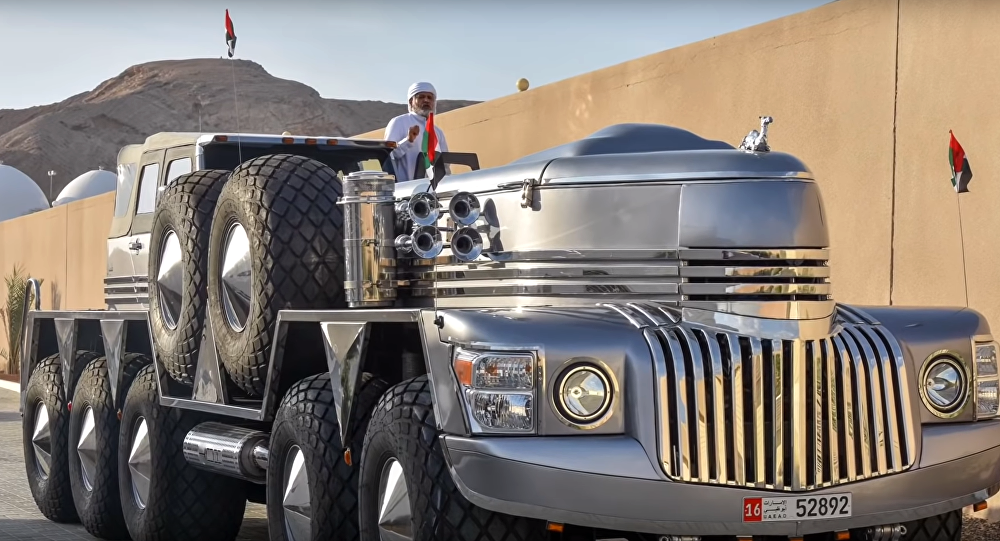
[1]: https://steelhorsemag.com/wp-content/uploads/2013/12/sheikh2...

Whether you are commuting 40 miles each way to work, hauling large loads for work everyday, bringing your ATV to the trail, or your trash to the dump.
Being able to hit the road in your own private vehicle is a great joy of life, and an essential liberty in America. So much so it’s quintessential of the “American Dream”.
Some people look at these things, and then decide they personally don’t like them, and only see a massive opportunity to regulate or tax them out of existence. Or they see the negative first order effects (e.g. traffic fatalities or pollution) and don’t consider both the first order benefits, nor the second-order costs of eliminating the thing itself.
I doubt I’ll convince anyone, but at least here is my alternative thinking on this. It is extremely important to reduce traffic fatalities, and reduce pollution per mile. Likewise it is also extremely important to allow people to choose their preferred modes and means of transportation.
It is merely a lack of creativity to pit these two goals against each other.
We are on the cusp of a clean energy and clean vehicle revolution, as well as what will arguably be one of the greatest technological accomplishments of humanity; a self driving car.
Dreams of regulating away SUVs or the right of private car ownership are over. Preferences will not be shaped by excessive gasoline taxes much longer. And passenger vehicles will only continue to become safer and cleaner from here on out.
Ultimately the war against private passenger transport will be lost to the Robotaxi. The marginal cost per mile will be lower than public transit, so they will be left to compete on point-to-point speed, safety, and convenience. And by safety I mostly am referring to safe from crime and safe from viruses, not collisions which will be exceedingly rare. Some cities might have a public transport system that can compete, but most will not.