Did you know that 50% of San Fransisco's stores have closed? Half. HALF. https://www.sfgate.com/business/article/Half-of-all-San-Fran...
Did you know 250,000 evictions are looming in Las Vegas alone? https://www.ktnv.com/news/coronavirus/las-vegas-could-face-e...
These are very real threats - not some fun internet discussion about inflation or gold or bitcoin. Your poo-poo'ing of economists is very out of context in this case.
The evidence is right in front of your face and you can find it on Google News.
SF where a huge amount of the residents have left the city since a majority of the white collar employees are WFH for the foreseeable future.
Not sure how you can take these places and extrapolate for the economic health of the entire country...
Certainly not. I don't think it's bad either, but some people (owners of expensive offices) do.
https://www.bbc.co.uk/news/business-53925917 -- Warnings of 'ghost towns' if staff do not return to the office
As to shareholders of chain coffee/lunch stores -- https://www.bbc.co.uk/news/business-53939526
Of course, but it has a significant, fundamental impact on huge aspects of "the economy" as we know it. Large segments of commerce - particularly in the U.S. - pivot heavily on people spending time and money commuting, spending time in an office, eating and drinking at nearby establishments, etc.
The effects will take some time to shake out.
Overpriced coffee shops (not Central Perk style ones in neighbourhoods - takeaway chain ones)
Daily Mail (the metro readership will vanish)
The trains will be interesting - especially in London. UK rail infrastructure is built to cope with large numbers of peak time commuters travelling with large discounts. That infrastructure won't vanish, but the income will (a £3k a year discount for a season ticket still means you're paying £4k a year - if that goes, times a million, it's a lot of operating revenue with little drop in costs)
[citation needed]
>I see this assured economic doom repeated so much without being questioned as anything but guaranteed I wonder where this incredible confidence is coming from?
All the stock market gains are from big tech. Any other markets are flat or down. ( https://finviz.com/map.ashx?t=sec&st=ytd )
Or maybe? https://fivethirtyeight.com/features/economists-are-bad-at-p...
"All of the gains are from big tech". All of the gains are always from some companies and all of the losses are always from others. This is just how the pie got sliced 2020. I don't think it has any special meaning we can divine from it?
The way the pie is sliced currently isn't really an indicator of stability.
[1]: https://www.isabelnet.com/wp-content/uploads/2020/08/Market-...
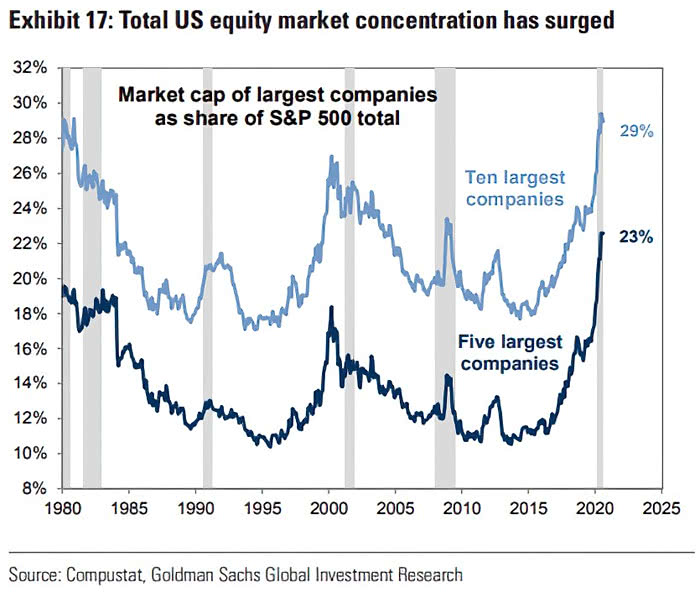
It doesn't really matter that it is big tech, if the ROI would have been highest in Agri, it would be those stocks.
Part of the issue of saying the Market is "up" is that we keep changing the size of the unit.
Is the market worth more now in Yen, Indian Rupees etc? Or are people just willing to part with more USD (that asset specifically) for the underlying asset (the stock)?
Those are...pretty easy questions to answer. The dollar is down about 10% since its March high compared to a basket of other major currencies: https://www.marketwatch.com/investing/index/dxy
Say .INX was 3250 in Jan and is 3500 now. -> 7.7% increase. But currency has lost about 10% of its underlying value.
If something loses 1/10th of it's value we expect people to pay 11% (1/.9) more of that currency. So the 7.7% increase in stock market is actually a 3.3% decrease in a mixed currency basket?
To bring CPI into this, the reason we don't see common inflation metrics such as food/gasoline spike, whereas assets suck as stocks do, is more a matter of supply/demand for the corresponding goods than anything else.
Said differently: if food was the only good there was, and we suddenly doubled the money supply, food would in time come to cost double.
However the market consists of many more things than what CPI looks at (which is why it's a bad measure of inflation). Stocks being one of such things. Real estate another. Right now, demand for stocks is higher than demand for food, and given the more money available, naturally we see stock prices rise, but food/gas prices staying relatively the same...
"The only function of economic forecasting is to make astrology look respectable," John Kenneth Galbraith, an irreverent economist, once said. ... Over the period [1999-2014] there were 220 instances in which an economy grew in one year before shrinking in the next. In its April forecasts the IMF never once foresaw the contraction looming in the next year. Even in October of the year in question, the IMF predicted that a recession had begun only half the time. To be fair, an average-growth prediction also misses 100% of recessions. One model does better, though. Our random-number generator correctly forecast the start of a recession 18% of the time."
This viz is amazing
Sure, sometimes it averages out. But often it's the opposite, more like catastrophic cancellation. The outcome of a close election is inherently unpredictable because large opposing forces mostly cancel out.
It's odd how, whenever we talk about what will happen next year, we forget how we were blindsided this year.
Who do you think has a higher chance of being right:
* macroeconomists when predicting the future of the economy
* fund managers when predicting the future of stocks
Just because people are smart or know a lot of things doesn't mean that that knowledge translates into useful ability.
That's unfair to astrologists, economists are not going to be that good. :-)
To be fair, the better economists work by creating models based on reality. But we don't have a rich dataset about modern economies responding to pandemics. It's not that they are stupid, it's that economies are difficult to predict in general, and we don't have the data sets to give any confidence for this case.
[0] https://en.wikipedia.org/wiki/Superforecasting:_The_Art_and_...
That's not fair. Paul Krugman has predicted seven of the last three recessions.
Well, it doesn't help that they don't have control over external factors. Like the Fed reducing interest rates to 0, and buying corporate bonds. Very hard to predict something when there's no free market where things just play out with no external influence.
When the first lockdowns ended in Europe, people started to do just that. Restaurants in many countries are like normal, gyms that I walk past on the street look about as full as they have ever been. I have spent two months of this summer traveling around, and I found some tourist destinations crowded with people who had come all the way across Europe to get there, including a lot of elderly pensioners who one would imagine would be the most at-risk group. If there wasn’t uncertainty about flight cancellations, even more people would have taken their holidays abroad this summer regardless of the virus.
Because of the high case numbers in the USA and the sheer uncertainty about the prevalence of the virus and public health measures’ effectiveness due to political indecision, I understand that a lot of Americans are panicked and truly afraid of going back to normal for the moment. But I suspect that with time, there will simply be a COVID fatigue and many of these same worried people are eventually going to go back to their same old routine.
Gyms are also almost empty. Tourism is surprisingly less affected, and I would imagine that restaurants in tourist places are much more full. But outside of those, it is definitely NOT business as usual.
Things will return to normal, absolutely. I just think it won't happen in 2021.
A number of European countries do not mandate masks at all, or the mandate is de facto only enforced in the largest cities and not in smaller towns. In many places where masks are a mere recommendation, only some people wear them and other people don’t. Observance of the "safety distance" in queues can be very lax indeed, and among the supermarket aisles people move around each other as closely as they ever have.
I am always amazed at people from the USA speaking of Europe as if everyone on this continent is deeply committed to what these Americans consider the proper public-health etiquette, but that just isn’t the case.
Yes, but a survey of economists or astrologers predictions it's still probably better than the survey of randomly chosen people, if for another reason then both of them are in the business of surveying your broad range of signals from a broad range of people to inform their predictions.
Any individual is capable of being wildly wrong in their predictions regardless of their title.
Still hasn't gotten any more sane, unfortunately.
Bonds are being sold that pay less money back than their sticker price. The equivalent is the bank charging you 400k for a 500k mortgage. That's pretty insane.
Stocks are apparently worth 30 years of their current profits, even for those stocks without a history of consistent profit (i.e. Tesla, Netflix etc).
I understand that lots of this is happening because of incredibly low interest rates, but pointing out that this is crazy is a public service in these ridiculous times.
if economists were so great at predicting the economy they’d all be rich
>Carlyle called economics the "dismal science". He was half-correct; it is indeed dismal.
Economics is like that. Economists predict horrible downturn. Economic policy makers do what they can to avoid or lessen its impact.
For example, economists predicted that Boeing (among others) was going to need a massive bailout to survive. The Fed purchased a ton of corporate bonds with printed money to juice the bond market and allow Boeing and others to refinance their debt. Do we blame the weatherman for being wrong when steps were taken to change the forecast?
I see this assured economic doom repeated so much without being questioned as anything but guaranteed I wonder where this incredible confidence is coming from? We have literally no idea what 2021 holds for us, in the same way we had no idea 2020 would be so uh unique.