Or maybe? https://fivethirtyeight.com/features/economists-are-bad-at-p...
"All of the gains are from big tech". All of the gains are always from some companies and all of the losses are always from others. This is just how the pie got sliced 2020. I don't think it has any special meaning we can divine from it?
The way the pie is sliced currently isn't really an indicator of stability.
[1]: https://www.isabelnet.com/wp-content/uploads/2020/08/Market-...
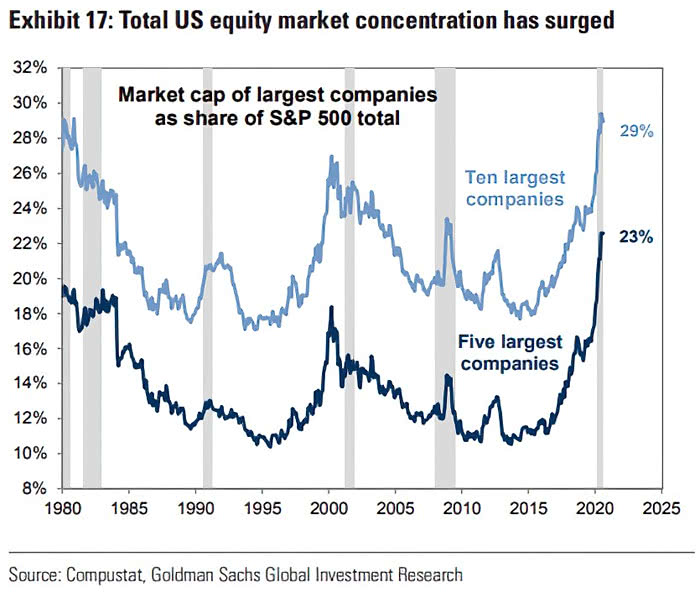
It doesn't really matter that it is big tech, if the ROI would have been highest in Agri, it would be those stocks.
Part of the issue of saying the Market is "up" is that we keep changing the size of the unit.
Is the market worth more now in Yen, Indian Rupees etc? Or are people just willing to part with more USD (that asset specifically) for the underlying asset (the stock)?
Those are...pretty easy questions to answer. The dollar is down about 10% since its March high compared to a basket of other major currencies: https://www.marketwatch.com/investing/index/dxy
Say .INX was 3250 in Jan and is 3500 now. -> 7.7% increase. But currency has lost about 10% of its underlying value.
If something loses 1/10th of it's value we expect people to pay 11% (1/.9) more of that currency. So the 7.7% increase in stock market is actually a 3.3% decrease in a mixed currency basket?
To bring CPI into this, the reason we don't see common inflation metrics such as food/gasoline spike, whereas assets suck as stocks do, is more a matter of supply/demand for the corresponding goods than anything else.
Said differently: if food was the only good there was, and we suddenly doubled the money supply, food would in time come to cost double.
However the market consists of many more things than what CPI looks at (which is why it's a bad measure of inflation). Stocks being one of such things. Real estate another. Right now, demand for stocks is higher than demand for food, and given the more money available, naturally we see stock prices rise, but food/gas prices staying relatively the same...
"The only function of economic forecasting is to make astrology look respectable," John Kenneth Galbraith, an irreverent economist, once said. ... Over the period [1999-2014] there were 220 instances in which an economy grew in one year before shrinking in the next. In its April forecasts the IMF never once foresaw the contraction looming in the next year. Even in October of the year in question, the IMF predicted that a recession had begun only half the time. To be fair, an average-growth prediction also misses 100% of recessions. One model does better, though. Our random-number generator correctly forecast the start of a recession 18% of the time."
This viz is amazing
Sure, sometimes it averages out. But often it's the opposite, more like catastrophic cancellation. The outcome of a close election is inherently unpredictable because large opposing forces mostly cancel out.
It's odd how, whenever we talk about what will happen next year, we forget how we were blindsided this year.
[citation needed]
>I see this assured economic doom repeated so much without being questioned as anything but guaranteed I wonder where this incredible confidence is coming from?
All the stock market gains are from big tech. Any other markets are flat or down. ( https://finviz.com/map.ashx?t=sec&st=ytd )