This describes perfectly the Brazilian state: big, distant, not prepared to deal in practical day to day issues (like having a place to change clothes or a sidewalk to walk on).
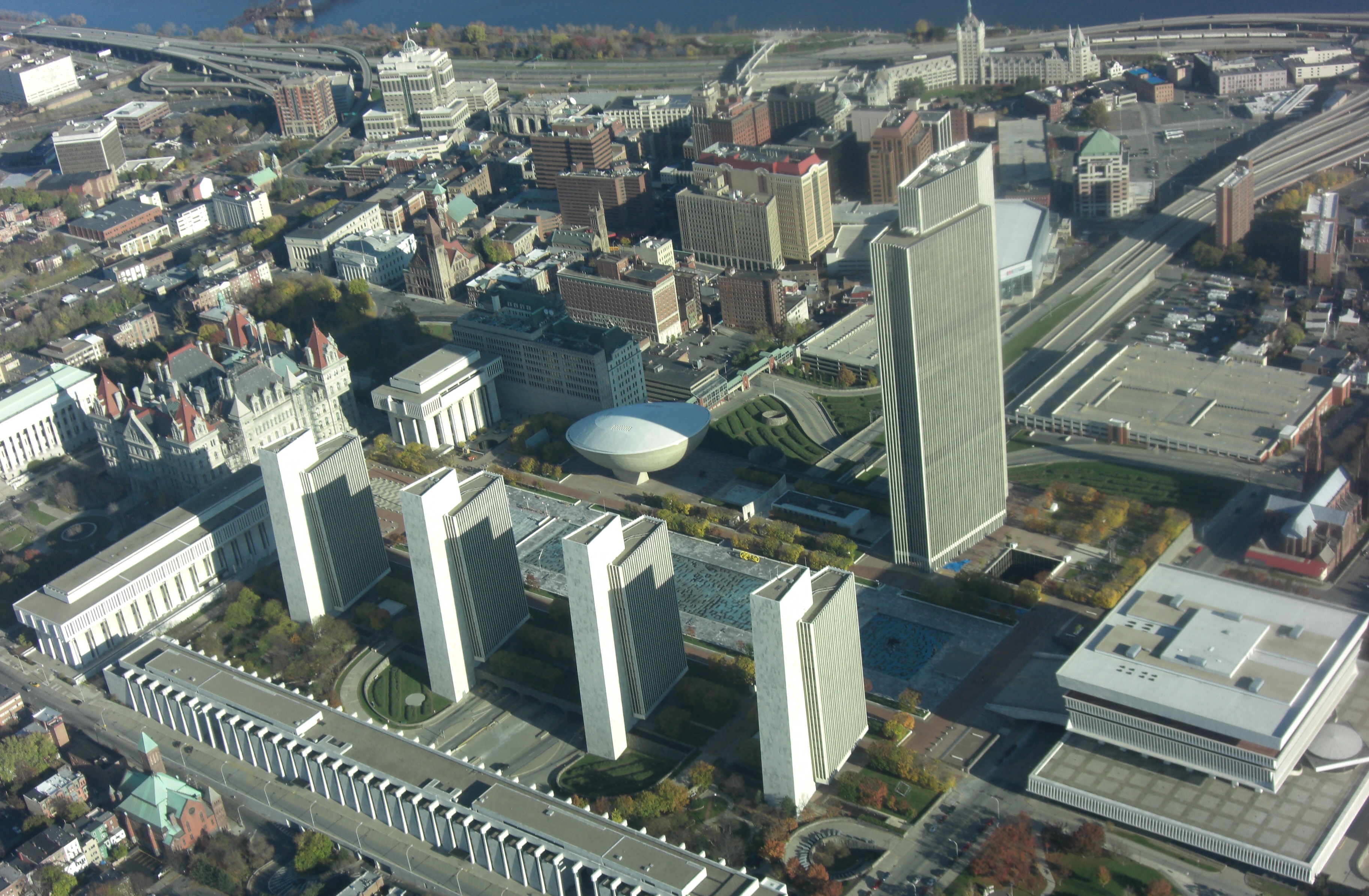
The architecture underlines this mentality quite well.
Empire State Plaza, Albany, NY:
https://upload.wikimedia.org/wikipedia/commons/f/ff/EmpirePl...
~
I would not want to live there either, just like I probably wouldn't enjoy living in an equally sublime Tadao Ando house. But in my opinion, Brasilia, regardless of its failure, is a sublimely beautiful work of architecture. I for one am glad it was built. I'm fairly certain it will serve [at some point in the future] as a 'blueprint' for a vocabulary of elements of architecture, in the same way that Vitruvius and classical orders played the muse for a resurgent European architecture.
You have this backwards. Brutalism was popular in the Soviet Union because it is austere, symbolizing equality and utilitarianism. Back in the early days, brutalism was actually seen as progressive. It’s association with totalitarianism is a result of western propaganda and the failures of the soviet bureaucracy.
> I often think of Brasilia, the capital of Brazil. A city literally built in the middle of nowhere and with virtually no sidewalks, making it incredibly costly for individuals to reach it and organize themselves to protest against the government. Its streets literally have no name⁰. Imagine living on SHS W2 or SEN L1!
Basically none of this is related to brutalism. What you are describing is a failed attempt at new urbansim. Brasilia is divided into "superblocks", which are essentially self-contained communities with all required services in the center. This design was similar to soviet urban planning at the time, though the superblocks were much bigger (and less successful) in Brasilia. This design ultimately resulted in large boulevards and car centric transportation, defeating its initial goals
I don't disagree it's purported to be egalitarian, but to me that's just a codeword for suppressing individual expression as I've said elsewhere.
And utilitarianism at the expense of beauty makes for terribly sad creations.
I'm on Roger Scruton's side on this one. https://www.youtube.com/watch?v=bHw4MMEnmpc
Some people might say that various religious monuments remind them of how that religion suppresses individual expression. On the other hand, the same might be said about certain architecture in say Japan, that it evokes a sense of collectivism. Yet some people will find that beautiful while others might find it stifling.
I would guess that the vast majority of people have never heard of "Brutalism", and if you were to show them examples there would be a wide range of responses. How many people could say whether something was influenced more by Brutalism vs Modernism vs Minimalism?
Take the Guggenheim. It was not well received when first revealed, but is now considered a prime example of Modernism, and even Brutalism, though I expect many everyday people would be still divided on whether it's beautiful or not.
Beauty is subjective and multidimensional, so when you say " utilitarianism at the expense of beauty", what I hear is "utilitarianism at the expense of a particular aesthetic of my preference."
An example that many people would be familiar with is IKEA. Yes, some people do find the Modernism of IKEA to be sad or lifeless, but others find pleasure in the simplicity and clever functionality.
I haven't even discussed how cultural and historical contexts influence these perceptions, and how that will differ depending on the audience. I think this plays a significant role in coloring our judgments of Brutalism.
Anyway, my point is just that it's not so simple, people define and find beauty in many different ways.
Stalin rejected brutalism firmly. Brutalism first gained traction in the Eastern block after it had gained popularity in the West.
He rejected the austerity, and he rejected examples of it such as proposed by Le Corbusier twice: both when Le Corbusier proposed an austere Palace of the Soviets, and secondly when Le Corbusier wanted to raze large parts of Moscow for a redesign along similar principles as what Brasilia adopted.
The austerity in Soviet design came under Khruschev as a cost-cutting measure to increase the housing stock, primarily, and while you certainly find more monumental buildings built in a brutalist style, that was the same thing: It was an end to the excesses of Stalinist architecture in favour of signaling a focus on saving money, and an actually desperate need to cut costs.
You're right that brutalism was seen as progressive, but initially that was the case in the west.
Le Corbusier actually accused Stalin of betraying the revolution when his proposals were rejected - he saw his proposals as revolutionary, but Stalin wanted a much more traditional style.
Stalinist architecture is anchored in the French Empire style, which you also find echoes of in parts of the US Federal style [1]. See e.g. Moscow State University as a prime example [2]. It has columns, and all kinds of architectural flourishes that you expect on more monumental Empire or Federal style buildings, and no sign of brutalism.
[1] https://en.wikipedia.org/wiki/Federal_architecture#/media/Fi...

[2] https://en.wikipedia.org/wiki/Stalinist_architecture#/media/...

I would not attribute that specifically to Brutalism.
I tend to find that style more likely to evoke a sense of modesty. The lack of ornamental or ostentatious features tends to make Brutalist designs feel, to me, more egalitarian.
Where German forces tried to pierce the Maginot Line, they were crushed. It worked exactly as designed. As usual, the lesson that History tends to recall is incorrect.
First, in part, the intention of the Maginot line was to make the Germans go through Belgium. French planners assumed their German counterparts were smart enough not to attempt a direct assault on the line, and felt that a maneuver battle in Belgium was safe for them in terms of stopping the Germans there, after which they could settle into stable lines or possible attack through the Maginot Line.
It wasn't literally a single road through the Ardennes, but the French did assume it was impassable and only weakly defended it; the Germans did gamble on attacking through the Ardennes and succeeded, flanking the French and British, forcing the evacuation at Dunkirk and permanently breaking the French lines.
A few minor or weakly held forts in the Maginot Line were taken at the northern end, but none of the major forts were taken, the Italian invasion was stopped at the Line, and the Line was becoming the main point of resistance where French forces would hold out; German attacks against the main forts failed utterly. The defense of the Line was ended by the surrender of France.
So, they were only mostly useless, and there's a big difference between mostly useless and all useless.
https://trip101.com/article/famous-buildings-in-vienna
Most of these look pretty safe to me and objectively prettier than cubes of exposed concrete
I think the design and living considerations of these structures outstrip American development in virtually every regard: https://designyoutrust.com/2018/01/bublik-circular-apartment...
I often think of Brasilia, the capital of Brazil. A city literally built in the middle of nowhere and with virtually no sidewalks, making it incredibly costly for individuals to reach it and organize themselves to protest against the government. Its streets literally have no name⁰. Imagine living on SHS W2 or SEN L1!
I was raised to love Oscar Niemeyer, but nowadays I can't help wishing he chose to lend his beautiful creativity to something other than architecture.
__________
0. https://www.quora.com/How-do-people-living-in-Brasilia-refer...