It's not democracy. There is no equality. You have no voice unless others want your contribution.
People are free to form a cliques of same minded people and ignore everyone else. You can hate those who make the software you use, but Theo & friends do what they want.
While I greatly enjoy the freedom that comes with voluntary association, I think it is worth realizing that it has few protections against the creation of toxic environments that exclude people/resources on non-technical issues. Our culture can be annoyingly straight-white-male oriented.
https://www.openbsdfoundation.org/activities.html
vs.
http://www.openbsd.org/images/rack2009.jpg
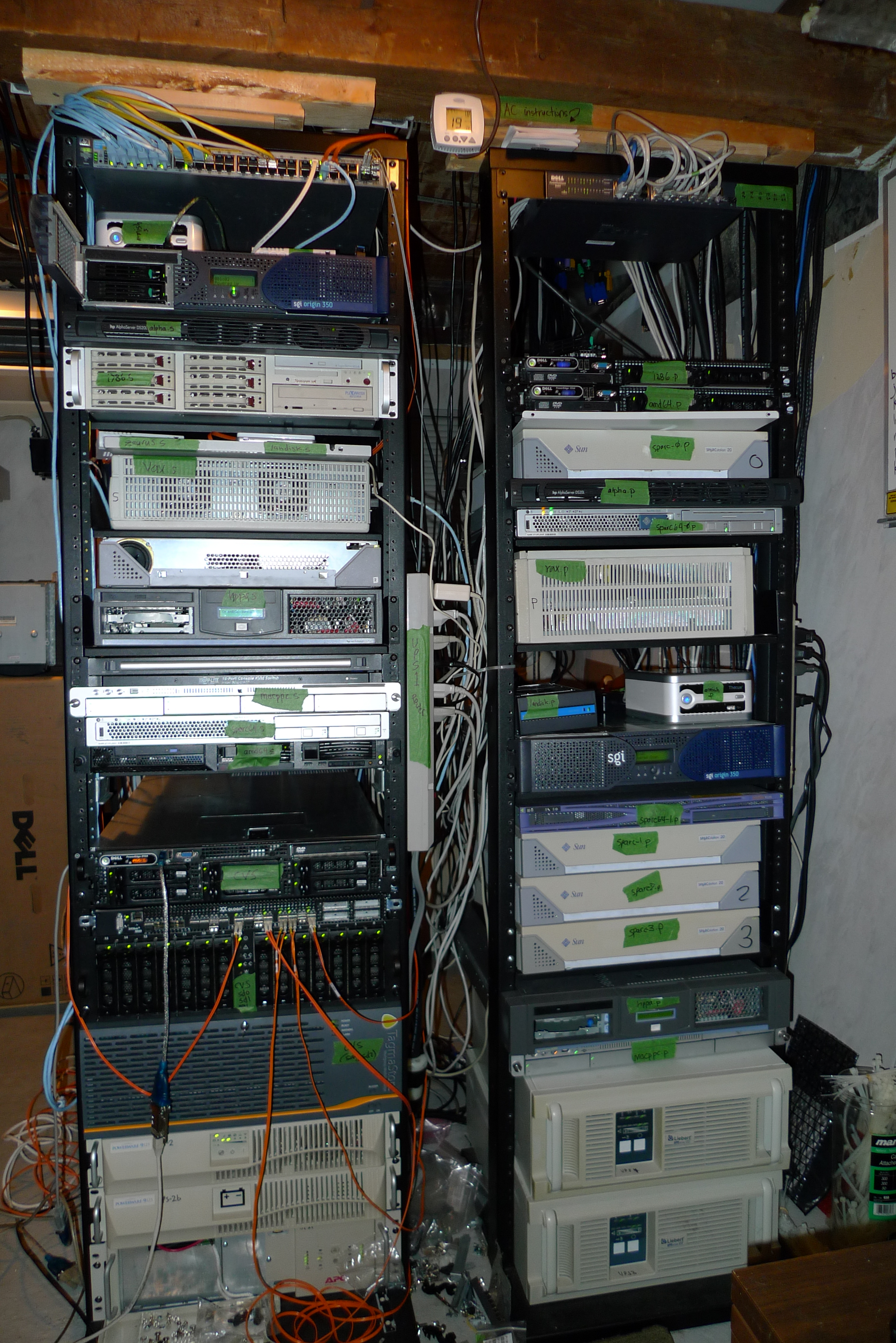
Security is an important issue to them so they feel they need physical direct control of the hardware and don't want it located somewhere else.
Also some of the equipment is old and may not survive being transported.
I remember them saying taht alignment and endian issues can only be found when compiling and running on the actual hardware. Cross compile to a different arch and emulators don't catch the same bugs.
Disclaimer: I've been using OpenBSD since 6.3 (~ 2 years ago), so quite recently, I don't know if he changed attitude at some point.
What seems to be the least tolerated are "ideas people". If you come in and suggest that it'd be lovely to port OpenBSD to this new SOC, or that someone should write new Bluetooth support, or what have you – that's when the teeth come out.
But conversely, if you bring a patch the OpenBSD community seems to be very welcoming. They definitely value you putting in the work, not just talking about it.
The support for "antiquated" architectures has a lot to do with them being OPEN, e.g. SPARC. This crew is some of the first along with rms to really push not just open and free software but also the hardware it runs on for a variety of solid reasons.
The support for "antiquated" architectures has a lot to do with them being OPEN
Not exactly...I recall Theo called it OPEN because he felt the NetBSD crew wasn't. NetBSD was around first, recall, and one of their core principles is wide portability, where OpenBSD took on the mantle of correctness and security and portability came along for the ride. Both side of the unpleasant history are documented; the truth is somewhere in the middle, of course.
That said, both crews advocate building on multiple architectures as a solid best practice to turn up 'interesting' programming issues. For example, Theo has stated that SPARC/SPARC64 porting is particularly useful for finding unaligned memory accesses (Alpha didn't like them either).
I'll leave out my own experience in dealing with the 'OpenBSD attitude' other than to say 'generally less than pleasant'. I still use OpenBSD daily, tho more for infrastructure (FW, DNS, DHCP, LDAP) than as a desktop.
Why -- he effectively builds and designs it and it's open source and free to copy and make your own.
Obscure architectures is important also to keep the world online.
Also obscure architectures are damn fun.
Current status:
Currently OpenBSD/powerpc64 only supports POWER9 processors and runs stably on PowerNV machines based on the Raptor Computing Systems Talos II and Blackbird boards. SMP is not yet supported. Support for POWER8 processors is planned but won't happen unless someone provides us access to suitable hardware.
OpenBSD/powerpc64 does not run under a hypervisor such as PowerVM or PowerKVM.
Sorta like English reads right to left, but left to right or top to bottom would work just as well. left to right was what won.
I did have a Tadpole Sparcle (which I liked so much I jumped at the Viper). It came in very handy once when I was learning C and was getting different answers depending on the machine. A deep dive into old newsgroup postings informed me that I had an endian problem. I was excited that I had one of those.
I do have a fondness for computing oddities which is why I bought the Sparcle in the first place and also why I have a "small" 1999 IBM mainframe.
SSH
Writing things
Being productive and having productive workflows in old software, well that's not a sin.
I assume the other odd stuff is probably things that are common in China, like the Landisk and Loongson, perhaps because OpenBSD is popular as a router/firewall OS.
Landisk (SH4) and Loongsoon (MIPS), while not common machines, are CPU architectures that are still in production and could be used as a port to newer machines, should someone do the work.
I'd point out that you don't even need to fork OpenBSD. NetBSD[0], FreeBSD[1] and DragonflyBSD[2] are available for anyone to use, hack on and/or contribute.
This is something of a tangent, but I've discovered over the years that understanding the history of a particular technology (or anything else, for that matter) provides a better understanding of where we are and where we might be going.
As Eugen Weber put it[7] (in a vastly different context, but certainly applicable to this subject): "We're going back to where many of our ancestors came from. To see where their stories came from, and their memories and their habits and the way they are which has made us the way we are. This is what history is about. Where we come from, what lies behind the way we live and act and think. How our religions, our institutions, our laws were made."
I first encountered BSD as SunOS[3] and found it to be useful and workable, although it did have some significant limitations, not least of which was vendor lock-in.
By the time GNU/Linux gained in popularity, most commercial vendors of Unix had moved to SVR3/4[8], and many folks (like this person[4]) chose Linux over BSD for that reason.
In the 1990s, I played with both BSD and Linux, but since Solaris[3], AIX[5] and HP/UX[6] were all SVR(3/4) based and my jobs were to implement/manage such systems, as such I (and many other folks) mostly used Linux personally.
IMHO, that's why Linux initially achieved broader acceptance than the BSDs, even though most folks don't use proprietary *nix anymore.
On a variety of occasions over the years, I implemented BSD variants for specific purposes (generally custom third-party software which required it).
I encourage folks to use the BSDs as well as GNU/Linux when each are appropriate.
Given that all of these OS' are open-source, it seems odd to expend the energy to put any particular OS flavor down, rather than picking one or more that meets one's needs and putting their energy into those instead.
[2]https://www.dragonflybsd.org/
[3]https://en.wikipedia.org/wiki/SunOS
[4]https://rtemsramblings.blogspot.com/2011/11/minix-versus-lin...
[5]https://en.wikipedia.org/wiki/IBM_AIX
[6]https://en.wikipedia.org/wiki/HP-UX
[7]https://www.youtube.com/watch?v=XCyO8meahME
[8]https://en.wikipedia.org/wiki/UNIX_System_V
[Edit: Fixed link references]
If you question Theo on anything, even something reasonable, you will incur his wrath, and that of his henchmen (the clique of project devs that surround him).
Case in point is the whole "Funding our Electricity" thing: (a) Theo insists on keeping their test lab in his own house (b) Theo insists on supporting obscure archaic architectures (c) Theo claims on list to have incurred 20,000 dollars of electricity that year (d) Theo refuses to answer reasonable questions, such as cost breakdown, why the equipment can't be moved elsewhere, why the insistent on obscure architectures. Or when he does answer its essentially "my way or the highway".
OpenBSD is great, no doubt about that. But the whole Theo & friends clique needs to change.