This reasoning is beyond absurd.
I just checked, and Black Mirror: Bandersnatch is playable on my iPhone.
Games like Late Shift or The Complex on Xbox are very similar.
(Which is not to absolve Apple of unethical behavior, but it is one way in which the analogy doesn't hold.)
They don't need to "verify every video" because a video is a video. It's all about the codec, security etc wise, not the content. With dynamic code, like a game or app, it's obviously different.
I’m surprised Google didn’t develop it that way to begin with.
iOS Safari isn't supported, however. Not sure if it has something to do with gamepads, video codecs, or what...
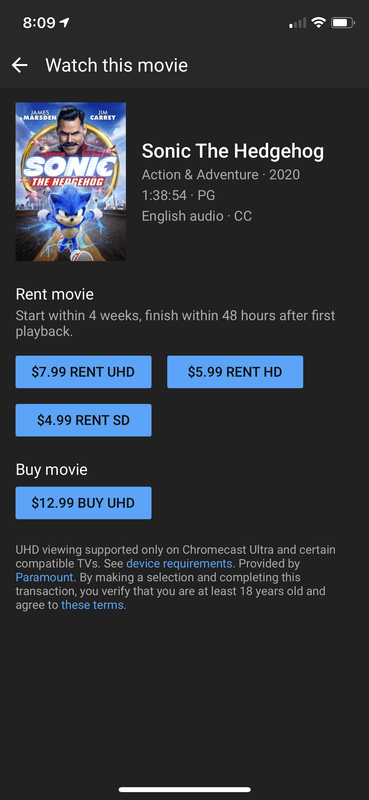
And do note that you can purhcase movies from Youtube app.
Not on iPhones?
Apple is just mad because they're not getting a slice of the pie. I could see them being paid for the initial app purchase (once, not a subscription) for the distribution, but why the hell should they get paid for all the games being streamed? They're not handling the game servers or any of the related bandwidth requirements behind the scene.
This is about the much more subtle and insidious way that Apple leverages their control over iOS to block software that Apple deems threatening. App Store guideline 2.5.2[0], disallowing downloading and executing code in most circumstances, is a sister policy to this one about game streaming services. What both of these policies have in common is that they ban things that have the potential to supersede iOS itself, e.g., by becoming a successful app platform in-and-of itself (if you squint you can see the connection, if you can play Halo this way, why not Photoshop?)
Ben Thompson has written the definitive article on this protectionist mindset that drives many of Apple's store policies[1].
[0]: https://developer.apple.com/app-store/review/guidelines/#2.5...
[1]: https://stratechery.com/2013/why-doesnt-apple-enable-sustain...
I'd love to hear Apple explain what the worst case scenario is for consumers if they were to let Netflix customers sign up the app, let Amazon customers buy books in the app, or play streaming games?
Apple is the most valuable company in the world and there's only one way for them to go from here.
No, that's the whole point.
>I'd love to hear Apple explain what the worst case scenario is for consumers if they were to let Netflix customers sign up the app, let Amazon customers buy books in the app, or play streaming games?
Infrequently heard perspective is that very often (non-tech) people call in to apple support about purchases made in apps on the iPhone. Apple owns the in-app purchasing of ALL purchases in app, and can reverse and refund the purchase. Worst case scenario is apple has to say "we can't help you" and they probs don't want that. When you stream a game/app instead of get it from App Store, apple can't say its a good experience or not broken, they can't refund or audit. Think about how apple was going to ban social media apps that allow p*rnographic content. They couldn't guarantee content on app... so ban it unless the app could self-censor.
You can say apple shouldn't care about the quality/type of content, and people should be smart enough to distinguish 3party apps from apple apps... yet talk to Apple Support workers, and they'll tell you that people don't.
Android, like google, has no real support services at all. Tons of people buy Apple because of support, and they will defend their ability to support (and take a nice fat chunk $$) until someone tells them its illegal.
Just for context, Apple became the most valuable company in 2011.
https://www.macrumors.com/2018/08/09/apple-most-valuable-com...
Microsoft was the most valuable company in 2002 and as of today, it’s #3. It could easily become number one again since it has much higher margins than Apple.
Of course eventually Apple will fail. But who knows how long that will take?
I’m not saying that I think Apple deserves a 30% cut of every service.
We basically got lucky that the web was invented and well-established long before the iPhone was. If it had been the other way around, I strongly doubt the iPhone would ship with a browser or that they'd be allowed on the App Store.
(googler, but i work on and far prefer iOS. i care about the platform and i wish it had actual browser engine competition)
FWIW I like Firefox or Chromium a hell of a lot better than Safari, except that both drop my Macbook's battery life by an hour or more versus Safari, and both feel heavier in terms of their effects on overall system responsiveness (the feeling I get is that Safari is way better at keeping JavaScript from stomping all over everything). I do use Firefox on Linux, if I'm on something beefy enough to use a really heavy browser and still be able to multitask.
For that matter, it'd be worth keeping other browser engines out if their integrations broke Apple's only-vendor-who-seems-to-give-a-shit accessibility features. I dunno, maybe iOS Firefox and Chrome already do, but I'd imagine forcing Webkit keeps people from embedding browser engines that screw with that. Which, again, wouldn't bother me if anyone else were half as good. Please, for the love of god, anyone, compete with Apple. No one is, right now.
[EDIT] and by Safari I mean Safari's webkit, of course. You can embed webviews! You can run JS! You can ship your own browser! You cannot ship your own browser engine, for a bunch of very good reasons, and I'm having a hard time in this case of thinking of any nefarious reasons for the rule.
[EDIT EDIT] and then of course a browser engine is a giant attack surface. Better one version of one browser engine on your device than 20 versions of 3 browsers, most of which anyone but a turbonerd won't even realize are there because they're included with non-web-browser apps.
In the case of Windows and the Mac, they are both insecure by design. You can’t have the functionality of either with the same level of security as the iPhone without reducing functionality. The best either can do is annoy users with pop ups that they eventually, reflexively just press OK.
I install all kind of random crap on my iPhone/iPad because there are more strict controls over what they can do. iOS aggressively kills battery and CPU intensive apps.
I refuse to install Zoom for instance on my computer because they have repeatedly been shown to be bad actors (https://www.zdnet.com/article/zoom-defends-use-of-local-web-...)
> I mean doesn't that literally keep me as their customer more? Now that I'm not switching to an Android device where the land is greener.
Apple charges $100 more for its cheapest phone than the average cost of an Android phone. Apple knows they aren’t going to get every customer.
In the famous words of Jobs - “if you want porn apps - buy an Android”. I’m not saying you want porn apps. I’m speaking to the fact that Apple knows it’s leaving some segment of the population out when it makes the choices it makes.
Love the analogy.
Even if you have another browser chrome wrapped around webkit, when you click a link it probably will open Safari.
Hopefully they follow through with the change on iOS 14.
They do by requiring that all apps (including Chrome) to use the Safari WebKit engine provided by the OS.
They actually justifies it by pointing to parental control and safe browsing.
Apple's approach for many years (at least) has been screaming "control freak", so it's completely in character.
Really wondering how Apple can think they need to have that much power. How can they let me, a simple-minded iPhone user use the web browser without checking every website so that the sites don't violate Apple's policies. How do they allow 3rd party web browsers. They display loads of questionable content, too.
And actually, I don't think that'd be too far off. Like what Google has their Safe Browsing list containing links to malware sites, Apple could create their own Apple Internet List, and demand through App Store policies that all browsers implement it or else.