According to you, Google should send users to a strictly worse app, so that it can become better over time? And unless it requires a lot of user data to become a better app, I don't see why it needs traffic from Google to become a better product.
Once it is an arguably better product, then yes, Google should definitely link to it first.
Google Search should list the websites that best match the user's search terms ordered by a fair Pagerank score that doesn't emphasise Google's own properties. That's it. Google shouldn't be making subjective decisions about "site quality" (objective factors like speed, mobile optimization, malware etc are OK..). If I search for "Sunderland"[1] I get 3 news stories about the local football team and the next 50% of the page is Google Maps...
Ok, but define "best match".
> ordered by a fair Pagerank score that doesn't emphasise Google's own properties
Even ignoring link farming (which already ruined a lot of the web the first time around), inbound links to content is a proxy for quality of content, not an actual measure of quality of content.
It's just offloading the subjective part of search quality to the wisdom of the crowd, which often does not work out.
We divide the knowledge and information into disciplines. We create awards in each discipline. If you accumulate enough awards you are offered the option to dedicate your life to the topic without exit strategy. (Quitting would cost 100 million) unless the topic is no longer of public interest.
You get: a house that you must live in, access to research facilities if (applicable), travel is pre-paid for if (applicable), a personal assistant who has to sign off on all of your expenses.
You yourself are not allowed to have cash or a bank account, no vacation and contact with friends and relatives is forbidden unless they can prove they have relevant expertise or are also in such committee.
Picture it, high priest of pokemon go. In charge of ordering search results and designing the portal widget.
No discrimination for artificial humans, we do full robotmancipation.
Data doesn't tell you everything.
They "Go to google, type what they want, google gives it to them."
Sure, you could click on the 9 dots on the top right and select maps for google maps.
But is that always there on every device, on every web browser, whether signed in with google account or not?
Apple has the only viable alternatives to those two, and the only way they are able to distribute them is because they control the home screen of iOS.
That is not my memory. Google maps used AJAX to let you pan around. It was fluid, and really nice. What I had been using up until then was MapQuest, where you needed to click an arrow to move around, with long delays.
Disclosure: I work for Google
It would have been easy to offer kml links and "force" the users into Google Earth. Before it was tinkered into a steaming pile of shit Keyhole was a truly fantastic product, with a lovely community, arguably the greatest thing since web browsers (with picasa & hello as a close 3rd and 4th)
For a web based thing the ajax maps was quite nice but today I really hate using it. The data is great tho and you cant complaint about the price.
How so?
Take route planning for example. It use to be that you could fly the route in google earth. A line on a paper like map with a bunch of dots is useful for finding a shorter or more preferable route but after you've made up your mind flying over the road from A to B allows you to drive or cycle without any map.
If the application is installed the search results can include tours. (people made countless illustrated tours that kept breaking with each api update until there were no tours left)
Google could probably embed google earth into web pages if the will was there.
We will see where https://earth.google.com/web/ ends up. For now it loads as if booting an OS but its quite smooth after that.
The other options were just as good, but often you had to pay for them. With Google, you could repeatedly refine the bad results until you found something useful, because there was zero additional cost involved.
Maps had smooth, animated panning and zooming that updated the map in real time without reloading the page. MapQuest and the other major competitors at the time only allowed panning and zooming by clicking buttons on the side of the map, which scrolled a predefined number of steps and reloaded, at least initially, the entire page when you did so.
Google Maps was also less cluttered and used the browser's real estate much effectively. MapQuest was a small, cramped map by comparison.
Screenshots:
https://i2.wp.com/www.matthewhurst.com/wp-content/uploads/20...

https://www.versionmuseum.com/images/websites/google-maps-we...
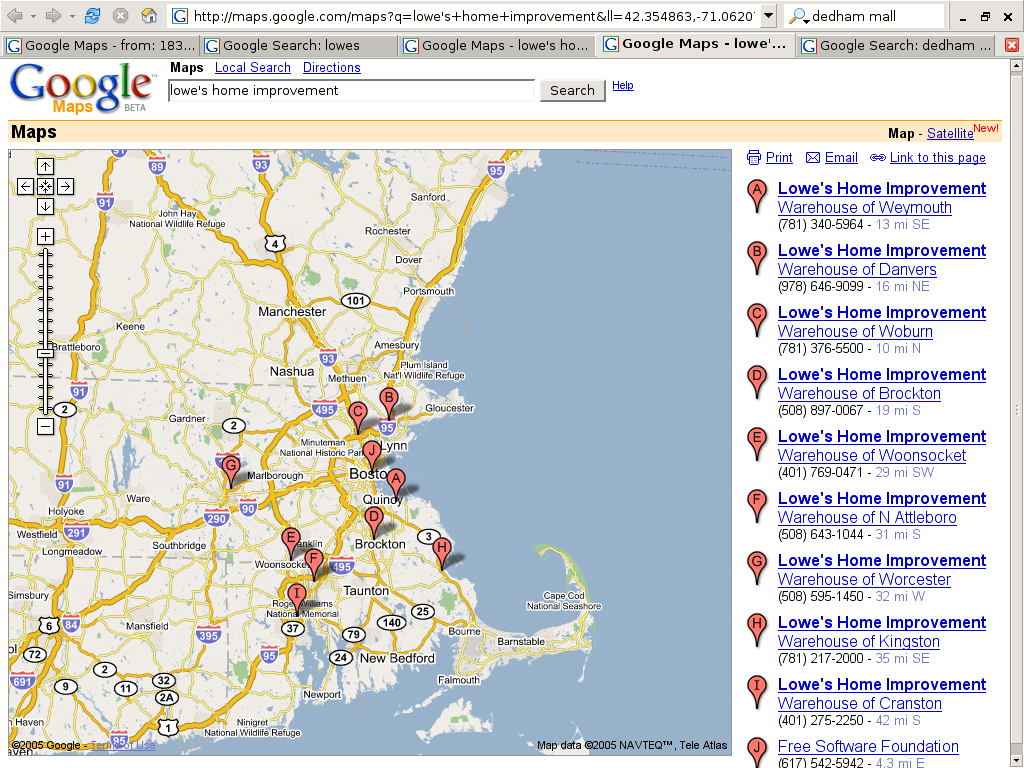
And when GMaps first started, it wasn’t the beast that it was today; sure it had some nifty UX improvements, but it was nothing close to competitors in the space at the time.
Out of curiosity, what exactly about Maps is unfair? They made money, they invested it in better mapping technology. You could say the same about Apple too, they bundled their Maps application with every iPhone sold which you couldn't even uninstall for a long time. And they had more money than Google too - yet their maps application was and still is garbage.
It just so happens Google Maps is the better product here and has nothing to do with anti-competitiveness. I was in China and I tried using both Apple and Google Maps (via VPN). And guess which one lead me to a wrong railway station?
And even now, having done so, clicking on an address to copy it will take you to a page telling you to reinstall maps to see it...
That’s the part that is illegal and anticompetitive: they didn’t make money from Maps to reinvest to create a better product. Rather, they invested revenue from other different markets for which they are exceedingly dominant, to invest and operate Maps at a loss (I.e. free and no revenue sources.)
>Apple
Apple did not have anywhere near dominant market share of devices when Maps came out. Antitrust cases hinge on that point. This is also why Bing can get away with many of the same tactics that Google uses : because Bing has very low market share of search compared to Google.
You: I wish people would build products that successfully compete with Google.
Also you: It's fine if Google do things that stop their competitors successfully competing with Google.
This is literally exactly the reason why anti-trust laws exist - to stop a company who are successful in one area (search, advertising) unfairly dominating other areas (maps, translation) by suppressing their competition. For all you know there might be a map provider that you'd prefer - but while Google leverage their advantage running the premier search engine to put themselves at the top of every geographic search you're never going to find out.