https://ark.intel.com/content/www/us/en/ark/products/205684/...
Epyc 7H12[1]:
- L1: two 32KiB L1 cache per core
- L2: 512KiB L2 cache per core
- L3: 16MiB L3 cache per core, but shared across all cores.
The L1/L2 cache aren't yet publicly available for any Cooper Lake processors, however the previous Cascade Lake architecture provided:
All Xeon Cascade Lakes[2]:
- L1: two 32 KiB L1 cache per core
- L2: 1 MiB L2 cache per core
- L3: 1.375 MiB L3 cache per core (shared across all cores)
Normally I'd expect the upcoming Cooper Lake to surpass AMD in L1, and lead further in L2 cache. However it looks like they're keeping the 1.375MiB L3 cache per core in Cooper Lake, so maybe L1/L2 are also unchanged.
0: https://www.hardwaretimes.com/cpu-cache-difference-between-l...
1: https://en.wikichip.org/wiki/amd/epyc/7h12
2: https://en.wikichip.org/wiki/intel/xeon_platinum/9282
Edit: Previously I showed EPYC having twice the L1 as Cascade Lake, this was a typo on my part, they're the same L1 per core.
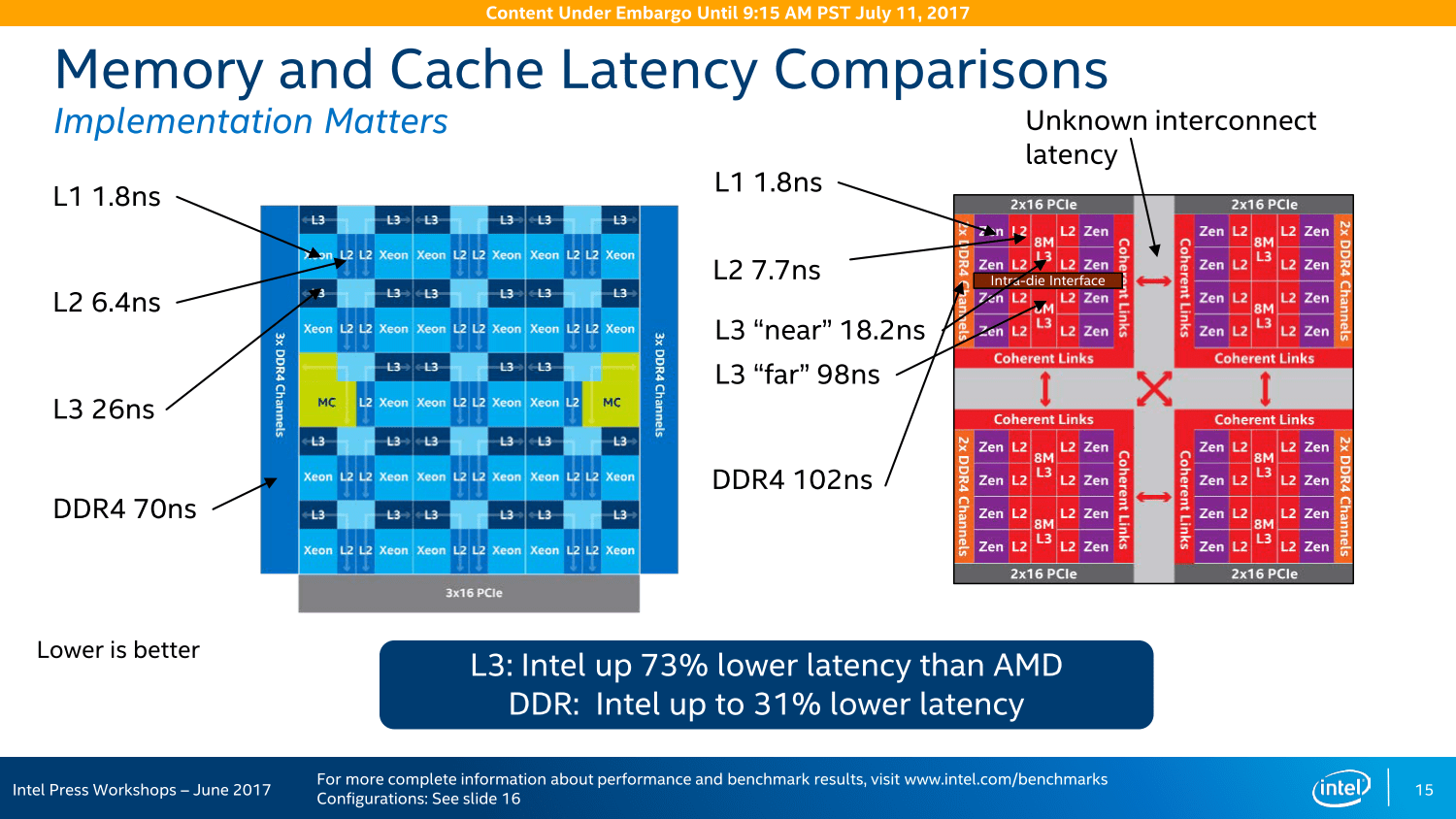
There's been very few cloud benchmarks where 1P Epyc Rome hasn't beaten any offering from Intel, including 2P configurations. The L3 cache latency hasn't been a significant enough difference to make up the raw CPU count difference, and where L3 does matter the massive amount of it in Rome tends to still be more significant.
Which is kinda why Intel is just desperately pointing at a latency measurement slide instead of an application benchmark.
As another commenter pointed out, though, not all caches are equal. Unfortunately, I was not able to easily find access speeds for specific processors, so single-threaded benchmarks are the primary quantitative differentiator.
And I think Xeon L3 cache tops out at about 40MB, whereas Threadripper & Epyc go up to 256MB.
I don't think there's any Intel CPU's with more than 36MB L3?
IIRC the only people who buy those vs. the equivalent dual socket system are people with expensive software which is licensed per socket.