News for hackers. Stuff that matters.
Re:Intel and ARM Performance Characteristics for S3 Compatib... by sitkack on Sunday June 07, 2020 @09:27AM (#23447176)
If you aren't compute bound, most workloads are dictated by the speed of main memory. And most business workloads spend their time waiting. Intel has historically focused on single core performance, this is what they are _really_ good at while this graviton part has decided to go wide and focus on many core.

The memory controller on the ARM part must be excellent given that the Intel machine had 2x sockets.

I don't think a core to core comparison or core to hyperthreaded core makes much sense. There are so many other unknowns, they only appear to be similar metrics. $/work_unit is the benchmark I would focus on in case like object storage.

Re:Intel and ARM Performance Characteristics for S3 Compatib... by byefruit on Sunday June 07, 2020 @11:35AM (#23448102)
My money would be on greater memory bandwidth and probably better use of that bandwidth.

If you look at the big graph later on in the article, even for similar _physical_ core counts the Graviton does better than the Skylake - this implies there's another bottleneck.

It's worth pointing out as well that ARM's weaker memory model gives it many more opportunities for aggressive optimisations that can make better use of the available bandwidth.

Re:Intel and ARM Performance Characteristics for S3 Compatib... by kllrnohj on Sunday June 07, 2020 @01:50PM (#23449148)
> even for similar _physical_ core counts the Graviton does better than the Skylake - this implies there's another bottleneck.

It doesn't, though, not until Skylake has already hit a bottleneck & graviton2 can eventually "catch up".

Skylake caps out at around 12 cores, at which point performance goes flat & even regresses. At 12 cores, though, skylake has a huge lead over a 12 core Graviton2.

Similarly, Cascade Lake caps out at around 18 cores. But again at 18 cores the gap between Cascade Lake & Graviton2 is huge.

The bottleneck in play here is most likely memory bandwidth. The Graviton2 chip has 8-channel DDR4-3200 memory for a theoretical bandwidth of 204GB/s. That's going to be far more than any single CPU Xeon currently on the market. By comparison the Skylake would be 6 channel DDR4-2666 and Cascade Lake 6 channel DDR4-2933.

So for this particular test the interesting comparison would be against Epyc Rome, which is also 8 channel DDR4-3200 and is up to 64 physical cores.

Re:Intel and ARM Performance Characteristics for S3 Compatib... by StillBored on Sunday June 07, 2020 @02:21PM (#23449388)
two words, "NUMA binding".

The cross socket NUMA bandwidth is like a tiny straw. If the OS or application is failing to pin the memory, cpu and IO together on the correct numa node your going to have a major scalability problem.

So, two things can really throw this off, having a Physical->VM topology mismatch, or using a language that is garbage collected and won't allow the programmer to control memory/node placement.

I've literally gotten 10x perf improvements by fixing these kinds of problems in the past.

Combined with comparing cores to threads and the results are somewhat predictable. In this way, the simpler gravaton topology is really going to shine for applications that don't scale well. That is until intel builds an actual high core count single socket machine.
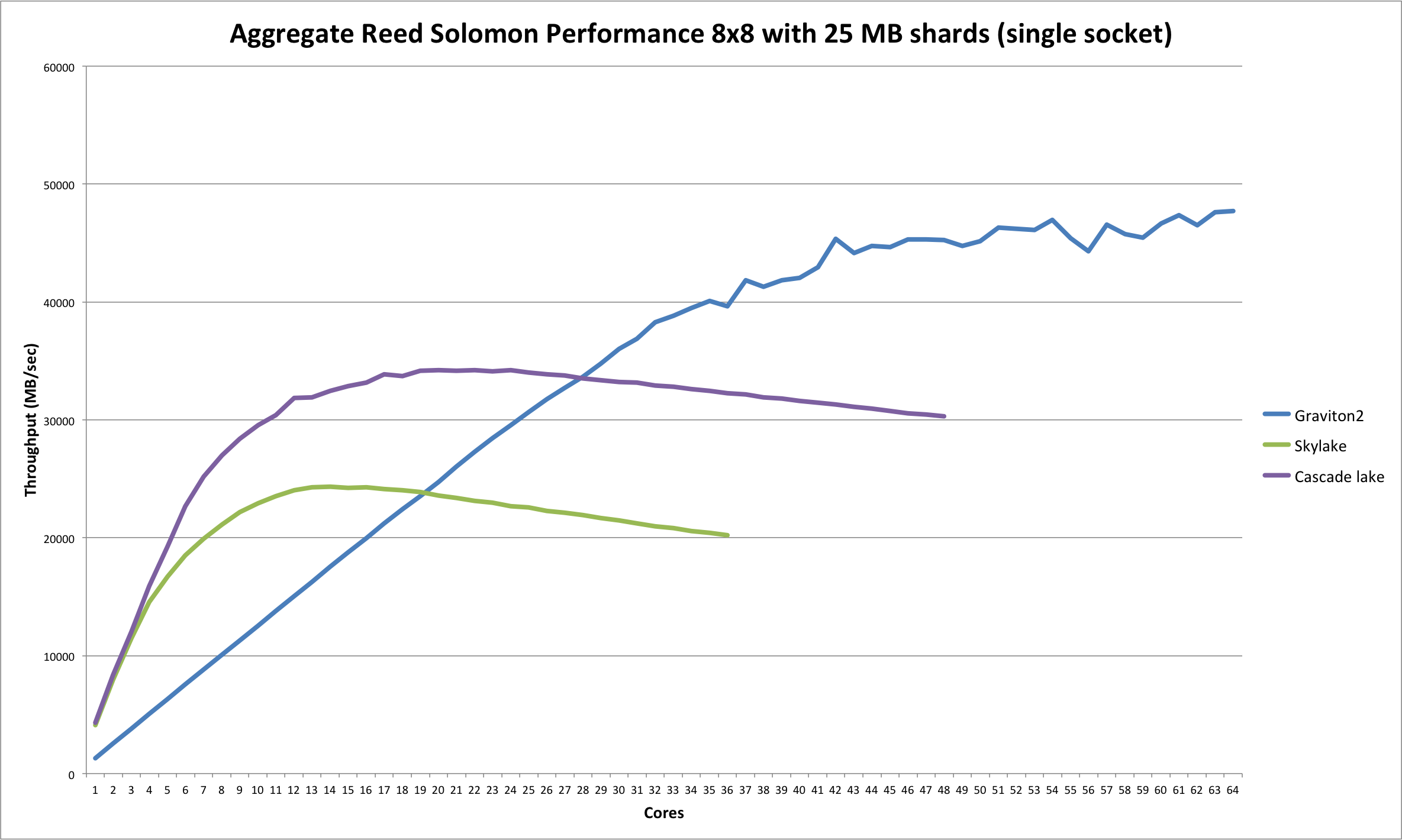
Re:Intel and ARM Performance Characteristics for S3 Compatib... by kllrnohj on Sunday June 07, 2020 @02:32PM (#23449476)
I was looking at the single-socket results for what I said above specifically to rule out any NUMA differences: https://blog.min.io/content/images/2020/06/single-socket-per...

That really looks like it's just sorting by memory bandwidth. Particularly with Cascade Lake's results vs. Skylake at the ~10 core number, since there's not really any other major difference between those two.

Being that memory bandwidth constrained, and then not being NUMA aware, is also quite likely why the dual-socket results are a disaster.

Re:Intel and ARM Performance Characteristics for S3 Compatib... by redis_mlc on Monday June 08, 2020 @01:09AM (#23453744)
> The cross socket NUMA bandwidth is like a tiny straw.

And the Internet is a series of tubes!

Re:Intel and ARM Performance Characteristics for S3 Compatib... by StillBored on Monday June 08, 2020 @09:54AM (#23456482)
How about a ballpark.

The unidirectional bandwidth across a two socket system is roughly equal to a single DDR channel. Which is why you see postings on the intel forums about people complaining about their perf falling off a cliff if the hardware decides to flag the directory as requiring cross socket snoop (or whatever its actually doing). So even if you have done a reasonable job keeping your thread+data locally, doing a remote reference, or accidentally running the thread for a short while on the wrong socket can permanently lower the performance. See https://software.intel.com/en-us/forums/software-tuning-perf... for an example about a contented cache line.

Thankfully the latest products are mostly 10.4GT (gold and above) as it appears intel isn't doing as much product segmentation based on UPI link speeds anymore (silver/bronze are still slower though).

https://www.microway.com/knowledge-center-articles/performan...

Re:Intel and ARM Performance Characteristics for S3 Compatib... by kllrnohj on Monday June 08, 2020 @01:51PM (#23458847)
> The unidirectional bandwidth across a two socket system is roughly equal to a single DDR channel

Depends on the implementation. Epyc Rome's 2P socket design is 64 PCI-E 4.0 lanes between the two CPUs. That's 128 GB/s bandwidth, which is roughly equivalent to 6-channel DDR4 2666.

Re:Intel and ARM Performance Characteristics for S3 Compatib... by StillBored on Monday June 08, 2020 @02:34PM (#23459332)
Yes, I should have been clearer that I was speaking of intel products (which is what the article was talking about) not NUMA in general.
Re:Intel and ARM Performance Characteristics for S3 Compatib... by karavelov on Sunday June 07, 2020 @11:56PM (#23453430)
> So for this particular test the interesting comparison would be against Epyc Rome, which is also 8 channel DDR4-3200 and is up to 64 physical cores.

Some different benchmarks that include the Epyc Rome and Graviton2 instances: https://www.phoronix.com/scan.php?page=article&item=epyc-ec2...

Re:Intel and ARM Performance Characteristics for S3 Compatib... by kllrnohj on Monday June 08, 2020 @01:41PM (#23458747)
Note that AWS seems to only offer up to 48-core Epyc's (96 VCPUs with SMT)
Re:Intel and ARM Performance Characteristics for S3 Compatib... by wolf550e on Sunday June 07, 2020 @09:15PM (#23452640)
Graviton 2 has a lot of memory bandwidth. See here: https://travisdowns.github.io/blog/2020/05/13/intel-zero-opt...
Re:Intel and ARM Performance Characteristics for S3 Compatib... by api on Sunday June 07, 2020 @11:28AM (#23448054)
Yes, and it's sort of apples and oranges for that reason. What it does show is that lots of cores may be much better for this type of work load.
Re:Intel and ARM Performance Characteristics for S3 Compatib... by CalChris on Sunday June 07, 2020 @11:31AM (#23448073)
Graviton isn't Arm IP. It's AWS ne Amazon IP. Amazon is an Arm architecture licensee. That's important because ...

  Arm capitalization:    $  31.6B
  Intel capitalization:  $ 272.4B
  Amazon capitalization: $1240.0B
Amazon can throw an insane amount of money at a problem when the want to.

Edit to add: a good source for how much the Arm IP Graviton2 uses which is more than I thought:

https://www.anandtech.com/show/15578/cloud-clash-amazon-grav...

The DDR4-3200 memory controllers are probably licensed IP.

Re:Intel and ARM Performance Characteristics for S3 Compatib... by baybal2 on Sunday June 07, 2020 @11:37AM (#23448112)
> Amazon can throw an insane amount of money at a problem when the want to.

Take a look on what's happening with Chinese state backed semi companies. Sure surely have money.

See how well the strategy of "just throw $100B on the problem" worked for them.

It didn't. Chipmaking is a harder thing to do than to run cat video websites, or a web hosting business.

Re:Intel and ARM Performance Characteristics for S3 Compatib... by parhamn on Sunday June 07, 2020 @12:08PM (#23448339)
As an outsider, I’d guess the biggest impact is the ability to buy chipmaking talent. That would certainly be easier for the American tech giants, no?
Re:Intel and ARM Performance Characteristics for S3 Compatib... by saagarjha on Sunday June 07, 2020 @12:22PM (#23448433)
Perhaps this might’ve helped? https://en.wikipedia.org/wiki/Annapurna_Labs
Re:Intel and ARM Performance Characteristics for S3 Compatib... by rapsey on Sunday June 07, 2020 @01:38PM (#23449063)
Well to be honest how much of the money was actually well spent and not used to line someones pockets.
Re:Intel and ARM Performance Characteristics for S3 Compatib... by dev_tty01 on Sunday June 07, 2020 @10:23PM (#23452983)
If they spent $350 million to create a strategic advantage for their $35 billion AWS business it is money well spent.
Re:Intel and ARM Performance Characteristics for S3 Compatib... by neximo64 on Sunday June 07, 2020 @12:57PM (#23448700)
All the market capitalisation shows is the closer you are to the customer in the supply chain the more value you can derive.

Also, Market cap isn't cash. Amazon could not recreate Arm despite their market cap.

Re:Intel and ARM Performance Characteristics for S3 Compatib... by rrss on Sunday June 07, 2020 @01:40PM (#23449078)
Graviton 2 uses off the shelf Neoverse N1 cores designed by ARM.

> Amazon is an Arm architecture licensee.

Do you have a source for this, or is this conjecture? As far as I can tell, neither Amazon nor ARM have announced that Amazon has an architecture license.

Re:Intel and ARM Performance Characteristics for S3 Compatib... by pranith on Sunday June 07, 2020 @12:38PM (#23448559)
Graviton2 is using Ares core IP from ARM.