To see the real root of the problem, compare the USA to other western democracies such as in Europe. The structure of society is very different, the nature of poverty, the number of people living as an economic underclass, the acceptance in the USA that poor areas of cities will just be fucked and that's normal, the presence of a never-ending source of ignorant, and often racist, people from small-town America, and the presence of a never-ending source of guns. Of course a lot of the above is related to the lack of a strong belief across the voting population that government should protect and support the poorest in society.
Things won't change in America until the above changes meaningfully. That would require the majority of the population to start thinking more like the liberal half, and there is no reason to think that that will happen any time soon.
This is certainly not limited to the USA and you will readily find it in European democracies as well. A significant portion of French people have long since assumed that the banlieues are hopeless and there is little sense trying to improve them. In Eastern Europe you will find the same attitudes about Roma neighborhoods. Even in the Nordic countries which are held up as models of social equality, one finds the genesis of immigrant-heavy neighborhoods that, local people tell themselves, will forever have the problems that immigrant-heavy neighborhoods stereotypically have.
"According to the Washington thinktank the National Center on Education and the Economy (NCEE), the average student in Singapore is 3.5 years ahead of her US counterpart in maths, 1.5 years ahead in reading and 2.5 in science. Children in countries as diverse as Canada, China, Estonia, Germany, Finland, Netherland, New Zealand and Singapore consistently outrank their US counterparts on the basics of education."
https://www.theguardian.com/us-news/2018/sep/07/us-education...
All this means that it isn't really evident that money doesn't translate into better results. It isn't strictly funding, that is true - poverty seriously affects how well students can perform, for example - but it should be quite obvious that a school that cannot afford maintenance, proper computers for students to learn on, or enough staff so that classes are a manageable size can't really teach as well as a moderately funded school.
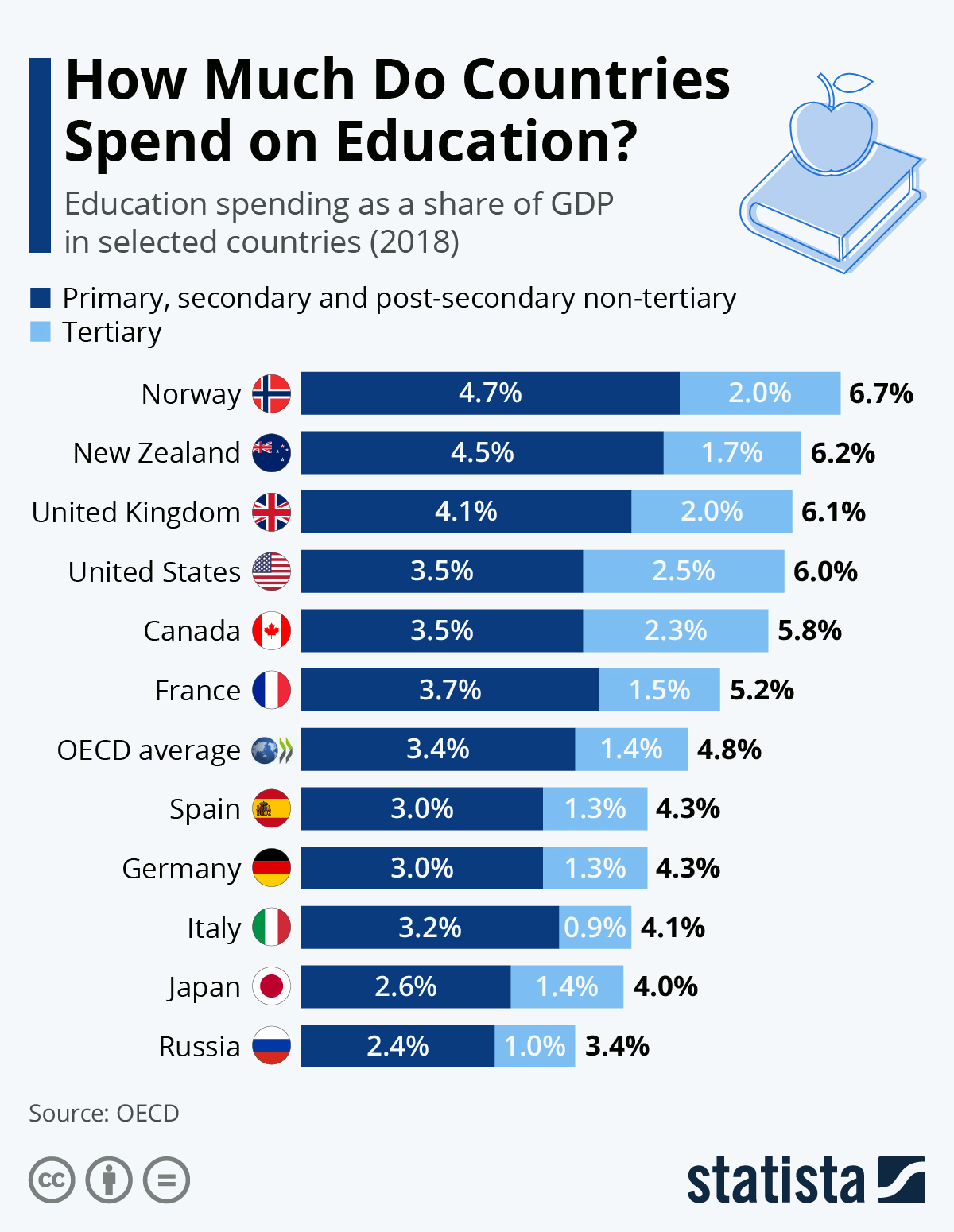
Some of the worst cities have the beat funded schools. Minneapolis spends as much per student as Switzerland. Baltimore spends more, and spends as much of more than the rich suburban schools around it. The US also has relatively low rates or private K-12 compared to the Scandinavian countries, the Netherlands, Belgium, etc.
It's the root of many of our problems.