News for hackers. Stuff that matters.
Re:5/3nm Wars Begin by seshagiric on Saturday January 25, 2020 @01:11PM (#22147608)
To quote Intel CEO Robert Swan (on CNBC); the Moore's law is going to come back live in the 5/3nm Fab capabilities. Intel is at 11nm, aiming for 7nm. Whereas Texas Instruments is going for 5nm. Per Robert, they had lot of learnings from 11nm to 7nm but expect the move to 5/3nm much faster.
Re:5/3nm Wars Begin by marvy on Saturday January 25, 2020 @01:29PM (#22147727)
But realistically it can't go on much longer, right? The diameter of a silicon atom is like 0.21 nanometers, so we're almost within an order of magnitude from rock bottom, right? I don't actually know anything about this stuff so I could be hopelessly confused, but that's my impression.
Re:5/3nm Wars Begin by PaulHoule on Saturday January 25, 2020 @01:57PM (#22147902)
Past that, it is various forms of chiplets, 3-d stacking, high bandwidth memory to intensify densification at some cost.

In the wings there are a few semiconductor materials, from Si-Ge to In-P and Ga-A and Ga-N that are used in optical transceivers, cell phone base stations, power electronics, and military electronics. Silicon is a good, not great superconductor, and it dominates because we are good at making things out of Silicon.

An In-P microprocessor as complex as a 6502 should be able to clock upwards of 80 GHz and could run with a fully populated address space of static RAM on the chip and be able to react to fast events in real time like nothing else.

Such a chip would replace 16 5GHz cores for more mainstream computation, so if cost gaps narrowed, the In-P part might compete with a Si part in a complex chiplet architecture. (e.g. the In-P chip can be built at 1/16 the density of the Si chip and not have all this multiple-patterning and lasers trouble that Si is getting into)

Re:5/3nm Wars Begin by hpcjoe on Saturday January 25, 2020 @03:52PM (#22148551)
Hmm ... I wrote my Ph.D. thesis on low temperature grown III-V material (GaAs to be precise) and studied InGaAs, and other variations.

GaAs would make for awesome switching systems, as it is a direct bandgap semiconductor, as opposed to Silicon, which requires phonon mediation. While this is a tremendous technological advantage, you have that minor problem of fabrication.

For GaAs, you need ~5 atmospheres of As gas at 550C. Not something anyone wants in their backyard, for good reason.

For InP, you need to worry about your supply of rare earth (In) elements, and all the surrounding tech needed to grow ingots of an appropriate orientation material for InP. You have to worry about the role of defects (which is what I simulated), how to dope, how to build structures.

Its not simply that it is technologically better, its that there is a whole massive ecosystem around Silicon, that for better or worse, pretty much guarantees that we are going to be running silicon based units for a long ... long time.

The joke, and there was one when I was in grad school, about GaAs and other non-Si materials was, they are the materials of the future. And always will be.

Re:5/3nm Wars Begin by davidivadavid on Saturday January 25, 2020 @04:06PM (#22148612)
How do industries typically break out of that kind of path dependence?
Re:5/3nm Wars Begin by AnimalMuppet on Saturday January 25, 2020 @07:52PM (#22149665)
First, it's not really a path dependency. Silicon is easier to work with than gallium arsenide, not just because we have more practice. We have more practice because it's easier.

How do we break out? By gallium arsenide offering enough more than silicon does to be worth the effort. So far, that hasn't happened. It may never, except for small niches.

Re:5/3nm Wars Begin by vardump on Saturday January 25, 2020 @02:33PM (#22148131)
> An In-P microprocessor as complex as a 6502 should be able to clock upwards of 80 GHz and could run with a fully populated address space of static RAM on the chip and be able to react to fast events in real time like nothing else.

> Such a chip would replace 16 5GHz cores for more mainstream computation,...

80 GHz 6502 would be about as fast as... 1 GHz x86 in integer operations, and even that is being generous.

Floating point would be several orders of magnitude worse than even that.

Typical X86 can do 64 8-bit SIMD operations per clock, 2x AVX2 instructions retired in a single clock cycle. At over 4 GHz.

But it'd sure be a beast in real-time applications... assuming signal integrity is a solvable problem.

Re:5/3nm Wars Begin by Dylan16807 on Saturday January 25, 2020 @02:46PM (#22148220)
> But it'd sure be a beast in real-time applications... assuming signal integrity is a solvable problem.

I'd be skeptical about whether it beats an FPGA.

Re:5/3nm Wars Begin by monocasa on Saturday January 25, 2020 @03:22PM (#22148415)
The idea is pretty closely correlated to the really high end cadence style hardware emulators. Those tend to be made out of a sea of tiny ascetic processors that only know logic ops rather than LUTs, AFAIK.

So it would seem they beat FPGAs in some niches.

I question the 80ghz number given by the grandparent though. Looking at visual 6502 you're not going to get a order of better magnitude fanout on that design.

Re:5/3nm Wars Begin by Dylan16807 on Saturday January 25, 2020 @05:27PM (#22149001)
> Looking at visual 6502 you're not going to get a order of better magnitude fanout on that design.

Better fanout than what?

The most useful thing I could find was this old article, but it certainly suggests that the room is there to expand: https://spectrum.ieee.org/semiconductors/materials/indium-ph...

Re:5/3nm Wars Begin by vardump on Saturday January 25, 2020 @03:09PM (#22148347)
Agreed, FPGA would be my go-to solution as well. Although FPGAs certainly can't touch gigahertz+ range yet. Even 500 MHz is... challenging.
Re:5/3nm Wars Begin by LargoLasskhyfv on Sunday January 26, 2020 @12:31PM (#22153335)
There has been the Achronix Speedster 22i HP(high performance), which was said to reach 1Ghz, produced by Intel at 22nm. That is now out of production, it seems.

I am angry for not having bought at least the 22i HD(high density) development kit, when it was available for 999USD for a time. But the software license was only valid for a year, so no-go.

They now offer embeddable FPGA IP cores targetting 750Mhz on TSMCs 7,12&16nm process.

And 'normal' FPGAs, the Speedster 7t, manufactured by TSMC at 7nm, also 750Mhz fmax.

All rather expensive and out of reach for the hobbyist :-(

Re:5/3nm Wars Begin by Dylan16807 on Saturday January 25, 2020 @05:19PM (#22148969)
> Although FPGAs certainly can't touch gigahertz+ range yet. Even 500 MHz is... challenging.

It's a relative difference though, that depends on what material you're building the circuit in. If you can build an FPGA to run at 1/10th the speed of a 6502, then with a sufficiently expensive process you get a tradeoff between a very weak 80GHz processor and a customizable 8GHz circuit.

Re:5/3nm Wars Begin by Dylan16807 on Saturday January 25, 2020 @02:41PM (#22148176)
A 6502 needs two and a half cycles per instruction, on top of a weak instruction set. The frequencies don't compare to a modern core. What really matters is the transistor speed, which does have the potential to be an order of magnitude faster, but nobody's going to be making 8 bit processors out of it.
Re:5/3nm Wars Begin by imtringued on Saturday January 25, 2020 @08:01PM (#22149703)
That has nothing to do with Moore's Law which is about the number of transistors on a chip. The process nodes are named so that halving the size of process node will result in increasing the number of transistors by 4x within the same area.

The problem with measuring physical features of a transistor is that once you change the design of the transistor multiple times [0] it no longer becomes meaningful to measure one specific dimension. As you can see the gate size barely changes but the transistor count keeps increasing drastically.

[0] https://www.hwsw.hu/kepek/hirek/2017/03/planar_finfet_gaa.jp...
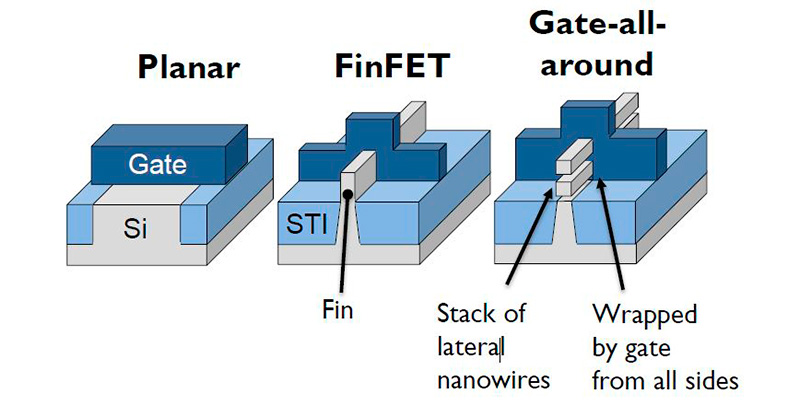
Re:5/3nm Wars Begin by stefan_ on Saturday January 25, 2020 @01:50PM (#22147863)
Remember this nm number has nothing at all to do with physics and is now purely a marketing term.
Re:5/3nm Wars Begin by Dylan16807 on Saturday January 25, 2020 @02:20PM (#22148042)
Not nothing. The sizes of various aspects of the process are still roughly correlated with the number, even if they're 2x or 3x that size.
Re:5/3nm Wars Begin by mcchew on Saturday January 25, 2020 @01:53PM (#22147881)
Can you clarify? I thought the number was still the length of the transistor.
Re:5/3nm Wars Begin by variaga on Saturday January 25, 2020 @02:07PM (#22147967)
For processes >= 40nm, the number is the gate length of the transistor. For smaller processes, the number is (approximately) the equivalent gate length that would result in the same transistor density (transistors per mm^2) as if the gate length had been reduced to that size, assuming everything else was scaled proportionately.

The trick is, not everything else scaled proportionately. The gate lengths (mostly) stopped shrinking at around 34nm but other things kept shrinking, so the overall transistor density kept going up.

(And that assumes planar transistors. Things like FinFET or nanowire which make the transistor structure 3d instead of 2d further disconnect the gate length from the achievable density.)

Re:5/3nm Wars Begin by judge2020 on Saturday January 25, 2020 @02:00PM (#22147921)
https://en.wikichip.org/wiki/technology_node

> Historically, the process node name referred to a number of different features of a transistor including the gate length as well as M1 half-pitch. Most recently, due to various marketing and discrepancies among foundries, the number itself has lost the exact meaning it once held. Recent technology nodes such as 22 nm, 16 nm, 14 nm, and 10 nm refer purely to a specific generation of chips made in a particular technology. It does not correspond to any gate length or half pitch. Nevertheless, the name convention has stuck and it's what the leading foundries call their nodes.

Re:5/3nm Wars Begin by agumonkey on Saturday January 25, 2020 @01:48PM (#22147845)
Who knows, maybe work at 5/3nm will give people new ideas.
Re:5/3nm Wars Begin by cedivad on Saturday January 25, 2020 @01:40PM (#22147800)
TI is aiming for 5nm?
Re:5/3nm Wars Begin by monocasa on Saturday January 25, 2020 @03:25PM (#22148434)
Not sure why you're being downvoted; I only know of Intel, TSMC, and Samsung attempting to hit 5nm.

https://en.wikichip.org/wiki/5_nm_lithography_process

Re:5/3nm Wars Begin by staffanj on Saturday January 25, 2020 @02:15PM (#22148020)
Did you mean TSMC?