Dr. Collins said he was unaware of any credible research on which Dr. Watson’s “profoundly unfortunate" statement would be based.' [0]
I think this video [1], does a good job of attacking a lot of race science and intelligence, though at 2.5 hours long it may be a bit too thorough.
[0] https://www.nytimes.com/2019/01/01/science/watson-dna-geneti...
[1] https://www.youtube.com/watch?v=UBc7qBS1Ujo
edited for formatting
"In the current study, EQCA experts wereasked what percentage of the US Black-White differences in IQ is, in their view, due to environment or genes. In general, EQCA experts gave a 50–50 (50% genes, 50% environment) response with a slight tilt to the environmental position (51% vs. 49%; Table 3). When EQCA experts were classified into discrete categories (genetic, environmental, or 50–50), 40% favored an environmental position, 43% a genetic position, and 17% assumed 50–50." - https://doi.org/10.1016/j.intell.2019.101406
> I think this video [1], does a good job of attacking a lot of race science and intelligence
'Attacking' is a good description, as the author of that video went to great lengths to mislead. For example, he says the author of The Bell Curve doesn't understand what 'hereditary' means. But the definition the video author gives for 'hereditary', and the definition given in the book he's reviewing, match almost perfectly. So how did he come to that conclusion? He went out of his way to find a live interview where the book author fumbled his answer, instead of giving the definition from the book he's reviewing, or as you more accurately put it, attacking.
"There was little to no support for separate subgroup norms for different racial, ethnic, or social groups or for people with different nationalities (natives vs. immigrants), with the percentage of experts favoring separate norms below 25%.
There was no clear position among experts regarding environmental and genetic factors in the US Black-White difference in intelligence."
Maybe Dr. Collins rubs shoulders with experts other than those surveyed here, who knows.
Looking at the SD in the survey responses suggests that the position of the researchers polled in this survey wasn't accurately represented by the quote you posted.
The example you use to critique the video I posted is also not very generous, and is a pretty lame rebuttal to what was a very extensive attack on the ideas presented in "The Bell Curve". Do you have any critiques on the more relevant points that the video actually makes? E.g. what is intelligence anyway and how can it be measured, if at all? Or, presuming that IQ is an accurate measure of intelligence, then how to square the supposition the Bell Curve makes about an idiocracy-style drop in IQ points with the Flynn effect?
Another relevant question is what exactly is the scientific support for "race" as anything other than a meaningless label[0]? For example, in the interview of Charles Murray conducted by Sam Harris for his podcast, Murray used Barack Obama as an example of a typical black man, saying that, and I'm paraphrasing, even supposing that there is a difference in IQ between the races, it wouldn't justify denying a job to someone like Barack Obama if he came in applying for one. But, like, why is Obama black and not white? Have you seen a picture of Obama's mom? She's the whitest white lady from Kansas. I was recently working on some cancer project and I had a spreadsheet of the subjects' self-reported race, as well as genetic ancestry results showing the percentage of African ancestry and European ancestry. Some of the respondents who self-reported as African American had 97% European ancestry.
[0] https://www.nationalgeographic.com/magazine/2018/04/race-gen...
There's one or two charts in the article, showing how many experts believe the IQ gap is 0% genetic, how many believe it's 10%, and so on, up to 100%. There's a large spike at 0%, then a noisy, mostly equal distribution up to 100%, where it drops back down to near zero - i.e. almost no hereditarian believes environment plays no role. So yes, there's no consensus, but the view that IQ is hereditary is well represented among experts - moreso than the opposite.
The Flynn effect disproves nothing, much like the increasing average height doesn't imply height isn't heritable. As I don't believe IQ is 100% determined by genes, there's any number of explanations that are consistent with heritable intelligence - changes in culture, environment, upbringing, nutrition, air quality, levels of athleticism, etc. For example:
"Similarly, researchers have shown that differences in the ways boys and girls spend their time (e.g., playing with Legos) (Bornstein et al., 1999), toy selection (Goldstein, 1994), and computer videogame experience (Quaiser-Pohl et al., 2006) are responsible for differences in their spatial abilities, also loaded on g."
> The example you use to critique the video I posted is also not very generous
The example was to show the video author was being deliberately misleading, going out of his way to hide data that opposes his conclusion. Meaning everything else in the video is probably similarly cherry-picked.
> what is intelligence anyway and how can it be measured, if at all?
I don't see how minor fuzzyness in the definition of intelligence casts any doubt on clearly defined IQ scores, especially when IQ has been shown to be such a useful and important measure - IQ is very predictive for success at other tasks also considered to require intelligence, such as academic achievement - this is referred to as being g-loaded. Moreover, the more g-loaded a test is, the more heritable performance on it is [2].
> Another relevant question is what exactly is the scientific support for "race" as anything other than a meaningless label[0]?
Race is simply how closely related people are, at a very coarse level, where clusters correspond to races. See this post: https://news.ycombinator.com/item?id=22052174
[1] https://www.cato-unbound.org/2007/11/13/stephen-j-ceci/signi...
The HN post you referred to supporting the idea of "race" included a link to a paper [0] where these are the final 2 lines of the abstract: "Respondents educated in Western Europe, physical anthropologists, and middle-aged persons reject race more frequently than respondents educated in Eastern Europe, people in other branches of science, and those from both younger and older generations. The survey shows that the views of anthropologists on race are sociopolitically (ideologically) influenced and highly dependent on education."
I wouldn't call that scientific support for the notion of race as a meaningful category.
Ever since the idea of "white" people was invented, groups which have at one time or another been considered non-white include the Germans, Greeks, white Hispanics, Arabs, Iranians, Afghans, Irish, Italians, Jews, Slavs and Spaniards. [1][2]
I agree with you about the video I linked to cherry picking that quote from Murray about heritability. That section was taken from a critique [3] of The Bell Curve, and the paragraph it was pulled from ends with this: "The Bell Curve itself does not make these embarrassing mistakes. Herrnstein, the late co-author, was a professional on these topics. But the upshot of part of this essay is that the book's main argument depends for some of its persuasive force on a more subtle conflation of heritability and genetic determination. And Murray's confusion serves to underscore just how difficult these concepts can be, even for someone so numerate as Murray."
It doesn't seem like we will be convincing each other of anything here. For me, it's just about impossible to be schooled on the history of America and the incredible multifaceted assault on people that aren't white, which is still very much ongoing, and then argue that there's any way to say that there isn't an overwhelming environmental cause for disparities in socioeconomic status/IQ/incarcaration rates/etc between blacks and whites. Just falling back on ockham's razor, which seems more likely:
A - After humans migrated out of Africa and spread out over the globe, there was selection for genes that generated differing amounts of melanin in reaction to different amounts of sunlight at different latitudes. For some reason, genes linked with intelligence shifted as well so that there is now a strong correlation between skin pigmentation levels and intelligence despite a lack of any obvious reason for these things to be linked.
or
B - Africans, being better adept at surviving the malarial load of the new world due to a genetic predisposition [4] were recruited en masse for the trans-atlantic slave trade. The people running this slave trade, having at least a modicum of morality and most likely Christian, invented a theory of race that placed Africans below Europeans so that it became less morally repugnant to maintain the chattel slavery system. This theory of race pitted all of the poor people against each other, allowing people in power to maintain their positions. This theory of race also allowed for a prolonged (and ongoing) withholding of resources from an entire population of people (defined by having dark skin), and this deprivation is having a direct effect on the success of dark-skinned people in many different measurements.
For me, it's B all the way.
[0] https://researchers.mq.edu.au/en/publications/current-views-...
[1] https://en.wikipedia.org/wiki/White_people#United_States
[2] https://digitalcommons.law.yale.edu/ylj/vol109/iss4/4/
[3] https://www.nyu.edu/gsas/dept/philo/faculty/block/papers/Her...
[4] https://www.nps.gov/ethnography/aah/aaheritage/lowCountry_fu...
No no no - the spike is not at "very low", but at zero. While the people that believe there's some genetic influence, are about evenly distributed between thinking that influence is anywhere from 10% to 90%. In total, more believe there's some influence than zero influence.
> I wouldn't call that scientific support for the notion of race as a meaningful category.
Neither is it a consensus debunking it. And what the idea used to be is irrelevant to the current understanding.
> argue that there's any way to say that there isn't an overwhelming environmental cause for disparities in socioeconomic status/IQ/incarcaration rates/etc between blacks and whites.
But I never argued that. A and B aren't mutually exclusive.
As for Occam's razor, well, claiming that of all the genetic distance caused by geographical separation for tens of millenia, none of it affects intelligence or personality - that just doesn't seem very likely to me. It's not the case for dogs [1], why should it be for humans?
[1] https://www.psychologytoday.com/us/blog/canine-corner/201304...
Watson wasn't crucified, or anything remotely analogous to it, his comments weren't particularly reasonable, and even his own near immediate apology explicitly noted that there was no scientific basis for them. (Though he has since returned to repeating them; the whole thing is weird since at the time he first made them, there was a very recent piece of work which could have been cited as support for the geography/IQ link he suggested, but in between then and the time he went back to issuing them that work had been torn apart for gross methodological errors, including deliberately excluding data to fit the intended conclusion.)
> Stripped of a Nobel prize for suggesting that two and two may equal four.
He wasn't stripped of a Nobel prize, and he absolutely wasn't suggesting two plus two may equal four; he made an at best thinly supported claim about geography and IQ combined with a completely unsubstantiated claim about the premises of development policy toward Africa, and drew a dire conclusion from that combination.
[0] - https://www.telegraph.co.uk/news/science/11261872/James-Wats...
[0] https://www.theguardian.com/science/2014/dec/09/russian-bill...
This isn’t true. Ashkenazi Jews and East Asians have higher IQ scores than whites. Male and female scores on IQ tests are identical by construction. They have different scores on the component sub tests.
http://www1.udel.edu/educ/gottfredson/reprints/1997mainstrea...
Mainstream Science on Intelligence: An Editorial With 52 Signatories, History, and Bibliography
Since the publication of “The Bell Curve,” many commentators have offered opinions about human intelligence that misstate cur- rent scientific evidence. Some conclusions dismissed in the media as discredited are ac- tually firmly supported. This statement outlines conclusions re- garded as mainstream among researchers on intelligence, in particular, on the nature, ori- gins, and practical consequences of individu- al and group differences in intelligence. Its aim is to promote more reasoned discussion of the vexing phenomenon that the research has revealed in recent decades. The follow- ing conclusions are fully described in the major textbooks, professional journals and encyclopedias in intelligence.
1. https://www-scientificamerican-com/article/race-is-a-social-...
[1] https://commons.wikimedia.org/wiki/Category:Principal_compon...
[2] https://commons.wikimedia.org/wiki/File:Individual-level_hum...

[3] https://commons.wikimedia.org/wiki/File:3D_PCA_plot_of_Xavan...

[4] http://sci-hub.tw/10.1111/j.1548-1433.2009.01076.x
[5] https://lesacreduprintemps19.files.wordpress.com/2011/07/on-...
Also, The original claim was:
> Every result ever has pointed that all races and genders are..
If you muddy the water wrt race, it invalidates the above claim also.
But it's become an unfortunate pattern that when people bring up the difference in scores, other people (like you) presume that mentioning the correlation data itself is akin to arguing that they are caused by genetic factors, and then attack them for not mentioning the environmental factors.
You are too predictable. You just did exactly the behavior I criticized, in response to my critique!
Really? The strongest rebuttals I ever saw boiled down to "it has not yet been conclusively proven impossible that all races are equally intelligent". Large meta-analyses certainly always find correlation, this one goes a long way towards showing there is causation as well: https://doi.org/10.1111%2Fj.1467-9280.2006.01803.x
No legitimate study has actually shown that such correlations are caused by genetic factors. However, numerous studies have shown that social factors (i.e. not having access to good schools, not having access to decent healthcare, etc, which statistically and historically correspond with racial divisions) play a major role.
No matter what the data is, you can always construct some convoluted theory by which ancestry doesn't play a role, just like you can keep adding spheres to make a geocentric solar system work.
[1] http://www.jbhe.com/latest/news/1-22-09/satracialgapfigure.g...
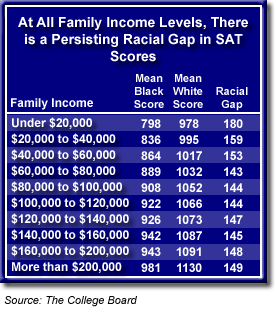
[2] https://en.wikipedia.org/wiki/Minnesota_Transracial_Adoption...
For example, if you are, say, a Christian and some other guy is a Muslim and your offended by that belief, well, that's on you. It shouldn't discredit a scientific theory. Evidence is supposed to do that.
And worse, they're thinking they're not racist because they think they have scientific backing for their beliefs..
If you disagree, show your reasoning, or your credentials.
You know what, who cares if Watson was a flaming racist? He has done more than almost any other person to save the lives of millions of Africans but he makes one opinion about intelligence and hes slagged off and completely discredited?
Cancel culture has been in science a lot longer than people know.
Everyone is aware of Watson's contributions (though there is of course ample evidence that he stole a lot of the work from Rosalind Franklin and gave her no credit for it, then said things like "of course Franklin couldn't envision the structure of DNA because jewish women can't see in 3D - he said this in front of a preeminent female jewish structural biologist too). The discredit isn't against his scientific achievements, it's against his racist-ass opinions. That's why people don't invite him to talks much anymore, because he just goes and says made up racist shit.
How?
On the contrary, when some facts put a positive light on certain groups (for instance the better maximal physical performance) there is magically no taboo about it at all, and no pressure groups asking for "affirmation action".
Either way, as far as I know, biologist haven't really considered human races to be biologically meaningful category for quite some time now opting clines[1] which are not discrete, but gradual genetic variations over geographic areas, nor does it follow the traditionally defined racial lines. This is why I'm quite suspicious of people pushing so called “race science” as AFAIK it simply doesn't seem to have evidence behind it, rather, it seems to have specific political viewpoints behind it generally.
[1] https://bmcgenet.biomedcentral.com/articles/10.1186/1471-215...
Developing a set of ancestry-sensitive DNA markers reflecting continental origins of humans
By means of our pairwise population FST ranking approach we identified a set of 47 SNPs that could serve as a panel of ASMs at a continental level.
[2] https://www.researchgate.net/profile/Kenneth_Kidd/publicatio...
Implications of biogeography of human populations for ‘race’ and medicine
In this review, we focus on the biogeographical distribution of genetic variation and address whether or not populations cluster according to the popular concept of ‘race’. We show that racial classifications are inadequate descriptors of the distribution of genetic variation in our species. Although populations do cluster by broad geographic regions, which generally correspond to socially recognized races, the distribution of genetic variation is quasicontinuous in clinal patterns related to geography. The broad global pattern reflects the accumulation of genetic drift associated with a recent African origin of modern humans, followed by expansion out of Africa and across the rest of the globe. Because disease genes may be geographically restricted due to mutation, genetic drift, migration and natural selection, knowledge of individual ancestry will be important for biomedical studies. Identifiers based on race will often be insufficient.
Actually, it's often worse than nothing. Even assuming that "race" is entirely genetic and not a social construct, fitness in society changes so rapidly, that no genetics can properly account for it.
A day laborer born in the 1950s U.S. a genetically perfect fit for mining coal, might have had a great deal of success for the first 20 years of their career, and then a poor outcome for the last 10 years. Nothing changed with their genetics, they just became less desirable within society based on social trends.
Genetic changes take generations, often dozens of generations, to realize any noticeable difference. Social changes often occur in years and sometimes months, far faster.
Therefore, any conclusions based on genetics that fail to consider how the genetics fall within society are missing most of the point.
You're right, it rigorously shows how well you will do on IQ tests. That's a real useful metric, now isn't it?
> This is often disputed by impulsively triggered non-experts browsing chat forums, but not by serious academics.
This is often upheld by people with latent fascist sentimentalities that there is some genetical component that makes one group superior to the other.
Surely IQ is measuring something useful if it correlates so well with things like job performance, school performance, income, and crime? https://en.wikipedia.org/wiki/Intelligence_quotient#Social_c...
It might be just correlating to zip code. We know poorer neighborhoods in the US have vastly higher rates of lead which has negative effects against IQ and violence. I've seen far more evidence against the concept of a general intelligence than for.
YOU tell me how any of these bold and outlandish claims are actually based on sound research and logic.
Your claim is simply a just-so statement. You're the one making an unjustified assumption. Why should I assume you're correct by default? Until you actually provide any plausible reason why I should take it seriously, your claim is invalid.
The impetus is on _you_.
Also, from the contents of these very same wikipedia articles: https://en.wikipedia.org/wiki/IQ_and_the_Wealth_of_Nations#R... https://en.wikipedia.org/wiki/IQ_and_Global_Inequality#Recep...
> Several negative reviews of the book have been published in the scholarly literature. Susan Barnett and Wendy Williams wrote that "we see an edifice built on layer upon layer of arbitrary assumptions and selective data manipulation. The data on which the entire book is based are of questionable validity and are used in ways that cannot be justified." They also wrote that cross country comparisons are "virtually meaningless."[4]
> Richardson (2004) argued, citing the Flynn effect as the best evidence, that Lynn has the causal connection backwards and suggested that "the average IQ of a population is simply an index of the size of its middle class, both of which are results of industrial development". The review concludes that "This is not so much science, then, as a social crusade."[3]
> In a book review for the Journal of Economic Literature, Thomas Nechyba wrote that "such sweeping conclusions based on relatively weak statistical evidence and dubious presumptions seem misguided at best and quite dangerous if taken seriously. It is therefore difficult to find much to recommend in this book."[6]
> The methods of the study were criticized by Richard E. Nisbett for relying on small and haphazard samples and for ignoring data that did not support the conclusions.[10]
> University of Reading geographer Stephen Morse also criticized the book (as well as IQ and the Wealth of Nations), arguing that the authors' hypothesis rests on "serious flaws". Morse also argued: "The central dilemma of the Lynn and Vanhanen case rests with their assumption that national IQ data are primarily (not wholly) a function of innate ability, which in turn is at least partly generated by genes. There are many assumptions of cause–effect in here, and some of them involve substantial leaps of faith."[11]
> Evolutionary biologist Satoshi Kanazawa claimed in 2008 to have found support for Lynn's theories.[10] Kanazawa's study has been criticized for using the Pythagorean theorem to estimate geographic distance, despite the fact that this theorem only applies to flat surfaces and the Earth's surface is roughly spherical. Other problems identified in this study include that Kanazawa incorrectly assumed that individuals migrated from Africa to other continents migrated as the crow flies, and ignored that geographic distance and evolutionary novelty do not always correspond to each other.[11]
> Earl Hunt cited Lynn and Vanhanen's work as an example of scientists going far beyond the empirical support to make controversial policy recommendations, and as such as examples of irresponsible uses of science. Hunt argues that in their argumentation they both made the basic mistake of assigning causality to a correlation without evidence, and that they made "staggeringly low" estimates of Sub-Saharan African IQs based on highly problematic data. He considers that by their negligence of observing good scientific practice Lynn and Vanhanen are not living up to the basic responsibility of scientists to make sure that their results can function as reasonable empirical support for policy decisions.[19]
> There's a lot of emotional hysterical screeching accusations of "racism" but those aren't valid arguments.
This is simply not true. I'm arguing that your claim is not based on solid rational foundations. You are the one throwing around irrational accusations, not me.
And nobody denies it. Yet plenty would ask to what extent and how has nutrition, education (notably during development), and other environmental factors have been factored in trying to draw conclusions from that.
India for example tends to score lower and that despite no lack of genetic intermingling with surrounding areas yet should anyone trying to find a cause not consider for example iodine deficiency which is more common there?
https://news.ycombinator.com/item?id=21253289
”Superior IQs associated with mental and physical disorders, research suggests”
That rings true with observations I've made of high-IQ types, myself possibly included - I've generally done well on intelligence tests and with some types of intellectual endeavours, but that hasn't translated to life success, and I've suffered a lot of physiological (including neurological) illness. I've observed this pattern in plenty of others.
Indeed. This study is complete bullshit: https://www.gwern.net/SMPY#fn1
It contradicts every (non-self-selected) longitudinal or cross-sectional study, including far more elite samples (which if their theory was correct would show vastly more dysfunctionality, except of course it isn't and those samples don't), and every genetic study as well, and the reported (self-diagnosis) rates are often orders of magnitude larger than any risk factor ever confirmed and literally unbelievable. Incidentally, Hambrick's writeup here is also quite bad. Aside from failing to mention all of those reasons why it's BS, he doesn't describe accurately the research he does mention. Consider this paragraph from the end: > All the same, Karpinski and her colleagues’ findings set the stage for research that promises to shed new light on the link between intelligence and health. One possibility is that associations between intelligence and health outcomes reflect pleiotropy, which occurs when a gene influences seemingly unrelated traits. There is already some evidence to suggest that this is the case. In a 2015 study, Rosalind Arden and her colleagues concluded that the association between IQ and longevity is mostly explained by genetic factors. How did he miss the fact that the Arden study in question shows, as all such studies show, that intelligence correlates with greater lifespan/longevity when he's written an entire credulous column about how intelligence is bad for you and makes people crazy and increases the rate of mental disorders (some of which, like schizophrenia, reduce your life expectancy by decades)? It's right there in the abstract, it's not hidden away. One would think that would at least merit a brief pause to puzzle over the discrepancy...
Also, Gwern's refutation doesn't cite a conclusive study that either links IQ/intelligence to genetic coding, or positively correlates IQ/intelligence with physiological health.
Another Scientific American article references several different studies that link brain/body impairments with enhanced cognition [1].
And we can easily see that several people generally accepted as being among the most intelligent in history – e.g., Hawking, Einstein, Tesla and Nietzsche – experienced debilitating physiological illness for much of their lives.
I'm well aware that none of this is conclusive; it's a hugely complex topic, with a lot of different evidence pointing in different directions, and the evidence one will embrace will likely be influenced more by their pre-established position than anything cited in this discussion.
For what it's worth, I had previously accepted the genetic-deterministic view of intelligence and general life outcomes, but can no longer do so after researching the topic deeply over many years. I do accept heritability has a strong influence, but I don't accept that it's limited to genetics, or that the effects are immutable.
[1] https://blogs.scientificamerican.com/guest-blog/transcending...
The asthma one may be correct (and probably due to the hygiene hypothesis, and for the same reason as myopia). SMPY and others have reported that one. It has nothing, however, to do with their theories about hyperactive brains or intelligence being a bad thing. And are also quite minor and tradeoffs we willingly make.
> Also, Gwern's refutation doesn't cite a conclusive study that either links IQ/intelligence to genetic coding, or positively correlates IQ/intelligence with physiological health.
Because there is zero need to do so, as even Karpinski et al admit that there is overwhelming evidence associating intelligence with health in the normal range (you say you researched this topic deeply...?); that's why they need to postulate a U-curve which tucks away all of the negative effects in the top percentile which stuff like population registry studies can't look at in order to save the appearances.
> Another Scientific American article references several different studies that link brain/body impairments with enhanced cognition [1].
No. They link artistic obsession and savant syndromes. These are not exactly what people think of as 'enhanced cognition'. No one is being whacked on the head and waking up able to do quantum mechanics, compose a symphony, run a marathon etc. They are changed in narrow specific ways, often at the cost of other things.
I may not have read all the same papers as you (just as you haven't read everything I've read), but I have read a wide range of material, and have been undertaking a several-years-long self-experiment on the links between physiology, cognition, and other factors including nutrition, toxicity and trauma. I am interested in the role of genetics too, and I'm open-minded about all of it.
In no sense do I claim my knowledge to be exhaustive, but I don't think I can be accused of approaching the topic without sincerity or dedication.
> The asthma one may be correct (and probably due to the hygiene hypothesis, and for the same reason as myopia)
Can you provide links elaborating on that topic so I can learn more about the basis of those assumptions?
> They are changed in narrow specific ways, often at the cost of other things.
I'm not sure how that contradicts anything I've said. The notion that such trade-offs exist is fairly central to my understanding of these things.
To be clear, the claim I'm questioning is that IQ-measured intelligence is genetically determined and immutable (and correlated with race), and I'm pointing out one example of evidence that factors other than genetics also seem relevant, sometimes in surprising ways.
There are of course plenty of other factors, including but not limited to nutrition, toxicity and trauma.
If you don't have any significant disagreement with the last two paragraphs then we don't have any quarrel.
If you do, I'd welcome links providing opposing evidence.
Look: all of these things, like high IQ correlating positively (and not negatively) with health are well established in the field, starting over a century ago with Terman. If you really had investigated these things as extensively and diligently as you claim, you would not need to ask me for links, and you would not respond to my mention of specific very well-known paradigms by asking for links. You need links on the hygiene hypothesis or on the standard light-based theories of myopia...? Assuming you had somehow never heard of these, you are unable to search for it yourself? Really?
No, I'm not going to waste my time digging up 101-level references for you; if you want to debate on these topics, get yourself up to speed so you understand the basics like why Karspinski et al do not dare to attempt to claim ill-health in the normal range and claim it's only at the extremes, and you know all the things that they leave out but everyone in the field knows perfectly well which is why they regard Karpinksi as steaming bullshit.
> To be clear, the claim I'm questioning is that IQ-measured intelligence is genetically determined and immutable (and correlated with race), and I'm pointing out one example of evidence that factors other than genetics also seem relevant, sometimes in surprising ways.
If savantism does not boost intelligence as opposed to narrow skills, then it does not serve as a counterexample and is simply a non sequitur. Obviously.
In my searching I found this 2018 tweet that indicates you accept it: https://twitter.com/gwern/status/1011605899469783042
Do you still stand by that position?
That aside, to correct the record:
- Yes, of course I know about the hygiene hypothesis and have done for decades, since well before I developed an interest in the field. And yes, I've heard about these kinds of theories about myopia. But, setting aside that plausible alternative hypotheses are easily found, what I was asking for something less hand-wavy than "probably" to explain away the finding.
- I haven't claimed, and have never believed, that there is a negative correlation between IQ/cognitive ability and physiological health. A positive correlation within the normal range of both is to be expected, and is central to my understanding and experimentation.
- I find the study and other article I shared moderately useful, not because of anything they prove - of course they don't conclusively prove anything - but for what they suggest, and for they way they align with what we see in nature: that extreme specialisation on one dimension is generally related to or co-existent with weaknesses or impairments in other dimensions.
Such a specialisation is unlikely to enhance overall life outcomes or evolutionary fitness, which is exactly what we see in society, where other aptitudes like social skills, leadership abilities and physical/physiological qualities are vitally important.
For what it's worth, I note in your writings, your mentions of the effects on IQ of lead and iodine, both of which are very much part of my understanding of the topic, so it seems we're not completely out of sync.
I stand by that and what I say in my next tweet about why I don't believe those rgs mean what people think they mean, which you apparently did not bother to read while trawling through my tweets.
> But, setting aside that plausible alternative hypotheses are easily found, what I was asking for something less hand-wavy than "probably" to explain away the finding.
There is lots of good evidence for both hygiene and myopia. They do not require dismissing an entire century of research based on a single completely wacky sample which is internally insane and has guaranteed bias due to double self-selection effects. One man's modus ponens... https://www.gwern.net/Modus
Edit: sorry, I misread a headline about him losing the prize, it read stripped of "honors". Point still stands.