News for hackers. Stuff that matters.
Re:US colleges struggling with low enrollment are closing at... by wyldfire on Monday January 13, 2020 @09:48PM (#22041340)
> Part of the problem is demographics.

> The number of high school seniors is dropping – dramatically in some parts of the country

Are we headed for inverted pyramid like Japan?

Re:US colleges struggling with low enrollment are closing at... by gibolt on Monday January 13, 2020 @09:55PM (#22041377)
The other problem is ballooning administration and the associated costs. The administration can run it into the ground and be unwilling to trim their unnecessary colleagues/selves, preferring to no longer exist or allow their hired professors to provide a valuable service
Re:US colleges struggling with low enrollment are closing at... by jonathankoren on Monday January 13, 2020 @10:05PM (#22041427)
This isn't true.

The main driver of the growth of public education costs is legislative funding cuts. As government has stopped paying for higher education, this cost has been shifted to families, making what once was affordable, increasingly unaffordable. This crisis is is the result of choices we've made.

https://www.savingforcollege.com/article/how-do-state-fundin...

https://www.apmreports.org/story/2019/02/25/government-colle...

https://www.cbpp.org/research/state-budget-and-tax/funding-d...

Re:US colleges struggling with low enrollment are closing at... by mixmastamyk on Monday January 13, 2020 @10:16PM (#22041485)
And a lot has been shifted to debt, which masks the problem, for a while. This makes the causes less visible.
Re:US colleges struggling with low enrollment are closing at... by Fomite on Tuesday January 14, 2020 @12:06AM (#22042013)
This is definitely true for public universities. Where I've worked, we've tried hard to keep tuition down, but it's literally the only dial left that can be moved with any degree of reliability.
Re:US colleges struggling with low enrollment are closing at... by matchbok on Monday January 13, 2020 @10:09PM (#22041448)
Gov does not pay for private colleges.
Re:US colleges struggling with low enrollment are closing at... by ReallyAnonymous on Monday January 13, 2020 @11:02PM (#22041747)
I went to Duke University from 1987 to 1991. Because I was a North Carolina Resident not using a public university, but staying in state, North Carolina paid Duke $1000 out of the $8000 tuition for me. Not sure what it is now, or if it still exists.
Re:US colleges struggling with low enrollment are closing at... by briankelly on Monday January 13, 2020 @10:27PM (#22041555)
Private colleges do receive federal funding, and can even receive more public funding than public schools. A few colleges like Hillsdale are notable (or notorious) for refusing it.
Re:US colleges struggling with low enrollment are closing at... by notfromhere on Monday January 13, 2020 @10:22PM (#22041518)
It indirectly does via loan guarantees
Re:US colleges struggling with low enrollment are closing at... by kxyvr on Tuesday January 14, 2020 @01:47AM (#22042456)
Unfortunately, this is a common misconception. The government pays for private universities in a number of ways:

1. Private non-profit universities are typically exempt from paying property tax. While this may seem like a reasonable idea, do note that many of these universities also own and operate commercial and retail centers, which complicates the tax exempt benefits. The ability to not pay tax is a direct subsidy from the local government to the university. One common and long standing story that illustrates this is the relationship between Yale and New Haven:

https://www.nhregister.com/colleges/article/Yale-s-tax-exemp...

Yale does pay some property tax, but really not as much as they should. They do actually make voluntary payments and New Haven is vastly better off that they're there, but they're still subsidized by the city and state.

2. The R&D departments at both public and private universities are heavily funded by the federal government. Note, only a fraction of the business that a university conducts relates to teaching students. One of its primary, central duties also involves research. The federal government funds both public and private universities and many private universities receive hundreds of millions dollars in such grants:

https://247wallst.com/special-report/2017/03/22/universities...

3. Pell grants, the GI Bill, and federal students are allowed to be given to private universities. In fact, for profit universities are supposed to limit their total income to only 90% of federal grants and most push right up against this limit. Without these government funds, they could not exist:

https://www.brookings.edu/blog/brown-center-chalkboard/2017/...

More generally, I'm not sure why the grandparent comment is getting as much grief as they are for laying blame on state legislators. The linked article from CBPP is pretty telling and damning. Candidly, the issue is complicated, but the state legislatures consistently decreasing funding the universities has made tuition raises inevitable. If anyone is interested, Pew has a recent article that has a lot of information that details the source of university funding:

https://www.pewtrusts.org/en/research-and-analysis/issue-bri...

There's a lot in there, but one of things they document is a shift from funding universities primarily through state funds to funding them through federal. Federal dollars are not just transferred to the university in the same way that state funds are. The law requires these funds be transferred through things like the GI bill, or Pell grants, or student loans, or some other vessel. Universities get access to these dollars by raising tuition. So, yes, federal student loans are a problem, but turning off that spigot doesn't magically mean the universities will have the money they need to operate. State legislatures should be held accountable for the problem that they helped facilitate.

Re:US colleges struggling with low enrollment are closing at... by L-four on Monday January 13, 2020 @10:22PM (#22041519)
Hahahaha good one.
Re:US colleges struggling with low enrollment are closing at... by killjoywashere on Monday January 13, 2020 @10:43PM (#22041641)
Yeah, take a look at University Affiliated Research Centers if you think Stanford and MIT do not receive federal dollars. They compete with McKinsey for highest hourly rate.
Re:US colleges struggling with low enrollment are closing at... by toomuchtodo on Monday January 13, 2020 @09:50PM (#22041349)
Yes. All developed countries are. Most of Africa is holding the fertility rate above replacement rate, but as they develop, education and birth control is wildly available, you'll see the fertility rate decline there as well.

https://ourworldindata.org/uploads/2014/02/World-population-...
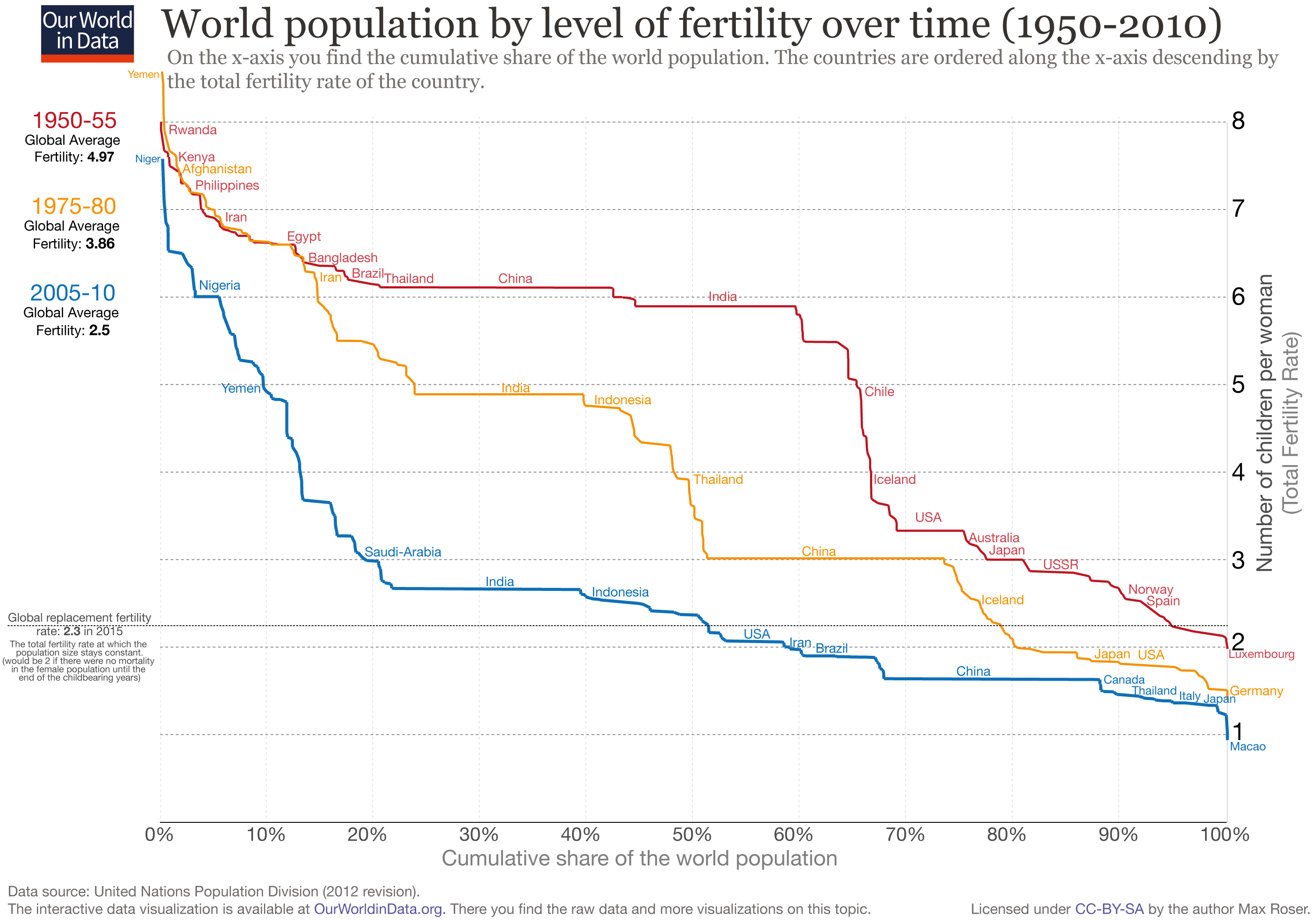
https://ourworldindata.org/fertility-rate

Disclaimer: Our World In Data is in non-profit YC19 batch.

Re:US colleges struggling with low enrollment are closing at... by kingkawn on Monday January 13, 2020 @10:08PM (#22041438)
I love imagining birth control being “wildly” available
Re:US colleges struggling with low enrollment are closing at... by tetraca on Monday January 13, 2020 @10:29PM (#22041569)
Depending on where your waste water is dumped, it is.
Re:US colleges struggling with low enrollment are closing at... by toomuchtodo on Monday January 13, 2020 @10:14PM (#22041474)
I'm going to let my typo stand! There should be no shame in any type of consensual sexual activity.
Re:US colleges struggling with low enrollment are closing at... by kingkawn on Monday January 13, 2020 @10:44PM (#22041648)
A wonderful typo, I meant no snark or admonishment
Re:US colleges struggling with low enrollment are closing at... by toomuchtodo on Monday January 13, 2020 @10:57PM (#22041719)
None assumed!
Re:US colleges struggling with low enrollment are closing at... by Nition on Monday January 13, 2020 @10:08PM (#22041441)
Hopefully. The world could do with a few less people and infinite-growth economics was never a truly reasonable proposition anyway.
Re:US colleges struggling with low enrollment are closing at... by WhompingWindows on Monday January 13, 2020 @10:13PM (#22041466)
It's likely, but not for certain. The demographics will change depending on death rates, birth rates, and immigration, all three of which could change depending on a multitude of factors. At the current rate, we already have somewhat of an inverted pyramid -- the boomers are a massive generation and their loss will heavily influence American society.