Statistically, you still earn way more with a degree than without.
You EARN that pay in the trades, and being an electrician is dangerous. The work is hard on your body. A lot of electricians end up on disability.
I wasn't very academic growing up. But then I grew up, and now I am a pretty successful computer programmer making a lot more than that, for way better perks and less dangerous, damaging work.
You can make that kind of money as a manager at Walmart and you do not run the risk of getting your arm fried off or falling off a telephone pole.
And where does a few years as an electrician leave you if you don't end up liking the career? "Sorry son, the internet told me trades were a good idea. Maybe go back to school now that you are an adult with a family?" Part of the reason you go to school as a young person is that you do not have a family to feed or a house to pay off.
This is becoming less and less true for lots of cohorts. I suspect it will stop correlating for everyone soon.
From a few days ago: "Is College Still Worth It? The New Calculus of Falling Returns" by Center for Household Financial Stability, St Louis Fed
https://www.stlouisfed.org/~/media/files/pdfs/hfs/is-college...
> The college wealth premium is at a historic low; among other races and ethnicities, it is statistically indistinguishable from zero
> Our results suggest that college & post-grad education may be failing some recent graduates as a financial investment."
It's hard to justify the ROI on college.
At $25k/year for a low-tier college, you'll spend $100k (if you don't need loans). If you take that $100k and put it in the market (avg. 7% annual returns) with 0 contributions for 45 years, you could spend every penny you make and retire at 63 with $2.1M.
At more expensive colleges ($50k/yr+) the math seems less and less in your favor.
I'm not planning for retirement. 63 is a long way off. There's a lot of life between now and then, indeed the majority of my life is between now and then.
These kinds of "responsible financial actions" are a bit silly imho. Invest in yourself now, and spend your time well now. College pays for itself, if you spent $100k on a decent degree I guarantee you'll earn that amount ten times over in any decent career. Aside from that, it's an experience, and that's worth some money in itself.
If you end up going to a 2nd or 3rd tier school it's basically a wash whether you end up anywhere good. And it's even worse if you don't get X degree, but instead have a degree that doesn't make it through the word filters. And you can't fuck anything up or make any mistakes in your entire academic career. You have to network aggressively. Many of my cohort ended up working as electricians, and one of them manages the line at a brewery. College was pretty useless for nearly all of us, and our lives probably would have been improved by not getting the degree, because at least that way we wouldn't be under the tens of thousands of dollars in debt.
We were mostly mediocre. But we were smart and we knew how to figure things out. That doesn't really matter to most employers, who just want you to know a specific field right out of the gate so they don't have to bother training you.
I lucked out, by the way. I managed to find a job in 2009 clerking in a warehouse at a technology sales company, and it was only because I knew someone who worked there as a service technician. His moving up created openings that I would be able to use to move into increasingly technical roles. And after 4 years there I was making about $44,000/yr., doubling my starting salary as a clerk. The real benefit for me was networking with my current boss. Because if I hadn't met him then I'd probably still be working long hours for little pay.
So I would strongly urge anyone who isn't in the top 10% to strongly reconsider taking your advice. $100,000 is a huge amount of money and would have been a crippling amount of debt for me. As it was, the $20,000 I graduated with after working two and sometimes three jobs was hard to cope with until I lucked out.
There's plenty of people that 'made it' from a local not-so-competitive state school. America remains the land of opportunity. But, unless you go to an Ivy or your parents are rich, you shouldn't expect it to come to you.
You can do things in America that you simply cannot in Europe. You mentioned a few way of doing college right in your own response. Wouldn't the correct response be to use your time in college wisely and not slack or "just make it through" but to make the most of it, rather than to skip college altogether just because it's going to be harder than having your life handed to you on a platter if you went to an Ivy?
----
2nd point I'd make is if you're in Europe student debt doesn't matter.
Tuition is almost always free/cheap, government pays for tuition and living for your time as a student, and gives very favourable terms to repay (e.g. in the UK you don't pay anything if you earn under £25k/yr, then you pay 7% of amount earned above that, debt is wiped clean after 30 yrs if any remains). It doesn't show up on your credit record or affect mortgages etc.
I'd describe America more as a country that rewards the ambitious (with perhaps some drops of luck) and the rich. If you're neither then the system is made to entrap you. Europe is easily better for general life, but it isn't great for ambitious people.
This isn’t clever, it’s irresponsible especially given that just putting a little money away now literally pays dividends later.
I do not advocate throwing $100k into savings for retirement at 18.
There's a difference between reasonable financial responsibility (401k, match pension contributions w/ employer, etc) and spending all your young years worrying about being prepared for retirement.
Enjoy the life you have. Be financially responsible, but don't over-do it, is what I'm trying to say.
The question is, will a degree give you a better return than putting the money in the market? Maybe a degree would get you a better job, but you get a later start.
Students just aren't taught to figure this sort of stuff out before going to college and getting into debt. College just isn't the right fit for many people and it often just puts them behind.
For most people, if you go to college, you can get to 2M a lot faster than you can by investing 100K and waiting around for 40+ years.
You shouldn't live on campus if you're price sensitive. And you cant include room and board in your calculations because you'd need that anyway.
7% annual returns are also misleading because it ignores inflation. Edit--I've since learned that 7% average already adjusts for inflation.
"One of the major problems for an investor hoping to regularly recreate that 10% average return is inflation. Adjusted for inflation, the historical average annual return is only around 7%."
https://www.investopedia.com/ask/answers/042415/what-average...
College has other benefits like signalling and networking though.
Most fields are not so competitive that you need a degree from an A-list school simply to get your foot into the door.
But you will need to get your foot into the door. Several or perhaps many doors throughout your career. Your network, even if it is not a blue-chip list of Ivy League studs and studettes, can help greatly. Particularly with your first position.
I went to a rather unprestiguous school thousands of miles away from Silicon Valley and the network I established before graduation has directly and indirectly resulted in a lot of work for me over the years.
Anecdotal, sure, but I've heard enough similar stories to be sure that this is a commonplace experience. Not that I need to prove anything. The burden of proof rests with anybody who makes a statement like yours.
Even if the networking one does at $SOME_UNIMPRESSIVE_SCHOOL results in only a few thousand dollars per year over what one would have earned sans networking, over the course of one's working life that can easily equal the cost of a college education.
1 year of working in Silicon Valley got me dozens of quality connections that turned into meaningful long-term projects.
This is essentially my story too, but IMHE, it hasn't been a realistic option for the people I have known who "don't like academics," and consequently struggled or opted out of the system.
(Fwiw, I couldn't stand academics. However, through dint of self study, it didn't prevent me from graduating.)
Half of the 'degrees' we have now are not academic, and half of these universities shouldn't even exist. I think all routes are fine. Everyone has different interests and learns differently. Trade school should be a prestigious route in its own right and they should be built up as such, rather than trying to chuck everyone into university regardless of whether it's the correct path for them. There shouldn't be a 'university' culture.
From my high school I can think of less than 10% of people that were honestly interested in/good at academics (of any type, science or arts/humanities) that should've carried on to university. In reality, it was pushed down and over 60% went. Most of them just spent their time partying.
And on the same note, schools should be better. It's sad that some people don't get to find their love in academics until college. It isn't necessarily always late blooming imo, it's that public pre-college education often sucks.
(And, IMHO, the many alternatives to academia aren't nearly the rosey picture you purport, particularly for people who hope to be sure of employment in a decade or two. It's clear that, while many will still be here, many won't.)
There should absolutely be institutions for education or trade-work post high school. These should not necessarily be universities and should still be aimed at all kinds of individuals, but talented individuals that are not good at and have no interest in academics.
Currently those institutions are often not widely respected. Colleges have become the norm post-18. That shouldn't be the case.
$2.1M is literally $100k compounded at 7% over 45 years.
Some would end up lower but some would end up higher.
Nothing is guaranteed, but neither is a job.
While freak accidents happen, most are due to foolish people doing foolish things. For example, you mention getting your arm fried, but "working it hot" is almost always going to break safety regulations. I got hit with 480v once, but only because someone flagrantly broke safety regulations and cut my lockout off of a breaker.
If you think injuries don't happen at walmart, try working as a stocker for a few weeks. Only a fraction of a fraction of walmart employees are ever managers and it seems they are very often put there due to nepotism rather than merit. At least if you broke your back as an electrician, you make enough to save for retirement and the IBEW has great disability benefits.
Your last statement disregards three important facts of life. First, if everyone could get that computer job, it would pay next to nothing. Most people simply don't have what it takes. Second, as long as you like having electricity, there will be a demand for electricians. Somebody must do that job and the pay is very good. Thirdly, liking a job is not a pre-requisite. I very seriously doubt most people in the service sector like their jobs. If you're going to dislike your job anyway, you might as well go for the one with higher compensation. If you do decide to switch careers later, you'd be a lot better off with all that extra money.
Not that easy given how weak unions are now in much of the US .
I agree that the "trades" meme is merely a "grass is greener" perspective. The low capped pay and lack of personal autonomy (if not strong discouragement of it by the union perks) can make one miserable, especially when you're pushed into it at such an early age based on others' perceived assessment of your abilities.
Also, I was a terrible math and science student in high school, and found my groove in college, only to graduate with a BS in CS in the top 1% of the class of almost 1k. Just a late bloomer I guess.
Nah, it's a meme being pushed with organized campaigns that take lots of money: it's an attempt to manipulate the labor pool to bring wages down in certain fields by increasing competition for jobs and increasing return to capital.
Of course, so is the similarly heavily promoted “train everyone to code” push.
I would need to see better information on this. I would think a lot of people without a degree don't do much of anything at all and bring the average way down. It would be better to see what the average is for people who complete a trade school program vs the average of people earning a degree.
If you go to art school as a young person, you won't have the problem of paying off a house because you won't have a job that qualifies you for a mortgage.
(Lesson: UX designers are as important as programmers)
I also have the luxury of waiting for a better opportunity rather than just taking the first one that matches.
Are young people who get through a degree course then super focused on getting as much money as they can because they have all this debt?
As opposed to people who don't have mountains of student debt, and can then afford to take lower-paying, better-for-their-life jobs?
Huge debt is really stressful, and hard on mental health. I don't know the comparative suicide rates of electricians and art grads, but I'd suspect art school is effectively worse for your health than a trade.
People generally have two or even three careers now. Migrating from electrician to manager is about as easy as migrating from software developer to manager.
https://academic.oup.com/ije/article/39/5/1362/802787
The correlation between intelligence and income also substantial, but seemingly not quite as strong. The correlation between intelligence and wealth is weaker still.
https://www.bcaresearch.com/images/Peter_PPT_presentation%20... https://www.sciencedirect.com/science/article/abs/pii/S01602...
With income based repayment, you pay 10% of your disposable income (income over 1.5x the poverty rate) , so this isn't really much of an issue.
And people end up in situations where they can't make payments and have to walk away and take the credit hit all the time.
Worrying about the theoretical amount you owe instead of the actual amount you have to pay is just dumb.
Is college universally useful? No, it may leave you without knowledge on how to earn decent money, while crippling you with a heavy debt.
Is college completely useless? No, it's quite useful for some, and even indispensable for certain professions (e.g. medical doctors).
I'd say that college is useful for those who actively extract knowledge and experience from it, and that knowledge can help pay the tuition. This is definitely not 100% of students. Going to college just to hang out with kids and obtain a diploma for decoration, expecting to be passively taught, or studying stuff no business wants to pay for, is silly, of course.
Yes, but we need many more trades people than managers at Wal-Mart.
You don't actually. Among non-hispanic white individuals the college premium is at a historic low, for all other groups it's indistinguishable from zero.[1]
And as for realism or pragmatism. I am German and in Germany the majority of people still learn trades and do not go to university. They start earning a paycheck at 17 or 18, they contribute to their social security from the same point, they have good chances of taking over a business given the demographic transition, and they do not have to participate in the competitive hamster wheel that is the American college system or the overrun white-collar service sector including dozens of applications.
And while I can't speak to the crafts and trade sector in the US, in Germany being an electrician is not particularly dangerous, there are strict safety regulations in place and you don't overwork yourself, companies painfully pay attention to it. This isn't the 1920s with people balancing around on steel beams.
When I see the constant anxiety in the US of the millenial generation, the debt driven barely sustainable lifestyles and the constant competition I can only say I am thankful to have grown up in a country where there is a path for normal people to take on jobs that guarantee secure income, without largely useless academic training for a population that is frankly largely unsuited for it.
[1]https://marginalrevolution.com/marginalrevolution/2019/12/is...
I think high schoolers should have two choices:
- Associates Degree track at a local university - apprenticeship at a local trade organization
The AA/AS by itself isn't particularly useful (a little better than a diploma though), but it gives you an introduction into college life. A trade by itself isn't particularly useful (need years of practice to master it), but it's a practical introduction to what's available without a college degree. Our current approach of teaching to standardized tests seems like the worse option since it's neither practical (college doesn't really work like the tests) nor in demand (your employer doesn't care about your standardized test scores).
Our whole education system is out of whack, and just making it free isn't going to fix it. We need more paths to success, and we currently only have one that's pushed by our education system: STEM degrees.
- Vocational: 2 or 3 years followed by 2+ years as an apprentice in a real company, often with a master craftsman where the apprentices pay increases from approx 30% of full pay and up towards full pay during the time you stay. In return for the limited pay they have to take time to teach you and they cannot easily let you go before your apprenticeship has ended.
- Study preparations: three years of languages (typically the two Norwegian ones, English and German but some people will choose French or Spanish or something instead of or in addition to German.) Students who aim for engineering or medicine studies will typically add math, physics and another sciency subject: chemistry and biology were popular back when I went to school.
- leave school and get a job (or more and more likely it seems: fall behind)
As for why I say roughly, there's been a very nice option where you could get certified as a craftsman and get enough subjects to enter engineering in four years.
Also there are some options for transitioning from vocational to other studies. Going the other way is pretty hard and probably involves getting a job as uncertified worker in the field, then work for 5 years, takes some courses and pass the certification test.
Note: I'm not saying this is unique. It would surprise me if something like this isn't common in many other countries.
Lots of Americans do learn a trade in high school. Just to copy the "Programs" menu from the Tech Center at the high school where my wife teaches (suburb in VT): Automotive Technology, Building Technology, Cosmetology, Computer Systems Technology, Computer Animation & Web Design, Dental Assisting, Design and Creative Media, Childhood Education & Human Services, Engineering & Architectural Design, Natural Resources, Professional Foods, Health Informatics. I understand that many of these programs, if not all, are supposed to be a career for the students, and that many of them are thought of as hard.
I went down this "trades are great!" rabbit hole a while ago because I had a cousin who had a friend telling him: "You can be making 6 figures in 5 years as an electrician!" I was surprised when I found out his buddy didn't have a bridge to sell him as well.
Your career is not just about money earned. It is about the lifestyle. It is about your physical health over a long period of time. It is about your chance for advancement. It is about what you are going to be doing day-to-day.
It always seemed like the cargo culting around trade school doesn't come from it as a career option but rather because it comes from a bias against traditional colleges. In reality what we should be doing is making both the trades and college free so that students have their choice of career and education rather than trying to pigeonhole them down one path because education has transformed from a societal good to one purely for work.
Well, who then is going to fulfill this necessary role?
Then what do we have? A lot of very angry people who feel betrayed by our insistence on trade school. And they'd be right to feel betrayed! We should be encouraging people to pursue fields that suit their interests, talents, and ambitions. If there are financial barriers then we need to tear them down.
The economy exists for the people, not people for the economy.
Electrician pay will also continue to rise quite a bit over the next decade. I already pay far more every year than the year before, if I can even book a decent electrician.
Applying population statistics to individuals is a fool’s errand.
Not everyone is cut out to be a software engineer.
There was a decent chance to get that success without college.
Meanwhile, what of the others who go to college? Most are not computer programmers. Lots of people get a BA in psychology, criminal justice, early childhood education, music, sociology, Spanish, drama, anthropology, journalism, or art history. These people seldom find success.
Then of course there are the tradies I knew of when I was young who are dead from it, not many but a couple, I don't know anyone who is dead from computer programming.
There is perhaps one trade that seems to be OK in my experience - plumbing, its not particularly hard work and there's always demand, but you know, digging up sh*t all your life is the trade off. You don't see many old plumbers though - they're probably out in their yachts. Worked with nurses in health for a while - the number of nurses with bad backs is incredible.
Go to uni
If you don't like being an electrician, you could move over into HVAC and make twice as much since you have an electrician's license. I feel your view is rather narrow.
With trades you have the ability of taking a 2 week intensive program and getting hired for $20/hr right out of school. Its a way better deal than some liberal arts education that gets you deep into debt and qualifies you to be a barista.
Ask an old electrician what they want their kid to be, and (excluding the scenario of a family business) it's usually "not an electrician"
Hate to be so negative, but it looks like it's all the game of prestige in the hierarchy as it always was: https://www.academia.edu/41235398/Personal_Income_and_Hierar...
This isn't quite true. What's true is people with degrees earn way more than people without them. But people /w degrees don't equal people without degrees.
And it's generally not a life threatening career.
Sure some small percentage of plumbers might make $90k after 5 years and manage to seriously save. But that's not anywhere close to normal.
Also even with the cherry picked example of a union plumber who is unbelievably disciplined with respect to saving. And a doctor who does an optional fellowship.
The doctor still comes out WAY ahead over their lifetime.
Example: In 2010 the median lawyer made 78k a year while the average made 120k. Note the 50% difference.
That’s the distinction most people gloss over.
so, uh, I guess I'm the modern equivalent of those trades. I mean, I don't have a union, but I fix computers and make a whole lot of money doing it, without any education. It is a lot like a trade, 'cause essentially I'm infrastructure for industry. I mean, instead of maintaining electricity at a factory, I'm maintaining servers in a build farm, but it's still infrastructure.
On the individual level you have a point. I mean, as a sysadmin, I do make like 30% less than a SWE, but I still make a whole lot of money, and I started when I was 17.
On a societal level, though? when you don't have a degree, the amount you make is dramatically dependent on how productive the people around you are.
Because I live in silicon valley and manage infrastructure for (mostly highly educated) engineers who are incredibly productive, I make a lot of money. A huge amount for someone who isn't educated or born rich.
If I was in a rural area, I'd be fighting for a job at geeksquad. I mean, I'd handily win that fight, but if I'm maintaining infrastructure for people who aren't very productive, I'm going to make... not very much money.
My point here is that if the US continues this trend of not educating it's children and excluding foreign educated people? Jobs like mine, for uneducated maintainers of infrastructure follow the jobs for the more productive people. If those people start working from china? They're probably gonna go find locals to do my job.
What I'm saying is that it is very much in my interest to do what needs to be done (mostly, I think, pay taxes) to see to it that kids go to college, even if I don't have any children of my own.
My own experience (I've tried at school several times. I'm currently enrolled in the computer information systems "competency based" degree at nau.edu, but I've tried a bunch of others) is that school is actually way more difficult than industry. You can't just be brilliant twice a month, as is my experience of industry; you have to show up and perform at 90% every day which seems impossibly brutal to me. I mean, this is probably a quirk of my own personality; I'm actually really good at coming in and dealing with disasters every now and again, but my consistency is... really pretty bad.
I mean, I personally think that a love of and respect for learning is fundamentally more important than education; but I also think that education isn't nothing. There are a lot of people who do a lot better with some formal education, and there are a whole lot of jobs, that as far as I can tell, are almost impossible to do well without a good formal education. I personally don't think I'd let a self-taught doctor hack on me if I had any other choice at all.
My personal opinion is that if there are any young people with the capacity to be good at those things that require an education who are prevented from doing those things because of money, our society has made a huge mistake, one that will cost us much money in the long term, just 'cause having those people perform at peak value is hugely valuable to society. Further, I think that the unwillingness, as a society, to pay for the education of young people evinces a lack of valuation of learning that might be an even bigger problem.
'failure' in academia seems, to me, to be way harsher than failure in industry; Nobody brings up even pretty big failures of mine that occured even a few years back in industry, but my high school academic record, more than two decades back, still haunts my admissions efforts, so as far as I can tell, community college is the most prestigious route open to me, and I need to execute almost perfectly to graduate to the next level. I probably won't execute perfectly, especially as my work is a higher priority than school for me, (and my work record isn't perfect either) so I think this is the most realistic route to some sort of undergrad degree, even though I generally work a lot better in person than remote.
There are a lot of 'competency based' programs, and while I think something like that is the best chance I have of getting a degree without permanently marring my record in ways that makes doing academic things harder in the future, I have no idea if I picked the best competency based option. I do personally think that on the low end, you are way better off with a government school than with a private school; that was a big part of my decision. But, for instance, a friend was telling me about western governors university, and... that might have been better? they have an actual CS degree, which would definitely get me further.
Also, a degree is an important plan B... I mean, as long as I'm employed where I am, and as long as the industry doesn't change, a degree in and of itself won't help me all that much, though basic management writing might. but if industry changes, there are a lot of cases where having a degree means you are legally middle class. Right now, the pay cut I'd take working anywhere else in the world would mean I should probably just travel on vacation, but if that ever changes? a degree is almost essential to do my job for a non-US company.
Anyway, what sort of graduate work would you like to do and why?
And I’m surprised your academic performance in high school is still a hinderance. Do you also have not great test scores?
If you could get into someplace reasonably prestigious, would you go back to school full-time? Or is being able to go to school while still working important for you?
I actually don't have a project in mind at the moment. I have in the past wanted to do a lot more with pushing forward open source diagnostics tools, (and with proving the ESD problems in the way most people handle physical servers) - but I don't know that is what I want to do now; it's been a while since I've been serious about the physical layer, and it's really really unstylish right now; it would be better done once the outsourcing pendulum swings back to insourcing.
I am interested in graduate level work in part because my impression is that my work style would be a better fit; my impression is that if you do something recognized as really pretty great every now and then, they forgive you failures in the meanwhile. Like industry. (I also think I'd be more comfortable going to school with graduate-school age people than with undergrad-aged people. I'm pushing 40 at this point.)
>And I’m surprised your academic performance in high school is still a hinderance. Do you also have not great test scores?
Only okay. I'm held back by pretty terrible math test scores. almost average GRE quantitative reasoning (95th percentile verbal, which is good, but not good enough to make up for an average quantitative) I did pretty okay on the MAT, too, but I don't remember the score, and anyhow, if I want to do something with language or the arts, I really badly need an undergrad. I can mostly read okay and can talk about themes of the classics as well as an arts major, (though, uh, I probably cant speak of the criticism of those works the way they can) - but everything else in the arts I'm pretty terrible at.
(I do have plans to take the LSAT this coming year, with little study. I actively studied for the FE exam last year, but found I have another year of math before I can even try. The LSAT looks doable; I mean, I would be surprised if I do well on it, but I'd give myself better than even odds of doing better than average on it.)
I think bringing up my knowledge of basic maths up through, you know, at least GRE math levels is a moderately high priority, but I haven't quite figured out how.
>If you could get into someplace reasonably prestigious, would you go back to school full-time? Or is being able to go to school while still working important for you?
If I seriously thought that I had a 90+ percent chance of graduating... and I do think that the admissions committees are pretty good at judging that sort of thing, yeah, I would be willing to spend four years on it.
This, though, I think is the crux of it. They won't admit me 'cause I don't have a 90+% chance of graduating. Yes, it seems horribly unfair that they hold my bad behavior of 20 years ago against me, but the fact of the matter is that I still don't have that level of discipline.
I suppose that's another reason I want to go; I see this lack of discipline as a big weakness, and... well, where do I go to learn it? I mean, the good colleges could be said to not teach that sort of thing 'cause they filter out people who don't have it on the front end, so I guess I'm in the right place? but maybe not availing myself to the right bits of it? I mean, there's a very large chance that this will simply be something like handwriting, something that I will be terrible at for the rest of my life, and that I simply work around by not doing the things that require discipline, but... like even with handwriting, I spent a few years at calligraphy as an adult before I gave up on it.
It's really interesting 'cause the feedback at the online classes feels... a lot harsher than any I have ever gotten at work; I wonder how much of that is just what is expected in school vs. work? or if it's a class thing, like the school isn't prestigious, whereas most jobs i've had, well, it's usually obvious that I have a lot of other choices... or maybe that I'm really bad at this, and at work, well, there's enough I'm really good at that people treat me somewhat diffidently even in the areas where I'm really bad? I don't know, but it's an interesting experience in a lot of ways.
I mean, it's not bad really, just... really different from how I'm used to people giving me feedback.
But... yeah, I mean, to me it feels like you are paying for essay feedback. Like, they also provide PDFs, videos and reading materials, but I can get all those things on my own; it's the essay feedback, I think, that is the individualized thing.
College functions to get you out of your class bubble and expose other opportunities that you wouldn't otherwise have living at home. You play college right like many do, you advance up that economic ladder, and in the process set up your future kids for trivially easy success.
In a way, they form a bit of a poverty / class mobility trap for those who aren't well off enough to afford them on their own but are attracted by the idea of a purpose-driven life (social work, librarian, historian, identity studies come to mind).
I mean, I do think I am rather a lot smarter than average, but everything is relative, and I believe I have accomplished so much more because I seek out situations where I am surrounded by people I think are better than I am on those scales.
https://www.cbpp.org/research/state-budget-and-tax/a-lost-de...
In order to stay solvent as institutions, the universities raise tuition, which is then enabled by student loans. My point isn't that student loans are blameless. They certainly are. In addition, there's a lot of blame that can be levied at the universities themselves for wasteful spending, but this itself is complicated due to donations being contingent on particular projects or buildings and competition between the universities to attract students who often choose a school based on how awesome the quad is. However, at its core, if a state like Arizona reduces its per student spending by over 50%, how is university supposed to stay solvent without dramatically raising tuition?
None of this helps the family in the article. I think they did the right thing. I wish more people would hold the states accountable rather than first blaming students loans.
Now, I agree that the Feds need to cut back on loans in order to put pressure on the states to reduce their tuition costs. Essentially, the student loan system allows the states to receive free federal money by using students as the vessel of that transaction. I find that morally wrong. At the same time, there are a huge number of students who need some kind of loan to pay for college. I believe it to also be morally wrong to create a system where only those of means can enjoy public education. If the states adequately funded their universities, the universities held their tuition costs down, and either the state or the feds provided loans, then this wouldn't be an issue. However, this requires all of these institutions to agree on the principles of access to education and this isn't happening.
I don't know how to fix this. If the Feds eliminated their loan and grant programs, I personally believe that tuition costs would go down or stabilize because a large-section of the population would not be able to afford the current prices, so the universities would be forced to reduce tuition. This would benefit middle class families who have saved for education. I also believe this would prevent low income families from attending college and I'm not fine with this prospect.
Pushing college the way we do helps to stigmatize the trades. Why don’t we push the trades? We give the impression they are “lesser”.
Trades aren't easier to get in and better paid because of their inherent characteristics. The supply and demand in the market has made them so. The new generation of advice is going to change the supply side. I am not sure if the advice is going to be valid for the rest of a young person's career should they choose this path. We have already done this once before with just go to college.
Few people go into those jobs or unions and make 200k a year. People def make a livable wage, but it's very demanding work physically. I have a friends that do flooring and roofing and they absolutely pay the bills but they are hurting and only just approaching 30. They have months where they have tons of work, and months where they have no work at all.
So while these jobs beat entry level roles and service jobs paying 15 an hour if you're luck, they don't hold the same value as being a lawyer or a doctor or like many of us here, an engineer. My back hurts because I have bad posture and sit all day, not because I was lifting hundreds of pounds of shit all day. And my salary is higher than my buddy that is high up in his union stopping OSHA violations.
Support trades, they are valuable and important. But I don't think we should praise them as the best path to securing your future. They are jobs just like any other with their own risks and rewards.
Not trying to devalue trades, they are great ways to get into a skilled job, but we can't pretend that they are silver bullets to achieving a happy, successful life.
I got a job while in college as a programmer - and work full time making around the 50k range. I feel that I self taught myself the necessary technical skills for my job, and that the biggest places for self improvement aren't acedimic but business/relationship related.
I have less then 5k in school debt left, and I already have the job I wanted, my only fear is when I eventually look for a new job, how well they'll consider me without a degree. I strongly feel my technical skills are at least up to par, meanwhile in school I watched classmates copy answers off YouTube...
2) make sure the program you're transferring to accepts a bunch of CLEP tests for credit and then pass those for anything you haven't already taken that qualifies—a book, a couple weekends of hard study, and a (relatively) cheap test beats paying for a class and taking all that time. These will mostly be 100-level courses, including and especially "gen ed" classes. Maybe you don't have any of those left, but if you do, CLEP right the hell out of them.
If you can get it cheap enough IMO it's definitely worth some money and some effort not to have questions about why you didn't go to or finish college, in interviews. If nothing else the confidence not having that stuff come up gives you frees you to ask for higher salaries. One 20k bump (not a crazy number for a jump with one job move, if you're at 50k, even if you're in like a 3rd- or 4th-rate city for tech) that otherwise would have taken a couple years longer to achieve, and that degree's a hell of a long way toward paying for itself. You could probably have one in under 3 years, maybe around 2, without taking on too much stress.
[EDIT] oh and ask your employer to chip in for tuition. Can't hurt to ask.
Unless you want to do some serious crypto research or something like that, more schooling probably isn't required. You'd be better served getting a CISSP or something.
I was going to school for physics and do plan to go back because I want to be in that field doing research eventually. If you want to do something similar, then school might be worthwhile.
For example
https://www.ox.ac.uk/admissions/graduate/courses/msc-softwar...
Oxford M.Sc. Software Engineering
A typical applicant will have at least two years' experience in a professional environment, and an undergraduate degree in a related subject. However, more extensive experience may compensate for a lack of formal qualifications, and a strong, immediately-relevant qualification may compensate for a lack of professional experience.
There are others but that’s the best I know of for Software Engineering without a Bachelor’s.
He never had any student loans ever or school expenses. When he was young he just saved most of his money....most of which has doubled or tripled in value due to how good the stock market has been.
But they can also make you cannon fodder or a deck swabber.
And ask the reservists about military promises from Iraq. Oh you're in the National Guard? Yeah we're deploying you to a foreign country for years on end.
And once you're in the military, you can be summoned for duty if they need you.
Given those risks, I can't see how the military is a good option.
> Crude mortality rates are lower among U.S. military members than their civilian counterparts; service members must be healthy when they enter service and deaths from illnesses are relatively infrequent.
Suicide rates for veterans is on the high end, but comparable to other highly physical professions. Adjusted for age and gender, the suicide rate among veterans is 50% higher than for the population as a whole: https://www.theguardian.com/us-news/2018/sep/26/suicide-rate.... That's on the high end, but not "high" in absolute terms: https://www.registerednursing.org/wp-content/uploads/2018/11.... (Scroll down to the chart showing suicide rates by profession for men versus women.) At 40-45 per 100,000, male veterans are about as likely to commit suicide as those in the arts and entertainment and installation/maintenance fields, and less likely than those in construction/resource extraction.
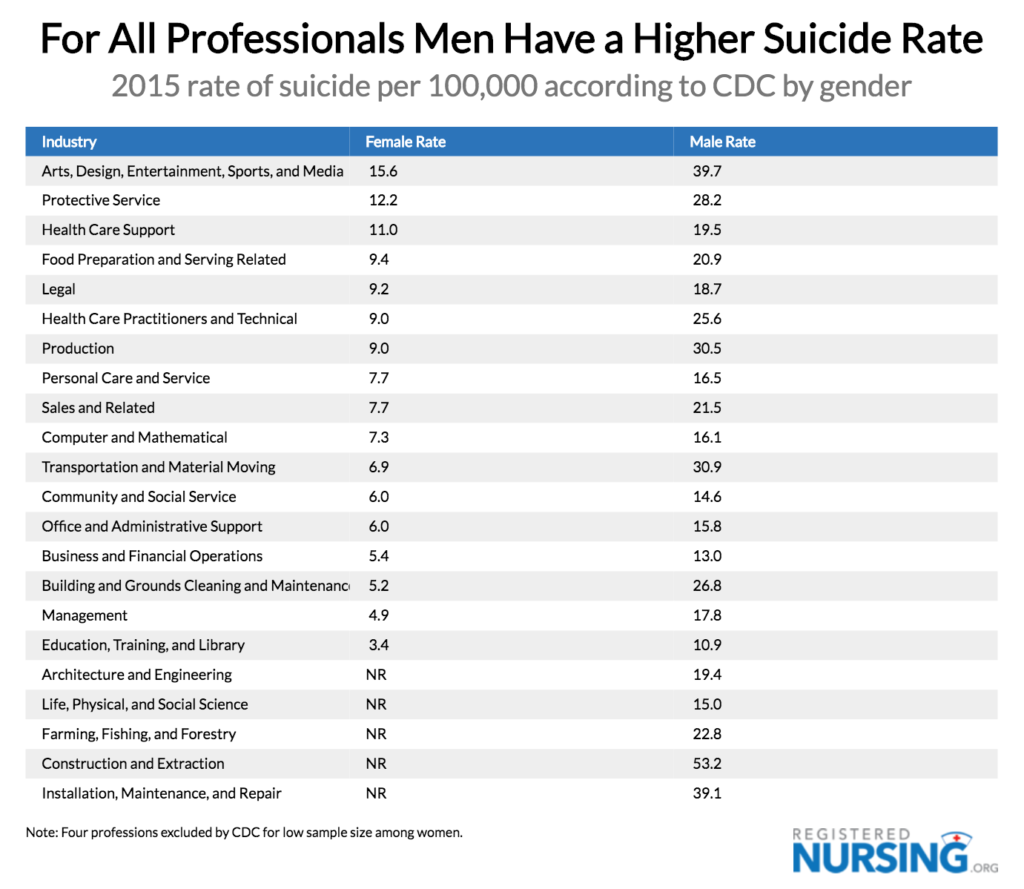
My stepdad, my next door neighbor, and 3 of my friends all have some kind of long term chronic injury caused by military service.
In fact I only know 1 guy well who's ex military who doesn't have at least a moderately severe problem related to his service.
Military service is either a noble sacrifice, or it's a good job. It can't be both simultaneously.
There may be a "cohort" effect. See this tweet for an example of this happening in the UK: https://twitter.com/ProfLAppleby/status/1161940914308300801?...
If this is happening it's potentially really worrying, because risk usually increases with age. So we'd see an increase in rates of death as this high risk group ages into a higher risk group.
The GI bill paying for college is a big benefit of service, but staying in as an officer can also be a great living.
OTOH, lots of people don't have my fortunate background and loving but poor parents can only do so much. Housing and food being taken care of and a paycheck on top is a very good incentive if the other choice is to be a "burden" on your family for another few years...
Not gambling health or life is only possible in a very privileged setting. Those not in it might actually be making a very wise choice.
There's lots of regular work, maintenance, staffing some random base overseas etc
Besides, military service changes you. It gives you perspective you will never get anywhere else.
2 have PTSD, one severe. The one with severe PTSD also got to spend 6 months in a hospital after being shot out of the air in a conflict that we are theoretically not involved in.
Given their other options, military service might have been a good thing. But the odds of PTSD or injury are much, much higher than I would like.
My sample size is thousands of times yours.
The odds are very low.
The odds are very high for post-9/11 veterans (and higher the more of their period of service is post-9/11 within that group), who are more likely to have been deployed and seen combat than veterans of earlier eras (both because of optempo and organizational changes that have increased the teeth to tail ratio of uniformed services as support functions have been moved to contracted support.)
There are ample actual studies of this, we don't need to rely on the “sample size” of competing anecdotal reports.
If you have current tooth-to-tail estimates, they'd be interesting to see.
https://www.armyupress.army.mil/Portals/7/combat-studies-ins...
My nephews serve as examples. Their non-combat roles were heavy construction, setting up communication networks, and airplane mechanic. However all three actually saw combat. 2 wound up with PTSD. And one wound up seriously injured when the plane that was delivering him to a secret mission got shot down en route.
In fact according to some estimates, the prevalence of PTSD among veterans of the Iraq war exceeds the fraction who were supposedly in combat roles.
PTSD is the easiest diagnosis to get through the VA, and thus it is rife with fraud. As a result, it is quite difficult to get anything approaching accurate or useful numbers for it.
It sounds like you're one of the ideal ones for your line of work, though; brains that are less susceptible to stress damage are rare. It's why not everyone is fit to become a police officer or give talks in front of big crowds. Others have an adrenaline sensitivity or a panic groove etched so deeply in their brains that they'll forget their names if you talk to them when they don't expect it.
I'm also assuming you entered the military voluntarily. There's a predisposition for certain brains to take on and thrive in certain careers. As a DWB friend of mine put it about the career mercs he treated, "They aren't psychopaths, just real mean sons of bitches."
You don't have to like people who aren't built as tough as you, but that doesn't mean they're faking.
The vast majority of the people in the military are never exposed to anything at all. They do a job and they get paid for it. They’re no more likely to develop ptsd than the local grocer, plumber or electrician. Many of them are exactly a grocer, plumber, or electrician with a military ID card. They’re not “Mercs” any more than the local grocer...
Everyone on active duty today entered voluntarily as well.
I retired last year.
I deployed to Afghanistan multiple times.
I’m literally someone who experienced the life you’re trying to tell me about. Your studies are mostly bullshit written to drive an agenda.
It could be that that's true of of a variety of scientific studies from diverse sources with no reason to have common agenda, or it could be that that's just true of your unsubstantiated pseudonymous anecdotal ranting in an internet discussion board.
Again, btdt. I don't need a think tank to write a paper to tell me how the military works.
You bring up another excellent reason to avoid military service. I'm sure there are plenty more.
Its certainly not for everyone, but with National Guard/Reserve options it's a pretty sweet deal that the vast majority of people could certainly handle.
Why doesn't it make economic sense to declare bankruptcy in any situation, even if you're a CS major from Stanford, at 22 when you have nothing if you've got a loan in the six figures and IF you're allowed to do so, which is what you're implying (loans that aren't guaranteed)?
If you're getting a necessary degree, it's very uncommon to default on your loan because you'll be in demand and getting a decent wage. Banks understand this fact and will do the math to give a loan anyway.
Some of my kids seem like they enjoy academics, but others do not. I'll be pushing the latter toward trade school. Average IBEW (electrical union) pay is about $20/hr for an apprentice and $33 for a journeyman. $40,000 to $66,000 with ZERO DEBT right out the gate is nothing to ignore (and that pay can easily double -- especially in your younger years -- if you're willing to travel and put in those extra hours). It sure beats minimum wage at a crappy service job.