But on the other hand, lots of people have a tendency to think and say that certain things are "obviously true" based on what they are used to seeing in society, like that boys like cars and girls like dolls, and even start rationalizing it ("This is what is natural and right!") and even actively fight to maintain this "natural truth". They treat boys who like dolls and girls who like cars as deviants who need to be corrected.
And that's bullshit, even if there is a natural inclination towards trends for genders, that doesn't mean that's "natural law" and we ought to make sure to maintain and protect it.
Isn't it somewhat likely though? Kids are born with all of their genes and they can't do anything straight out of the womb. What has zero impact at that point is nurture though. Nurture therefore seems to have a huge influence, this somewhat downgrades genes to only push what's already been established by culture.
I don't think that's a safe assumption to make.
I agree, but the reality is we don't know. Also there's evidence that cultural norms do substantially shape our opportunities (e.g. Denmark vs Saudi Arabia) and we should be mindful of this always. This cuts both ways too — men in Scandinavia are much more likely to be involved in child rearing through choice, and this is something men in other cultures miss out on.
The real fallacy has always been people who think that if something can be proven to be nurture rather than nature, that means it's "naturally right" and should thus be encouraged, and deviancy from that norm "corrected".
It's totally okay for boys to play with dolls even if it turns out nature makes boys favor toy cars over dolls on average.
This seems absurdly out of touch with reality.
To give just one example, but I hope you'd agree there are literally millions if you think about it for a second: There was a recent Hollywood movie and documentary about the true story of a man who was beaten into a coma and permanently brain damaged for wearing the wrong kind of clothes for his gender. And that doesn't seem particularly unusual to me (it's not really the focus of the movie).
I can't think of anything close to that in reverse?
GP did not say anything about x > y. The post merely pointed out that some people like to link everything to social influence.
Yes, pi is not 3 but are people really unaware of the social signals they give off by being so outraged at the mistake given the context?
To extend this analogy far beyond what is wise, I'm not really sure there are that many people who think that pi is 3, probably mostly 3.1 or 3.2, which makes fixation on extreme outliers who might believe it's 3 extra odd.
This has changed over time too. Just look at lego adverts from the 70s https://flashbak.com/wp-content/uploads/2018/08/LEGO-81-768x...
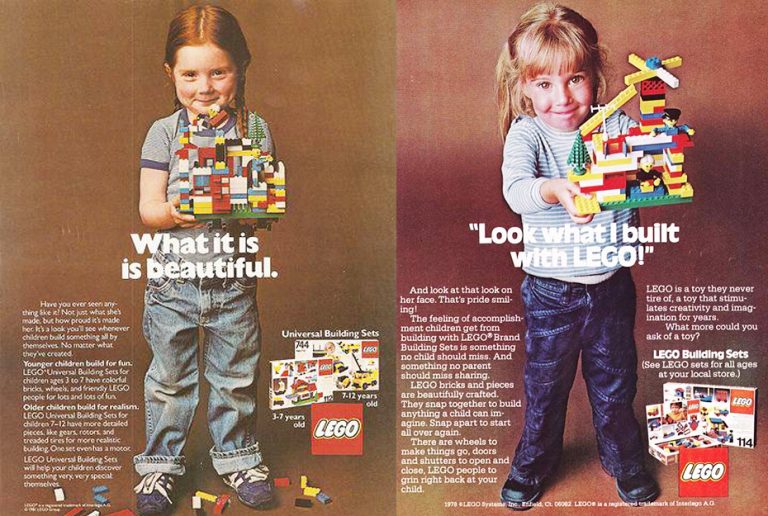
They don't look like that now!
All I want to say is that there seems to be a stupid amount of aggression towards even the mere idea that statistically girls/boys might like something other than boys/girls do even if social conditioning were completely removed(which is a nonsensical idea in the first place, a child is a member of the society from the second they are born, they are not goldfish).