News for hackers. Stuff that matters.
Re:SpaceX working on fix for Starlink satellites so they don... by mentos on Sunday December 08, 2019 @09:56AM (#21736136)
Not a valid solution but I thought maybe SpaceX could launch a bunch of telescope satellites that could be used by hobbyists.
Re:SpaceX working on fix for Starlink satellites so they don... by wongarsu on Sunday December 08, 2019 @10:05AM (#21736198)
SpaceX directly profits from space enthusiasm, and having their in-house satellite team design such satellites (during downtime, as practice or testbed, etc) and launch them using unused capacity on existing launches would be way cheaper than anything NASA could do. It's not as absurd as it seems at first glance. Not a good replacement for a proper solution, but a nice idea for something they could do in any case.
Re:SpaceX working on fix for Starlink satellites so they don... by dylan604 on Sunday December 08, 2019 @10:36AM (#21736394)
Could you imagine the enthusiasm from amateur astronomers, kids in school, etc where they could schedule time on a space based telescope? Sure, they won't be anywhere close to Hubble, but even a 6"-12" mirror in ~0% atmosphere would be very cool. And if it were a true constellation, you could schedule time on a satellite in the night time part of the sky during normal daytime class room time rather than trying to take a class field trip to a typical astronomy facility. You would also eliminate the most frustrating thing about astronomy: cloudy skies. And you'd also be able to see parts of the sky that you wouldn't normally based on location, ie Northern/Southern hemisphere.
Re:SpaceX working on fix for Starlink satellites so they don... by remarkEon on Sunday December 08, 2019 @01:50PM (#21737440)
Yeah there’s a ton of other engineering skills you could teach in parallel. It really isn’t that crazy of an idea. If SpaceX is putting them in orbit on excess capacity from scheduled flights I’d hope they’d give away the time for free. Or they could invent their own market here for scheduling time.
Re:SpaceX working on fix for Starlink satellites so they don... by chr1 on Sunday December 08, 2019 @11:09AM (#21736555)
Why is it not a valid solution? It is actually a much better solution than using small low quality telescopes. If starlink is successful in a few years launching satellites will become cheap enough to allow us to launch multiple telescopes better than hubble, and we'll have equivalent of google earth with high quality images of night sky. Combined with VR why would anyone even want to use telescopes? (Maybe people who have personal memories linked to telescopes, like watching night sky with parents, but then even their children would prefer to use the VR version instead).
Re:SpaceX working on fix for Starlink satellites so they don... by throwaway2048 on Sunday December 08, 2019 @12:21PM (#21736936)
Because there is a difference between things that could maybe happen, and things that are almost certainly going to happen. Especially when the "maybe" is relying on the largesse of somebody else to fix the problem they created.

History is full of disasters and situations where that absolutely does not work out.

Pinning the near-entire future of astronomical observation on Musk's good will is ridiculous.

Re:SpaceX working on fix for Starlink satellites so they don... by chr1 on Sunday December 08, 2019 @12:55PM (#21737116)
First it doesn't depend on Musk's good will at all. It depends on companies making profit by selling space launches. Second "the near-entire future of astronomical observation" is a gross exaggeration, the satellites only add a bit of inconvenience, which is a much smaller issue, than existing issues like light pollution from the cities. The benefits of starlink, and the slight inconvenience for astronomers are simply not comparable.
Re:SpaceX working on fix for Starlink satellites so they don... by throwaway2048 on Sunday December 08, 2019 @01:18PM (#21737238)
There are a tiny handful of space based satellites, its far more than only a "bit" of inconvenience.
Re:SpaceX working on fix for Starlink satellites so they don... by chr1 on Sunday December 08, 2019 @02:52PM (#21737852)
I mean it is a small inconvenience for telescopes on earth, and not that "it is a small inconvenience in general because there are space telescopes".

Genuine question: is your opinion about these satellites based on working in some related field, or simply on dislike of greedy capitalists? I have a phd in physics and have friends who work as astronomers, with whom i've talked about this. Of course there is always a chance that we misunderstand everything, but i have never seen any plausible arguments for why are some people considering starlink to be the end of world for astronomy, and i don't understand why are there so many people on hn defending "poor astronomers" from "The Evil Corporation".

Re:SpaceX working on fix for Starlink satellites so they don... by mlyle on Monday December 09, 2019 @11:38PM (#21749627)
I have worked on high-end telescope controls and imaging systems.

For some types of astronomy --- especially larger fields -- heavily increased use of LEO may reduce the effective hours of observation by 4 hours a night by spoiling most exposures, while creating some impact at other hours. This is more than a 33% reduction in throughput.

Even with a smaller satellite population, there's been losses of valuable data. Two images in an early sequence of SN1987A had a (amazing improbable) perfect satellite streak right down the middle.

Or there's this past APOD https://apod.nasa.gov/apod/image/1910/M31Before_Scherer_4298... where we see the effect of the current satellite population (and a few planes with the ~10 parallel lines from upper right to lower left) on a big stack of images of Andromeda. Zooming in makes it obvious there are many more trails than leap out -- including a few neat tumbling objects's with periodic brightness changes (not the plane strobes).
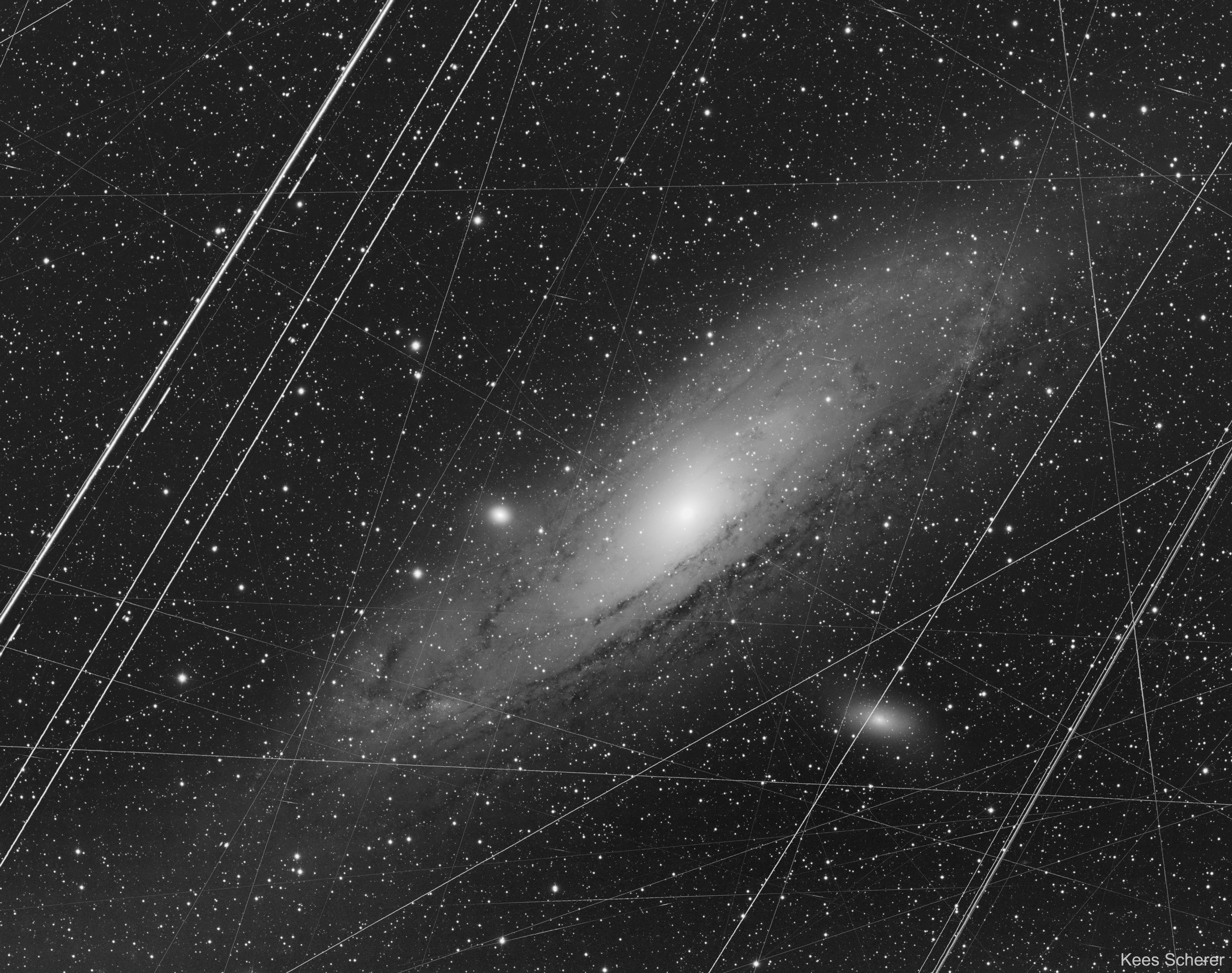
What's tripling the number of satellites going to do?

I am concerned about increasing satellite counts for a few reasons (including the potential debris problems) I don't think it should preclude progress, but existing and future stakeholders (astronomers, people who enjoy dark skies, current/future users of LEO) should be considered.