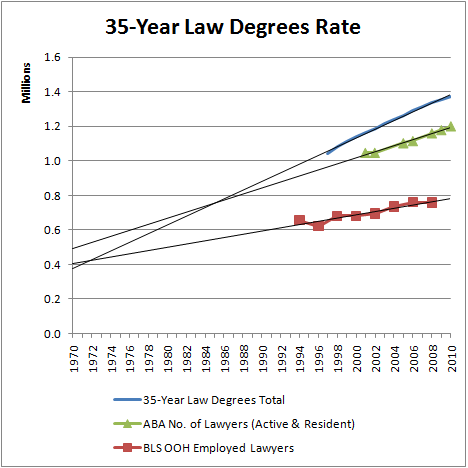
There is an American Bar Association, but it does not regulate licensing. It regulates accreditation of law schools, but it was sued by the DOJ in the 1970s for antitrust violations. Unlike the AMA, it has aggressively accredited new law schools. Since 1970, the cumulative number of JDs granted over the previous 35-year period increased by 3.5x, while the number of employed attorneys increased by 2x: https://www.mybudget360.com/wp-content/uploads/2012/01/35-ye....
The mechanism is a little different than that. They don't limit the supply, they drive demand by causing attorneys to be risk-averse.
For example, there are questions an attorney might be able to answer off the top of their head and be correct about 99.9% of the time. A low income client may like those odds and be much happier to take them in exchange for getting charged for 15 minutes of time than to have the attorney take two hours to double check the answer. The attorney, however, would answer a thousand questions like that a year and then have even odds of getting one of them wrong and getting disbarred over it. That takes option one off the table. Multiplied by every question the client has, that means the client has to pay for eight times as much lawyer time. Even if it isn't worth paying your lawyer $5000 more to e.g. avoid a 1% probability of a $15,000 penalty.
Being represented by an under-qualified attorney can ruin your life. You can go to jail because your attorney was incompetent. When the consequences are that high, we need the Bar.
The same concern cuts both ways though. It's just as problematic to have rules that raise the cost of legal services beyond what some people can afford, because not being able to afford an attorney can lead to all the same dire consequences.
Let's consider this from a different lens though. "Bridge Engineers are too expensive so lets make the requirements to become one more lax" is obviously a dangerous idea. There is a minimum amount of knowledge and experience a person needs to be qualified to build a bridge. If you cannot afford to pay someone who meets the requirements, you have no business building a bridge.
The issue is funding, not the requirements.
"In theory there is no difference between theory and practice but in practice there is."
> "Bridge Engineers are too expensive so lets make the requirements to become one more lax" is obviously a dangerous idea.
A lot less dangerous than the alternative of not hiring a Bridge Engineer at all and still having to build the bridge, which is the analogous situation for legal services.
> The issue is funding, not the requirements.
Not necessarily. Standards can be inefficiently high. It's not worth spending A to avoid a 1% chance of losing B when 100A is more than B.
That is the absurdity here though, that people are being forced to build a bridge with no support. With more funding, we could provide an engineer for every bridge (and a lawyer for every case). Nobody should be forced to go through the legal system without an lawyer. Period.
The number of lawyers has been growing in recent years. It's hard to claim standards are too high when more people are becoming lawyers than ever before. See: http://www.abajournal.com/news/article/lawyer_population_15_...
But those lawyers aren't working as public defenders because it's probably the worst job to take once you've invested in a law degree in terms of pay and stress. And until the funding situation changes to make that job more desirable, people will continue to suffer no matter how many lawyers there are.
That's fair, but then you're also talking about a foundational change to the legal system. Just providing a real public defender to criminal defendants would dramatically reduce the number who take a plea, and then you're not just funding public defenders, you now need more prosecutors and police officers and judges because there are so many more cases where the defendant would have their day in court. That would explode the budget so much that the proposal would be politically impossible without some significant changes to the laws (e.g. end the war on drugs and do something more meaningful than we ever have before about poverty) to dramatically reduce the number of criminal defendants to begin with. Which is what we need -- but that's hardly just a matter of funding. It requires a huge political change.
And it gets even worse for civil cases, because then you're going to want to fund the plaintiffs as well, otherwise you're back to the little guy being unrepresented. But then you're creating an incentive for plaintiffs to file thousands of frivolous lawsuits at taxpayer expense to try to find one that sticks, because who benefits is no longer aligned with who pays. Spending money reduces barriers which multiplies the amount of money you would have to spend.
The only way to reduce the cost is to actually reduce the cost, i.e. reduce the number of man-hours it takes for a given legal process, not just change who is paying for it.
> The number of lawyers has been growing in recent years. It's hard to claim standards are too high when more people are becoming lawyers than ever before.
The claim isn't that the standards are preventing people from becoming attorneys, it's that they're raising costs on clients. If you over-regulate nuclear power, the problem isn't that then nobody wants to be a construction worker and build nuclear plants, it's that it makes nuclear cost more than fossil fuels like coal. And that, even when it does get used, it still costs more than it should because you're imposing rules whose cost exceeds their value.
There's also no reason a lawyer cannot charge a fixed fee, which is more standard for document drafting.
You might not want to pay a lawyer a fixed fee for a case though, as that would incentivize them to put in as little work as possible.
And none of this has anything to do with the licensing, which artificially restricts the supply of Barbers and Lawyers, letting them charge more regardless of the billing scheme.
> One used to be able to self-study, pass an exam, and practice law. Now it virtually always requires 3 years of law school, at a cost of thousands.
This is state by state. In most U.S. states, you have to go to an accredited brick-and-mortar school, graduate, and pass the bar exam. At that time, there was only two online law schools, both in California. I believe that in CA (maybe one other state) also will let you apprentice for a licensed attorney and pass the bar to become a licensed attorney.
AFAIU your beef is with state legislators and not the Bar. They're the ones setting the regulations for practicing law. I agree with you, though: self-study or apprenticeship + exam sounds like a valid way to become an attorney.
The bar associations are actually trade unions. Restricting the supply of labor is the only mechanism unions have available to increase the wages of union members, and all unions do it, only the various lawyers, doctors and pilots unions are simply the most effective in this regard.
However, FTA:
> Last year, the Trump administration effectively closed the Justice Department’s Office for Access to Justice, designed in 2010 to make lawyers available to everyone.
Let's put the blame where it should go.