- Temperature. Highs, lows, daily range. Most especially lethal highs/lows, which either discourage or kill those who are exposed.
- Precipitation. More is worse, predictable is better. Most west-coast precip outside coastal WA/OR falls in a few major winter storm events. In much of the rest of the country, rain or other precip can happen at any time and frequently.
- Humidity. Excessive is worse, though in otherwise moderate climates, tolerable.
- Proximity to services.
- Precipitating causes. Locales which chew up and spit out people, especially w/o community / family / social bonds, are likely worse.
- Land values. Higher is generally worse, both in terms of overall affordability, and in the tendency toward NIMBY exclusionism.
- Culture. This cuts both ways, but a tendency to look after people probably tends to reduce risks, while a tendency to provide some level of institutional support or cover may help. Pronounced opposition may discourage lingering.
- Economy. A thriving economy raises living costs, but can also increase either casual/gig labour, or handouts.
- Avenues out. If there are ways to get back on track after falling through the safety net / cracks, peope may not remain homeless for long.
- "Nontraditional" housing and living arrangements. Options outside detached single-family dwellings, opportunities for the noncredentialed / intermittantly employed.
- Family, addiction, and mental health services.
I'm still far more ignorant of this area than I'd like to be, and most of this is impressions rather than substantive and evidence based, but as a first-order set of factors seems likely.
Normalcy is perhaps more important to the unsheltered. It's generally acceptable to pathologize their necessary behaviors. It's less acceptable to pathologize behaviors enabled by wealth. Indeed it is common to idolize them.
$100 of gas gets you about 24 gallons at california average prices, even at 20mpg that's 2x what you need to get to reno (218mi), on the way to reno you travel through sacramento. there are alternately many other central valley options at less distance from SF (from which many uber/lyft drivers commute to SF for their day -- for example stockton, modesto). redding is also 217mi from SF if you want to go north instead. eureka is only 271mi. grants pass OR, and los angeles are both in the 380mi ballpark, still within the $100 budget.
i'm not sure why you think vegas has a wider diversity of options -- it could be i don't understand your criteria for options. vegas is central in a vast amount of desert. it's 271mi to LA, 286mi to bakersfield, 302mi to phoenix and 421mi to salt lake city. a massive amount of NV north/northwest of vegas is off-limits military test range -- population density is extremely thin in most directions from vegas.
sources: gmaps for distances, and AAA for gas price (https://gasprices.aaa.com/?state=CA) i rounded up to $4.20/gal. 20mpg i picked semi-arbitrarily because i didn't find a good hit in the first search i did.
I used $4 for California. But nobody in Orlando is saying "3.89 what a deal".[1] California's high gas prices exacerbate the problem of distance. In the east $100 provides more range in addition to go along with more options. Even $2.00/gallon wouldn't get you across the all deserts and mountains between SF and Denver. It wouldn't even get you to El Paso where there's nearly 1000 miles of Texas still left.
[1]: https://www.google.com/search?client=ubuntu&channel=fs&q=gas...
The west coast largely doesn't, and the intermountain and west plains region is far less populated still. See:
http://modernsurvivalblog.com/wp-content/uploads/2017/06/pop...
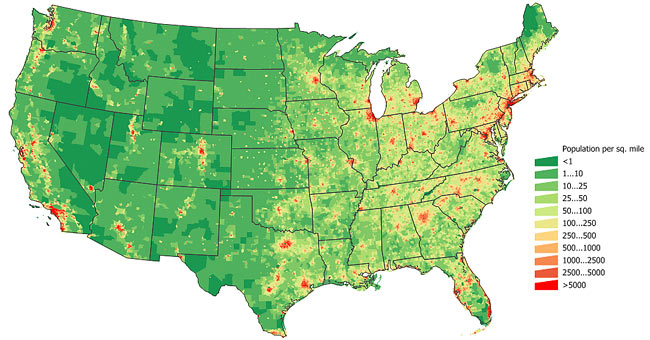
https://en.wikipedia.org/wiki/List_of_metropolitan_statistic...
Dense population centres as vertical relief:
https://i.imgur.com/a8tsVUP_d.jpg?maxwidth=1024&shape=thumb&...

The "whys" of this are interesting, though I suspect much of this revolves around water and transport. How much it affects homeless populations is an interesting question as well.
The climactic factors Doreen mentions are undoubtedly a factor, though I suspect the ease/difficulty in finding nontraditional means of support (odd jobs, busking, panhandling, gig work) likely matter. The options for other than traditional single-family and long-term apartment dwelling, and the relative costs of mortgages and rent also undoubtedly matter, as does the ability to get too and from residence, work, and/or services.
My experiences travelling through the US are:
1. The changes in density are hugely apparent, with the almost wholly unpopulated region between California's central valley and the eastern front of the Rockies being most pronounced. There are marked transitions at, say, SF, the 9 bay counties region, Sacramento, Reno, excepting Salt Lake / Wasastch next Denver / Front Range, Omaha, Chicago, and then points east. The density of development along the East Coast, from Boston well into Virginia is hard to appreciate for those who are only familiar with California. And even more rural regions east of the Mississippi and well through the South are far more developed than most of California is. The stretch of CA-99 from Roseville to Bakersfield being only slighly comparable -- it's a linear belt whereas through the Eastern US you'll find comparable or higher densities in all directions.
From San Francisco, for two hours' travel, you have ... more or less two destinations: Sacramento or Stockton. Going north or south, there's nothing until Portland, OR, or Los Angeles. And once you pass Sacramento, there's very slim pickings until you cross the Rockies, or better, the Missouri or Mississippi rivers, which is at best days travel by car or bus. And once you arrive, options may be few and attitudes not particularly welcoming.
2. Density alone isn't vitality. There are relatively habited regions which offer little economic opportunity. That's pointedly obvious as you travel through the Mississippi Delta region, much of Arkansas, and old rust-belt regions of Indiana, Ohio, and Pennsylvania. Even with density and clement weather, and despite low costs, support is scarce.
The feel of regions that do have some level of wealth or at least money flows is palpable. Aspen, CO, Seattle, WA, and Menlo Park, CA have tremendously different feels than Clinton, IA, St. Louis, MO, or Gallup, NM. Even attractive tourist-based regions often seem to have an edge of concern based on a mix of past indigenous sources of wealth (often mining and timber) now gone and a fear for what happens when the travel fad fades. What passes for generally vibrant in most of the US would be considered strongly depressed in much of California, where the distinctions between even thriving core and outlying regions of the SF Bay Area are severe.
3. Local attitudes matter. Homeless, housing-challenged, car- or van-dwellers, and the like, are more evident where support and services exist, all else being equal. Over the past few decades, I'd say they're more evident generally, and aren't strictly limited to the west or even coastal regions generally.
4. Much of coastal California, as well as the central valley, has and has long had its homeless or transient populations. I strongly recommend Steinbeck's Grapes of Wrath as a backgrounder.
The question of why homelessness suddenly emerged in the late 1970s / early 1980s is one that's interested me. I've had an occasional correspondence with Doreen since replying to a comment of hers on HN about a year ago based on some research I'd done on the question at the time. How much of the phenomenon is simply nomenclature and semantics, and how much is an increase in the number / visibility of the unhoused, is something I still don't have a good handle on myself, though I do strongly suspect the problem is getting worse. Failing to offer options other than detached single-family dwellings or rabbit-hutch apartments or housing tower blocks seems another. There really ought be a sensible middle range. There isn't.
Doreen has been advocating for SROs as at least a partial solution. She may be right on this, though I see it as at best only a partial element. Co-housing, intentional communities, boarding, and other options may also be useful. As well as a widely implemented land value tax.
Treating housing and real estate as financial assets rather than essential societal services seems to me a very strong component.
https://news.ycombinator.com/item?id=18499697
That last element turns up in another item I've found fascinating, a 1937 analysis of resistances to technological innovations which includes among other sectors housing, by Berhnard J. Stern:
https://archive.org/details/technologicaltre1937unitrich/pag... (Markdown copy: https://pastebin.com/raw/Bapu75is)
My attention had been first brought to that by Stern's research assistant for the project, a young Columbia University graduate student named Isaac Asimov.
There are a whole slew of valuable lessons from that piece. I've submitted it a few times to HN though discussion's been light to date.
https://news.ycombinator.com/item?id=20532443
All told, though, this is a problem that's proved stubbornly resistant to technological (or any other) solutions attempted to date, and for which awareness and understanding are at best limited. Doreen has direct experience (I really don't), and her criticism of what I'd seen as a generally sensible and surprisingly sympathetic White House white paper is cogent.
My understanding is that deinstitutionalization plays a large role here. The US institutionalized about 500k people nationwide until 1965, when that number cratered to about 100k by 1980 [1]. Not everyone who is released this way ends up homeless, but a recent study in Massachusetts in Ohio found that about a third of people released from mental institutions have no known address within six months [2].
You seem to have thought a lot about this topic, what is your take on the role of deinstitutionalization? Institutionalization seems cruel, but our current system pushes many people with severe mental illnesses onto the streets or into prisons, which seems worse.
[1] http://bpr.berkeley.edu/wp-content/uploads/2017/10/Mental-Ho...
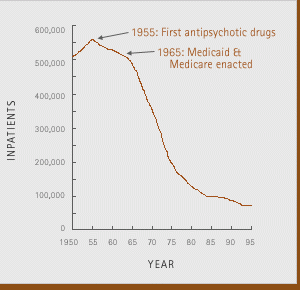
[2] https://www.treatmentadvocacycenter.org/fixing-the-system/fe...
The quality of housing at the left of a price histogram became higher. But so did its minimum cost. There's less transient and temporary housing. The overall population is larger. Hope VI continued the removal of the least expensive housing under the rubric of urban renewal policy right up to the twenty-first century.
Then demographic and economic reality changed, but we've been both reluctant to rebuild the cheaper accommodations that got demolished and we face serious logistical barriers to recreating such. Cheap housing tends to be older housing. New construction is generally built for the middle class or the wealthy. Poor people don't finance new construction.
So we currently have a huge shortage of housing that works for lower income people. It's not just a factor of rent price per se. We also have created a situation where most Americans cannot live without a car, which is de facto another substantial financial burden and logistical barrier for anyone with physical barriers to being able to drive. On top of that, we just straight up do not have a lot of decent housing options for anyone who prefers a smaller home for some reason.
I'm still trying to figure out out how to document and communicate the shape and extent of the housing problem. Using the term "affordable housing" fails to be helpful in talking about the issue. In fact, it's counterproductive.
But the huge loss of entry-level housing is a large part of this problem space and the period of its active destruction coincides with the findings by dredmorbius that at some point our terminology changed in a way that suggests the issue of homelessness fundamentally changed such that it is inherently more serious, problematic, chronic and long term.
Stigmatization of poverty is not the only tradition at play in America. San Francisco's namesake advocated poverty and homelessness. The city was literally established by homeless men who lived in poverty.
The "affordable housing" problem limits solutions to those meeting some criterion for "economically deserving." It precludes pursuit of universal shelter security free of relative political disability. Affordable housing allows eviction from public housing when a family member is criminally charged. Affordable housing allows assistance disqualification for past drug offenses fully paid. Affordable housing is premised on scarcity not abundance.
At the macro-economic scale affordable housing has the delusional premise that there's a housing market that exists in an independent way. The delusion that there's a housing market that can reach equilibrium. Housing is not just one among many alternatives for achieving returns on real-estate investment.
It's one of the worst because conversion of real-estate to housing is sticky. Conversion of housing to more productive commercial, industrial, and agricultural uses ranges from hard (rental trailer parks) to near impossible (multiple single family fee simple lots). Politically, housing houses voters. Economically, homeowners have an incentive to hold out during aggregation.
Real-estate investment is primarily a vehicle for preserving wealth. It's long term. Cashing out is only rational when the returns are high. Cashing out into housing only makes sense when the cash value of the housing at time of delivery exceeds the potential long term value of other uses minus the increased risk from liquidating a perpetual real property title into goods, chattels, and/or financial instruments.
I see our current homeless crisis as a crisis that emerged out of the success of past generations, much like London burned to the ground because as big cities finally emerged from a growing population, it wasn't obvious beforehand that thatched roofs and the like would be a disastrous detail when building a lot of housing under conditions of population density that had not been previously seen.
I am aware that classism and other evils exist. I experienced classism first-hand while homeless.
But I don't find it constructive to focus overly much on that and I don't feel that framing is particularly accurate. I think the majority of the problem is due to factors like blind spots on the part of the privileged.
In a case where you have a mix of root causes, it's generally better to focus your effort on the more readily resolved pieces of the problem. When one of those pieces is prejudice, addressing other pieces of the problem is an effective means to combat prejudice.
Condemning people for their prejudice tends to entrench the problem, not remedy it. Casting light on the fact that their assumptions are incorrect is far more productive.
I believe that this problem exists not because most people in power actively desire to be abusive assholes punishing the lower classes for existing but because they don't have good answers. I think the best thing I can do is do the research, figure out how to effectively communicate it and make it freely available on the internet for anyone interested in the topic.
That still leaves me with an unresolved question of how to pay my own bills. I'm off the street, but I still struggle to make ends meet. I'm currently nearly broke and facing a week where I am likely to go hungry for a few days.
This is an all too common occurrence in my life. Ads are "dead" so to speak and I don't know how to get enough tips and/or Patreon supporters to turn my writing into a middle class income for me.
But other than the detail that it isn't paying enough, I feel pretty confident that this model of 1. Do the research and 2. Put out good info for free is our best hope for finding a viable path forward on some of our current hard problems.
Thank you for your participation in this discussion. Your comments have been enormously helpful for me.
I think in the context of homelessness, "affordable housing" is used to muddy the waters. "Affordable housing" gets people off on the tangent of home ownership and the American Dream expectations of FAANG engineers. And when that connotation starts to gain traction, "affordable housing" can be used to derail that conversation by bringing homelessness into the mix. No matter what I mean, "affordable housing" has another meaning that can be used to derail my point.
I am really glad you are writing what you are writing and sharing it on HN. It makes Hacker News a better place.
My perspective on housing has developed over the thirty years since I studied architectural drafting at vo-tech and later an MArch. I worked nearly exclusively in housing from 2001 until just a few years ago. With and for developers and homebuilders plus some time in government as a planner and building plans examiner. I watched Hope VI go down in grad school. I worked on some Tax Credit housing projects when I had an independent practice.
Anyway, if I can help, my email is in my profile. Thanks for making HN better.
Thanks.
I did write you about my latest project. If you don't see an email from me, check your spam folder.
The connection is complicated, but plausible.
As the US increased its share of oil imports, starting in 1950, its balance of trade shifted from net exporter to importer (debtor). Before the OPEC crisis of 1973-4, Nixon took the US dollar off the gold standard. I see this not so much as a problem as a response to one: it's not possible to maintain a stable currency against a consistent spending outflow.
The '73 crisis itself not only cut off oil supplies but created a huge spike in cost, again exacerbating the BoT problem. One of the critical events in resolving the crisis appears to have been a meeting in December 1973 between Henry Kissenger and the Saudi finance minister, on which I've as yet found little as to substance. A consequence of this was the "dollarisation" of the US-Saudi oil trade, later extended to the entire international oil market.
From a currency perspective, this solved two problems. The US saw a huge new demand for dollars (absorbing much of the inflationary consequence of increasing the money supply, and both government and private spending), and the Saudis weren't saddled with an ever-appreciating (deflating) riyal.
But the US and the Federal Reserve still had the problem of how to manage the money supply, and fixed on fractional reserve banking and open market operations to do so. This meant that banks and bank assets played a huge role in managing the money supply, where bank assets are loans, largely business and real estate. (Stocks and other equities play a relatively minor role.)
Appreciating real estate valuations, already attractive to banks, became even more so.
A second whammy came with the Iran embargo in 1979, by some measures more severe than the 1973-74 crisis. Meantime, increased energy costs and political shifts were undermining both manufacturing and union jobs, with them, pensions. Appreciating housing also became the household asset and retirement plan for homeowners. Toss in environmental regulations (not a bad thing of themselves) and tax revolts such as California's Proposition 13 in 1978 (a bad thing of itself), and you'd pretty much put all the ingredients together for a fatal brew.
Stew over a sputtering GDP for 50 years, and voila!
The first major reporting on homelessness came in 1980, during the US presidential election campaign, from CBS. The Doonesbury comic strip began an item at about that time, and many homeless organisations date from 1980 or shortly afterward.
There's the question of why this hadn't happened earlier. I'd largely chalk this up to the post-WWII urban exodus and suburban housing boom, throughout the US, but in particular in California, which until 1970 had never seen a subdivision or freeway it didn't love at first glance. OK, slight exaggeration -- the San Francisco freeway revolts began in about 1956, and numerous planned routes in SF were cancelled in 1959, but the movement continued to pick up steam statewide through the 1960s:
https://en.wikipedia.org/wiki/Highway_revolts_in_the_United_...
By the mid-1970s, the idea of simply rolling out massive new tract home and automobile-centred transport projects within California had largely ended. Projects could move, but took far longer and cost much more. Urban centres were already unpopular (the reverse migration into SF began in the 1980s), and there were considerable resistances to densification. What effect events such as the Loma Prieta Earthquake (1989) and Oakland Hills Fire (1991) I'm not sure.
By the mid 1990s, housing prices were taking off again, new dense construction was at best difficult, and at the same time, employment was fairly ill-defined -- California was in the process of shrugging off much defence-related activity (base closings, shifts from defence-related industry), but hadn't yet discovered high-tech. "Multimedia Gulch" (South Park, SF) was A Thing briefly in the mid-1990s, biotech was generating far more hype. There were military base closings across the state (San Diego, Los Angeles, Santa Barbara/San Luis Obispo, Sacramento, Stockton, Vallejo, Alameda, Mountain View, Concord, Fairfield/Vacaville, and more).
Then Netscape appeared and Dot Com 1.0 took off, August, 1995.
Maybe it'd be better to look at Greyhound bus fares, instead.
On the street, gas money is still more than a proxy. For the carless, gas money is an ordinary way to get a ride in someone else's car.
Just now, the lowest fair on the Greyhound website for San Francisco to Atlanta six months (4/20/20) from today was $186 and 62 hours. I used six months because that seems like a reasonable lead time for a planned relocation. I used Atlanta because it is a lower cost metro with a lot of opportunity and moderate weather.
The lowest cost ticket to Atlanta tomorrow (10/21/19) is $217. Denver is $156 and leaves at 11pm. Chicago is also $217 at 11pm. I'd need convincing that Denver or Chicago is a better unsheltered living option than San Francisco.
On the one hand, even a Prius is unlikely to get you to Atlanta for $217. On the other hand, you can't take a lot of worldly possessions on the bus and two or more people can't share the cost of transportation.
You can get out of California for $100 or less by train if you buy your tickets in advance for a mid-week date. That's how I left and got back into housing (I'm the author of the piece under discussion).
That can get you to parts of Oregon, Washington or Reno, Nevada. You might also be able to get to Arizona, but I didn't research that because I had no desire to go to Arizona while homeless in California and looking for a path out, so I can't say for sure.
But giving that bit of information sounds like your point is irrelevant and I don't think that's the case.
When I was in San Diego County, I was having trouble figuring out how to get the hell out because there is a large military base occupying much of the far northern part of the county, so you can't just walk through there. With limited funds, paying for Greyhound tickets or the like was a barrier to leaving. I also did not want to go through Los Angeles and most or all long distance transit routes through that area. I have serious health issues, including respiratory problems, and the LA basin is horribly polluted. I didn't want to pass through that on my way out.
I found it challenging enough to find a viable route out of San Diego County on a budget that didn't pass through LA that when I finally left, I documented how I did it for the benefit of other homeless people in San Diego who might want out but think there is no viable way out on their budget, in their circumstances:
https://sandiegohomelesssurvivalguide.blogspot.com/2015/05/o...
Homeless individuals typically come from the general population and when they don't have the funds (or necessary papers) to do things the "usual" way, they may have trouble thinking up alternate methods. Commuter busses are a non intuitive way to travel that work especially well for homeless individuals because they don't require ID, advance purchase of tickets etc and they don't cost much. I spent a lot less on commuter busses than Greyhound would have cost to cover the same route.
I'm trying to figure out how to effectively publicize that fact, as well as help homeless people find other ways to overcome their myriad barriers to relocating so as to take advantage of opportunities to try to make their lives work. I think the degree to which homeless people end up trapped in homelessness because homelessness itself is a barrier to relocation is a significant part of the problem.
The logistical barriers to relocation once you are homeless are quite substantial. But you are correct that barriers to ready solutions for the general population contribute to a slide into homelessness and then help make it hard to escape. This is an element of the problem overlooked by most people: that factors that make it hard for "normal" (housed) people with problems to address their problems fosters a slide into intractable poverty and ultimately homelessness. The homeless are not a separate population. They are drawn from the general population and policies help create situations where they get behind the right ball and then can't get out. We need to find policies and practices that regerse that trend rather than help to entrench it.
Thank you for leaving the comment. I'm disinclined to agree with the implicit assumption that this metric is the entire explanation, but it does resonate with some of my experiences and highlights an aspect of the issue I'm aware of but haven't explicitly focused on.
I'm aware enough of the connection between physical mobility and upward economic mobility that it influenced the grouping of information on my first homeless site:
https://sandiegohomelesssurvivalguide.blogspot.com/p/mobilit...
$60 in gas would have got them closer. I started thinking about how hard it is to get away from California back in January. I was heading back to Auburn from Mojave. I got a brake related warning light on I8 in Arizona and pulled into an Advanced Autoparts to get an OBD code. It's close to 10pm The store's reader doesn't do brake codes. But one of the guys has his in his car. He's from...I don't remember...but not a California city I'd go out of my way to visit. He tells me had to get out. Bad environment. His car is something small. Twenty + years old. And was cheap when it was new. Tuscon is a long way across a lot of Mojave and basins and ranges from where he left. Far enough that he doesn't go back to visit mom. He didn't half to check my code. He gets bored with nothing to do. ADHD diagnosis. I get the sense his coworker feels there's more dignity in boredom. Probably helps him cope with the other guy's ADHD on the dark winter nights. He's read the codes. I express my gratitude and crash for the night in the Walmart parking lot...staying at the W.
Sometime in the next 600 miles I realize how far California mostly is from everyplace except somewhere else in California. Six hundred miles gets me to Odessa Texas. The last 100 of it smells like motor oil. Lights twinkling in the night like the edge of a city that never comes. Permian Basin full tilt. The hotels have shed houses in their parking lot. The RV parks aren't recreational. Neither are the vehicles. Roughnecks are living in the biggest tent Walmart sells at the state park campground. It's full. I sleep next to an abandoned truck scale along a stretch of US80 now routed on I20. I'd miss it all if I flew. I wouldn't have time to think.
Since June 2017 I've made five road trips in the American west. The most recent was the shortest at 3000 miles over 12 nights. Unless my move to California counts in the van with a little furniture and the two dogs. That was 2400 miles in 72 hours and there are six trips. The longest 9600 miles in 28 days out to the end of the Olympic Peninsula with Victoria across the Straight of Jaun de Fuca.
There are only four significant routes from the great plains to the Pacific (plus a few variations). The Great Northern Railroad route from Minneapolis to Portland now I90. The Union Pacific from Omaha to Oakland ends up being I80. The ATSF through Flagstaff and across the Mojave into Barstow is now I40. It used to be Route 66. And the Southern Pacific is now I10. It's still the only all weather route to the West Coast and was only made possible by the Gasden Purchase despite all that Mexico ceded following the war. Time hasn't changed the geography. The only road over the Sierra Nevada between Barstow (access to LA) and Donner's Pass (access to Oakland) runs through Yosemite National Park over Tioga Pass. Two lanes. No commercial traffic.
Living on the road isn't being homeless and it's elements of poverty are the poverty of choice. But it exposes the challenge that geography. There's no conspiracy behind Amtrak terminating all those east west lines in Los Angeles. Geography is why I40 turns south at Barstow toward LA. Going around the Sierras is viable. Going over them isn't.
In the east distance is lesser, mountains lower, routes more. It impacts our mental maps. Americans think about the West based on the geography of the East. Based on Europe. It isn't. Most of the coast between San Francisco and LA is sparsely inhabited. There's Monterey. All the coast North of San Francisco is. Portland and Seattle and Vancouver are a mountain range inland. They're relatively near the Pacific coast. But not nearly on it.
I got evicted from an apartment in Columbus, Georgia. I decided to try to return to the western US because I had lived here previously and I knew from firsthand experience that my respiratory problems are more manageable out here.
So me and my sons left out on foot nominally heading for Wyoming. We ultimately abandoned that plan and returned to California.
Arizona was a really bad experience. We were going through northern Arizona and large parts of it are Indian Reservations, which means it's basically a dead end. You can't just drive through there. You only go down that road if you have reason to go to the reservation, from what I gather.
It's illegal to walk on the highway, it's illegal to hitch hike and there are no other roads through there in some parts of Arizona. If you don't have a car yourself and can't afford a bus ticket and didn't know any of this before going, you are trapped. There is no legal path forward if you are dirt poor and on foot.
While trapped in some part of Arizona, having learned the above information the hard way -- by going there on foot while homeless -- a law enforcement officer gave us a ride to a shelter because a snow storm was coming. That's how we got out of that mess.
We ended up not staying at the shelter. We found a small cave on the face of the bluffs to camp in, basically, a tip from a Navajo man who had given us a ride in New Mexico. We were toasty warm while the snow came down and we were fine for the night.
If you don't go through northern Arizona, you have to go through southern Arizona. This brings you close enough to the Mexican border you may have to deal with border patrols.
My sons had no ID at the time. I couldn't prove they were American citizens. I didn't want to deal with the border patrol. That was potentially a very big problem for us.
A lot of people on the street have little or no ID. If you don't have ID, you don't want to travel to close to the border. Worst case scenario: You get deported from your own country because you can't prove you are American and now your problems get vastly worse.
We desperately need an internal amnesty program that helps homeless people get ID so they aren't "illegal aliens" in their own country.
My sons and I eventually caught a ride in Arizona that got us to San Diego County, where we had decided we wished to go. The eastern part of southern California is extreme desert with features like sand dunes. I had not realized this prior to getting a ride into San Diego, a city I had been to briefly only once before for a GIS conference while I was in GIS school in Riverside years ago.
So you can't walk north to get out of San Diego because there is a military base. You can't go west because that's the Pacific Ocean. You can't go south because that's Mexico. You can't go east because you will probably die walking through the desert.
If you don't have either a car or some means to access transportation, there are parts of the west that are traps that you may not be able to readily escape.
I don't really think that's true of San Francisco. I think you could probably walk south to get back to mainland California on foot and there are various transit options that shouldn't be too pricey. But maybe it's worse than I realize and maybe San Francisco is as bad as San Diego in terms of "Good luck with getting the hell out of here if you are dirt poor and traveling on foot!!!!!"
If that's true, your original comment may be a far larger part of the problem than anyone suspects. I have no idea how I would research that.
Where I grew up, in Georgia, there are plenty of roads between cities that are two lane roads that you absolutely could also walk on. It's not the case that the only way to get there is some limited access freeway that it's not legal to be on if you aren't in a vehicle.
When you need both money and paperwork -- like ID -- to go anywhere, being homeless can mean being trapped where you are currently with little to no hope of getting out of there. That's definitely something that needs to be looked at a whole lot more based on my firsthand experience. And it definitely seems to be a bigger issue in the western US due to the high mountains and the desert landscapes of so much of the west.
We were traveling through Arizona and the like because we were traveling in January, February and March. I got to San Diego County in late March, having ended up on the street on December 31st.
We were in sandals and we spent a month on the beach in Port Aransas from January 15th to mid-February because I didn't want to lose any toes to frost bite or die from hypothermia while traveling in winter. Even with continuing on west after a month safely ensconced on the balmy Gulf Coast, we were traveling through snowy conditions at times.
I ended up with open wounds on my feet from the cold making my skin brittle and the sandal straps cutting into my brittle skin. I have health issues and the circulation to my feet wasn't so good at that time. My sons didn't have this problem, but I did.
A lot of people who are homeless have serious health issues. that's basically one of the risk factors for homelessness in the US because of our shitty healthcare policies.
If you want to avoid Arizona because the northern part cannot be traversed on foot and the southern part takes you too close to the Mexico border and you have no ID, when the next state above you is Colorado. In winter, that seemed like a death sentence. I also imagine it is as challenging to traverse as Arizona because it's so mountainous. This means that you have natural geographic bottlenecks to travel and you can only get from point A to point B by going through a mountain pass and you may not be able to legally walk through there. The only path through there may be a federal highway and it's illegal to walk on it.
When we were heading from San Diego to Fresno, we got dropped in some town in the High Desert and ran into exactly that kind of situation where we couldn't get to Barstow because we were on foot and the only road through the pass was a highway and it was illegal to walk on it. We ended up taking a commuter bus.
It's straight up Verboten to walk to some parts of the US because the only path through there is a highway it's illegal to walk on the highway and it's usually illegal to hitch hike. So you literally have no legal means to travel if you are poor enough. Our travel routes are designed for vehicles and no one thinks it is necessary to make sure that walking or biking or similar are still viable if you don't drive or whatever.
There are many parts of the west where you simply "can't get there from here" if you are on foot. Even if you have tons of stamina and energy and so forth, it's against the law.
And our travel routes are often designed in a manner that is actively hostile to foot traffic even when it isn't illegal. We do not have pedestrian-friendly policies in the US. We are an insanely car-centric nation and it's quite challenging to make your life work without a car here.
San Francisco is a local minima/maxima. Vegas has more diversity of options within 600 miles. Orlando is just another place in the east. Consistent with my intuition/hypothesis, the report says Hawaii has a much higher than predicted unhoused homeless population. Objectively you can't get anywhere better/different with $100.