It's dead simple. But it hinges on the state having a database with every citizen's address. As I understand it such an idea would be very unpopular in the US.
The problem comes in when those addresses change. There's no requirement to inform your old state you left, so millions of inactive voters are left in the database. Generally there's a requirement to register in the new state (drivers license) within 30 days which is often missed, or not required for temporary moves like college students.
These purges do serve a legitimate purpose, but are often used as a political tool to alter turnouts.
In Germany when you arrive somewhere we know that you are coming from somewhere. So when you register at your new address that usually involves your new city hall informing your old one that you moved.
I guess that doesn't really work if registration isn't universal (in Germany we track you place of residence basically from birth, it's used not just for voting but also for determining where your taxes go, for government communication, to make sure nobody skips out on bills by moving, etc).
If we tried to institute that kind of system, the political party which currently is all against voter id would be up in arms too.
The problem comes when we start trying to purge the rolls and there are false positives. The bigger problem is when those false positives are disproportionately citizens of color. Similarly, voter ID cards are not problems philosophically as much as these ID laws disproportionately affecting poor people and people of color.
If you want an ID law, you make IDs free, you account for many of the edge cases like elderly people who don't have birth certificates yet are clearly citizens, and you bend over backwards to make sure everyone who can vote gets one regardless of it costing a little more.
1. The people can keep track of a card for 10 years. 2. They can afford to pay 20-30 Euros for something they only use for voting, since apparently they aren't involved in any other part of civic life that involves having an id.
And you believe it's the Republicans who are hating on immigration enforcement? The proposal for tracking everyone's residence not going to fly(coincidentally another thing you need id to do) with those people.
If you are a farmer who uses undocumented workers, same thing. Put the onus on wealthy citizens for doing the wrong thing and have real consequences. Have sting operations. Yes, there's a basic underground economy of labor like maids, but that's a small portion of the undocumented economy.
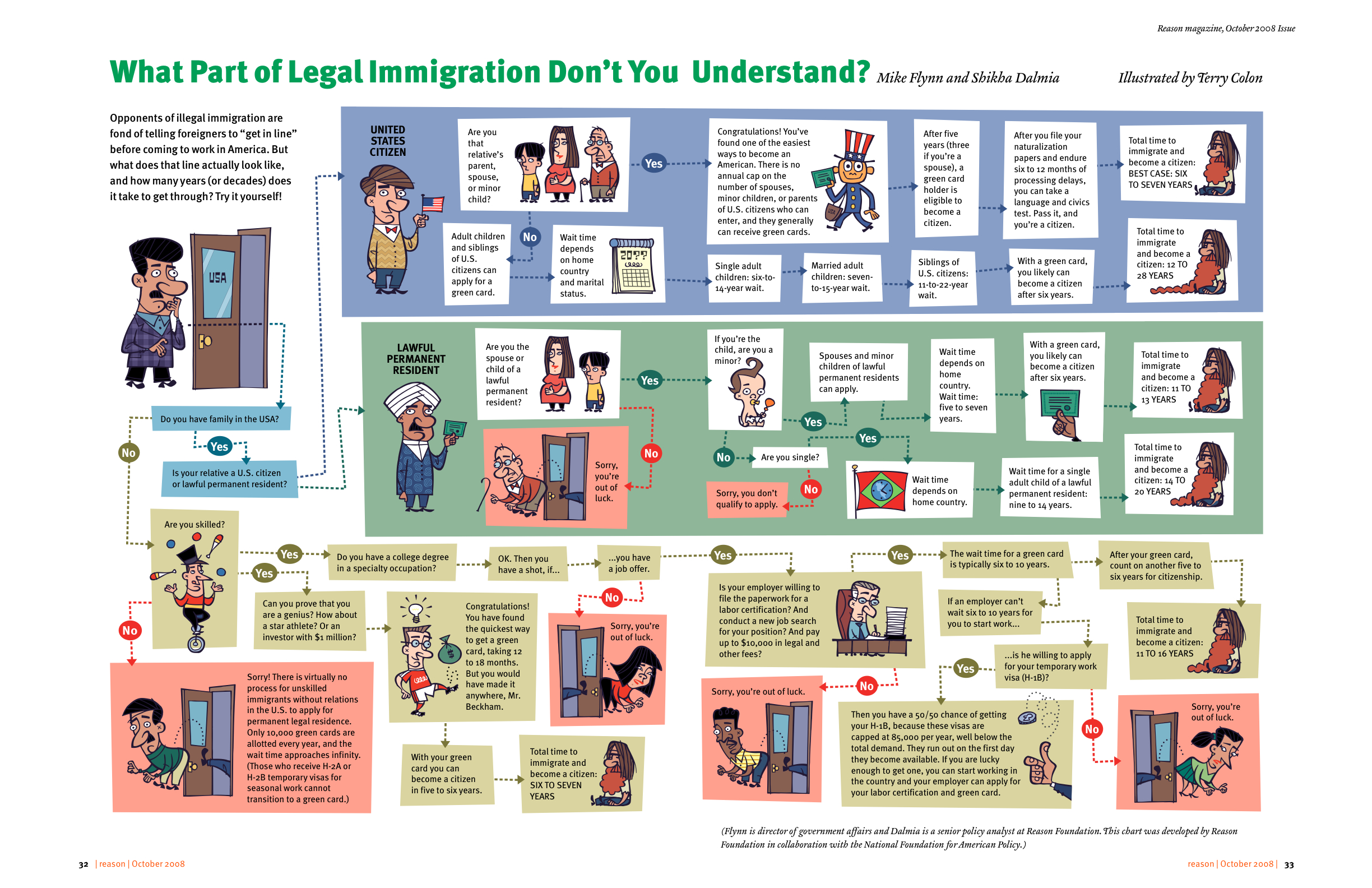
Then, create a Real immigration system that does not have 15 year wait systems. (http://www.openlawlab.com/wp-content/uploads/2011/10/IMmigra...) Fix the H-2A guest worker program. (See https://www.farmworkerjustice.org/advocacy-and-programs/gues... ) Provide pathways to citizenship. Replace the H1-B program with one that is not exploitative. (permission to change jobs? Immediate deportation if you lose a job and don't immediately have another?) Accept that grocery and dining prices will rise.
Oh, and don't put kids in cages. Treat asylum claimants as human. Provide pathways to legal status.
The problem is that every Republican solution is based on punishing those who are poor and turns a blind eye to those who are wealthy.
Don't let that get in the way of actually responding to the objection regarding tracking of the residents of the US. But tell us how you really feel.
We already lost that battle. And we are tracked when we register to vote.
It so happens that active voter suppression is actively practiced by republicans, because we have their emails from people in state legislatures to researchers asking questions in two key areas: what forms of ID are minority voters not likely to have that 'our' voters do, so that we could block them for registering [0]. And the second thing is picking your voters, which used to be in both parties but today is pretty much also used by one party. Also doing things like cutting early voting and other extended voting which predominantly let people with low-wage jobs have time to vote on weekends. Another cool one, preventing kids from pre-registering, cause those kids are of course not so conservative [1].
Also we have conservative conferences including ALEC talking about how to suppress voters [2].
Today there is no question that republicans use these tactics to actively suppress votes and voter registration for people that are likely to vote against them. It's not in question, it's not just a few bad apples.
[0] https://www.chicagotribune.com/nation-world/ct-north-carolin...
[1] https://www.thenation.com/article/north-carolina-wont-stop-s...
[2] https://www.mediamatters.org/american-legislative-exchange-c...
In a very real sense: because that would make it easy to vote.
Free IDs are directly inimical to the effort to prevent people from voting. That prevention is a major effort of one major American political party because it's seen as the only way they can win in an increasingly diverse country.
The folks who are against free IDs--who want it to be hard to vote--also get very weird about "databases of people", even though they already exist and corporate entities compile them right alongside governmental ones every day.
I get the desire to assume good faith in this, but we literally have the receipts.
I always frame the argument like this to my family when they complain. "I'm not opposed to the government maintaining a database of everyone's current address and related information, but if they are going to do that, they should provide free IDs and encourage everyone to participate."
https://twitter.com/grascarp/status/1184049934653427712
The GOP learned a long time ago that if you win it doesn't matter how dirty you are. You're not going to prosecute yourself after all. By the time the leadership changes hands everybody will have forgotten about it.
Because the goal of the Republican Party is explicitly to use these laws to suppress the votes of certain demographics, not to actually secure the vote.
For an example direct quote from a court case: https://twitter.com/haroldpollack/status/1051657219899617280
Your linked source is talking about an entirely different issue. Does not prove your point about Republicans using voter id laws to suppress the votes of certain demographics, or that it's a point of the Republican party as a national organization to do that. All we know is that some Republicans are biased, just as all people have biases. Also, your source is not substantiated.
I'd be happier if proof of citizenship was required to vote, not just photo id. Don't know of a practical way to do that except to check passports, but the passport office would be overwhelmed.
It's a court ruling that shut down North Carolina voter ID and early voting laws, in part because the defense of those laws included that that literal quote about it making harder for black people to vote.
> All we know is that some Republicans are biased, just as all people have biases.
When 'some' is enough to control a state legislature, and similar things happen across the country (https://www.npr.org/2018/10/23/659784277/republican-voter-su...), it's a logical conclusion.
> Also, your source is not substantiated.
It literally links directly to the court judgement.
I don't see how it follows that a state legislature's cupidity directly translates to a national party's intentions. That's a bridge too far. If there's a smoking gun, such as a leaked internal memo, I would agree totally. People are scumbags and are biased to try to make their side win in most situations.
>It literally links directly to the court judgement.
Yes, for closing the polls early, not for voter id laws.
1. 4 times Alec was caught talking with republican lawmakers about how to suppress the vote (Montana, Alabama, Phoenix, Omaha : https://www.mediamatters.org/american-legislative-exchange-c...
2. North Carolina suppression tactics https://www.thenation.com/article/north-carolina-wont-stop-s...
3. More on N.C. voter id law to suppress voting: https://www.chicagotribune.com/nation-world/ct-north-carolin...
It's not just some scattered occasional thing of a few bad actors. There are state by state actions and national conferences making this happen.
What about a variety of direct quotes from the heads of different state Republican parties? https://www.nytimes.com/2016/09/17/us/some-republicans-ackno...
>Yes, for closing the polls early, not for voter id laws.
The judgment is on a law that affects both.
That shows no evidence that they are willing to make their views public or that they are shared by republicans on a national level. There is absolutely no evidence for that. > The judgment is on a law that affects both.
That is not in evidence. The article you cited did not link the court decision mentioned. The court decision is only speaking to the decision to close polling spots on Sunday because it will suppress black, and majority Democratic voters.
What measure of proof do you require?
Let me put it into computer terms: when your program isn't fast enough and you've got a nice profile trace, do you start your analysis with the functions using up a lot of time? Or do you start among the functions that aren't using lots of time?
Why approach vote fraud any other way? The majority of vote fraud (the 'r' is deliberately dropped, BTW) is by the incumbent party systematically preventing votes and voters from being counted.
Jimmy Carter tells the story, for example, of a town in Georgia where the voters were recorded as having voted in alphabetical order. That's real vote fraud, and something that no amount of pretend voter ids will help.
None of those things make any sense. A church is more than welcome to only accept people with a passport. I can't imagin that will be going on for long. The post office is a service, and they will sell to whoever can pay. Sending a letter to your representative - you'd probably get a bigger impact if you somehow managed to convince him you voted regularly for different parties. As for "access to a free press", I don't know what you mean. They want your eyeballs as long as they can make some dosh there.
The rest of your post doesn't make sense. The computer analogy breaks down as you don't have a nice evidence log for voting and possible illegal voters, so you start trying different things.
> The majority of vote fraud (the 'r' is deliberately dropped, BTW) is by the incumbent party systematically preventing votes and voters from being counted
That's begging the question. You're asserting the point you're trying to prove, which is what "begging the question" means.
> Jimmy Carter tells the story, for example, of a town in Georgia where the voters were recorded as having voted in alphabetical order. That's real vote fraud, and something that no amount of pretend voter ids will help.
Yes. First, the plural of anecdote is not data. Second, just because something helps in that situation, doesn't mean it will help in the problem you want to solve right now. You _can_ do both. Nuance and stacked solutions are important.
Ah, so we are still acting like Republicans aren't the legacy bearers of Jim Crow.
Democrats enacted Jim Crow laws (0). I see no evidence that Republicans have enacted any laws that systematically discriminate against black people, in fact Trump has tried to reform the criminal justice system (1). He pardoned Jack Johnson posthumously, and has been handing out pardons like candy to wrongfully accused blacks.
0: https://en.wikipedia.org/wiki/Jim_Crow_laws
1: https://www.washingtonpost.com/national-security/3100-inmate...
Today the jim crow defenders, the people that say slavery wasn't so bad, some people were even better off. Those are republicans.
They switched.
> They switched.
A lot of them switched for reasons unrelated to race. "Many white southerners switched to the Republican Party, some for reasons unrelated to race. The majority of white southerners shared conservative positions on taxes, moral values and national security. The Democratic Party had increasingly liberal positions rejected by these voters.[20] In addition, the younger generations, who were politically conservative but wealthier and less attached to the Democratic Party, replaced the older generations who remained loyal to the party.[20] The shift to the Republican Party took place slowly and gradually over almost a century.[20]"
From https://en.wikipedia.org/wiki/Politics_of_the_Southern_Unite...
If you add in some of the requirements for getting a valid State ID, it can be even harder for people to get. (Many poor people don't have ready copies of their birth certificate, marriage license to show the change in name, etc)
One of 2 major parties in the US has made making it hard for people to vote a central strategy. This has happened in the past as well.
[1] https://www.brennancenter.org/sites/default/files/legacy/d/d...
Millions of these people do exist. I've had family members in this boat. Renewals, name changes (especially for women), DUIs, homelessness (which encompasses much more than literally not having a roof over your head), lack of mobility, a DMV that's 30+ miles away, and the simple fact that successfully voting isn't exactly high on the list of priorities for people facing these issues--these are just a few of the myriad random barriers that conspire to hold back people from voting. I've personally seen them among acquaintances; if you haven't, consider yourself fortunate.
I don't see why it needs to be denied. The level of effort the state should expend to address these issues, what sort personal investment and initiative we should expect of people, and such burdens relative to the risk of fraud--these questions are worthy of debate. But nobody wants to argue these things fairly because, for better or worse, the facts are uncomfortable, especially if you cling to the principle of universal suffrage, which we're all expected to do. And maybe that's unfair--it is difficult for certain political perspectives, such as that we should recognize some aspect of voting as an earned privilege requiring some modicum of initiative, to be voiced these days. But that's no excuse for denying facts.
And then there's just the standard phone survey stuff, where you up-multiply based on (once again, self-reported) attributes to match population demographics, causing everything to be wildly out of whack.
This level of obfuscation of methodology is pretty high even by the standards of regular polling.
[1]] https://www.washingtonexaminer.com/24-things-that-require-a-... Almost every single one of which is either illegal, or very difficult to do without an ID.
On the other hand, unless you are one of the 538 electors, you don't have a constitutional right to vote for the president.
So if "constitutional rights" is the determining factor, it's the ID requirement for guns that you should be fighting against.
Also this topic isn't limited to presidential elections, so that Electoral College logic loophole doesn't apply to all elections.
From TSA's website[1]:
>In the event you arrive at the airport without valid identification, because it is lost or at home, you may still be allowed to fly. The TSA officer may ask you to complete an identity verification process which includes collecting information such as your name, current address, and other personal information to confirm your identity. If your identity is confirmed, you will be allowed to enter the screening checkpoint. You will be subject to additional screening, to include a patdown and screening of carry-on property.
[1] - https://www.tsa.gov/travel/security-screening/identification
There are a lot of people for whom the 'small' barrier to entry of dealing with state bureaucracy is much larger than it is in your world.
Voter ID would be important, but unfortunately, the Republican Party has repurposed the concept as a tool of oppression rather than a way to secure the vote. People are rightly wary of the idea because of this, and will continue to be wary of it until free and no-hassle IDs are available to everyone first.
> However, for most people in America I would wager that this is not the case at all
Most? Probably. But "most" doesn't matter. Voting is a fundamental part of the democratic process, and "most" still leaves millions of people in the lurch. Make it "all" and then I'll stop being upset about it.
What you typically see is a Voter ID go into effect, and then whoops, the state budget is too tight this year so we're closing down a whole bunch of DMV locations and restricting hours on the rest.
In-person fraudulent voting is one of those problems that basically doesn't exist. People have looked for cases of it happening and have come up empty handed. Attempting to solve that problem is a waste of time. The only point of these laws is to suppress voting blocks.
I'm not a Republican, and I'm not advocating for a legislative majority for any party. You're not participating in good faith.
> In-person fraudulent voting is one of those problems that basically doesn't exist. People have looked for cases of it happening and have come up empty handed. Attempting to solve that problem is a waste of time. The only point of these laws is to suppress voting blocks.
Maybe. It's probably an order of magnitude easier and cheaper to implement some basic voter ID reqs (you know, like so many Europeans enjoy) than to continually validate that voter fraud is a non-issue _and_ persuade the country that it's a non issue. The idea that these laws only exist to "suppress [legitimate] voting blocks" is absurd; many countries have them, including those enviable European countries. How can securing our Democracy be a bad thing, any way? Recall which party was paranoid about foreign meddling in the last election, after all.
Someone is posting this link about one dmv being opened only 4 days a year for some reason but the population of that place is ca 3000 people. In Europe you don't have a dmv in a village and you get it done after every ten years at some bigger city or town.
It's not an accident, it's designed to be this way, for the last 15+ years, at least. People in certain states, in a certain party, know their way to victory is to disenfranchise a certain other party's members.
> "Do we need to start messaging ‘widespread reports of election fraud’ so we are positively set up for the recount regardless of the final number?"
> I was in the closed Senate Republican Caucus when the final round of multiple Voter ID bills were being discussed. A handful of the GOP Senators were giddy about the ramifications and literally singled out the prospects of suppressing minority and college voters.
> "The Republican Party, the strategists, the consultants, they firmly believe that early voting is bad for Republican Party candidates. It’s done for one reason and one reason only."
I think most Americans have a problem with the government keeping lists about them. How that makes sense in the modern age of driver's licenses, SSNs, and the Patriot Act, I'm not sure, but as long as people here are so against the idea, it's kind of dead-in-the-water.
The other problem is there's never been a real effort to establish a universal ID in the US. Which means you can't fairly do voter ID, since a lot of people don't have ID for various reasons. The lack of voter ID doesn't turn out to be a big problem; there's basically no voter fraud in the US. But it means there's no proper role of eligible voters, either.
The politics of this can't be ignored. The Republicans have a deliberate strategy of making it difficult for people to vote, and employ that strategy every time cleaning up voter roles or enacting voter ID comes up. They do not operate in good faith.
> “I voted three times last year,” said Ms. Miller.
I am still baffled at the election system in this country. Every state does its own thing. One state uses paper, other uses some machines which can be easily hacked, some use both. Somehow voter ID is controversial, but India, with more people, poverty and issues seems to have managed it. Why can't they issue free IDs and track every voter in a database and call it a day?
> The state of Ohio had released names of 235,000 voters it planned to purge from voter rolls in September [...] voting rights groups found an unexplained tranche — around 20,000 people
But that means 200k some thousand should have been purged. If they died, and a death certificate was issued, doesn't some government database know about it and say, "yeah, person is dead purge their voter record". It's 2020 almost, we flew people to the moon, there is a Tesla roadster in Sun's orbit, self driving cars, but somehow managing a few hundred million voter records is an impossible task and I don't understand why.