The vast majority (~80%, [1]) of the greenhouse gas emissions do not come from "lifestyle" choices such as eating meat, but from transportation, industrial use and electrical production. These require changes at the policy level that individuals can't create by themselves but only by calling for action by legislators. Planting more trees on a national scale can absolutely be one of the many policy changes that we call for to help balance the scales, because we will never get those three sectors down to zero.
As for the specific question of meat, it would undoubtably help for everyone to eat less meat, but in fact if every single person in the US went vegetarian, it's estimated that it would only reduce the US's CO2 output by about 5%. [2]
1. https://www.epa.gov/ghgemissions/sources-greenhouse-gas-emis...
2. https://www.nytimes.com/2019/08/21/climate/what-if-we-all-at...
But the reason we use so much transportation, industry, and electricity is due to lifestyle choices. Meat requires feed which is transported, and then the animals are transported, and then the meat itself is also transported. Industry makes those iPhones you buy a new model of every other year. Etc.
> As for the specific question of meat, it would undoubtably help for everyone to eat less meat, but in fact if every single person in the US went vegetarian, it's estimated that it would only reduce the US's CO2 output by about 5%
5% is nothing to sneeze at. Eating less meat alone won't stop climate change, it's true, but in combination with other sacrifices?
Here's my problem with the people who make arguments like you're making: I feel like you're unwilling to make sacrifices and are using this argument to justify how you can claim to care about the environment while also doing basically nothing to improve the situation. You'll say "well, one person isn't going to make a difference", yes, in the same way a raindrop does not consider itself responsible for the flood. If we are so unwilling to make sacrifices for ourselves, why should we believe that other people will make any? Why will they vote against their interests? Pay lip service to the idea in a public forum and then explain away your own contribution to the problem as being but one drop in the flood, voting is secret. Someone says "we should eat less meat", an objectively helpful thing to do by your own metric, and you say "No, no. It's a small thing, we should focus on something less important to me!".
It's frankly quite frustrating to see. Short of some miracle techology, I'm pretty sure this kind of thing is the reason we won't be able to avoid the worst case scenarios of climate change and future generations will look back on us with well deserved disgust.
Food or Goods which are cheap are very often not handled in environmentally friendly ways. For example, shipping foods and clothing from the US to china produces a huge chunk of greenhouse gas. Yet because of the labor differences offsetting the shipping costs, those goods are very often cheaper than locally made goods.
This is where policy really needs to be put in place. Personally, I think a carbon tax and tariff would probably make the most sense. Because, until it hits the wallet, you simply can't expect someone to choose the green option over the inexpensive one.
It also isn't always a matter of people being greedy or heartless. How can you expect the portion of the US making less than $60k per year (about 50% of the population https://www.census.gov/library/visualizations/2019/demo/p60-... ) to choose green over cheap? A reduced salary translates into reduced options.
You'd want to say something like "We are going to impose a 10% import/export tariff on all shipped/air transported goods" since land transport is a lot green than air or shipping.
The problem for the US is that if Mexico and Candida don't play ball, then what will happen is you'd see people shipping goods to Mexico and Candida and then ground transporting them into the US (That already happens now with Trump's tariffs. People are shipping to a non-tariffed country and than shipping it up to the tarriffed country).
So, what you end up needing to do is a 10% across the board tariff for all countries indiscriminately. But that can put you in a pretty big financial disadvantage if you are the only country doing that.
IDK, maybe someone will do it. I certainly wouldn't argue it for the EU, for example, simply because many of those countries are closer to each other than states in the US are.
I honestly don't know what the solution is to the shipping problem. It is a huge CO2 emitter and yet it's very nature resists any sort of financial disincentive. It is simply too easy to make goods switch hands in a non-taxed area to avoid taxes.
Maybe you could achieve some sort of useful agreement where countries can get tarrif exemptions for meeting similar labor condition, quality, and pollution standards AND enforcing the same tarrif on any country not party to the agreement - making a 'raised standards' zone, somewhat similar to EU. Enforcement may add more complexity than its worth, though.
> So, what you end up needing to do is a 10% across the board tariff for all countries indiscriminately. But that can put you in a pretty big financial disadvantage if you are the only country doing that.
I don't think this would actually be that bad. For one tariffs go into the coffers: we can use those funds to subsidize local manufacturing of goods our country cannot produce competitively vs other nations and help achieve local economies of scale.
I could see an exception if nuclear powered shipping became a thing, but that isn't really likely (I wouldn't want a shipping company in charge of nuclear waste management). That leaves us with battery electric shipping and... well... that's a TON of batteries. Battery density would need to be WAY higher than it is (like, near fuel density)
The tariff idea was one that would work if everyone plays ball, but I'm not enough of an optimist to think that is going to work.
I wrote that without really thinking about the ramifications (until the second post). At which point, my pessimism won out.
Carbon tax could still work though (especially if it becomes a "carbon dividend" type plan). Probably it's biggest problem would be measuring carbon output.
Candida is scientific name for the Yeast genus
Precisely because individuals act in the way you describe, change has to come from the top, ideally in the form of economic incentives. Make polluters pay, and the market will work out the rest. If you're worried about carbon taxes hurting the average Joe, well, just give the tax revenue back to the citizens – the competitive incentives still work regardless [0].
Getting this kind of legislation through requires putting pressure on politicians. And they would love nothing more than for us to continue bickering amongst ourselves about whether vegetarianism or plastic straw bans are the greater personal sacrifice.
[0] https://citizensclimatelobby.org/basics-carbon-fee-dividend/
I can have the exact same lifestyle in France and the US and in US my carbon footprint will be twice larger.
Eating local is bad advise in many countries, as impact of transporting food is much lower than the impact of growing it in sub-optimal climate: http://freakonomics.com/2011/11/14/the-inefficiency-of-local....
If you look at carbon footprint of an average person, it is made up of electricity consumption, transportation, heating and food. Durable goods like iPhones and fridges are absolutely irrelevant to the carbon footprint for 99% of humanity.
Real impact comes from renewables/nuclear, getting rid of beef and lamb in your diet, public transport and well insulated homes. That would get us down to 2 tonnes per person per year, and we would never have climate change and ecosystem can recycle 3.
It costs $50 to plant enough trees to offset your carbon footprint, you need a couple hundred trees a year and they cost 30-50p per tree to plant in UK.
It would cost $100-$1000 to sequester same carbon through carbon capture directly from the air, depending who you speak to.
And in terms of difficulty it's far easier to pass a carbon tariff that reduces our carbon footprint 5% than convincing the entirety of the U.S. to go vegetarian.
https://www.wri.org/blog/2018/08/why-positive-climate-feedba...
We don't need miracle technology, we have the technology to take control of the climate, and we'll be forced to use it, whatever other measures are used.
So lifestyle choices are great and all, but please stop saying they're for the climate. They're insignificant, even if 100% implemented.
The proverbial raindrop you're talking about matters very little if the reason for the flood is a dam breaking. Great attitude on the part of the raindrop to not make the situation worse. But all the raindrops together only make the situation 0.1% worse than it was before the rain ...
This is false.
> That’s why the late 2018 IPCC report stood out that reducing meat consumption by 90% is the single biggest way to reduce global warming. Some studies also show that without meat and dairy consumption, global farmland use could be reduced by over 75%. In this way, reducing your meat consumption is also a big step to stop not only deforestation but also global warming on a larger scale.
https://e-csr.net/definitions/what-is-definition-deforestati...
https://www.nature.com/articles/d41586-019-02409-7
Or better yet: https://www.ipcc.ch/site/assets/uploads/2019/08/Fullreport-1... (search for "meat" and "diet")
But reducing farmland by over 75% is not enough by itself to counter climate change. And, if we can plant enough trees outside of farmland the reduction of farmland is not even neccessary.
It seems, we agree that we need more trees. But you want to get there by eating less meat. Yes, there is a connection between meat and trees, but why not just plant trees?
Edit: reduced the quote to relevant part
Just like death, I guess we shouldn't bother with trying to slow that down.
You're right, and it drives me mad. There's also the other side of it, when someone really does live off the grid, eat vegan etc. "Ugh who wants to live like that?"
> The vast majority (~80%, [1]) of the greenhouse gas emissions do not come from "lifestyle" choices such as eating meat, but from transportation, industrial use and electrical production
1. These industries don't generate emissions for the heck of it - they do it to satisfy consumer demand.
2. To force industries to change their ways of doing business, there's not many options beyond carbon taxes. Which will result in some changes - in manufacturing techniques, costs, end product - that are hard to predict now. Some may be for the better, and some, for the worse.
Given these facts canny businesses will almost always successfully lobby against climate regulation and taxes with appeals like "bad for jobs! no more cheeseburgers! they're taking away your SUVs!" to the electorate. But if people are OK with more expensive cheeseburgers or SUVs, these appeals have less purchase. You're not going to get everyone to give up these things, but at least they'll realize their true cost.
> if every single person in the US went vegetarian, it's estimated that it would only reduce the US's CO2 output by about 5%.
And that's exactly what GP was getting at. There isn't one single solution that will fix 90% of the problem. This type of thinking introduces complacency - "They'll fix it before it gets really bad. I heard you just have to plant a bunch of trees/drop some rocks in the ocean/run a carbon capture machine."
Our economy is a leaky pipe, with carbon dripping out all along its length and breadth. The solution to climate change is a bunch of 2-5% solutions.
Solutions to these problems really do need to take the human factor into consideration as well. Failing to do so will continue the flailing we're currently seeing.
Planting trees is a great start; I know of few people who want fewer trees.
The absolute best way to fix the problem is to develop new technologies which are cleaner and cheaper and equivalent or better than what they are replacing.
It is absolutely possible to discourage “dirty” production by taxing the externalities to drive production to cleaner methods at a higher cost. The effect of this is to drive up costs and this causes inefficiency, which is an economists way of saying it is harmful (to the economy and therefore to people).
Instead, if a new technology is developed which makes the “dirty” method obsolete which is both cleaner and cheaper, then the economy benefits and the world benefits.
We see this perfectly with the rise of renewables in power generation, and the fall of coal. In the last 5 years renewable share has gone from 13.4 to 17.6%. There is a tipping point ($1/W) which we’ve recently hit which will increase the growth rate. Give it 15 more years and between increased solar efficiency and lower solar deployment costs, combined with grid storage batteries, the grid could be 50% clean energy.
Similarly with EVs you have a product which now that’s it’s gotten to a point where you can make one that is better in every way than an ICE vehicle, manufacturers are racing to switch. You can’t tax your way to an EV future, but you can subsidize the R&D which ultimately allows a superior product to come to market.
If the message was consistently that cleaner products are superior products both in price and performance, you will have 100% agreement that products and production should be clean.
The alternative — that we need to sap trillions of dollars out of the economy to deploy substandard products and infrastructure which will deliver the same or worse service at higher cost, ban scores of products which people use, enjoy, or rely on, and increase taxes on a massive scale, I think that’s not only a losing proposition but that’s where you end up with the disastrous politics we have today.
Yes and no. We absolutely have to pursue cleaner technologies but many of those technologies are not mature yet. We shouldn't continue driving full throttle towards the cliff when we don't actually have fully developed solutions to go carbon neutral yet. It would be absolutely irrational not to cut consumption.
> It is absolutely possible to discourage “dirty” production by taxing the externalities to drive production to cleaner methods at a higher cost. The effect of this is to drive up costs and this causes inefficiency, which is an economists way of saying it is harmful (to the economy and therefore to people).
Yes, and this is part of what has helped renewable energy develop. If fossil fuel energy sources don't have their negative externalities priced in, they're going to be more economically attractive than renewable energy than they should be. When the true price is factored in, renewables are far better. In absence of a carbon tax, subsidies are another way to make the develop of renewables more favorable.
> Similarly with EVs you have a product which now that’s it’s gotten to a point where you can make one that is better in every way than an ICE vehicle, manufacturers are racing to switch. You can’t tax your way to an EV future, but you can subsidize the R&D which ultimately allows a superior product to come to market.
Part of the reason EV's have gotten to that point is because of tax subsidies and government investment. Without those helping hands EV's wouldn't be as far along as they are.
> The alternative — that we need to sap trillions of dollars out of the economy to deploy substandard products and infrastructure which will deliver the same or worse service at higher cost, ban scores of products which people use, enjoy, or rely on, and increase taxes on a massive scale, I think that’s not only a losing proposition but that’s where you end up with the disastrous politics we have today.
People need to let go of this idea that somehow we can make a shift to 100% renewables without any sacrifice. In some places the shift will be painless, in others it won't be. But make no mistake, the pain of climate catastrophe is going to make the pain of going carbon neutral look like a paper cut.
Laws of physics do not owe us miracle technology, and can't afford to sit on our collective asses doing nothing until one shows up.
https://static.skepticalscience.com/graphics/sea_ice_predict...

These reflect heat from the surface of the earth. Without them we could be looking at rapid deterioration of living conditions due to feedback loops.
https://en.m.wikipedia.org/wiki/Ice–albedo_feedback
Innovations will not save us at this point. The global food supply chain falters and civilisation collapses.
Not consider that electrification of trucks, ships and planes is basically at 0%. Replacing powerplants and other large caliber infrastructure takes even longer.
So we don't have the luxury of sitting around and wait for the market to sort itself out.
With funds materialized from where?
> sap trillions of dollars out of the economy
Are you suggesting that the taxes collected would just disappear out of existence?
We could tax carbon emission _and_ spend the revenue to subsidizing R&D
So I guess you could say yes, if we collect the taxes and then sink them into substandard infrastructure, that effectively destroys a lot of wealth.
Likewise, if you subsidize something to the point where an inferior product only makes sense because of the subsidy, that's destroying wealth. There needs to be a technological path which shows how any given piece of subsidized infrastructure can ultimately stand on its own. If the subsidized thing is structurally inferior, it has to be turned off the moment the subsidy is taken away, or the government is forced to subsidize it forever.
My own argument against subsidizing is simply the information problem. While a tax can add information to the market (this externality is expensive) a subsidy must be someones best guess at what should be done, which is most likely wrong. And as you point ultimately based on a distorted market.
I guess a public dividend would be better, less distorting. And it would offset some of increased costs.
But there are some lifestyle changes that, if we could convince a large section of the population to do it, may make some real difference. Like eating less meat -- and eating less food (see https://bigthink.com/surprising-science/obesity-climate-chan... ).
I look a the local thing because in my country's shops I can buy stuff that comes from thousands of kilometers away (I live in europe and I see quite often potatoes coming from Egypt, yep, and my country is the biggest exporter of products derived from potatoes...) Local makes sense on the fuel department.
Buying local stuff prevents me of buying non local stuff like : most exotic fruits, many fishes. Of course if I buy a pineapple that is grown in my country, it'll have a huge fuel quantity attached to it.
Buying local helps the farmer around my town. Even if it doesn't help, it sends a signal to whoever looks.
It also helps me to know the farmer, to ask questions (that's how I understood how screwed the milk market is).
It is also an exercise to learn to enjoy what's readily available and not look for novelty. And that, I assume, qualify as "imposing my view". But learning to love what's there and not always wish for more is a very important lesson in life.
People like me want less things and slower things. Everybody can do that (ie at some point in your life you'll have to accept you'll never have that sports car).
Now I use a car, an internet connection, etc. which doesn't help climate at all. It's impossible to be 100% coherent. But the little things I do, I do them to push for a change in mindset, mine first.
But the equations as to whether it's better in terms of the environment is a tricky one....
They buy gas guzzling cars. They stay in huge houses with massive heating bills. They endorse sparse suburban housing too.
I am also not a huge fan of those advocating for complete veganism in the name of climate change. (not those who make an individual choice mind you. That I respect). Ingredients like fish sauce, worcestershire and the like have trace contributions to climate change, and make it incredibly difficult to cook certain cuisines without. Fish, chicken and to an extent milk products make minuscule contributions to climate change and are still lumped together with red meat.
Some peer review & published studies [1][2] believe that total US veganism will lead to only a 2% decrease in GHG emissions in the US.
[1] https://www.pnas.org/content/114/48/E10301 [2] https://theconversation.com/yes-eating-meat-affects-the-envi...
IMO, the most effective move would be to move to low meat cuisines. Stir frys, curries, brothy soups and the like use a lot less meat than burgers or steak. Some of those work perfectly fine with zero meat (minus meat derived spices/sauces). Feel like the current trend with veganism is a stop gap until we figure out hoew to lag grow our meat anyways.
Sure, they may require systemic changes, but certain people have to then get out of the way, like stop resisting things like traffic calming and bike lanes and dense housing development near their workplaces that allow people to change their consumption in the first place.
It's a self-fufilling problem. Previous generations prefered single family units so cites enacted building height limits and zoned most of their residential land for low density housing. Those areas are still highly coveted so they are too expensive for most people (e.g Boulder) so the current generation of middle & upper middle has to live in the suburbs which are also low density housing.
https://www.nature.com/news/one-third-of-our-greenhouse-gas-...
I do think that all options should be on the table, and moving the needle is an overall good. For the upper-mid US, a couple more nuclear power plants. For the mid-west, more wind. Southwest, more solar. Continued support for electric tax credits. Expansion of efforts to increase forests in terms of trade policy. Reducing/elimination of farming subsidies to large mono-crop farming, especially where using patented seed. Nutrition policy based on science, not religion.
Reduction of pollution as a primary focus would help a lot as well. Abusing pollution and climate change to push a political agenda brings out a lot of resistance. It also shows that most of those screaming the loudest really don't care as much about it as they claim.
> Agriculture, Forestry, and Other Land Use (24% of 2010 global greenhouse gas emissions): Greenhouse gas emissions from this sector come mostly from agriculture (cultivation of crops and livestock) and deforestation. This estimate does not include the CO2 that ecosystems remove from the atmosphere by sequestering carbon in biomass, dead organic matter, and soils, which offset approximately 20% of emissions from this sector.[1]
Plus, as other comments have pointed out, transportation and the rest are closely related to our lifestyles.
[1] https://www.epa.gov/ghgemissions/global-greenhouse-gas-emiss...
Bitcoin, for 2019, is another Denmark in CO2 production (34,730,000,000 kg this year alone) due to the amount of electricity it burns. This data compiled by digiconomist. https://digiconomist.net/bitcoin-energy-consumption
Mind you, there are universities and critics that claim digiconomist understates the amount of power consumed by Bitcoin. I also think their average .49 kg of CO2 produced per kWh is a bit too low. Even when weighing for renewables on the average grid. Also, this doesn't take into account cooling costs. But at these numbers, it takes about 1.9 billion trees to neutralize the excess CO2 produced by Bitcoin, alone. There are other coins red lining computers as well.
Certain lifestyles as a target are silly when there's some others that are much easier low hanging fruit to deal with.
The non-cynical intepretation is that people focus on lifestyle changes because those are the ones they are personally able to do.
Edit: here https://academic.oup.com/ajcn/article/78/3/660S/4690010
[1] https://www.nytimes.com/2018/01/25/climate/cows-global-warmi...
Transportation, industrial use, and electrical production are all directly related to lifestyle choices.
Transportation is affected both by personal choices in accepting mass transit, using one's car, etc. Transportation of products is fueled by mass demand for new products built in far away lands, as well as cheap produce.
Industrial uses are usually in supply chains for goods people do not strictly need, but want for convenience.
Electricity production is either used directly as a consumer or to support that which the consumer would like to buy.
The greatest myth that has been fed to us in the climate change 'debate' is that there are large corporations out there polluting and burning fossil fuels for fun.
Most places don't have public/mass transit that can get you to work on time. Most people who care about climate change are also in favor of publich transport and already vote liberaly.
> Industrial uses are usually in supply chains for goods people do not strictly need, but want for convenience.
> Electricity production is either used directly as a consumer or to support that which the consumer would like to buy.
Without CO2 & other emmision taxes how am I suppose to know which consumer products are the worse offenders? (Besides the obvious ones like meat).
> The greatest myth that has been fed to us in the climate change 'debate' is that there are large corporations out there polluting and burning fossil fuels for fun.
No one is saying that. It's just considerably more effective to put the emmision taxes & limits on the production/corporation side than the consumer side. A good portion of American's aren't going to do anything of their own accord so policy at state & federal level is much more attractive.
In my experience, I know many 'liberals' who vote for transit, but do not take it, preferring to drive their car for convenience. Voting honestly doesn't matter. Public transit being provided by the government also does not matter. What matters is actually choosing to take multi-person transportation. Whether that be a public bus, or a private car-pooling service like uberpool, the effect is the same. You do not get brownie points for voting, sorry.
And before someone says this is anecdata, the facts support it: https://psmag.com/economics/why-people-are-not-using-public-.... Thus, conservatives and liberals are equally bad. Actually the liberal voters who voted for transit and then don't use it are worse because the transit going unused is probably worse for the environment.
> Without CO2 & other emmision taxes how am I suppose to know which consumer products are the worse offenders? (Besides the obvious ones like meat).
Just consume less? I dunno... wild thought.
> No one is saying that. It's just considerably more effective to put the emmision taxes & limits on the production/corporation side than the consumer side. A good portion of American's aren't going to do anything of their own accord so policy at state & federal level is much more attractive.
Um, that's fine. Choosing to tax at the production side due to easier regulatory enforcement is fine. The tax will be passed to the consumer, who can then use pricing to better judge externalities. However, taxing the production does not mean that the production is what is ultimately to blame for the emissions. The consumer is to blame. Without the consumer, the production wouldn't take place, and a production-side tax is a great way to enforce that consumers (who are fantastic at tax evasion) actually comply.
Suppose I need a new shirt, because my old one is ragged (pretend that I only have one shirt). There are two short brands I am deciding between, A and B. A is cheaper and they look like the same quality, so I buy A. However, the production of A (made in China, shipped to the US) is much more carbon producing compared to B (made just across the border in Mexico). Instead, I should have bought B. But the label doesn’t tell me that. A carbon tax on the shipping would resolve this.
That's important because the exact same product could be produced I a variety of ways, some many times more polluting than others.
- go by car or by public transport?
- buy local vegetables vs eating a burger in a franchise?
- turn on the heater vs use a bigger blanket?
- go to work in a suit with a tie in summer with A/C at maximum power vs go in summer clothes with a normal A/C?
That is voting with your wallet and your lifestyle. Please stop saying is others fault... it is our fault, of everybody, from politics to regular people. And we ALL have to do something.
I can have the exact same lifestyle in France and the US and in US my carbon footprint will be twice larger. There is no reason eating out should have higher environmental footprint than cooking yourself. Buying locally grown vegetables is often the wrong choice.I can buy a tomato in the supermarket, and if it grown locally in the UK, it's carbon footprint will be twice larger than if it was imported from Spain due to fuel and heating needed for greenhouses. http://freakonomics.com/2011/11/14/the-inefficiency-of-local...
Let's dig into details, do you know how environmental impact of bananas compares to that of oranges? You might have heard avocados have high environmental impact, but is that per KG, or per unit of calories?
But let's consider buying a manufactured product, like a microwave. How would I, as a consumer, ever know if was manufactured with renewable energy or coal?
I am happy to be proven wrong. If you do claim it's easy, I take it you at least know what's your annual carbon footprint and how many trees you need to plant to offset it?
There are obvious things, there are complex things. But not caring is not a solution.
Why did you exclude transportation and electrical production from "lifestyle choices" since lifestyle choices can reduce both of those? And it doesn't even have to be a large change in lifestyle -- do you really need that 18mpg full size SUV/truck, or would a 29 mpg car suffice for your daily needs and you can hire a truck when you actually need to haul stuff?
Humans do not have a great track record of predicting the secondary effects of their actions on the earth.
Meanwhile our society is incredibly wasteful of energy, and has a ton of low hanging fruit via reduction and efficiencies. The less emissions we produce now, the less we have to clean up with solutions like the linked above.
I'll also repeat this again because it's a common accusation leveled on HN. Most people interested in addressing environmental issues are not doing it to "virtue signal" or impose arbitrary values but because they want a healthier environment and to make the world sustainable for future generations.
But it seems to me it’s more than that: there’s also a lot of that age old instinct of trying to control others behavior... There’s a lot of talk about “we cannot keep...” and “the fallacy of never ending economic growth”. To me that just sounds simplistic and ideologically motivated.
When the world turns away from science and innovation, towards dogma and social control, it rarely ends well...
Great! Then you'll be happy to know the science modelling climate change due to human emissions has been well underway since the 1970s, and that science is also saying we need to reduce emissions AND sequester carbon already in the atmosphere to avoid catastrophic social and economic consequences (aka "lifestyle changes").
https://news.ycombinator.com/item?id=21115669
You should also be interested in the large amounts of innovation needed to address this - renewable energy sources storage, and delivery, innovative new ideas on how we can travel, grow our food and transform our economy into a more efficient and sustainable one.
Since you're interested in carbon sequestration such as Project Vesta, I'm sure you'd agree it makes no sense numerically to only start capturing carbon without also reducing emissions which have been growing non-stop. How do you propose this happens?
I know this is the accepted dogma, but I can’t say I see it as “numerically” self-evident. The OP seems to argue that %67 of all the CO2 emissions since the dawn of industrialization can be captured in a few decades, solely by planting trees. That sounds like a capture rate “numerically” comparable to the current emissions rate, no...?
(I’m not saying there is a silver bullet, but why do people seem so hellbent on there not being one...?)
The alternative, lifestyle changes, is better understood and the effects of which are easily predicted, but is only effective if done in a unified manner at a scale that current human nature will not allow. We can’t even figure out how to cure hunger and poverty in a world of plenty, good luck getting everyone to make the dramatic changes to even get us to stabilize at mostly broken planet.
The real answer is that beyond a deus ex machina there is no answer and that the inevitable easily and indisputably modeled result of the current situation is dramatic near-term biosphere changes, ecosystems collapse and likely the end of most advanced human civilization within a couple centuries, conservatively.
It must be a weird time to be a climate scientists, with the best computer models that have ever existed essentially returning a result that ends the world within a half dozen generations.
2. They are proven to reduce your impact at a level that most consider manageable
3. The other poster said AND - eat less meat AND get involved in other mechanisms for change
I dont have any interest in virtue or signalling: i just want people to impact the planet less so we dont trigger any unwanted changes. Is that a valid enough reason to ask everyone to try their best or do we keep having to have philosophical arguments about how individual free choice (shaped often by the corporations themselves!) trumps any imperative to collectively sacrifice?
For example, we can plant as many trees as we want but if population grows even at the current rate we are gonna need another planet. So what’s wrong in saying we need to slow down our own expansion. Same for industrial scale agriculture.
What I always find puzzling in all these conversations is the attachment people have to their lifestyle which probably evolved to where it is only in the last five decades - at most. Meat was never this readily available in history. Neither was energy. These are incredibly recent in our evolutionary period and yet they wreak havoc like nothing else.
In fact, population growth is slowing. [1] Claiming that we need population control is false and IMO extremely damaging to building consensus.
[1] - https://www.pewresearch.org/fact-tank/2019/06/17/worlds-popu...
China's former one-child policy, while reasonably successful, had its own unintended consequences (for one thing, too many people aging out of the workforce with too few to replace them). And even with their relative success, there was still a decent amount of dissent and people secretly working around the rules. And China had an authoritarian government to enforce all this. Do you really expect Western democracies to be able to push through any kind of population controls? Do you really expect, for example, the American public to get behind some kind of limits (even if just socially-enforced limits) on the number of kids they can have? That's just not going to happen.
But if you actually have something that will reduce emissions? Well that's a threat to their plan to get more money and power.
On the other hand, all current IPCC scenarios require both lifestyle changes and a staggering amount of carbon capture, starting from 2030 peaking with up to 20 Gt/CO2/year in 2050 for the worst scenario (which we are very much on track for) [0]. (Current emissions are around 40 Gt/CO2/year. [1])
Nobody knows how, and especially not how without side effects. That does not mean we should not try - we need to - but that means we have to pull all the stops, now.
Look at those plots, this is a desperate situation, and the IPCC reports are actually optimistic. [2]/[3]
[0] https://www.ipcc.ch/site/assets/uploads/sites/2/2019/02/SPM3...
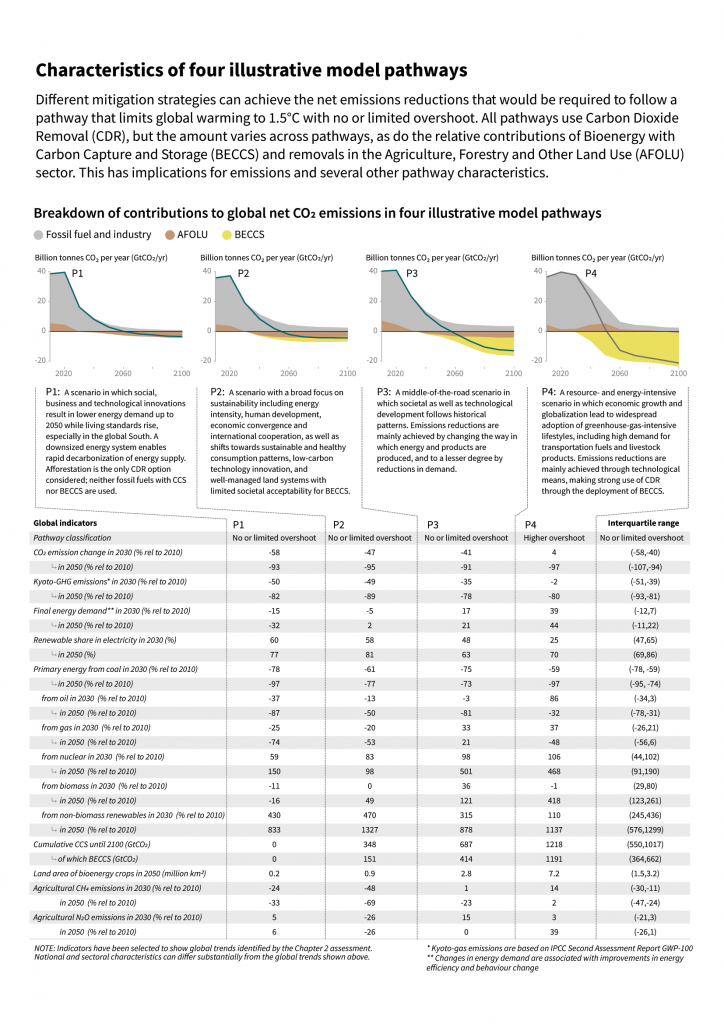
[1] https://www.ipcc.ch/site/assets/uploads/sites/2/2019/02/SPM1...
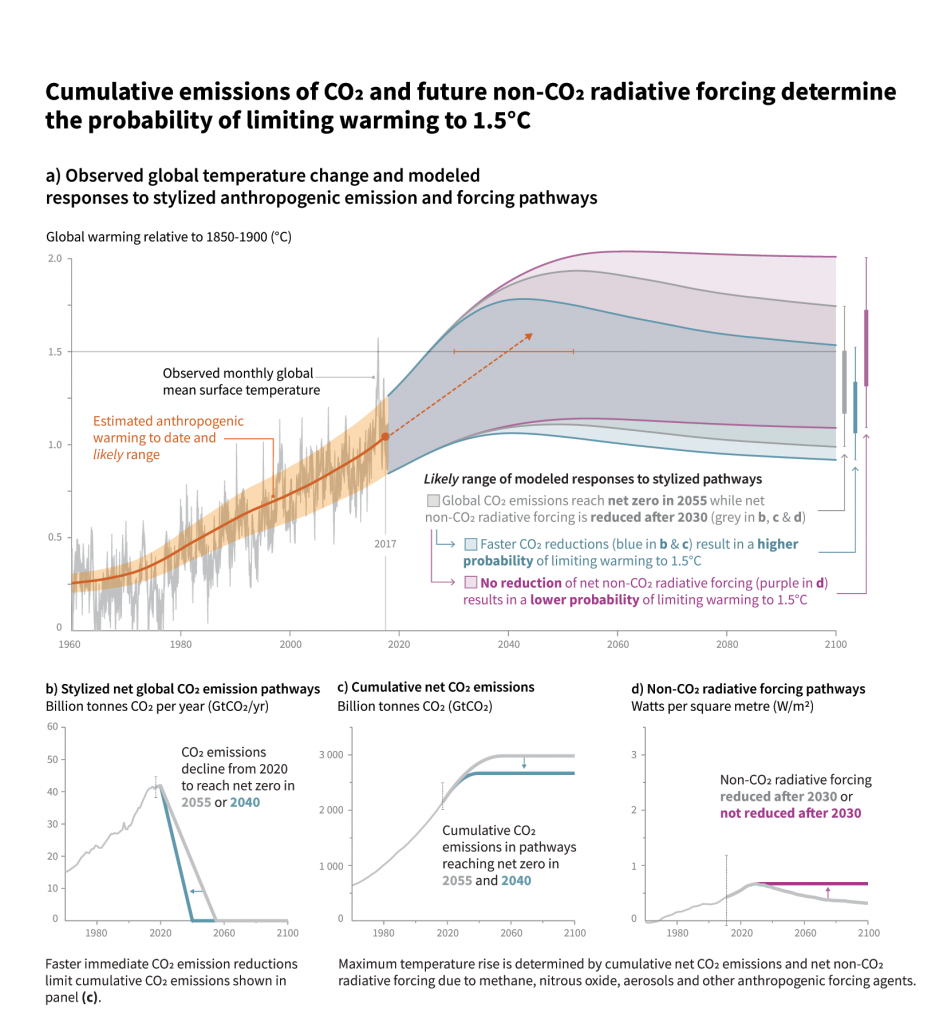
[2] https://www.ipcc.ch/site/assets/uploads/2018/02/FigSPM-10.jp...
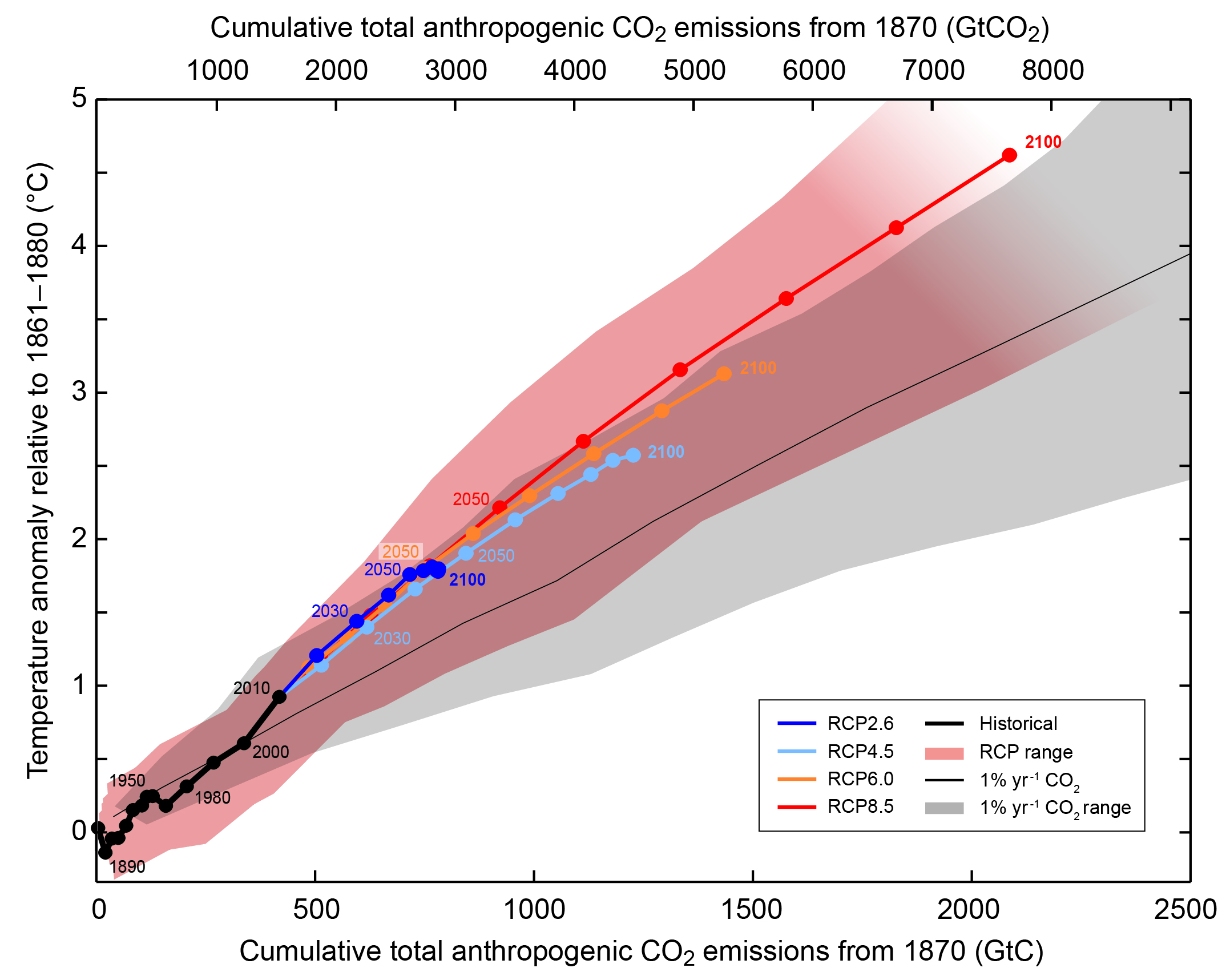
Some geoengineering solutions don't seem to be all that expensive (e.g. spraying sulfur dioxide into the stratosphere), and if things get really bad in some particularly hot places, somebody (India?) may decide to apply them unilaterally. Will we be happy about that?
If things get bad enough we'll get forced into geo-engineering, but as you said, unilateral action could complicate things in unforeseen ways.
Read about TWR (Traveling Wave Reactor) designed by these guys, financed by Bill Gates. It runs on depleted uranium, not enriched uranium. It's amazing how it works.
There's so many solutions being developed like this on so many fronts. But we're not doing any of them. I don't understand it. Government is not even being asked to finance this, but yet they won't approve it because of politics.
That's the problem with all these "We'd have cheap safe nuclear power if it wasn't for those stupid treehuggers" arguments - if nobody is doing it, not even in countries that are pretty reckless and unregulated like China, maybe the problem isn't regulation.
Overall our atmospheric models are not yet mature, which make carbon-trapping mechanisms from the atmostphere hard to gauge. Easier if we reduce or trap carbon emissions before it is spread into the atmosphere.
Please also consider we will eventually run out of fuel/oil/gas/coal; carbon dioxide savings is the long term strategy.
Project Vesta hasn't proved efficacy or ability to scale. It's reminiscent of the "solar roadways" hype from earlier this decade.
Most greenhouse gas emissions come from industry and transportation of goods.
It's less politically expedient to blame entrenched powers for their hand in climate change than it is to blame Joe Nobody for driving instead of walking to work.
So yes, I am a part of the problem. But we've gotten into this mess with technology; why can't we use technology to get out of it? Part of the problem is that, in taking part in these activities that increase our carbon footprint, we're not actually paying for the true impact of our actions. I'd be fine with paying more for my plane tickets if I knew that extra money was going toward carbon capture, or other technologies that are in development to reduce the impact of these -- by now very common -- activities.
I'm reminded of the checkbox memes; "You are attempting to apply an X solution to Y. Your idea will not work because:" -- one of my favorite checkboxes on those, was always "You are attempting to change the behavior of everyone, which does not work". I feel like this applies to most climate issues.
Implementing worldwide population controls is a non-starter. Implementing restrictions on air travel is a non-starter. Outlawing meat consumption is a non-starter. I love that companies like Beyond Meat and Impossible Foods are trying to come up with more sustainable meat substitutes. I think they have a ways to go, but I'd be happy to switch over to them at some point. That's a great example of using technology to reduce carbon footprint, while still allowing people to have the same (or nearly the same) experiences. Can't we do more of this?
At the end of the day, people are going to do what they're going to do, as long as they can (financially) afford it. Cultural/societal change on this level, in the time frame necessary, just isn't realistic.
We have no idea how that further manipulation would affect the environment, in a thousand unforeseen ways that would only be apparent decades down the line.
Half of the earth habitable area is used for animal agriculture, so that should be the first part being reforested, meaning less cattle feed, meaning less meat.
So we cover the surface of the earth with crop fields, plant a bunch of trees on the other and everything is going to be all right? Of course not, it's just not that simple.
Scientists simply cannot predict how the ecosystem would respond, the models are too simple for something so complex as the Earth.
We need to stop using so many resources, continuing to increase the rate of consumption while waiting for some miracle technical silver bullet solution is just suicidal as a species.
Coal is such a huge contributor to the problem that you can almost say that climate change is a coal problem. Not quite, but you're not wrong. I am deeply puzzled by anyone discussing climate change who doesn't bring up coal first, yet I see tons of discussion where coal is not even mentioned.
https://www.eia.gov/energyexplained/index.php?page=environme...
Snark aside, here's a source that says globally coal power production accounts for 30% of global CO2 emissions. That's a lot, but not quite the whole problem.
https://www.iea.org/geco/emissions/
Actually I agree with you that getting upset over meat eating and plastic straws is a silly way to avoid tackling the much larger issues.
Also, I was genuinely asking for more information, and am still interested.
I'm not saying it's the best or only way to address climate change but it does seem consistent with addressing how it started.
A volume of 7 cubic miles (11 km^3) of olivine, or around 30 Gigatons, is needed each year. This is less than half the volume of construction materials and less than that of fossil fuel equivalents mined yearly.
That's gigantic, how can they sustain that 30 gigatons a year ?
1. https://projectvesta.org/