News for hackers. Stuff that matters.
Re:HTTP/3: the past, the present, and the future by tobib on Thursday September 26, 2019 @11:20AM (#21081712)
From a adoption perspective, how much is adopting HTTP/2 or /3 different from adopting a new IP "version" i.e. IPv6?
Re:HTTP/3: the past, the present, and the future by matsur on Thursday September 26, 2019 @11:28AM (#21081834)
It's much easier to get the adoption flywheel moving for new application and transport protocols than things farther down in the OSI stack.

To get critical mass for HTTP/3 we'll need large server implementations (eg Cloudflare) and large client implementations (eg Chrome and Firefox) to build support and drive adoption. Which is what is happening!

Contrast this to v6 adoption which requires software support _and_ support from hardware vendors, network operators, etc.

Re:HTTP/3: the past, the present, and the future by tobib on Thursday September 26, 2019 @11:53AM (#21082170)
I hope I didn't miss this from the article but how do client and server "negotiate" which protocol to use?
Re:HTTP/3: the past, the present, and the future by tialaramex on Thursday September 26, 2019 @12:21PM (#21082532)
Already in HTTP servers can send an "Alt-Svc" header which proposes a different way that clients might reach the same resources. So one thing that can happen goes in full like this:

1. User type http://example.com into browser

1a. Browser does DNS lookup example.com AAAA or A -> 10.20.30.40

2. Browser connects to 10.20.30.40 TCP port 80 and speaks HTTP/1.1 over that port, announcing Host: example.com where it gets given a 301 redirect to https://example.com (and HSTS pre-load would skip this step)

3. Browser connects to 10.20.30.40 TCP port 443, using SNI for example.com where it is offered an ALPN option h2 (meaning HTTP/2.0) and it takes that option and speaks HTTP/2.0

4. Browser receives Alt-svc: h3=":12345" which is an announcement that this same HTTPS service is available as HTTP/3 using UDP port 12345 from the same IP

5. Now for any future resources from https://example.com/ the browser knows it could get them using HTTP/3

In future, maybe, perhaps, a new DNS record (only really practical via DPRIVE such as DoH since useless middleboxes will probably make this undeployable without) will do what the SRV record was trying to do, but this time focused on HTTP servers in particular. So with that record (again, not even a draft exists for this yet AFAIK):

1. User types http://example.com/ into browser

1a. Browser uses DoH to ask HTTP-SERVICE DNS lookup example.com -> big pile of stuff about how to get this service. If the DNS lookup fails it tries asking for A or AAAA instead.

2. Browser intuits from the big pile of stuff to do QUIC to 10.20.30.40 UDP port 12345, and then speaks HTTP/3.

Re:HTTP/3: the past, the present, and the future by lucaspardue on Thursday September 26, 2019 @12:30PM (#21082624)
Nice overview!

There is a draft [1] that would support Alt-Svc in DNS. Lots to consider there but it is being presented to IETF.

[1] - https://tools.ietf.org/html/draft-nygren-dnsop-svcb-httpssvc...

Re:HTTP/3: the past, the present, and the future by teddyh on Thursday September 26, 2019 @01:16PM (#21083099)
That looks very interesting, but, like SRV records have been studiously ignored in the past, I doubt that Google, Cloudflare, etc al. will allow this to be the norm, since this would eliminate much of the value proposition which Cloudflare has, and also partially drain the moat which Google has constructed around itself.
Re:HTTP/3: the past, the present, and the future by tialaramex on Thursday September 26, 2019 @05:59PM (#21086042)
Maybe take another glance at the "very interesting" draft? Those named authors are from Google and one of Cloudflare's competitors, Akamai.

Of course you can imagine these are rogue actors off developing technology that's hostile to their employer's needs. But, like, Occam's razor. It seems simpler to assume that these outfits see improving the place where they make money (the web) as just good business.

Re:HTTP/3: the past, the present, and the future by teddyh on Friday September 27, 2019 @08:05AM (#21090932)
I’ll belive it when I see it. SRV has been around for ages, and the arguments given for not using SRV in HTTP/2, QUIC etc. have been weak and unconvincing, despite its obvious benefits.
Re:HTTP/3: the past, the present, and the future by amluto on Thursday September 26, 2019 @08:25PM (#21087212)
I can’t fathom why CloudFlare world dislike this. To the contrary:

> They also enable aliasing of apex domains, which is not possible with CNAME.

That would help eliminate a major annoyance of using a CDN.

Re:HTTP/3: the past, the present, and the future by teddyh on Friday September 27, 2019 @08:07AM (#21090940)
If this draft RFC keeps the “priority” and “weight” features from SRV, it also means that most people would’t actually need a CDN.
Re:HTTP/3: the past, the present, and the future by amluto on Friday September 27, 2019 @10:27AM (#21092356)
If clients could assist in load-balancing, it might be handy, but large web hosts would still need a lot of nodes, a lot of bandwidth, DoS mitigation and, ideally, a way to get clients to use a local point of presence. In other words, people would still want most of the services that CloudFlare provides.
Re:HTTP/3: the past, the present, and the future by teddyh on Friday September 27, 2019 @07:15PM (#21097118)
> large web hosts would still need

> a lot of nodes,

Not that many, say three or four servers at most should IMHO be fine for the vast majority.

> a lot of bandwidth,

If your service gets popular enough that you need that much bandwidth, you can then very likely get enough funds to get adequate bandwidth. (Either by commercializing or by donations.)

> DoS mitigation

If you have four servers on four different networks, how hard would someone have to DoS them all before all four give out? And, maybe at least one of those four servers are placed on an ISP which is actually somewhat competent in helping you to filter out DoS traffic? Cloudflare doesn’t have some secret magic sauce, you know.

> and, ideally, a way to get clients to use a local point of presence.

That’s technically true, but only if you are desperate for your latency enough to merit such needs. But you probably aren’t. You are, most likely, much more served by optimizing your server caching and HTML page code than you would be by trying to claw a few extra milliseconds out of the network itself.

If you are desperate to get a few extra milliseconds, and already have a dead-simple homepage, and are enormously popular enough to merit it, then you are Google, and you can solve this problem by means not available to mere mortals.

I have written before in more detail why Google et al. probably doesn’t want SRV records: (In short, SRV solves problems for other people which Google have already solved for themselves, and Google would like to keep their moat.)

https://news.ycombinator.com/item?id=15906664#15908696

https://news.ycombinator.com/item?id=8549348#8550133

Re:HTTP/3: the past, the present, and the future by nirui on Thursday September 26, 2019 @10:34PM (#21087902)
Can the HTTP/1.1 server directly return the Alt-svc: h3 header? That way the entire HTTP/2 can be skipped, lower the bar of server implementation (maybe).
Re:HTTP/3: the past, the present, and the future by lucaspardue on Thursday September 26, 2019 @12:04PM (#21082320)
We use HTTP Alternative Services (RFC 7838). This appears as a Alt-Svc response header that advertises the availability of HTTP/3 to a client.

The client uses its local knowledge (and maybe other heuristics) to decide if it wants to change protocols.

Re:HTTP/3: the past, the present, and the future by rumanator on Thursday September 26, 2019 @05:42PM (#21085874)
> To get critical mass for HTTP/3 we'll need large server implementations (eg Cloudflare) and large client implementations (eg Chrome and Firefox) to build support and drive adoption. Which is what is happening!

Isn't the critical path determined by the availability of web servers and client libraries? I get the importance of browsers, but I would guess that having HTTP/3 supported by projects such as Apache or nginx or curl is far more critical.

Re:HTTP/3: the past, the present, and the future by steveklabnik on Thursday September 26, 2019 @05:50PM (#21085952)
It's a chicken and egg problem; without having clients, there's no reason for servers to support things, and without servers, there's no reason for clients to support things.

It seems everyone recognizes this and so both clients and servers are getting implementations going to make sure this all goes smoothly.

Re:HTTP/3: the past, the present, and the future by rumanator on Thursday September 26, 2019 @06:08PM (#21086105)
Nginx and Apache alone run about half of all active sites. That's pretty much the critical path to adoption. In fact, I'd argue that it would be impossible to adopt HTTP/3, or any other protocol, if those projects don't support it.
Re:HTTP/3: the past, the present, and the future by steveklabnik on Thursday September 26, 2019 @06:09PM (#21086114)
Sure. I’m not saying that they aren’t valuable. I’m saying that they are, but clients are too.
Re:HTTP/3: the past, the present, and the future by pdimitar on Sunday September 29, 2019 @09:31PM (#21110989)
Are you guys working on a QUIC and HTTP/3 client/server in terms of future de-facto go-to crates for Rust? That would be amazing.
Re:HTTP/3: the past, the present, and the future by steveklabnik on Sunday September 29, 2019 @10:59PM (#21111422)
Cloudflare has made quiche, but I can't personally say that it's the go-to; I just haven't had direct experience enough. We'll just see how it all shakes out.
Re:HTTP/3: the past, the present, and the future by throw0101a on Thursday September 26, 2019 @11:51AM (#21082149)
> ... and transport protocols ...

Are you referring to Layer 4 here? SCTP and DCCP may want to have a word with you. :)

Re:HTTP/3: the past, the present, and the future by dtech on Thursday September 26, 2019 @12:01PM (#21082274)
Which we so successfully introduced that they needed a way to tunnel over UDP [1] and still have very niche support compared to TCP and UDP.

[1] https://tools.ietf.org/html/rfc6951

Re:HTTP/3: the past, the present, and the future by takeda on Thursday September 26, 2019 @12:08PM (#21082367)
SCTP, DCCP are special case. Ideally those protocols supposed to be handled only by the endpoints, but over time the support of those protocols leaked to the network as well. Mainly because of wasteful allocation of IPv4 addresses we had to use NAT. A lot of that equipment makes other protocols impractical because they are not supporting them, even though initially they shouldn't have anything to do with them.

I suppose HTTPs equivalent of that would be various http proxies, but in that case barely anyone uses them.

Re:HTTP/3: the past, the present, and the future by cesarb on Thursday September 26, 2019 @11:27AM (#21081821)
Much simpler. For IPv6, every hop in the path between the client and the server has to understand the new protocol. For HTTP/2 and HTTP/3, only the endpoints (the client and the server) have to understand the new protocol. And since they run on top of TCP (HTTP/2) or UDP (HTTP/3), not even the operating system on either endpoint has to understand the new protocol; only the client application (the browser) and the server application (the HTTP server daemon).
Re:HTTP/3: the past, the present, and the future by takeda on Thursday September 26, 2019 @12:00PM (#21082256)
Adopting IPv6 is much much harder.

The problem with IPv6 is that it needs to be everywhere at once before it is useable, while protocol like http can be deployed incrementally and can coexist just fine with other protocols[1]
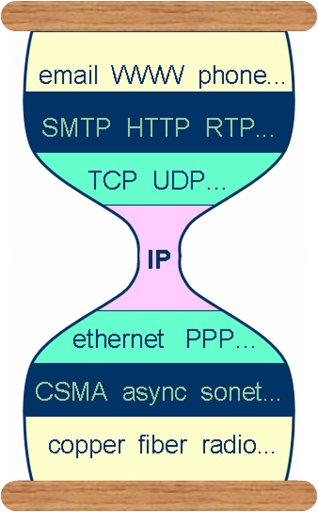
[1] http://gumuskaya.com/images/tcp-ip.jpg

Re:HTTP/3: the past, the present, and the future by skybrian on Thursday September 26, 2019 @11:27AM (#21081820)
It's much easier, since it mostly affects browsers and websites, not ISPs and routers.
Re:HTTP/3: the past, the present, and the future by sedachv on Thursday September 26, 2019 @02:42PM (#21084067)
As others have mentioned, moving HTTP versions is easier because it is at a higher protocol layer. But it is also an apples-to-oranges comparison, because the benefits of HTTP 2 or 3 over 1.1 are marginal compared to IPv6. The amount of benefit I got from going to IPv6 is so large in comparison to what HTTP 2 or 3 offers over 1.1, it is not in any way a fair comparison (and I am a pretty basic IPv6 user). A better comparison would be with TLS. Here again, I think new TLS versions offer benefits far above the marginal ones of HTTP 2 or 3 compared to 1.1.