I agree. Google provided ample evidence why they believe the websites must have been exploiting phones for about 2 years (https://1.bp.blogspot.com/-97vEtS5TpiM/XWfds8hYAyI/AAAAAAAAN...). Meanwhile Apple appear to be playing down the severity of all this with zero evidence.
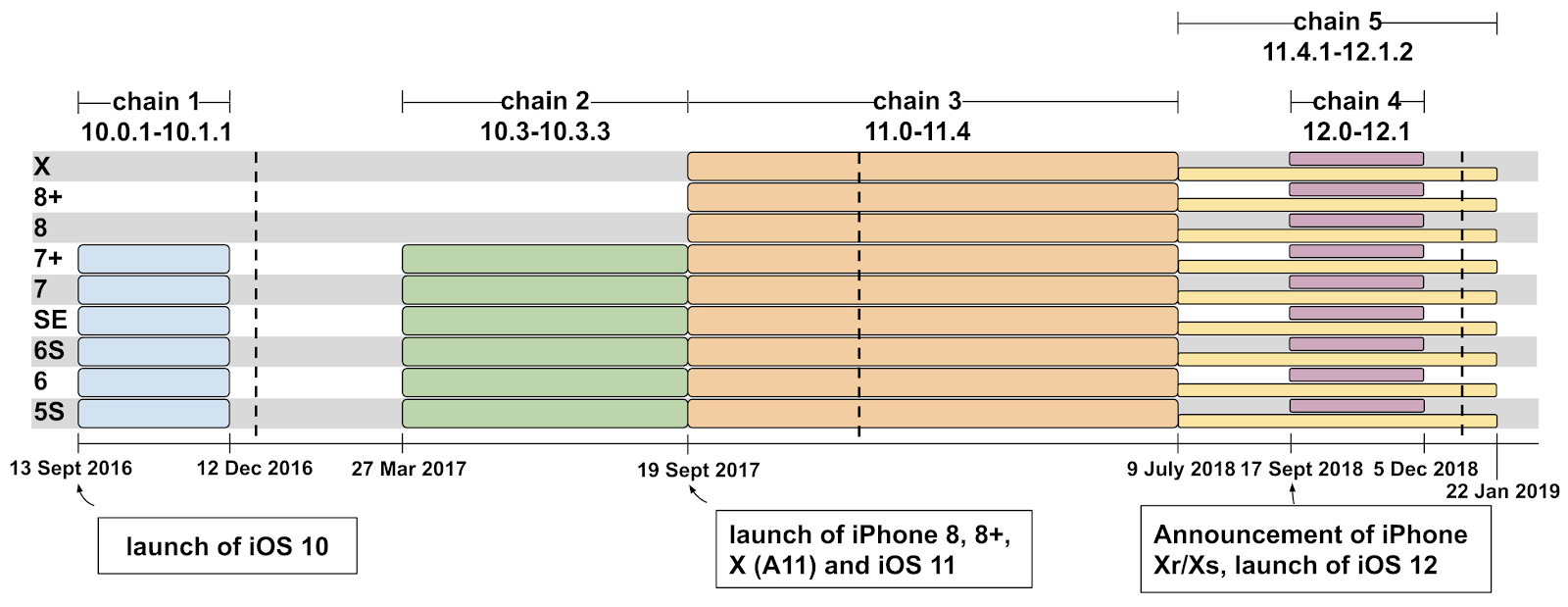
Chain 1: iOS 10 launched 13 Sep 2016 and 10.1.1 lost relevance when 10.2 was launched on 12 Dec 2016
Chain 2: iOS 10.3 was launched 27 Mar 2017 and lost relevance when iOS 11 was launched on 19 Sep 2017.
Chain 3: iOS 11 was launched 19 Sep 2017 and lost relevance with the release of iOS 11.4.1 on 9 July 2018
Chain 5: iOS 11.4.1 was launched on 9 July 2018 and worked until the release of 12.1.3 on 22 Jan 2019.
Chain 4: iOS 12 was launched 17 Sep 2018 and worked until 12.1.1 which was released on 5 Dec 2018.
The span of dates during which a particular version of iOS was the latest release does not necessarily mean that exploit chain was active contemporaneously. I can think of several reasons for someone to be unable to upgrade to the latest version of iOS, requiring an attacker to maintain and deploy exploit chains for multiple versions of iOS simultaneously.
1) Apple has historically dropped support for older iPhones with each new iOS major version.
2) Users who jailbreak tend to refuse to update until a jailbreak emerges for the new version.
3) Some users are slow to update
4) Some users might just refuse to update
Because of this reasoning I find it plausible that Apple only has evidence that the exploit chains were active for only two months and that the attacker chose to deploy the five chains for only two months. I do not find Google's chart insightful for understanding this attack.
Also, note that the exploit used in chain 4 was unpatched when Google discovered it. It looks like the reason it doesn't support newer iOS versions is because they abandoned it in favour of the cleaner chain 5, which entirely obsoletes it in terms of versions and devices targeted. Just this pair of exploits alone suggest that the attack was live in the wild for at least a year.
In theory I suspect that most recent exploit could be backported to cover all the iOS versions covered by all the other exploits too (and some they missed) but they just didn't bother.
I guess Apple could go back and look at their crash report telemetries to determine when the exploits were active. Google doesn't have that type of historical data for iOS devices. Of course there were no mentions of that as evidence.
E.g. once an exploit is detected by Apple, you might as well use it. Or an exploit that only relevant to an iOS version with low install base - just use it.
My thought was that they could be to target old versions, even if the site is new, but if the new exploits work on old versions that seems unlikely (though it could be to limit the exposure of the new zero-day - fingerprint an old version, present an old exploit - but if the exploits are new, that seems like a lot of work for next-to-no benefit).
That would make a lot of sense if we were talking about Android but how many iOS devices are still on iOS 10? Apple's stats show 97% of devices are iOS 11+ ( https://developer.apple.com/support/app-store/ ). It seems rather unlikely that someone would invest in finding & weaponizing a zero-day exploit against iOS 10 for less than 3% of users. Possible, sure, but Apple's claims needs evidence here.
https://googleprojectzero.blogspot.com/2019/08/a-very-deep-d...
"Earlier this year Google's Threat Analysis Group (TAG) discovered a small collection of hacked websites."
"We estimate that these sites receive thousands of visitors per week."
"TAG was able to collect five separate, complete and unique iPhone exploit chains, covering almost every version from iOS 10 through to the latest version of iOS 12. This indicated a group making a sustained effort to hack the users of iPhones in certain communities over a period of at least two years."
Google was responsible in identifying estimated scope. They didn't say it was widespread or impacting millions of devices. And that there are vulnerabilities of 2 years worth of iOS versions is pretty reasonable evidence that this has been a 2 year project.
Meanwhile Apple's counter-claims sound like pure damage control with no supporting evidence. They claim it was only operational for 2 months. Yet they provide no justification or evidence for that claim. They are in no position to monitor what happens on the web as they don't crawl it, and don't even attempt to explain why there would be exploits for 2 years of OS versions if this was only operational for 2 months.
But I'm not seeing any reason to believe Google was anything but responsible in its disclosure, nor that they sensationalized it in any way.