If someone wants to put up a statue of a confederate private soldier, who was kept poor by the exploitation of slaves in a feudal system, and answered the call and sacrificed anyway, that’s also different. And would say more about southern culture than the worship of Lee or a monster like Forrest.
The content of your politics doesn’t change whether folks are assholes or not. People pushing for eliminating challenging art are feeding their ego first.
And that's precisely why those generals were being honored; to proactively show that, despite them being on the losing side, we would not be regarding them as traitors! This kind of thing used to be seen as an important part of peacefully reabsorbing and reconciling the South with the rest of the nation. It strikes me as incredibly foolish to renege on this deal today even as cultural divides within the country are widening to the point where they might essentially split it apart all over again. (Not on racial or ethnic lines however, but, loosely speaking, on ones pitting "elite intellectualism" against the "common man's good sense". And I say this while fully acknowledging that the latter is at least as flawed as the former.)
> ...the ideals... That is, black people need to know their place.
Not so. The Civil War was indeed "about" slavery in many ways, but the "confederate private soldier, who was kept poor by the exploitation of slaves in a feudal system, and answered the call and sacrificed anyway" you mention above would be able to tell you plenty of reasons why he was going to fight the Yankees with full conviction no matter what.
Slavery and "keeping black people in their place" were important to the opportunistic elite of the South; but in the common man's view, what was being threatened to the point of wholly justifying their sacrifice was their culture and way of life. And this viewpoint is still one way that the war is understood in many parts of the South.
Many of them were put up in the 60s, as a reaction to the civil rights era. Most of them were put up in the 1910s, for similar reasons.
https://media.npr.org/assets/img/2017/08/18/southern-poverty...
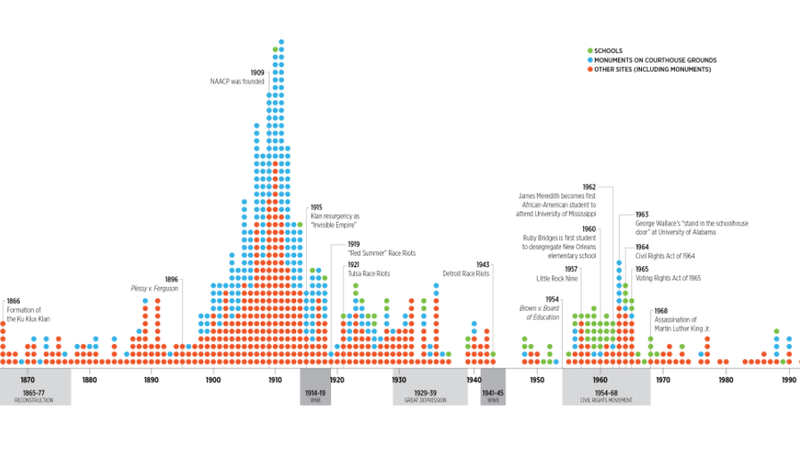
They were erected to rewrite the history exactly as you are presenting it.
The 1910s were also within living memory of people who were born as chattel, property of someone else. What did the heroic statue of Forrest mean to them? This was put up with because the political machinery of the south was incredibly powerful, and northerners, particularly immigrants weren’t exactly woke to the troubles of former slaves either.
The new South era was unique in many ways, including the end of open racial oppression and blacks voting in numbers. LBJ broke the back of the solid south for a few years.
Actually, I've consistently been trying to make the point that the things being honored in this way do NOT include slavery itself. Yes, it's a weird point of view which involves a whole lot of willful cognitive dissonance on the part of those white southerners who celebrate their heritage today. Yes, it is entirely fair to criticize it on that basis. But it's not any more inherently weird than celebrating Washington despite him being a slaveowner, or celebrating the U.S. itself even though its expansion was accomplished by killing Natives. It's just not fair to be in denial about these nuances, and insist that "Southerners who respect their own heritage are celebrating slavery" in a way that others are not. (Note that one can fairly object to the Confederate flag on other grounds - it has always been an overt symbol of illegal secession, and a secession that was explicitly motivated by slavery - that don't quite apply to the statues of defeated generals.)
> What did the heroic statue of Forrest mean to them?
I'm sure that they had plenty of other things to worry about. And that, by and large, they wouldn't have wanted a South that failed altogether to reconcile with the North. Failed reconciliation after a defeat in war can be very dangerous - and if the "Redeemers" were willing to use paramilitary violence in our timeline as a reaction to a comparatively mild "Radical Reconstruction", can we even imagine how Southerners would have reacted to extreme levels of festering resentment? It would have gotten quite ugly, to say the least.
A lot of people now dream about such a thing, they have not perhaps read what that actually means. US let South get away with this crap because it WAS beaten and peace and unity of the country was worth a lot more.
The “traitors” things is somewhat silly, since even men who served with them Before the war did not consider them such. Most considered their state to supersede the union that is all. If Virginia did not secede Lee would have been happily helping Union put down rest of the states.
Lincoln movie has a great moment at the end of president talking to Grant, they were wise men and luckily for all involved did not turn the aftermath of the war into bloodbath that would span decades and turn US into police state.
To be clear about it, the US let the South get away with plenty of terrible things that they shouldn't have. But yes, the monuments thing that people are objecting to nowadays was a lot milder and more positive in its goals than many people assume. The reality is that at some point, by all appearances, many people in the North did not so much care about the plight of the formerly-enslaved; they mostly wanted to punish the South, no matter how counterproductive this would have been. The 'Radical Reconstruction' was in no small part a result of this attitude, and had the North objected to the Confederate monuments, this too would've been seen as such.
It's interesting to note that Lincoln himself did not make this mistake; it may be fair to blame the comparative chaos following his assassination by a radical slavery supporter (which, it should be noted, was immediately condemned in no uncertain terms by the saner voices in the Southern states, including Lee himself) for the sudden change in attitudes. At the very least, the fact that Andrew Johnson, a Democrat, was thereafter made President (leaving him free to sabotage even that remarkably mild approach to Reconstruction, and to antagonize Congress over the issue to a perhaps unprecedented extent) did not exactly help matters.
Except the South reneged on the deal almost as soon as the war ended, violently suppressing and oppressing the formerly-enslaved.
[1] Well, not quite; the "Radical Reconstruction" was a bit of a later development. But then, the truly nasty politics on the other side, with a "Redeemer" movement working together with violent, paramilitary organizations (including the 1st 'Klan') to ensure that white Southern democrats would dominate the South and impose overt white supremacy, was itself enabled and triggered by a backlash to the Radical Reconstruction.
Your comment seems to imply that the premise of "white privilege" should carry a connotation of "white genocide," and that anyone who accepts the former likely desires the latter. I certainly hope that was not your intent, if so you are very mistaken.
White privilege simply means that white people benefit, however implicitly , from a society which was founded on white supremacist ideals. Or more abstractly, that the descendants of the people who stacked the deck of Western civilization in their favor may enjoy privileges that those against whom the deck was stacked may not.
No sinister overtones of purges or mass murder need by applied, except by those with an agenda.
But then why were most slaves black? Europe was almost exclusively Christian and the church had long since forbade Christians enslaving Christians. And across the world there were various powerful empires forming. In the Mideast there was the Ottoman empire, China had the Qing dynasty, and so on. Then there was Africa: a disorganized, technologically underdeveloped people whom also had a thriving domestic slave trade already in place. Africans were not chosen to be slaves because of their skin color, they were chosen because their nations' lack of development left them susceptible.
But I think we should go even further on slavery. In spite of the normalcy of the practice of slavery at the time, many of the founding fathers were actively working to see its end. Thomas Jefferson, indeed a slave owner by inheritance, had penned an explicit condemnation of slavery into the original draft of the constitution. However this was not workable when trying to form a union of states when some still endorsed it. It was stripped from the final revision. In its place we saw two things. The first was the addition of "all men are created equal", which was a fully self aware statement. The second was an agreement that the US would not federally ban slavery prior to 1808. Thomas Jefferson was the president who would effect a law in 1807 that would ban the slave trade on January 1st, 1808. [1]
America, in spite of an extensive "need" of slavery, was also a very small player in it. About 12.5 million Africans were shipped to the new world, 10.7 million survived the voyage. How many were shipped to North America? 388k, less than 4%. [2] There are complex reasons for this, but our mixed relationship with slavery no doubt played a significant role.
But perhaps you mean voting laws. Once again this was hardly an American institution. The idea of the masses being able to vote is something very new. The reason this was avoided in the past was to try to avoid demagoguery and corruption. What do I mean there? Our current president is a reality TV star who had no experience in politics. At one point it looked like he might be running against Oprah, a TV talk show host - with no experience, for the 2020 election. We are a living demonstration of the very reasons that nations feared letting people vote without condition.
After downvoting this because... reasons, please do at least consider that not a single statement I've made here is false. It's quite dangerous when ideology becomes more influential than facts.
[1] - https://en.wikipedia.org/wiki/Act_Prohibiting_Importation_of...
[2] - https://www.pbs.org/wnet/african-americans-many-rivers-to-cr...
They tried to do the same to the Statue of Cecil Roads which I believe is in Oxford University.
There is also ideas of "Colonial Science" or "White Science" which reminds me of movement of removing "Jewish" Science and Mathematics in preference to "Aryan Science" before World War II.