News for hackers. Stuff that matters.
Re:Economists Are Obsessed with Job Creation – How About Les... by neilwilson on Sunday June 02, 2019 @01:51PM (#20076905)
The problem is fairly simple. The actual output of society is produced by a relatively small minority of skilled individuals that are not easily replicable (ie fungibility is largely a myth).

We need those people to work a full week operating the machines that actually make all the output we all consume.

But why should they do that if nobody else is working? They could just make enough for the small set of people that are actually required to make enough stuff and stop work on Tuesday - having the rest of the week off.

So we all give up full weeks of our finite lives in solidarity with those who we need to give up full weeks of their finite lives if we're actually going to get the goods and services we need to live. And that's because we're a species that tallies our debts with each other - the reciprocity principle (https://www.en.uni-muenchen.de/news/newsarchiv/2016/paulus_s...)

Or to put it in other words, sharing out the needed work is rather more difficult in practice than it is in theory where fungibility is largely assumed. And the more advanced our technology, the harder the sharing becomes and the more difficult it is to maintain the illusion of sufficient reciprocity.

Re:Economists Are Obsessed with Job Creation – How About Les... by thatfrenchguy on Sunday June 02, 2019 @05:25PM (#20078329)
> The actual output of society is produced by a relatively small minority of skilled individuals that are not easily replicable

This speaks personally to me as why tech workers (and multi-generation urbanites) are seen as widely disconnected: being persuaded a small number of people "create value" while forgetting about the people building your stuff, growing your food, extracting your oil (and killing the planet in the process), moving your stuff around, nursing people, building your house, installing your AC, shipping your amazon packages, and all the other ultra-necessary jobs (that are usually underpaid) that I don't even realise exist.

Without the drivers, Uber does not exist. Without Foxconn and its army of underpaid labor, Apple does not exist. It's not a small number of people creating value, it's a small number of people capturing all that value thanks to shitty wages and work conditions for everyone else.

We can all pretend "automation" will replace people, but it's obvious the complexities of those tasks will always mostly done by humans.

Re:Economists Are Obsessed with Job Creation – How About Les... by roenxi on Sunday June 02, 2019 @08:11PM (#20079362)
> while forgetting about the people ...

You might be reading the comment slightly sideways. My read was that the people you list are from small businesses creating value, and most of the tech workers are creating very little value with a few peakers who do amazing things.

> Without the drivers, Uber does not exist.

Personal bugbear, there is as yet no evidence that Uber is creating more value than it destroys. It has a pretty basic business model, trivial positive externalities and is making loss. It looks like it is slow-burning value until someone goes broke.

Uber could be cited as evidence in favour of the idea that most people don't by default know how to create value.

That might be the core disagreement here. There are a lot of people doing activities that are useful. I struggle to think of them as value creators because what they are actually doing is whatever someone tells them - there is a lack of agency in deciding what they do, so I have difficulty attributing outcomes to them. They are fungible, but the people telling them what to do are not. If you tell them to do something stupid, they will do it (as seen with Uber).

Not a comment on personal worth; economic value isn't everything. But the people who make decisions are just more important than laborers. Small businesspeople in particular are a backbone of society in a way that most workers really are not.

Re:Economists Are Obsessed with Job Creation – How About Les... by fao_ on Sunday June 02, 2019 @08:59PM (#20079570)
> That might be the core disagreement here. There are a lot of people doing activities that are useful. I struggle to think of them as value creators because what they are actually doing is whatever someone tells them - there is a lack of agency in deciding what they do, so I have difficulty attributing outcomes to them. They are fungible, but the people telling them what to do are not. If you tell them to do something stupid, they will do it (as seen with Uber).

I think this speaks to your own lack of understanding of these jobs. Just because the general goal is set by someone higher up, does not mean that there is not hidden variation for the exact task, as well as a lot of places for 'hidden mediocrity'.

Take cleaning the toilets, for example. The general order given is "clean the toilets". Think, however, about how this task has to be broken down. The small things like cleaning the tap heads, under the rim of the seat, etc. that most people might not explicitly think of without being reminded. The person has to do those small tasks, possibly hundreds of times, while dealing with any unexpected obstacles.

Or take something less unsavory, like baking bread. Anyone who has baked bread understands that, while the general instructions _sound_ simple, there is a lot of complexity that is not accounted for, and a lot of room for variability of skill.

Sure, anyone can train for a month and play X tune on the guitar, but are you going to pay for someone who has spent simply one month training, or someone who can really play the tune that has been playing for years? If they are interchangeable then there needn't be thousands of threads submitted to hacker news about how to hire "10x developers".

> Small businesspeople in particular are a backbone of society in a way that most workers really are not.

The matter of fact is that once a company has been established, it can float for a long time without the business owner contributing much whatsoever. I can think of more than a couple of companies that have changed CEOs three times in the last 5 years, while the actual inputs and outputs of the company remain steady. Direction only matters in a vague sense until you hit bad economic times. The ultimate truth is that 'fungibility' has nothing to do with 'value'.

Re:Economists Are Obsessed with Job Creation – How About Les... by gnarlee on Monday June 03, 2019 @11:37PM (#20091619)
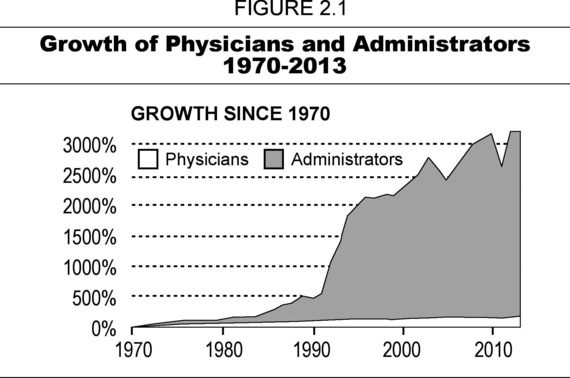
I clean trains (includes lots of toilets) the hilarious story to share is that long long ago one would just show up at the trainstation and be hired to clean by annother cleaner. Paid in cash every friday. Over time a truly insane number of madly overpaid deskjokeys was tagged onto the process to do countless completely nonsensical tasks. From a really well paid job and really good cleaning, in 70 years, things moved to really shit pay and half the employees. The work didnt change at all but everything is measured to the detail. Apparently the combination of shit pay and more work than one can do makes employees unreliable enough to justify tons of desk work. The hr and countless job agencies are completely overworked. The measurment of bad results triggers countless meetings. The ppl making work schedules are tasked with a completely and utterly impossible mission. But it gets truly hilarious where the cleaners bring new employees into the 3rd party job agencies, when we dont like it change the work schedule and carefully compare salaries with hours worked. So nothing has really changed at all. The only new thing is that for every 1000 euro in actual cleaning there is now 2500 euro in administrative tasks.
Re:Economists Are Obsessed with Job Creation – How About Les... by throwayEngineer on Sunday June 02, 2019 @05:43PM (#20078468)
Because making the tech that is safe and reliable enough for technician's to use is the hard part.

I can teach anyone how to clean a mold.

I can't teach just anyone how to design a mold.

And if you designed a mold before, you have been stressed AF designing and reviewing it. For some reason that is disconnected? I still work 40+ hrs

Re:Economists Are Obsessed with Job Creation – How About Les... by Avshalom on Sunday June 02, 2019 @05:55PM (#20078533)
the appearance of disconnect thatfrenchguy is talking about is the idea that designing the mold is the actual output of society despite the fact that designing the mold no matter how few people can do it is completely useless without a massive web of interconnected labor that, yes anyone can do but, must done in order for society to actually output anything.

It's not a swipe at engineers, it's a swipe at engineers who think they few highly skilled individuals are the engine of the world.

Re:Economists Are Obsessed with Job Creation – How About Les... by thatfrenchguy on Sunday June 02, 2019 @06:50PM (#20078896)
That was the idea I was trying to convey, albeit said in a much better way thank you :-).
Re:Economists Are Obsessed with Job Creation – How About Les... by qrian on Sunday June 02, 2019 @08:33PM (#20079437)
Not trying to critique anything, but it seems like engine itself is also useless without the rest of the parts.
Re:Economists Are Obsessed with Job Creation – How About Les... by Avshalom on Sunday June 02, 2019 @08:56PM (#20079549)
That is point. The wheels, the engine, the frame, hundreds of other things... You can't point to one part a car and say "that's the bit that actually gets us from point a to point b"

(It's also a jab at the intellectual bankruptcy of Atlas Shrugged)

Re:Economists Are Obsessed with Job Creation – How About Les... by qrian on Sunday June 02, 2019 @09:04PM (#20079593)
I am still confused. So are you implying the engineers who think they are the engine of the world incorrect or not?
Re:Economists Are Obsessed with Job Creation – How About Les... by Avshalom on Sunday June 02, 2019 @09:16PM (#20079659)
Oh, Sorry. It's a really shaky rhetorical flourish if you don't instinctively associate "the engine of the world" with Atlas Shrugged, Galts Gulch and the criticisms thereof.

In plainer English: it's not a swipe at engineers, it's a swipe at engineers who think they few highly skilled individuals produce the majority of the economic output of the world.

Re:Economists Are Obsessed with Job Creation – How About Les... by jp555 on Sunday June 02, 2019 @08:34PM (#20079444)
So if you get a degree, it’s really the book publishers, librarians, and coal burning electricity plant that kept the lights on who deserve most of the credit?
Re:Economists Are Obsessed with Job Creation – How About Les... by Avshalom on Sunday June 02, 2019 @08:45PM (#20079501)
Their contribution was necessary, I mean it's utterly facile but: you weren't gonna get a degree from a university if the university doesn't exist. There's a billion or so people in addition to them and a few billion more that got us to this point.

It's not that there is no such thing as individual achievement it's that there is no "small minority" skilled or unskilled that the modern economy can be reduced to.

Re:Economists Are Obsessed with Job Creation – How About Les... by jp555 on Sunday June 02, 2019 @09:40PM (#20079765)
Sure as a whole, on average.

But there absolutely is a small minority of extreme producers in most domains.

Re:Economists Are Obsessed with Job Creation – How About Les... by unionpivo on Monday June 03, 2019 @05:38AM (#20081634)
If you take out truck drivers and train operators, most modern cities die in a few weeks.

If every star programmer/engineer died, a lot of things would stop working, but people would at least live long enough to maybe deal with it.

Re:Economists Are Obsessed with Job Creation – How About Les... by kjsbfkjbf on Monday June 03, 2019 @09:54AM (#20083072)
Especially considering many start programmers and engineers seemingly exist to increase revenue of complete luxury services like Netflix.
Re:Economists Are Obsessed with Job Creation – How About Les... by someguydave on Sunday June 02, 2019 @06:58PM (#20078942)
That fails to respond to the point that there exists skilled necessary work that armies of unskilled workers can not replace.
Re:Economists Are Obsessed with Job Creation – How About Les... by Avshalom on Sunday June 02, 2019 @07:26PM (#20079104)
And there exists unskilled necessary work that armies of skilled workers can not replace.

But even beyond that there's armies of skilled necessary work that skilled workers can not replace either but seem to forget exist.

Apple doesn't exist without massive sophisticated logistical support but no one ever points out that the naval architects at Maersk or the welders at their shipyards are one piece of the process that allows any one to actually buy anything from Apple.

Re:Economists Are Obsessed with Job Creation – How About Les... by kjsbfkjbf on Monday June 03, 2019 @09:53AM (#20083059)
It would also be nice to frame "necessary" and "unnecessary".

I would think developments like saving the environment, healthcare research, improving public transportation, energy consumption, etc. are all "necessary" work. Building Uber or Twitter or Facebook? I'd lean more towards "unnecessary".

HackerNews is so close to arriving at the conclusion that most jobs (including their own prized "skilled" engineering) are worthless outside of capital accumulation. :)

Re:Economists Are Obsessed with Job Creation – How About Les... by dahfizz on Sunday June 02, 2019 @08:57PM (#20079552)
> And there exists unskilled necessary work that armies of skilled workers can not replace.

I think this is false. Unskilled work is easy to teach and learn, by definition. All you need is an "army" and the unskilled work can be easily fulfilled.

Re:Economists Are Obsessed with Job Creation – How About Les... by ionised on Monday June 03, 2019 @05:26AM (#20081594)
I'm thinking you haven't done much 'unskilled labour'.
Re:Economists Are Obsessed with Job Creation – How About Les... by Avshalom on Sunday June 02, 2019 @09:17PM (#20079664)
Well then it'd be an army of unskilled labor wouldn't it.
Re:Economists Are Obsessed with Job Creation – How About Les... by DuskStar on Monday June 03, 2019 @12:54AM (#20080499)
Yes, but the point was that one side could learn to do the other side's job, but not the other way around.
Re:Economists Are Obsessed with Job Creation – How About Les... by Avshalom on Monday June 03, 2019 @01:14AM (#20080567)
Only if you take as given that people doing unskilled labor are to a one doing it because they are incapable of anything else.
Re:Economists Are Obsessed with Job Creation – How About Les... by dahfizz on Monday June 03, 2019 @10:19AM (#20083307)
Nobody is arguing that unskilled laborers are incapable. We are saying that they are by definition unskilled. These skills are slow to teach and learn. Having lots of people willing to perform skilled jobs is not enough - they need the skills. The same is not true about unskilled work. Hence the comment about armies of people being able to perform unskilled labor.
Re:Economists Are Obsessed with Job Creation – How About Les... by gnarlee on Monday June 03, 2019 @11:53PM (#20091721)
I just like physical labor. I could be in some open floor plan trying to write code in some langulag designed by an unsophisticated person over the weekend while interupted by slack nonsense and by a manager who cant tie his own shoes. One coworker is an accountant and annother is an industrial designer. Im incredibly fit and my brain is reserved for private use only.
Re:Economists Are Obsessed with Job Creation – How About Les... by DuskStar on Monday June 03, 2019 @01:26AM (#20080609)
The dichotomy doesn't have to be perfect to be useful. There are certainly people who are incapable of anything else - and the US military has also pretty consistent in their statements that there are many people who are incapable of anything useful (in the military).
Re:Economists Are Obsessed with Job Creation – How About Les... by Frondo on Monday June 03, 2019 @09:06AM (#20082671)
Much, if not most, of "unskilled" work also has a lot of hidden complexity that means your productivity starts off slow and improves over time.

There's a reason capitalists have gotten us to think of some work as "unskilled," and that's so they can pay those people far less than they should be, and no one raises a stink about it.

The farm worker is an obvious example of "unskilled" labor, but if you watch a video of what these people do minute by minute, hour after hour, for the entire harvest, they are absolutely being underpaid by criminal amounts.

Yet, because we've been convinced it's "unskilled" labor, hardly anyone cares.

Re:Economists Are Obsessed with Job Creation – How About Les... by Bakary on Monday June 03, 2019 @02:16PM (#20086325)
Unless you hold some capital, you are paid according to how much your work is valued and how much of it can be supplied, not how hard your work is. They are unskilled in the sense that many other people can perform their job after some training. In aggregate the work of farming is highly valuable, but many individuals who partake in such work aren't specifically so and can be replaced easily even if their work is in fact difficult in itself.

An established rapper could be paid millions for a single mumbled line on a single song but that happens because he can export his value to millions of people who have in interest in it, whereas the ditch-digger can only rely on his labor and what it can provide in his current location.

You say hardly anyone cares, but are you willing to pay extra for the items and services that are produced by farmers and other workers? Perhaps you are, but in reality that is the stopping block that makes people stop caring, and it does have a certain cold logic to it.

Re:Economists Are Obsessed with Job Creation – How About Les... by someguydave on Tuesday June 04, 2019 @12:15AM (#20091835)
I'm impressed you are willing to address a serious point deeply embedded in my downvoted comment.

You are correct - the market will match labor supply with demand. Note that this also cuts both ways - sometimes the market at the "top end" of labor is also constrained. Just because someone is highly skilled does not guarantee a high salary.

Re:Economists Are Obsessed with Job Creation – How About Les... by gnarlee on Tuesday June 04, 2019 @12:11AM (#20091809)
Haha, you've nicely described how things work but didnt provide any sane justification for it. But ok, ill play along. How much extra are we talking about? I've just cleaned trains for about 50 000 travelers with 4 people. In my previous job we bake half a million boxes of cookies with 8 people. Farmers however, they feed truly insane numbers. If we charge you 1 cent extra for things you wouldnt complaint about it. Lets see, that would be 50000 cent extra, 500 euro split 4 was. Shit, that would double my salary!

But dont worry about it. I get that you are just that cheap. (Joking)

Re:Economists Are Obsessed with Job Creation – How About Les... by Bakary on Tuesday June 04, 2019 @07:35AM (#20093952)
I'd say saving money is one of the sanest justifications in the insane world we live in.

We are talking about aggregates here. I would have to pay not just you, but tens of thousands of other people that extra cent. Farmers, cleaners, attendants, cashiers, literally any of those professions that play a part in modern life. I guess I could pay only you, but it would hardly be a sane justification, would it?

Again, the problem is that your profession is valuable in aggregate but each individual has very little negotiating power. Unfortunately, if you want to double your salary, you'll have to enter a profession whose members each have a better bargaining position.

Re:Economists Are Obsessed with Job Creation – How About Les... by hokus on Tuesday June 04, 2019 @02:58PM (#20098099)
Its not about me but about the system as a whole of course. Likewise, it isn't about you. You are not the one paying for everything, we all do. If we optimize for lack of purchase power there will only be economy of scale for necessities.

It just struck me that we might be that we are missing the most important part of the topic.

You are not just saving whole cents left and right but in the process you will also be required to emotionally detach yourself. On the large scale the choice is really between engineering empathy vs psychopathy. If we minimize cost and maximize what people have to pay we cant be all to concerned with peoples well being.

I've had lots of other jobs, I can easily earn twice what I get now. I just one day had the rather silly realization that doing a lot of cycling to improve my shape is a lot of work. Its not work like a job, you have to push yourself until you cant do any more if you want to make progress. It seemed odd to do work without getting paid. It clearly is possible to be both productive and physically active.

You can imagine what it looks like, without a money driven thought process I do 2 times the work one could expect from an employee. You would think it is enough but that is not how the system works. There are other employees who are suppose to get more work out of me, they have no idea about the work, are really unfit and earn a lot more. My effort doesn't make cleaning cheaper or result in better cleaning. They just scale down the number of workers, get larger bonuses and the owners of the company make more money. With 2/3 already going towards the bureaucracy the 1 cent extra is really a joke.

For the people in those jobs to feel productive they have to emotionally detach themselves. I have to buy cheap products made by wage slaves who are probably much worse of, they might not be able to sustain themselves. I'm similarly forced to not overthink it.

Its not impossible for the animals I eat to see some daylight. Its not that if we abolish child labor or slavery the economy collapses. People are just making a lot of money telling that story or they need to tell themselves that in order to cope with the system.

If you can spend 1 euro extra and double a hundred peoples salary the money is the least of your concern.

Re:Economists Are Obsessed with Job Creation – How About Les... by pm90 on Sunday June 02, 2019 @08:33PM (#20079439)
This is a very good comment.

Some people like to do more repeatable tasks while others like to do more creative tasks and others don't want to do any tasks at all. We are told that one is better or more required than the other. If we can make a society where people can do what they want to while continuing to have a decent life (whatever "decent" means), its all good.

Re:Economists Are Obsessed with Job Creation – How About Les... by petra on Sunday June 02, 2019 @07:22PM (#20079080)
Value, for people, isn't necessarily dependent on scarcity.

A good hamburger is valueable, to me. And this doesn't change depending on how hard or how easy it was to make that meal.

Re:Economists Are Obsessed with Job Creation – How About Les... by ionised on Monday June 03, 2019 @05:25AM (#20081590)
If you're talking about software development, it's not hard to learn.

You can teach someone unskilled to be a developer in around 6-12 months. Within a year or two they will be working unsupervised to a professional level.

You don't need university for it. You don't need a degree. Anyone can learn it. It's not magic, it just takes time.

Re:Economists Are Obsessed with Job Creation – How About Les... by spaced-out on Sunday June 02, 2019 @08:31PM (#20079433)
>forgetting about the people building your stuff, growing your food, extracting your oil (and killing the planet in the process), moving your stuff around, nursing people, building your house, installing your AC, shipping your amazon packages,

What do you mean "forgetting"? I pay those people for their services out of the money I earn. They're not doing all those things out of the goodness of their hearts, they working for the same reason I'm working, for a paycheck.

>and all the other ultra-necessary jobs (that are usually underpaid)

Their pay, just like my pay, is set by the market. If you don't think that's fair, your issue is with capitalism. I'm actually open to the idea of moving away from capitalism, but very few people, especially in the US, are, and I have no expectation that will change in my lifetime.

Re:Economists Are Obsessed with Job Creation – How About Les... by hurryskurry on Sunday June 02, 2019 @09:51PM (#20079812)
I would say, to be pedantic, that your pay isn't set by the market "really," because of market distortions of all kinds.

Like doctors are highly paid for a number of reasons one of which is cause the APA restricts the number of doctors that can be trained, but also because of the nature of the finance of healthcare in America, and the cost of training doctors. None of those is determined purely based on the market really.

Re:Economists Are Obsessed with Job Creation – How About Les... by spaced-out on Monday June 03, 2019 @03:53PM (#20087738)
A distorted market is still a market. Considering there has never in history been a market completely free of distortion due to authority figures, I don't see the distinction you're making.
Re:Economists Are Obsessed with Job Creation – How About Les... by thatfrenchguy on Sunday June 02, 2019 @10:31PM (#20079954)
By forgetting I meant forgetting their contribution to society (and the value they create).

There is a lot to say about pay to show that wages are not a real market as well :-)

Re:Economists Are Obsessed with Job Creation – How About Les... by spaced-out on Monday June 03, 2019 @03:55PM (#20087770)
A distorted market is still a market. Considering there has never in history been a market completely free of distortion due to authority figures, I don't see the distinction you're making.
Re:Economists Are Obsessed with Job Creation – How About Les... by agent008t on Monday June 03, 2019 @07:47AM (#20082182)
> Their pay, just like my pay, is set by the market. If you don't think that's fair, your issue is with capitalism. I'm actually open to the idea of moving away from capitalism, but very few people, especially in the US, are, and I have no expectation that will change in my lifetime.

No, the pay of people that you pay is set by you, not by capitalism. If you think some people that provide you services deserve more pay, what is stopping you from paying them extra?

Re:Economists Are Obsessed with Job Creation – How About Les... by spaced-out on Monday June 03, 2019 @03:55PM (#20087759)
That is a good point, however, I generally don't know what percent of what I'm paying is going to the employee who's providing the service to me, so I usually can't make that determination.
Re:Economists Are Obsessed with Job Creation – How About Les... by pojzon on Monday June 03, 2019 @01:27AM (#20080614)
Unfortunately with how the world works it requires some level of slave-like population to operate.

Noone really likes to talk about that because that hits our morality itch, but thats how it is. Without slavery-like labour, our society would collapse.

Re:Economists Are Obsessed with Job Creation – How About Les... by ionised on Monday June 03, 2019 @05:27AM (#20081596)
You mean capitalism would collapse.

Society would continue on in another form.

Re:Economists Are Obsessed with Job Creation – How About Les... by kjsbfkjbf on Monday June 03, 2019 @09:58AM (#20083102)
Yes! I wish people would take a better look at history and recognize that _throughout_ history we've had the ruling class make claims about the structure and survival of society and invariably those claims require the status quo of oppressed people.

Shorter work days and society will collapse. No slavery and society will collapse. Providing worker's rights and society will collapse. We find a way to survive because... the majority of people _are_ workers.

The only thing that collapses when we get rid of a slave population is the capitalist's free lunch.

Re:Economists Are Obsessed with Job Creation – How About Les... by jandrewrogers on Sunday June 02, 2019 @04:51PM (#20078092)
To rephrase:

Surpluses and shortages of skilled labor are very unevenly distributed. Differences in ease of automation will magnify this. If there is a demand for 100 neurosurgeons and then cut everyone's hours by 20%, you effectively created a shortage of 25 neurosurgeons. Decreasing hours doesn't increase supply and supply of highly skilled labor is not fungible i.e. you can't trivially retrain a PhD in electrical engineering or truck driver to become a neurosurgeon.

This leads to the following conundrum:

If we forcibly cut hours for everyone across the board then it will create severe supply shortages for the most highly skilled labor that is most difficult to automate, some of which already have severe shortages because it is so difficult to create supply. If we cut hours such that labor supply is proportional to demand then the most highly skilled labor that is most difficult to automate will be required to work by far the most hours, which isn't fair to highly skilled labor and creates a disincentive for required labor.

Systematically reducing working hours may benefit the majority but it creates perverse social and economic dynamics for the highly skilled minority whose labor society can't easily replace.

Re:Economists Are Obsessed with Job Creation – How About Les... by Retric on Sunday June 02, 2019 @07:56PM (#20079273)
We already forcibly cut doctors hours by giving them inefficient education and excessive paperwork. A doctor working 3 days a week in an efficient system could spend more time with patients in a lifetime than the average US doctor does.

The US labor market only really has shortages by design.

Re:Economists Are Obsessed with Job Creation – How About Les... by jandrewrogers on Sunday June 02, 2019 @11:14PM (#20080124)
I agree that some labor shortages are the product of artificial restriction. But I strongly disagree that all labor shortages in the US have this property. Some labor shortages are unambiguously intrinsic and very difficult to eliminate. Sometimes there simply aren't enough people with deep expertise necessarily acquired over several years to meet demand.

Take my specialty for example. I mostly work on operational multi-modal spatial and sensor analytics at extremely large scales and high velocities (as is typical for these data models). Right now, half the Fortune 500 are trying to hire people that know how to design these systems and throwing silly money at anyone that seems like they can. There is no open source software that can do it and half the required computer science is not in literature, it is an extremely deep technical specialty that takes years of experience to learn. There are, maybe, a half-dozen people in the world right now that know how to design these systems end-to-end from first principles and likely a demand for several hundred. There is no way to manufacture that supply on a time horizon that matters to anyone that wants to hire them.

Even one level lower, high-end systems engineering talent demand is at least an order of magnitude higher than the actual supply. This requires very deep experience to be competent that you can't learn in bootcamp or six months of on-the-job training. Yet despite being paid extremely well even by software engineering standards, as an industry we don't come remotely close to producing enough of them. In fairness, it takes serious devotion to craft and no small amount of talent to become high-end systems engineer -- but few people with the raw talent have that ambition or interest, even though it pays extremely well. You can't force people to do what they have no interest in doing.

Re:Economists Are Obsessed with Job Creation – How About Les... by Retric on Monday June 03, 2019 @07:49AM (#20082191)
6 months may not be enough to train up someone without a technical background, but when a skill shortage extends beyond the time horizon of training a pool of 100’s of thousands of people up it’s very much self inflicted as the company simply does not want to pay market rate + training.

PS: People with related skills can always pick up these deep specialty skills with extreme speeds. I have seen someone paid contractor rates to learn a extreme specialty. Including that training, he actually finished the project in less time than the original team had wasted.

Re:Economists Are Obsessed with Job Creation – How About Les... by jandrewrogers on Monday June 03, 2019 @11:47AM (#20084472)
There are many deep specialties that no one picks up with "extreme speed" no matter how technical they are, certainly not to the level required by companies that want to hire these skills. Think database kernel engineering or non-trivial parallel systems design. Acquiring these skills happens almost exclusively by apprenticing for years with real experts. In six months you could go from no skills to mediocre skills with a lot of training, but no one wants "mediocre" working on their database kernel for good reason.

It would be like me assuming that I, a broadly competent technical expert, could quickly and easily develop a deep expertise in e.g. high-performance graphics engines. A diagnosis of Dunning-Kruger would not be incorrect were I to make such an assertion.

Re:Economists Are Obsessed with Job Creation – How About Les... by Retric on Monday June 03, 2019 @12:17PM (#20084874)
This is not a new problem.

https://en.m.wikipedia.org/wiki/California_Institute_of_the_...

Look into it’s history and Walt Disney has been training animators for decades. It’s a deep skill that is takes significant time to master, so you need an actual pipeline.

Continuing the idea, NASA trains astronauts. They don’t need very many world wide, but they need a few and the only way to get them is to train these people.

I could go on, but outside of a months to few years for absolutely new fields shortages are by design.

Re:Economists Are Obsessed with Job Creation – How About Les... by petra on Sunday June 02, 2019 @07:10PM (#20079012)
The assumption that highly skilled jobs are harder to automate may turn out as wrong.

Also, many given the right augmentation tools, the training time for highly skilled jobs may be much shorter.

Doctors(but maybe not neurosuregeons) is such case, because of regulation. Nurses , with some training and tools could replace many.

But this could be true for other professions.

Re:Economists Are Obsessed with Job Creation – How About Les... by SubiculumCode on Sunday June 02, 2019 @05:27PM (#20078342)
Forcing hour cuts would seem to me to have more unintended consequences than sat UBI policies.
Re:Economists Are Obsessed with Job Creation – How About Les... by rayiner on Sunday June 02, 2019 @10:13PM (#20079894)
> The problem is fairly simple. The actual output of society is produced by a relatively small minority of skilled individuals that are not easily replicable (ie fungibility is largely a myth).

This is an HN conceit that’s not actually true. Take something like health care. It takes a large number of individuals to produce health care services, and technology hasn’t really reduced that amount. The other day, I needed to schedule an appointment for my son, to follow up about his ear infection. I called the nice lady at reception who set everything up. I could’ve used an app, but that’s like saying you don’t need chefs because you could just eat grass. You can, but you don’t want to. Likewise, dealing with a computer to do something like this is an exercise in self abuse. And computers haven’t gotten any better at interacting with a human at the human’s level in decades. (On that front, I think self check out machines are similar. There is a reason Whole Foods mostly has regular cashiers. It’s because computers haven’t automated away the cashiers job, they just make it possible for customers to save a few cents by doing the job themselves.)

Likewise with pretty much everything else. In the legal field, secretaries have universally been downsized to cut costs. The result is just reduces efficiency, where $700/hour lawyers waste their time doing something a secretary should be doing. (Computers have done precious little to actually eliminate any of that work.)

Re:Economists Are Obsessed with Job Creation – How About Les... by Conjoiner on Monday June 03, 2019 @01:36AM (#20080641)
Re:Economists Are Obsessed with Job Creation – How About Les... by eevilspock on Sunday June 02, 2019 @06:48PM (#20078884)
> The actual output of society is produced by a relatively small minority of skilled individuals that are not easily replicable (ie fungibility is largely a myth)

That's a very arrogant and elitist attitude. I wish Galt's Gulch actually existed and we could exile elitists there. Let's see how they do without all the lower castes in society who pick their fruit, clean their toilets, cook and serve their food, take care of their children, pick up their garbage, and have to smile at them in order to have the honor of serving them.

Gold is more expensive than water because gold is rare. But no one would choose a world with plentiful gold and no water. Gold is not worth more, it is just priced higher by market dynamics.

Putting a value on one's work by the price the market gives it, and then justifying the market as the arbiter of value by the total price of work it incents people to do is amazingly circular.

Re:Economists Are Obsessed with Job Creation – How About Les... by Viliam1234 on Monday June 03, 2019 @07:54PM (#20090312)
> pick their fruit, clean their toilets, cook and serve their food, take care of their children, pick up their garbage

Already doing most of this, so... if I start picking my fruit (and vegetables) and learn to drive a garbage truck, what do I get in return?

Re:Economists Are Obsessed with Job Creation – How About Les... by petra on Sunday June 02, 2019 @02:53PM (#20077248)
The Israeli Army is mostly made out of 18 year old people who get drafted for 3 years, reserves that come for a few weeks a month, and a small percent of career employees.

Many of those people fullfil complex , Critical roles, successfully.

But most of it's "employees" are easily replaceable.

So why won't this work in the general economy ?

Re:Economists Are Obsessed with Job Creation – How About Les... by sooheon on Sunday June 02, 2019 @03:58PM (#20077698)
A draft does not guarantee efficiency or efficacy of work. The Korean military has a monopoly on labor of a certain age (and gender), any roles it needs will of course be filled, but from experience the arrangement is rather far from peak human output.
Re:Economists Are Obsessed with Job Creation – How About Les... by perfmode on Sunday June 02, 2019 @03:23PM (#20077433)
the command structure consists of lifers.
Re:Economists Are Obsessed with Job Creation – How About Les... by devcpp on Sunday June 02, 2019 @04:45PM (#20078026)
I can tell you that I gave my best during my 5 years at the IDF solely because I knew how well I would be paid afterwards if I did well, and I got directly hired at a FAANG. I can say the same about almost anyone I've known during my service across all programming units and beyond. Even the ones who knew they would stay did it for the chance to become Lt. Colonel and then director afterwards as a civilian. As for the ones claiming to be motivated by patriotism, they too usually ended up pursuing more lucrative venues.

As for IDF jobs with less potential, they are usually accomplished by people with fewer ambitions doing much less than their best and placed there because of that (think of military HR, secretaries, nurses, cleaners).

In short, there are no surprises. The Israeli military service is just a minor inconvenience in the path of ambition that is fueled by the capitalist spirit of the general economy, rather than being a replacement for it.

Re:Economists Are Obsessed with Job Creation – How About Les... by petra on Sunday June 02, 2019 @06:57PM (#20078935)
Of course, today's context is capitalism, so it motivates many.

But there are other ways to motivate people.

If we're talking about a different , more utopian world, shouldn't we consider those ?

Re:Economists Are Obsessed with Job Creation – How About Les... by harimau777 on Sunday June 02, 2019 @08:57PM (#20079559)
What alternative do you suggest?

The alternatives that I can think of:

Enjoying the work and similar motivations: This tends to only apply to certain jobs. In addition, just because I'm intrinsically motivated to work on programming, for example, that doesn't mean that I'm motivated to program the things that society wants me to.

A sense of duty: I think this motivation tends to have limitations and is likely hard to achieve consistently without propaganda, nationalism, or a state religion.

Social status: Call me cynical, but I think this only works if someone can use their social status to get the things they want; in which case it doesn't seem that different from capitalism.

Re:Economists Are Obsessed with Job Creation – How About Les... by petra on Monday June 03, 2019 @08:16AM (#20082335)
In the old Jewish tradition, religious studies gave people high status, but also, because of the culture, were considered very valuable.

This meant that those who we're good religious students(a life long pursuit, and not financially rewarding) married the most desired women.

And that's just on culture.

So maybe there are ways to cretae a motivating culture .

Re:Economists Are Obsessed with Job Creation – How About Les... by nerdponx on Sunday June 02, 2019 @05:03PM (#20078176)
The problem is fairly simple. The actual output of society is produced by a relatively small minority of skilled individuals that are not easily replicable (ie fungibility is largely a myth).

Citation needed?

Re:Economists Are Obsessed with Job Creation – How About Les... by iamnothere on Sunday June 02, 2019 @07:12PM (#20079026)
Or, perhaps those people could be rewarded in proportion to the value they deliver compared to others. You could then choose to live simply (but with life's essentials), working less, or alternatively you could work hard to obtain prestige and money.

You could say that our society works that way now, but there are innumerable pressures at work (many of them created by our public policy) that compel the less driven and the less capable to work ridiculous hours in "bullshit jobs" just to survive. It isn't necessary to compel less-skilled or less-interested people to work full-time just so that neurosurgeons will go to work. The people at the top of the skill pyramid get there because (a) they want to be seen as "the best" and (b) they want access to the money, power, and/or social prestige that comes with their chosen profession.

So many jobs are either not necessary or could be done in 1/4 the time. Our allocation of labor is massively inefficient, and it can't be just because we are afraid of making hard workers unhappy.

Re:Economists Are Obsessed with Job Creation – How About Les... by perfunctory on Sunday June 02, 2019 @03:59PM (#20077711)
I am not really sure I understand what you are trying to say. 40 is not a magic number. Just like we once standardised workweek to be 40 hours, we can now (re)standardise it to be 32, or 16. Why not.

I've been working 4 days a week or less for more then 5 years already. No problems.

Re:Economists Are Obsessed with Job Creation – How About Les... by brighter2morrow on Sunday June 02, 2019 @04:38PM (#20077976)
This is very interesting way to view it, but in my office there's a few people who do literally nothing and honestly I would like work more if they didn't have to be there.
Re:Economists Are Obsessed with Job Creation – How About Les... by pm90 on Sunday June 02, 2019 @08:38PM (#20079466)
I didn't truly understand how powerfully demotivating bad coworkers can be until I actually experienced them.

Good coworkers are encouraged and inspired when you do great work, or create automation that saves time and do more. Bad coworkers get jealous and feel threatened. if you're the kind of person who generally like to avoid conflict (most geeks fit this category), that alone is a powerful de-motivator .

Re:Economists Are Obsessed with Job Creation – How About Les... by mrob on Sunday June 02, 2019 @05:58PM (#20078551)
Unproductive people must do pointless work or the productive people will be unhappy. But conversely, the productive people are paid less than the value they create, to keep the unproductive people happy. Why didn't Norman Borlaug die the richest man alive? Most people have never even heard of him. It's human instinct that only people of great social status are allowed great wealth. Obviously the CEO has to be paid more than the engineers, because the CEO has mastered the (zero sum) social status game. They were lucky enough to be born tall, attractive, well connected, sociopathic, intelligent, etc., and exploited their natural advantages. According to common sense this makes them a better and more deserving person.

There's an obvious positive sum trade: the useless people get to slack off (e.g. living on UBI), and in exchange the useful are paid commensurate with the value the produce. The useful are happy because they're fabulously rich, and the useless are happy because they're not the ones working so hard. The only real losers are the social status masters, and social status is positional, so they'll always be a small minority.

Unfortunately that small minority controls the cultural narrative. They can reinforce the natural human tendency to zero-sum thinking, and they can hold out the false hope that the useless can become successful parasites too. Everybody is born equal, so if you're not rich it must be because you didn't work hard enough! It's easy to fall for it when your brain is hard-wired with the just-world fallacy.

This combination of cognitive biases and active manipulation means I don't expect to see any improvement before environmental collapse renders the whole thing moot. The 1% rule and everybody else is either overworked or underpaid. You'd have to think like an economist to even see the possibility of escape, and who wants to do that?

Re:Economists Are Obsessed with Job Creation – How About Les... by neilwilson on Monday June 03, 2019 @01:22AM (#20080588)
"and in exchange the useful are paid commensurate with the value the produce. "

The trouble with that is that there is a fallacy of composition there. The only thing you can have in that system is more money. You can't have more stuff because by definition there is no more stuff being added to the pubic value pool.

And if you have more money, but the same amount of stuff, then all that happens is prices go up. Unless you believe more people than now value money for its own sake.

Trying to hide a transfer using a money illusion only works for so long. Then people work out they are being fiddled and have the system shut down politically. Which is historically what has happened in every single case it has been tried.

Alms to the poor is resented not just by those forced to provide the alms but by the poor themselves who resent being patronised and seen as useless.

Such systems are generally put forward by those who believe they can value signal to their peers by being the ones handling out the alms.

Re:Economists Are Obsessed with Job Creation – How About Les... by scottlocklin on Sunday June 02, 2019 @07:38PM (#20079178)
> The actual output of society is produced by a relatively small minority of skilled individuals that are not easily replicable

C'mon man, that's not even remotely true. Even taking the outlier; google, $360,000 revenue generated per employee. Big deal; I'm pretty sure a decent accounting firm creates more value per employee.

Re:Economists Are Obsessed with Job Creation – How About Les... by Consultant32452 on Sunday June 02, 2019 @08:54PM (#20079539)
I didn't read it as Google employees are productive while $othercorp employees are not. Even within google, things like Price's Law apply. Essentially half of all productivity is accomplished by the square root of the workers. So if Google has 10k developers. 100 of those developers are producing half of the value. The other 9,900 work together to produce the other half.

https://www.am1st.com/another-reason-companies-fail/

Re:Economists Are Obsessed with Job Creation – How About Les... by scottlocklin on Monday June 03, 2019 @03:58PM (#20087810)
I used the example of Google because it is a particularly productive company on a per-employee basis for a large company in a way that can be measured. Not that I think Google is awesome: I think they should be broken up, and its employees should consider their life choices that they continue to work for the Great Satan. FWIIW they have more like 100,000 employees.

The older I get, the less I believe in crap like Price's law. It sure seems like this in large and old organizations, but I can never point to the actually productive people. Some people appear to do nothing in a large group, but the group then falls apart when they leave/retire. In smaller groups, it definitely, trivially doesn't work like this.

Re:Economists Are Obsessed with Job Creation – How About Les... by imgabe on Sunday June 02, 2019 @03:38PM (#20077552)
We are not in a static equilibrium. I don't think anyone believes we have reached an ideal state of technology where we don't need to progress any further. People who are not producing things that are immediately useful can be working to improve processes for building things, inventing new things, doing basic research, and supporting people who do that.

There's also the issue that the population is constantly growing and in flux in different areas. Nobody knows the exact right amount of stuff to make to serve everybody and underestimating can have dire consequences and get lots of people killed, so we can and should make more than might be necessary.

It's a huge oversimplification to say we just need 100 units of food so get the 5 people to make 20 units of food each and then we're good, no need for anyone else to work.

Re:Economists Are Obsessed with Job Creation – How About Les... by kadendogthing on Sunday June 02, 2019 @11:36PM (#20080221)
How in the absolute fuck is this the top comment? There's so many platitudes stuffed side by side it just needs to be flagged.

That is to say: citation needed. For all of it.

Re:Economists Are Obsessed with Job Creation – How About Les... by hedvig on Sunday June 02, 2019 @05:32PM (#20078386)
I agree. In that there are still U.S. fortunes that originate from slave ownership that have not been reciprocated
Re:Economists Are Obsessed with Job Creation – How About Les... by badrabbit on Sunday June 02, 2019 @07:24PM (#20079096)
> But why should they do that if nobody else is working? They could just make enough for the small set of people that are actually required to make enough stuff and stop work on Tuesday - having the rest of the week off.

Reward for the extra day worked? If top performers are rewarded more than everyone else and working the extra day or two is optional,everyone else can opt to not work the rewardless extra day while top performers opt to work a full week for the reward.

It's much like competitive shift jobs for waiters, the good performers get the hard well tipping shifts.

Does this simply not work at scale?

Re:Economists Are Obsessed with Job Creation – How About Les... by hurryskurry on Sunday June 02, 2019 @09:41PM (#20079770)
Can you provide actual sources to support the claim that a very small number of people are responsible for output?
Re:Economists Are Obsessed with Job Creation – How About Les... by doboyy on Sunday June 02, 2019 @06:18PM (#20078684)
The definition of a highly skilled worker kind of hinges on the fact that there are few. If everyone was skilled then we'd raise the bar.

Your argument makes sense, but I'm suspicious that there is that wide of a gap between the 2 classes of people described.

Re:Economists Are Obsessed with Job Creation – How About Les... by jacobwilliamroy on Sunday June 02, 2019 @04:18PM (#20077830)
What about the slave laborers in foreign nations who produce raw materials and manufactured goods for the products consumed here in the U.S.? Surely they do the majority of the work?
Re:Economists Are Obsessed with Job Creation – How About Les... by brighter2morrow on Sunday June 02, 2019 @04:35PM (#20077952)
No they don't. According to Amnesty International there's about 40million slaves in the world, which sounds like a lot until you realize that's only about 1% of the world's workforce. The reason they are slaves is not to make things cheaper forthe rest of us but because they live in corrupt societies that allow it. The amount of slaves in a country is highly correlated with that country's placement on the WBO's global corruption index.
Re:Economists Are Obsessed with Job Creation – How About Les... by wavefunction on Sunday June 02, 2019 @05:57PM (#20078547)
The WBO's global corruption index surely fails to take into account inter-national corruption. That corrupt resource extraction requires people outside the country interested in purchasing the outputs.
Re:Economists Are Obsessed with Job Creation – How About Les... by llamaz on Monday June 03, 2019 @04:39AM (#20081418)
This is just Ayn Randian reactionary propaganda, a society based on these hateful ideas is not one I would want to live in.
Re:Economists Are Obsessed with Job Creation – How About Les... by sonnyblarney on Sunday June 02, 2019 @03:55PM (#20077678)
"The actual output of society is produced by a relatively small minority of skilled individuals"

No, the majority of work is laborious and tedious and it's not a 'small number of people' doing it.

Do you realize how many retail service workers, customer service workers, restaurant servers, cooks, line pikers etc. there are?

This idea that somehow it's just a 'small number of folk working' is mythology.

And a lot of middle management is brutal - though it is often very inefficient, it's still essential.

Yes, a lot of jobs could dissapear overnight, but most could not.

Re:Economists Are Obsessed with Job Creation – How About Les... by 0815test on Sunday June 02, 2019 @05:04PM (#20078187)
That majority of work only accounts for a small portion of value on the margin. You could reduce that work quite a bit with very little overall effect. In fact, this could even increase total product since the unskilled do tend to be heavily liquidity- and risk-constrained, so freeing up some time and effort on their part (without the stress of involuntary unemployment!) would significantly incent them to do such things as retraining, starting businesses, entering formal education etc. etc. This is a major argument for UBI, in fact - which would work a lot better than cutting working time across the board by fiat!
Re:Economists Are Obsessed with Job Creation – How About Les... by sonnyblarney on Sunday June 02, 2019 @05:43PM (#20078464)
"That majority of work only accounts for a small portion of value on the margin."

No, the surpluses yielded by consumers and profits by companies of those people 'doing the work' is vast.

If they stopped doing it it would be a nightmare.

We don't need resto servers to get English degrees, and then what, exactly? We need someone to do the resto serving.

If they 'start their own business', like 'a restaurant' ... well then they're still going to need servers!

If anything, wages could be increased for that cohort. Surely there's some opportunity for automation, but even then we still need people to do the work.

We all like the idea of 'education' and that everyone should have an opportunity for it, but there's simply quite a bit of work to be done, we should think about how to make it work better for everyone.

Re:Economists Are Obsessed with Job Creation – How About Les... by pm90 on Sunday June 02, 2019 @08:54PM (#20079537)
> we should think about how to make it work better for everyone

This is one of the strongest arguments that I can see in favor of more lenient immigration, specifically to larger countries like US and Canada.

The number of low-skilled laborers content with the current level of pay will keep decreasing, rendering businesses unsustainable. However, for whatever reasons, other countries are better at producing low skilled labor content with those wages. If they are so willing, they should be able to immigrate, allowing the more educated and more skilled native to work in more creative, leadership capacity. Purely from the monetary perspective, natives should see the immigrants as a win-win.

However, when Immigrants cultures or skin colors are seen as being different and not worthy of being assimilated into the country, cultural reasons influence the reasoning strongly.

Re:Economists Are Obsessed with Job Creation – How About Les... by sonnyblarney on Sunday June 02, 2019 @10:28PM (#20079944)
In eras of low unemployment, yes, America can take in highly skilled migrants.

But in almost all eras (low and high employment) the import of unskilled workers into the US is probably bad. There are already tons of workers on the black market causing pricing weirdness and downward pressure on wages.

I think it's a primary driver of inequality. Recent interview on FT with direct of the Fed indicated for the first time in a long time, US companies are starting to actually 'train people', i.e. they will do this if necessary.

Some jobs Americans will do with the right wages and conditions. For those jobs Americans truly will not do - put them in other, cheaper countries, and let the surpluses go to those areas and villages, helping those people. It's much more fair that way, and more 'good' is created overall.

Re:Economists Are Obsessed with Job Creation – How About Les... by 0815test on Sunday June 02, 2019 @08:58PM (#20079562)
Isn't that argument even stronger for allowing the higher-skilled to immigrate? They give you a lot more bang for the same or lower effort spent on assimilation.
Re:Economists Are Obsessed with Job Creation – How About Les... by pm90 on Monday June 03, 2019 @12:07AM (#20080333)
From the perspective of American society, yes.

From the perspective of Native born Americans, no. Because these skilled workers would be competing for similar jobs.

However, it’s possible that the Skilled Immigrants + Native Born Americans create a synergy that works even better, so IDK. It seems hard to do thought experiments with this stuff.

Re:Economists Are Obsessed with Job Creation – How About Les... by 0815test on Sunday June 02, 2019 @08:56PM (#20079543)
Did you miss the part where I was talking about effects on the margin, not just an arbitrary global change like 'they "just" stop doing it'? If the volume of that work were to drop by, say, 1% in value, product might drop by 0.1%. Or maybe, the unskilled workers' wages might rise to compensate, and then the skilled worker would no longer be so "scarce" compared to the unskilled worker. And you're very much underestimating the plausible effects of education or training. Maybe we don't need resto servers to get English degrees, but they might want to study some culinary-, food science- or hospitality-related track, and become more productive at the job they're already doing.
Re:Economists Are Obsessed with Job Creation – How About Les... by pascalxus on Sunday June 02, 2019 @05:29PM (#20078362)
There's already a vast oversupply of high skilled non engineer white collar labor. Adding more would just exacerbate the situation
Re:Economists Are Obsessed with Job Creation – How About Les... by 0815test on Sunday June 02, 2019 @05:36PM (#20078414)
"Vast oversupply"? Wage levels/compensating differentials say otherwise. Plenty of highly-skilled (even STEM) workers are non-engineers, and they get high wages.
Re:Economists Are Obsessed with Job Creation – How About Les... by dredmorbius on Sunday June 02, 2019 @06:47PM (#20078874)
Not in, to pick an arbitrary example, biotech.
Re:Economists Are Obsessed with Job Creation – How About Les... by pascalxus on Sunday June 02, 2019 @11:08PM (#20080098)
I suspect there's price anchoring going on there. They don't actually need to pay such high wages. The unemployment rate amongst MBA people is over 30%.
Re:Economists Are Obsessed with Job Creation – How About Les... by DuskStar on Monday June 03, 2019 @01:05AM (#20080527)
> The unemployment rate amongst MBA people is over 30%.

I thought we were talking about skilled workers though?

(I kid, but only kinda)

Re:Economists Are Obsessed with Job Creation – How About Les... by deadA1ias on Sunday June 02, 2019 @02:32PM (#20077138)
This is exactly right, and I wish I could have put it as succinctly as you. I fear it will take longer than expected for society to adapt to this dynamic.