Can you perhaps comment on what restoration work may have caused this?
Over the weeks we'd spent on the spire, we photographed and documented literally every square centimeter of the spire and roof space.
Outside of its intrinsic value, the spire also held religious relics (Thorn from the Crown of Thorns etc..). They were apparently contained in the wind-vane on the top of the crow's nest.
We were unable to access the crow's nest - the last 3 ladder rungs (the spire had iron foot pegs every 50cm or so up one side) had been removed - ( presumably to stop people from getting to the relics ) - and there was no way we could get access without installing scaffolding.
There was so much hidden detail on the roof - works that would never be seen from the ground - invisible to everyone but the workers and artisans. Truly a loss.
As for the cause, there would be some solace in an 'unavoidable' situation - I just hope it wasn't someone discarding a cigarette butt.
Are all those photos available somewhere?
The smell of the roof space was incredible - deep, wooden and wise.
To prevent fire, there was no electricity wires in attic, because the oak beams were extremely dry.
Where is that coming from?
I don't see any definitions that constrains antique to a specific time window, some definitions/laws include "at least 100 years old"
Antique: a work of art, piece of furniture, or decorative object made at an earlier period and according to various customs laws at least 100 years ago
> The 3-meter-tall statues are being sent to southwestern France for work that is part of a 6 million-euro ($6.8 million) renovation project on the cathedral spire and its 250 tons of lead.
https://www.sfgate.com/news/article/Cleaning-offers-rare-gli...
https://www.youtube.com/watch?v=VAzDXgxaq94
https://www.youtube.com/watch?v=W5wDX-pZLOs
It'll be decades, but if I'm very lucky enough to live very long, I may hear those peals myself.
On one of the sides I did - there were the traces of what we could only assume to be some type of explosion (probably a stray explosive from WW2 ..?).
There are also the eagles that were halfway up the spire. Curiously enough, there were six, each one had a number stamped on its head - if you traced the numbers, it made a star composed of 2 equilateral triangles.
It seems the North Tower has since caught fire as well - so the bells will have gone, and all of the stored relics too - so some photos of those.
This allows free movement when the bells are ringing, without stressing the stones.
It was a priority to extinguish the north tower fire to prevent the bell structure from collapsing - the falling bells would have destroyed the stone structures on the way down, presumably triggering the collapse of both towers..
It’s debatable, however, how much that means. I suspect it serves more of a symbolic purpose, as a kernel of truth to a shared future fiction that the building is at least partially “original”.
In terms of costs, I suspect integrating those structures is likely to be more expensive than rebuilding from scratch. The loss is also greater than just the building, as it contained a multitude of art, some of it part of the structure like the famous stained glass windows, some not.
What takes time is often the financing: there are churches in Germany where, to this day they are collecting money and constructing piece-by-piece. I don’t know how this will play out here. For example: how much is the Catholic Church still involved? But I would assume the French state to be somewhat generous.
The other potentially delaying question is how to reconstruct. Going for an exact replica often feels anachronistic and sometimes tacky. The German Reichstag, for example, was reconstructed with a rather modern glass rotunda, and feels like a great example of combining old and new. The World Trade Centre was replaced by something entirely new. If they decide to go in such a direction, some time will be spent on architects’ competitions.
The reconstruction will be a restoration, to what degree, it remains to be seen, for example Reims Cathedral roof was rebuilt using concrete for the structure, but the general appearance will remain the same.
The symbolic is rather different that of the Reichtag, the Reichtag being the symbol of a new state in the XIXe century, destroyed during its darkest hour, and finally reconstructed after the rebirth of Germany and the Reunification with a mix of old and new, By itself the Reichtag summarizes German history.
Nowadays churches in France belong to the city, not the Church. Which has led to many tragedies recently, with town halls (usually Communist) intentionally neglecting churches until there was no choice but to destroy them. I don't have any faith in the French state these days to be consistent with monuments.
Looking at some aerial pictures (https://pbs.twimg.com/media/D4OFOKMWkAEEHsz.jpg), it looks like the vault is holding except maybe for the section above the transept area (where the spire collapsed), but it has probably suffered, if not from the collapse of the roof, the heat has probably weakened it.
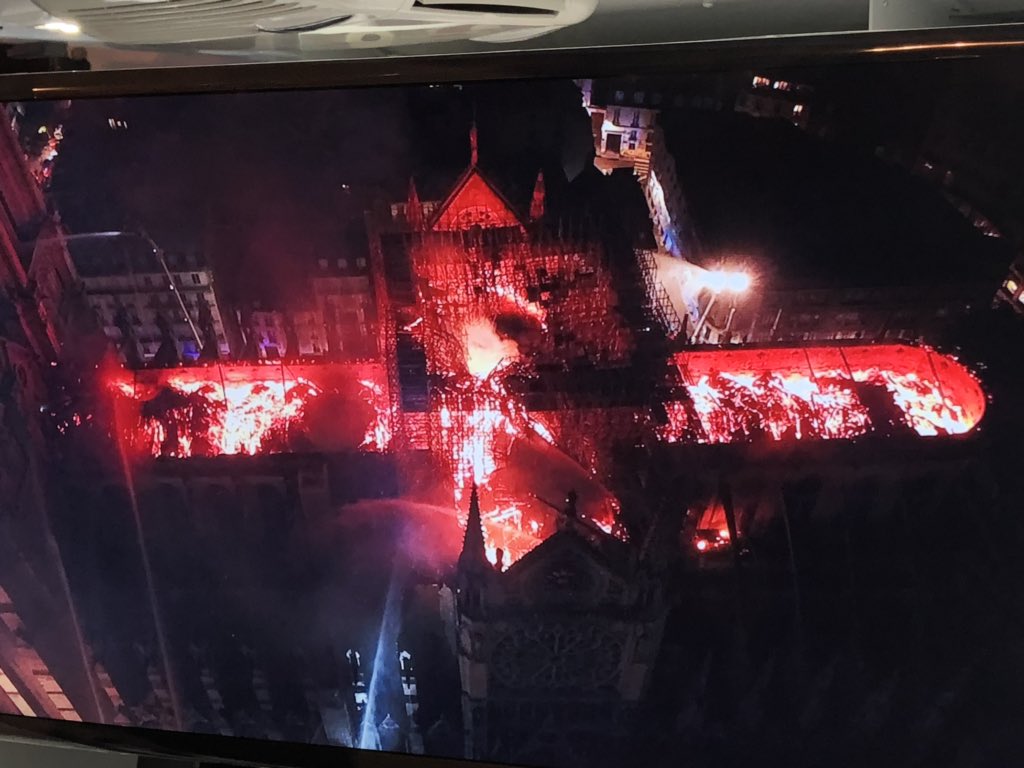
But yes, one or two decades of restoration is a realistic estimation, it's roughly what it took for other cathedrals to be restored (Rouen, Reims) after the World Wars (hopefully Notre-Dame will be in a better state after the disaster)
https://images.scribblelive.com/2019/4/15/556d889a-06ba-4094...

Hopefully things will move faster with Notre-Dame de Paris, but it'll take at least decades.
But in this kind of restoration, the devil is in the details, repairing the structure and rebuilding the roof and the spire will probably take around 8 to 10 years, if the vault is not in too bad of a shape, more otherwise. But repairing the the sculptures and decoration, with all their minutes details will take generations.
For these, what was not destroyed by the fire is probably heavily damaged by the tons of waters poured to save the edifice.
Respectfully, you have no idea what you are talking about. Nobody in Europe would consider tearing down the remaining structures and rebuilding from scratch because it's cheaper.
Above the vaults of stone, a wooden frame supports the roof which is covered with metal (zinc). This is obviously lighter, and easier to build and to maintain than a roof made of stone. Unfortunately, after a few centuries it becomes extremely burnable.
I've been to many Catholic locales, and there are many poor Catholic artisans who would be willing to create beautiful Catholic art if they had resources. I'd rather they get the resources, than some secular artisan simply trying to copy Catholic art.
I would rather see resources go to actual Catholics to be used in an actual Catholic place of worship that is frequented and populated than to non-Catholic artisans attempting to mimick Catholic beauty to restore a building that is not actually used.
The fact is that the well-loved parish stands a chance of becoming a Notre Dame of the future, whereas, Notre Dame itself is likely to fade away and become a museum, unless the people of France actually decide to become Catholic again.
The truth is that, it was the underlying belief in the Catholic world view that made Notre Dame the legend it is today (the constant creation of beauty, the grandeur, the preservation through the ages). No amount of money to secular authorities can possibly recreate that exact mythos, whereas it could if sent to another diocese that still practiced.
EDIT: perhaps I'm wrong and Notre dame is more active than I thought and I just visited at a bad time, but from what I've read, there's not many actual Catholics in France, at least when compared to California.
It’s also a miserable stance to take while the place is still literally on fire.
The restoration works that were under place are a result in part of our recommended actions.
The spire was incredible. It was one oak trunk, connected with a "Scarf Joint", or "Jupitre" in French (Bolt-of-lightning joint)
There were the names of the last guys to inspect it in the 1930s, engraved at the top. There was a french ww2 bullet embedded in the spire, presumably shot at a germany sniper who was in the spire...
Everything in the roof was antique wood. Anyone that went into the roof was paranoid of fire.
It's a very, very sad day.
As a celebration, I'm throwing up some photos that we'd never published from our study.
https://imgur.com/gallery/9k9I8Y0