There are valid criticisms against privatisation or how it was executed, but generally claiming that it hasn’t worked is not accurate. From a usage stand point, it has worked rather well.
[1] https://en.wikipedia.org/wiki/Impact_of_the_privatisation_of...
A Virgin Pendolino is a far more pleasant experience than the old British Rail equivalent.
I agree on the fare rises but rail remains subsidised while road and air travel are taxed.
Below is a link to is a YouGov poll from November 2018 (see the second-to-last question).
https://d25d2506sfb94s.cloudfront.net/cumulus_uploads/inline...
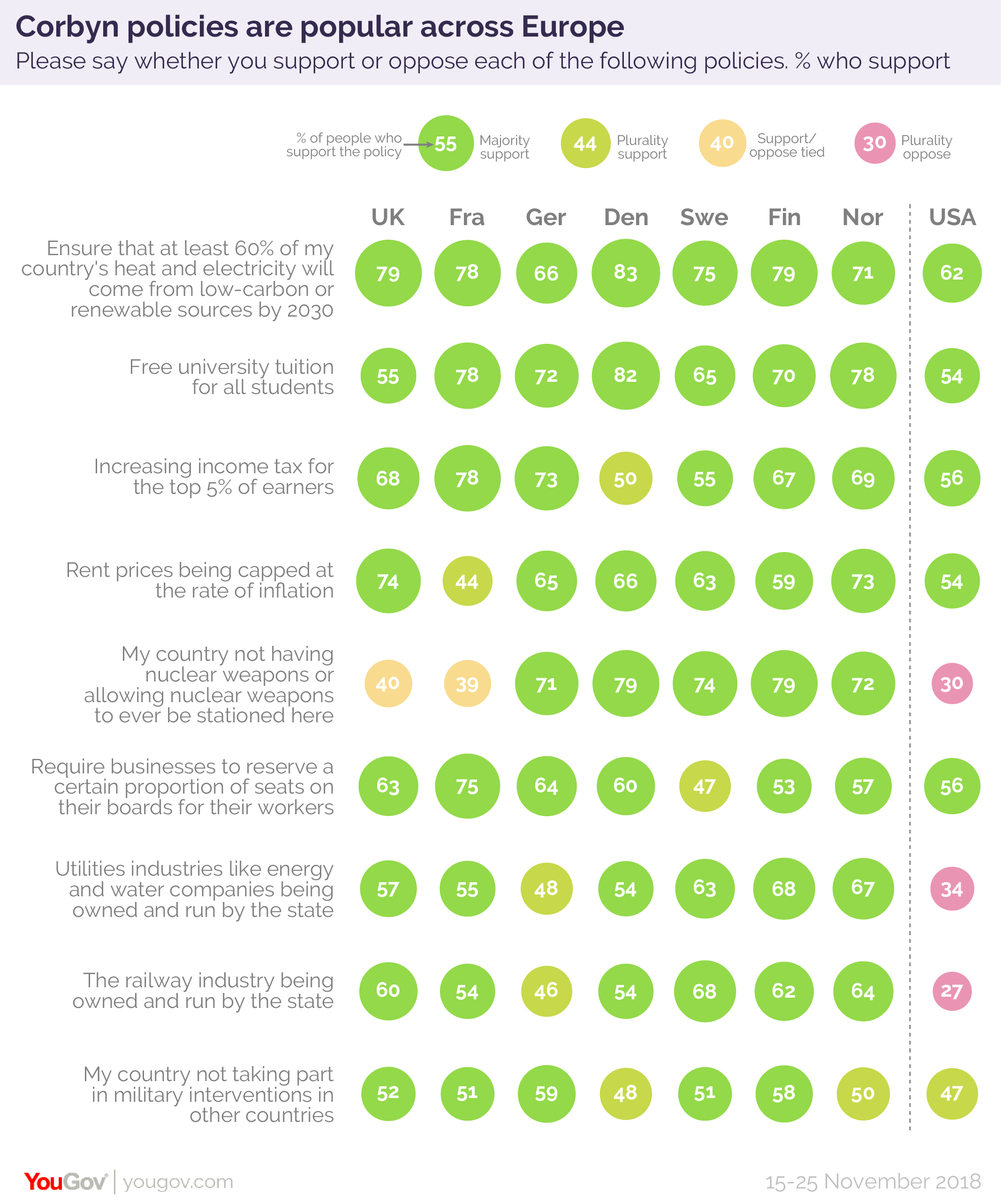
Every country polled had support for state-owned railways above 50%. The exceptions were Germany and the US. Of course, you have to view these polls with caution - it's a snapshot in time. Nevertheless, it's interesting that even in countries perceived to have reliable and affordable railways, support for state-run railways is high.
Edit: added ‘which in most cases has to be centrally coordinated.’
The real problem is that so many people need to travel within a narrow time window.
Also, in the south, lots of people are commuting 100 miles or more each way because they can't afford to live near where they work.
Rail travel in the UK is a victim of its own success in a perverse kind of way.
Asking seriously, I have no concept of rail pricing.
As an example: Southampton to London is a relatively short journey and IIRC the standard non-first class fare is over £70.
But best of all: maintenance is paid by the new private company, but replacements/acquisitions are still paid for from taxes. Therefore it pays to scrimp on maintenance until stuff breaks, then get a replacement for free. Really bad incentive structure there. I sincerely doubt privatisation was a good deal overall.
This is wrong. Deutsche Bahn is 100 % owned by the Federal Republic of Germany: https://www.deutschebahn.com/en/investor_relations/ir_tochte...
I meant to say, that the Deutsche Bundesbahn was legally non-independent. It's successor is a stock company, even if wholly owned by the state. It was touted, using the structure and mindset of a public company, that costs could be reduced by increasing efficiency. With disappointing results.
The competition works differently. Our country wants train that will run from A to B, X times a day and companies will present their offers. Who has the best offer will run this route for Z years.
Nationalization was tried and doesn't work. It has to be supervised by state, but not run by them, that will lead to inferior service.