The competition works differently. Our country wants train that will run from A to B, X times a day and companies will present their offers. Who has the best offer will run this route for Z years.
Nationalization was tried and doesn't work. It has to be supervised by state, but not run by them, that will lead to inferior service.
There are valid criticisms against privatisation or how it was executed, but generally claiming that it hasn’t worked is not accurate. From a usage stand point, it has worked rather well.
[1] https://en.wikipedia.org/wiki/Impact_of_the_privatisation_of...
A Virgin Pendolino is a far more pleasant experience than the old British Rail equivalent.
I agree on the fare rises but rail remains subsidised while road and air travel are taxed.
Below is a link to is a YouGov poll from November 2018 (see the second-to-last question).
https://d25d2506sfb94s.cloudfront.net/cumulus_uploads/inline...
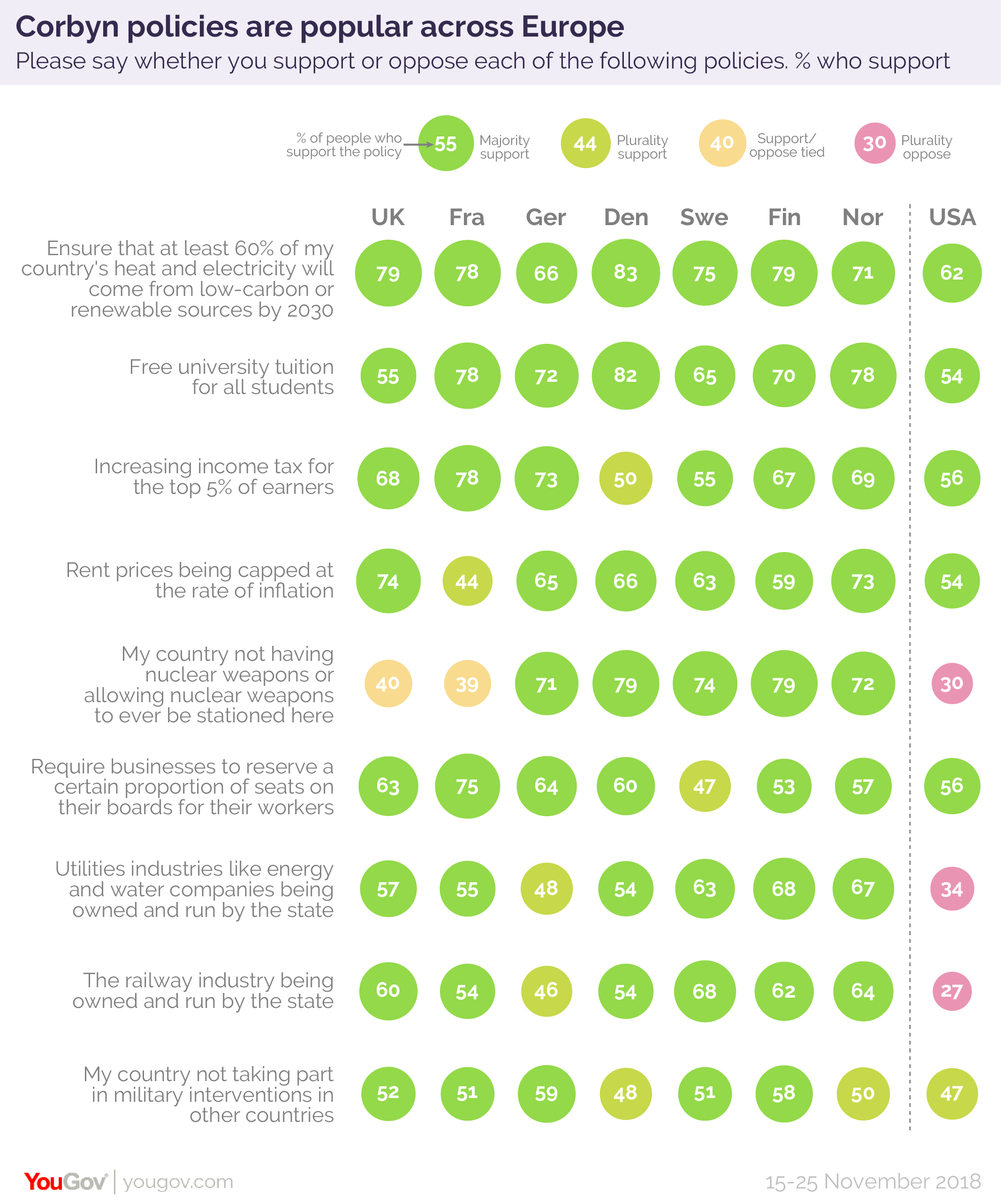
Every country polled had support for state-owned railways above 50%. The exceptions were Germany and the US. Of course, you have to view these polls with caution - it's a snapshot in time. Nevertheless, it's interesting that even in countries perceived to have reliable and affordable railways, support for state-run railways is high.
Edit: added ‘which in most cases has to be centrally coordinated.’
The real problem is that so many people need to travel within a narrow time window.
Also, in the south, lots of people are commuting 100 miles or more each way because they can't afford to live near where they work.
Rail travel in the UK is a victim of its own success in a perverse kind of way.
Asking seriously, I have no concept of rail pricing.
As an example: Southampton to London is a relatively short journey and IIRC the standard non-first class fare is over £70.
But best of all: maintenance is paid by the new private company, but replacements/acquisitions are still paid for from taxes. Therefore it pays to scrimp on maintenance until stuff breaks, then get a replacement for free. Really bad incentive structure there. I sincerely doubt privatisation was a good deal overall.
This is wrong. Deutsche Bahn is 100 % owned by the Federal Republic of Germany: https://www.deutschebahn.com/en/investor_relations/ir_tochte...
I meant to say, that the Deutsche Bundesbahn was legally non-independent. It's successor is a stock company, even if wholly owned by the state. It was touted, using the structure and mindset of a public company, that costs could be reduced by increasing efficiency. With disappointing results.
Um... are you counting the airports when making that comparison? And the air traffic control infrastructure? And the maintenance costs of the planes themselves vs the maintenance costs of the trains?
> Privatised rail makes no sense anywhere in the world.
Are you counting the US freight railways in that? If so, you are badly mistaken.
To what extent is this a prerequisite for competition? The hour has 60 minutes, there is no need for all trains to depart and arrive in exactly the same minute.
Apart from that, it is also not possible for several aircraft to take off from the same runway at the same time. So there is no difference between trains and flights.
> Nationalise it. All of it.
That's a non sequitur. If you want better service, enforce it through regulation; if you want lower prices, use regulation to improve competition. You do not need a state monopoly.
False. (Factual) counterexample: On the Stockholm-Malmö route, there are three operators (SJ, MTR and Snälltåget). The number of passengers on each company's trains will depend heavily on their pricing strategies.
https://www.omio.co.uk/search-frontend/results/1307902350/tr...
One error I made is that there are only 2 operators: SJ and Snälltåget (MTR operates to Gothenburg, not Malmö). On the route to Gothenburg, the journey time is equal (~3h00), and again the companies depart within minutes of each other (e.g. Apr 18: SJ departure 12:33, MTR departure 12:43), and again there is only one physical rail route linking the cities [1].
[1] see https://www.openrailwaymap.org
It makes sense in Japan. It is a small country with a high amount of population that is very concentrated.
In any other part of the world governments are the ones paying the bill for the rail networks meanwhile "private" companies are just adding their profit to the cost. There is no competition, there is no long term investments (until the government pays), customers are captive, ... It just doesn't work.
Planes and their associated physical plant are pretty expensive too and suffer a lot of variable costs trains don't. Do you have figures?
Apart from that, your suggestion is not obvious.
The SNCF is a nationalized train system, and it arguably works well.
Britain's rail network was built privately and suffered after nationalization (and subsequently after privatization)
The US's nationalized passenger network is in dire shape. The private sector freight system is thriving.
It SO doesn't!. Apart from the flashy TGV Network, Frances Railways are a total mess. Try taking a Train in a rural area and you'll most likely find it's been replaced by a bus, or there's gaps of Hours between Services.
The French governement will soon, finally, Long after most of the rest of Europe, allow private companies to bid to provide the Government-subsidized local rail Services. The regional goverments who actually provide the subsidy are champing at the bit to be able to Dump SNCF, who can essentially Name their Price, with the regions then forced to give it them.
Cost to run includes more than just the underlying infrastructure costs. Look at how much it costs to ship goods. Rail is over two orders of magnitude cheaper per ton mile than air, and about an order of magnitude cheaper than trucks, and about 1/3 of the cost of than boats. This suggests that the high infrastructure cost of rail has little impact on cost to run.
Like, the company rents the traincar barebone and puts in seats, foodstalls, wifi, ac, etc.
Finally, while we are at modernizing, can we get maglev trains - with detaching and attaching passenger cabins? Because, the real slowdown in europe is local "little" emperors having a say where the train stops, and theire voters region is that one place, the ICE has to stop.
Trains are also more expensive to run than planes because they need more infrastructure to operate, and that infrastructure is high maintenance. So we have almost no competition, high operating costs, and we've set it up so the people operating the trains are in opposition to each other and have no incentive or obligation to work together to lower prices or improve the service.
Nationalise it. All of it. And let's just accept that there are some things that simply shouldn't be run by the private sector.
And I realise that "Nationalisation" in the context of the EU is the wrong word. What I'm saying is the that EU should run the whole thing. Whatever that's called... Federalisation? I don't know.