Also take note that the scale of the graphs is different. E.g. Figures 5 & 6 makes it look like Java energy is super low when it's really just similar to the compiled languages.[1]
[1] http://greenlab.di.uminho.pt/wp-content/uploads/2017/10/sleF...
JVMs and CLR had those a decade ago. The state of the art are concurrent, compacting, region-based pauseless or millisecond-pause collectors.
I'm sure you're also aware that recent Go's GC pauses are sub millisecond for most use cases:
"We now have an objective of 500 microseconds stop the world pause per GC cycle." - 2018 Go team
https://blog.golang.org/ismmkeynote
My personal experience with microservices is to expect STW pauses in the 350 microsecond range. The best part is that it requires zero tunning or developer's attention while still being light on memory usage. Can't say the same for Java's default GC.
OpenJDK's default collector - parallel or G1GC, depending on version - is not the best available among JVMs and if your goal is pause times then yes, it will be worse than Go's. But if you switch to say C4 or ZGC you'll get comparable pause times and compacting on top and being able to scale to terabyte heaps.
10 years ago we had Metronome and CMS, which are more comparable to Go's collector.
And pause-times are not everything. Throughput and fragmentation resistance matter too. Compacting collectors fare much better on the latter metric. I don't know how the former is now, but those slides talked about 25% GC overhead in older versions of Go, that's utterly terrible.
Go is facing one challange that java doesn't: internal pointers. But the CLR's collectors have to deal with those too, so that's not terra incognita either.
> 25% GC overhead in older versions of Go, that's utterly terrible.
25% overhead of what? And compared to what? Just throwing numbers in the air and saying it's terrible makes no sense.
The only 25%'s if could find in the slide were these: https://blog.golang.org/ismmkeynote/image6.png
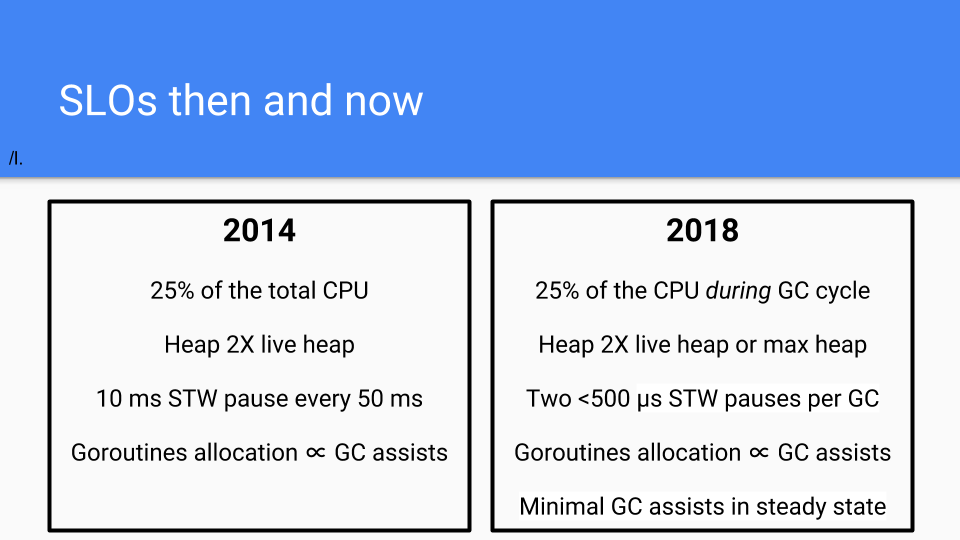
2014 Go: 25% of CPU used by GC
2018 Go: 25% of CPU used during 2x STW GC of < 500 microseconds
So even if STW GC occurred as frequent as every second (which it doesn't in my use cases), this would amount to 0.025% of the CPU being used for GC, not 25%.
> Of course gains are to be expected when switching from Java's default GC to something specialized.
So? That's irrelevant for what's state of the art.
-Note- I'm not saying one is better than the other. ARC works great on iOS for creating applications.
1 - Why would you want to replace java on the server? (Seems obvious that it provides the best balance of productivity and performance per watt.)
2 - Assuming a company would want to replace jave, why, on earth, would we not use C++? (Or, perhaps, rust if we want to use a newcomer?) Why are we better off going all the way down this list to go and swift?
Well one reason, if you look at the paper, is memory consumption. One of the ways Java gets good performance despite being a GC'd language is less efficient memory usage. (Although there are many advancements in this area akin to what Go has accomplished but as the paper's metrics show, often Java uses a lot of mem.)
Also probably lots of people will agree that it has accumulated some cruft over the years and predates lots of modern trends and things like concurrency and functional programming and whatnot require more complicated code patterns.. a classic example is the getter/setter verbosity of a simple value type (not trying to start a flame war here).
However it's fair to say Java is the thing to beat in terms of "goldilocks" languages that blend productivity/safety with performance.
> 2 - ...would we not use C++?
Because it's a huge regression in productivity and safety. The goal is to reduce memory consumption while achieving great performance and, crucially, consistently low latency which is a greatly underappreciated server metric and really should be the number one benchmark IMHO.
???
You're recommending a slower language, that uses more watts, on a presumably 24/7 backend...
to save a few bucks on memory?
As I said, if you want a company to switch to c++ or rust because you want to save money on memory IN ADDITION to all the money you're saving on watts, while getting the same or better performance? That might make some sense.
Switching to go makes, No, sense. You end up paying more money per user session to do the equivalent work. (Even worse, each user waits longer because the work is done slower.)
And then, like typical engineers, we'd proceed to explain to our bosses that all of this is actually better...
because our new program uses less memory.
Also, a request. Try to take it easy on the ???, all caps and excessive italics.
And golang does what exactly for this? As a matter of fact, Java is superior here to golang on these fronts, and is only going to get better. There is a lot of unsubstantiated golang hype and people should know better.
That's a pretty cool idea. I read something on HN the other day about using swift in the back end, but haven't used it myself. Hopefully Apple gets support for non-ubuntu linuxes as well as windows out the door (especially since they're no longer making their own hardware). I've heard anecdotally that it has very slow compile times, so that might be another issue.
> Swift is unique in the server world in that it uses reference counting
Out of curiosity, why has no-one done automatic reference counting on the server side before? C++11 has smart pointers, and I believe python does as well (can't speak to this one personally).
I also feel like most languages using the llvm backend could achieve performance at least close to c++; wasn't that part of the purpose? It seems like Swift might be especially ripe for this because Apple is the big developer of both LLVM and Swift.
Those examples are both interpreted languages, and they have a higher runtime cost for memory management because they're actively breaking reference cycles, so it's not apples-to-apples, but it's still reference counting.
My guess is you fall into one of two categories:
1- You don't care a ton about efficiency because you can scale out to infinite servers that are relatively cheap and affordable. So you can run on django or rails or whatever and it's fine at "pre-IPO" scale.
2- You do care, but Java is good enough.
So you kind of have to be at Google's scale to care about creating a new server language. In Swift's case, the motivation was super constrained mobile devices, so bringing it to the server side is more of an incremental engineering cost against that massive investment.
Not sure what you're responding to but I specifically said "at scale" and "developer productivity / friendliness is important to overall success."
If it were up to me, no matter the energy consumption, a piece of software in that realm should be proven correct (both crash-free and doing what the specification says).
You do realize that a lot of autonomous driving software uses ML techniques that make providing guarantees like that difficult, right? (To be honest, oftentimes we can't even provide an explanation of why an ML decision was made, let alone "prove" why an ML decision is made. We only show tha most of the time, 98.3995% or whatever, the system should do "something like this".)
But in any case, none of that would affect the languages at issue here, because no one would write self driving software in any of these languages. There's about a 10,000% chance that any such startup would use GPU languages to do the meat of that work. Almost 0% chance any reputable company relies on something like go or swift to drive an automobile out on public roads.
You couldn’t be more wrong. Tesla hired the creator of Swift to run Autopilot software.
He’s now at Google where he’s working on making Swift a primary language for TensorFlow.[1]
I think Rust w/ macros like you see in Rocket (https://rocket.rs/) looks promising. I haven't used it, but the guarantees, simplicity, and performance (possibilities - it doesn't use async yet) are really interesting.
Reference counting, by contrast, is entirely predictable. It doesn't defer any work. I would argue that CTOs are a lot more interested in consistently low latency than in requests per second. So it's very interesting to see an approachable, performant language take the ARC route on the server. It is early days though.
ARC would be just one my issues using Swift outside of iOS.
I think you are overstating the pause duration of a modern GC. I have used both Go and the JVM server side, not at a huge scale but enough to see GC effecting response times. They add some fluctuate, but nothing compared to network latency or the multitude of other factors that fluctuate heavily. It was never significantly relevant for response times. I'm looking at my server logs right now and theres not even a real correlation between GC and response time. Unless you are considering a 0-10ms fluctuation.
If you are interested in using an ARC server side I know Kotlin Native is using ARC however their implementation eliminates the cyclical reference issue.
Funny you say that because just this week there has been an investigation into what seemed to be “leaks” but turns out it’s memory fragmentation. It’s a fascinating read into how to debug a server problem if you’re into that sort of thing.[1]
Agree that modern tracing GC can be very good in a wide range of cases but there are some where it’s not. Very dependent on the case. Ultimately you are deferring work and hoping to find some time in the future to squeeze it in unnoticed. ARC is a cool paradigm to explore on the server as it doesn’t have this problem to begin with.
[1] https://forums.swift.org/t/memory-leaking-in-vapor-app/22209...
Memory fragmentation is another legit concern I guess, as far as I can remember iOS has no memory compaction. Again not a necessarily an issue for a short live user space application, it is a larger one than memory leaks at least at my company. In some hot spots of our app we specifically slow down reading of some queries to reduce memory fragmentation.
Frankly Chris Lattner's claim that a GC leads to 2x-3x memory consumption over ARC is unfounded and sorta shocking coming from someone held is such high esteem. It's something thats continually shown to be untrue.
It always seems Swift's biggest selling point is it uses ARC instead of a GC, which is either not a large issue or a GC is actually more beneficial. Other than that you still haven't dealt with the toxic "Swifty" community, the terrible tooling situation, the immature libraries and frameworks, etc, etc.
There seems to be so many better solutions to writing server side code. This is all coming from someone who uses the language on a daily basis.
(And then you have ref cycles which is another kind of headache. And poor cache behavior from all those refcount updates.)
[1] https://en.wikipedia.org/wiki/Intergovernmental_Panel_on_Cli...
Just pointing out this distinction because the “can’t predict next week’s weather” is a disingenuous soundbite that has been used by climate change deniers to discredit climatologists in the eyes of the of the public who don’t understand the difference. I’ll give you the benefit of the doubt that you weren’t trying to be disingenuous, but the distinction still makes your question somewhat irrelevant.
[1] https://climate.nasa.gov/news/2743/the-scientific-method-and...
1- This is exactly how we should all be thinking about server engineering moving forward, as we aim to drastically reduce carbon footprint within 11 years. Efficiencies at the language level are one of biggest bangs for buck here. Just by redeploying, you can reduce energy consumption by perhaps double digits. Imagine how hard that is to do at the hardware or energy farm level.
Think about it: You, brave software engineer, can literally make a significant contribution to saving the world by adopting a more energy-efficient language, if you are fortunate enough to deploy something at scale.
2- Rust is killing it in these metrics but developer productivity / friendliness is important to overall success. Looking at these results I have a conjecture that is maybe provocative: The top two candidates for long-term success at supplanting Java on the server in my eyes are
a) Go
b) brace yourself.. Swift
Swift is extremely young on the server, to the point where I'd expect your natural reaction to be "WTFLOL?! never heard of it". But here's some food for thought: the Netty team, one of the top performing Java server stacks, has been recruited by Apple and is chewing through all that stuff and just launched their NIO2 release[1] which I've heard is already very close to Netty.
Go has an amazing concurrent garbage collector and has really pushed the envelope with that.[2] Swift is unique in the server world in that it uses reference counting which sidesteps the whole GC collection problem, which could translate into very low, very consistent latencies as well as memory usage. It's still quite early days for Swift, but these are the two languages I'm watching the closest.
[1] https://forums.swift.org/c/server
[2] https://blog.golang.org/ismmkeynote