News for hackers. Stuff that matters.
Re:How Germany got it right on the economy by wheaties on Sunday November 28, 2010 @11:30PM (#1949381)
The problem with this article is that is glosses over one major problem: if Germany's currency moved in accordance with its economy rather than the entire European Union then its exports would be grossly overpriced and uncompetitive. It's the formation of the EU and a single currency that has allowed it to remain an exporting country rather. The article can not compare apples to oranges and make sense.
Re:How Germany got it right on the economy by brc on Sunday November 28, 2010 @11:57PM (#1949430)
But you could make the same argument against any US state that remains cost competitive due to the currency. And it also discounts the fact that Germany did very well during the period when it did have it's own currency. As it is, German economic performance does have an effect on the Euro, being the largest member state.
Re:How Germany got it right on the economy by whakojacko on Monday November 29, 2010 @12:10AM (#1949455)
>But you could make the same argument against any US state that remains cost competitive due to the currency.

Indeed you can.

>And it also discounts the fact that Germany did very well during the period when it did have it's own currency.

This is true. However Germany also gets decent manufacturing benefits from the income disparity in the east.

>As it is, German economic performance does have an effect on the Euro, being the largest member state.

Of course. However, about half of Germany's exports are to Eurozone, for which EUR flucations have no effect.

Re:How Germany got it right on the economy by rb2k_ on Monday November 29, 2010 @02:42AM (#1949713)
> However Germany also gets decent manufacturing benefits from the income disparity in the east.

Strangely enough, the east has (by far) the highest unemployment rate in Germany:

http://upload.wikimedia.org/wikipedia/commons/6/6f/Arbeitslo...
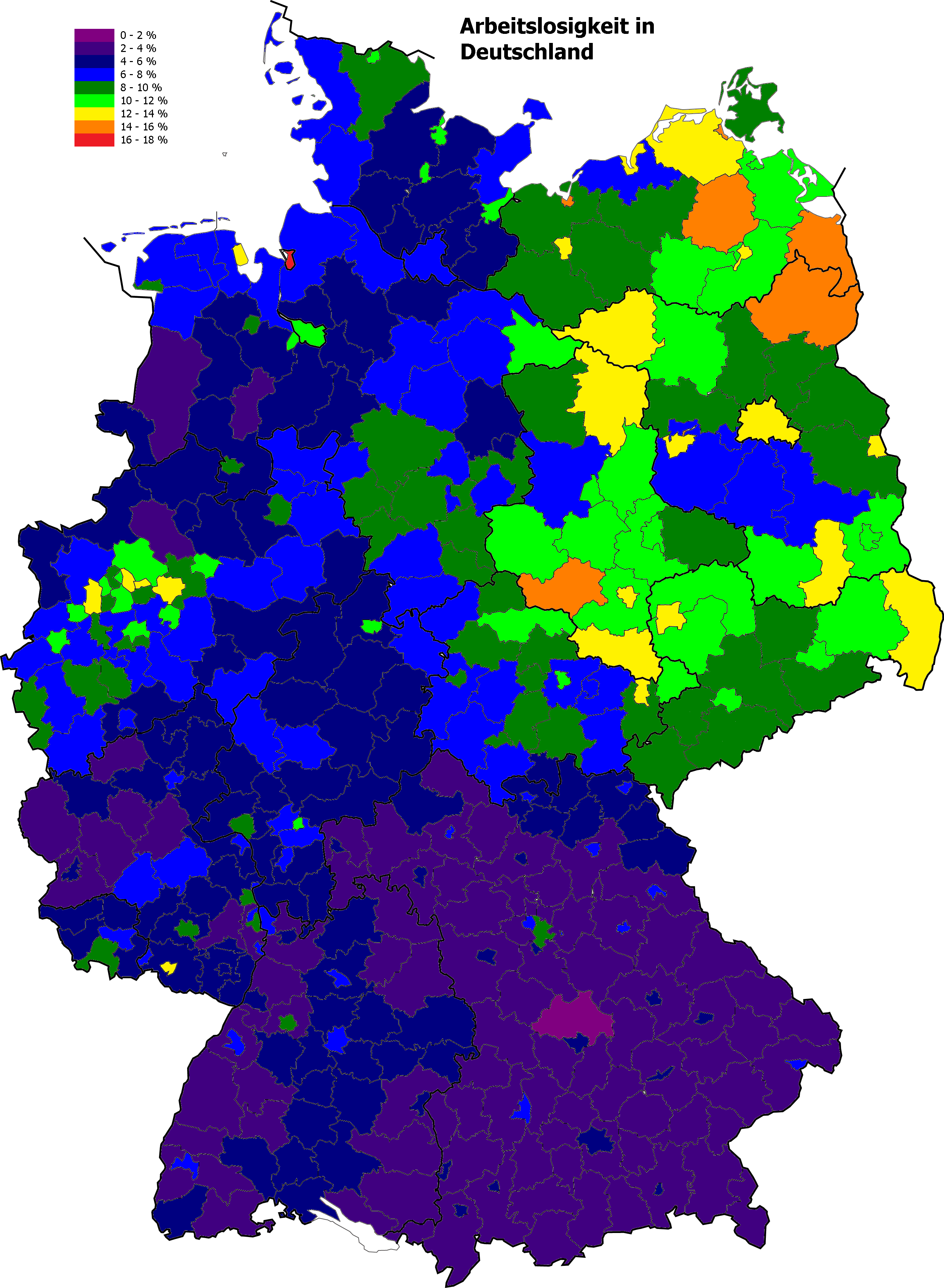
The big German manufacturing plants for e.g. cars are usually also found in the south/west (Daimler + Porsche around Stuttgart, BMW in Bavaria). This goes even as far as adding a "solidarity surcharge" to help the east:

http://en.wikipedia.org/wiki/Taxation_in_Germany#Solidarity_...

Re:How Germany got it right on the economy by DuncanIdaho on Monday November 29, 2010 @09:01AM (#1950267)
That is not due to work shortage - but due to shortage of work that can be done by socialistic, highly (unproductively) unionized and unqualified work-force.

Eastern Germany will stay like that until the workforce that was raised in socialism gets out of the way. Eastern Germany has more in common with Poland, Czech and Slovakia than with western Germany and France.

I'm from ex-socialist country and it is the same situation here - plenty of high value added opportunities are available - but nobody to take advantage of them.

Re:How Germany got it right on the economy by lispm on Monday November 29, 2010 @05:33AM (#1949914)
The automotive industry was the first to build new state of the art factories in East Germany. Porsche in Leipzig, VW's transparent factory ( http://www.glaesernemanufaktur.de/gmd.jsp?dok=&lang=&... ), ...
Re:How Germany got it right on the economy by lispm on Monday November 29, 2010 @08:29AM (#1950187)
Re:How Germany got it right on the economy by wazoox on Monday November 29, 2010 @07:29AM (#1950080)
The problem comes more from the fact that 70% or so of German exports go to the rest of European Union and mostly the Euro zone.

Germany actually kept itself out of the water largely by lifting itself upon its neighbours' heads. Then Merkel will rant about the "lazy greeks" and other amenities.

Actually the problem arises from the disparity between a monetary union without financial, fiscal and debt union. Unsurprisingly, the biggest boy did better than the rest of the pack.

Re:How Germany got it right on the economy by lispm on Monday November 29, 2010 @08:14AM (#1950155)
The EU is diverse and has a lot of different member states. Germany's largest trading partners are not Ireland or Greece. Far from it. It is France. Germany is also the largest importer in the EU. For many products it sells there are suppliers somewhere else in the EU.

The problem of Ireland and Greece are not so much caused by trade deficits with Germany. There are problems caused by trade deficits (while at the same time Germany is transferring lots of money into the EU by its EU contributions and investments), but Ireland's problems were caused by its bursting housing bubble and its banking crisis. Greece OTOH has internal budget deficit problems (expensive public sector, corruption, arms deals, ...).

Re:How Germany got it right on the economy by dublinclontarf on Monday November 29, 2010 @02:08AM (#1949643)
Ireland and Greece are a blessing to the German economy, without these two economic ancors the Euro would be rocketing up and pricing Germany out of the market.
Re:How Germany got it right on the economy by _grrr on Monday November 29, 2010 @03:31AM (#1949778)
>But you could make the same argument against any US state that remains cost competitive due to the currency

True, but, there is a policial union of states in the US that doesn't exist in the EU. The EU is a monetary union without a political union, this means that it's politically unpalatable to explicitly redistribute tax money from the relatively rich to poor regions (Germany/France to Greece/Portugal) in the same way as Washington or London might to W.Virginia or Newcastle.

Re:How Germany got it right on the economy by Loic on Monday November 29, 2010 @04:05AM (#1949818)
Europe is redistributing enormous amount of money from rich to poor countries within EU. Spain would still look like an underdeveloped country without the massive injection of money coming from the EU. EU (the organisation), even with problems here and there and the need to take a good diet, is working wonderfully at equalizing the rich/poor countries. This is why most of the countries do not want Turkey to be part of EU, under the EU rules, this would mean an insane amount of money going to Turkey every year for maybe 30 years or more.

With respect to the article itself, not everything is rosy in Germany, a large part of the population is living out of the social help system (7.5 millions people) and another large par is getting miserable wages, in the range of 4€/h or less. So yes, the German economy is robust, but the social state is struggling too.

Re:How Germany got it right on the economy by _grrr on Monday November 29, 2010 @04:46AM (#1949862)
> Europe is redistributing enormous amount of money from rich to poor countries within EU

Yes, they are, but it's a political hot potato, arguably without mandate, and I doubt that it's on the scale of national regional development funds.

Don't get me wrong, I am pro Europe, but I think politicians have done an abysmal job of explaining the project to voters (esp in the UK).

Re:How Germany got it right on the economy by tallanvor on Monday November 29, 2010 @08:48AM (#1950227)
The US has around 37 million people (over 10% of the population) who receive food stamps, and that number may be greater now. Some of the people on unemployment may also be receiving food stamps, but not all of them. Another 4+ million are on some sort of state welfare or aid program (again, some those may also be included in the 37 million number). So Germany's 7.5 million people in the social welfare program doesn't seem that bad.
Re:How Germany got it right on the economy by mooism2 on Monday November 29, 2010 @04:24AM (#1949835)
The EU does redistribute a large amount of money between its member countries... but this is still small compared to intrastate transfers.
Re:How Germany got it right on the economy by ckuehne on Monday November 29, 2010 @04:03AM (#1949812)
Ahem, Germany is net payer into the European Union bugdet with an estimated net payment per capita of 1045 Euro ( http://en.wikipedia.org/wiki/Budget_of_the_European_Union#St...).
Re:How Germany got it right on the economy by brc on Monday November 29, 2010 @04:45AM (#1949861)
I also don't have the numbers but I do know that the 'poor' EU member states do receive a lot of money from the richer economies of Germany, France and the UK. If anything threatens the strength of the EU and the Euro, it will be German taxpayers deciding they've had enough of paying for infrastructure in other countries and/or underwriting their profligate borrowing.

I think the amount of wealth that gets sent to West Virginia is probably overestimated as well.

Re:How Germany got it right on the economy by roel_v on Monday November 29, 2010 @04:15AM (#1949825)
At first I had typed a paragraph here about how you are wrong, but then I realized that I don't have any numbers on this, nor do I even know a measure on how this could be quantified. I still think you're wrong, but I can't prove it. Do you have any numbers on the amount of redistribution that happens e.g. from blue to red states in the US? If so, is there a description of the methodology used somewhere? Or does anyone else know of figures or research in this area?
Re:How Germany got it right on the economy by _grrr on Monday November 29, 2010 @06:32AM (#1949987)
The UK spends ~£6 Billion/yr on EU. Total UK Budget is £620 Billion.

Sources:

UK Budget: http://www.guardian.co.uk/news/datablog/2010/may/17/uk-publi...

EU Contributions: http://news.bbc.co.uk/1/hi/8036096.stm

Afraid I don't have figures for US.

Re:How Germany got it right on the economy by roel_v on Monday November 29, 2010 @07:47AM (#1950106)
This BBC is a very nice summary, thanks. It looks like it accounts for payments that are not directly to the Member States too, which is the hardest part to account for (I base this on the total payments to France which must include the CAP (agricultural) subsidies).

I have only briefly searched for a couple of reference countries, but it seems that about 1% of the state budget contribution to the EU is the 'normal' amount, with the 'net' expenditures (after discounting for income) is only 30% of that at most (for Germany, for the lesser net contributors that number drops exponentially). So that seems very small, certainly less than I had expected.

Then again, most the most expensive government jobs (social security, medical insurance, pensions) are governed at Member State level, so maybe it shouldn't be that surprising.

So anyway, then we can reduce the original question to 'is there more than 1% income redistribution between states in the US'. Which I think there will be, since Medicaid and SS are federal programs, right? Plus military spending, which redistributes from states without bases or research to states who do have them, and which makes up a big part of the federal budget.

Maybe my initial feeling was wrong, and there is much more redistribution between US States than there is between EU Member States. I'd love to spend the rest of my day researching but I'm afraid I don't have time for that ;)

Re:How Germany got it right on the economy by Derbasti on Monday November 29, 2010 @02:23AM (#1949677)
What you are missing here is that the Euro only works if the stronger countries support the weaker ones financially. Without this, the Euro could not be a stable currency.

If a country like Greece or Ireland is basically collapsing, it survives because countries like Germany and France pay for it. There is no such thing as a free lunch. What Germany gains now because of the weak Euro, it had to pay a few months ago to help Greece.

However, Greece has been paid by the government, not small businesses. Small businesses only have to bear that burden gradually by paying taxes.

Re:How Germany got it right on the economy by lispm on Monday November 29, 2010 @05:40AM (#1949924)
Ireland and Greece were not supposed to be 'weak' countries.

Ireland just a few years ago was seen as a model for economic growth (supported by very low tax rates for companies). Ireland is a victim of its own misguided policies (housing bubble, banking system, ...) and its orientation to anglo-saxon economic policies.

Greece also failed to reform its economic policies (after cheating on the economic data for quite some time). There was time enough to do that.

I also don't think these countries are 'collapsing'. But adjusting their economic policies will be tough.

Re:How Germany got it right on the economy by deadmansshoes on Monday November 29, 2010 @06:59AM (#1950031)
It's a good job Germany don't follow anglo-saxon policies...
Re:How Germany got it right on the economy by Derbasti on Tuesday November 30, 2010 @02:31AM (#1953446)
Sure, they did not collapse actually. But their economy very nearly did. Both Greeces and Irelands economy basically only survived because the rest of Europe paid for it. And I think this is a good thing. Europe is a better place if we help each other.

Of course, no country in the Euro zone is supposed to be a weak country. After all, investing so much money in Greece and Ireland is a testament that Europe indeed does believe that these countries can get back on their feet.

Re:How Germany got it right on the economy by InclinedPlane on Monday November 29, 2010 @02:46AM (#1949721)
And Ireland, which has been recently bailed out to the tune of a significant fraction of its GDP.
Re:How Germany got it right on the economy by lispm on Monday November 29, 2010 @05:31AM (#1949908)
Germany has been consistently exporting its goods over two decades, independent of the exchange rates. The German export success is not tied to the exchange rate. German companies learned to live with high exchange rates. For example the automotive industry has factories in the US, Mexico, Brasil, ...