For things like the EGR, blocking it off is simply installing a bracket or two and closing off some vacuum lines. I can imagine people would simply reinstall this and swap the tune to pass and then immediately remove it after.
In the US, for emissions, all you have to do is not run any check engine lights when at the test center which is easy to do in the software tune.
Which is very disappointing...
When I first moved to Arizona I had a '67 Galaxy and that thing got to run on the dyno in the emissions office but when I got my truck to replace it (not having AC in Arizona isn't fun) all they did was plug in into the computer and charge me more for the test.
My (carburated) motorcycle was in between, they couldn't run it on the dyno and couldn't plug a computer into it so just tested it at idle -- which seemed pretty pointless to me, even being all hopped-up it still got better gas mileage than most cars on the road, though it did get pretty horrible gas mileage for a motorcycle considering I had to run premium in it.
Probably we should do as many Asians do in this, and make it normal to go out with a face mask.
Not sure what kind of masks have to be used to effectively not breathe pollution, and their effectivity, though. Getting informed about that is in my to-do list.
(However surgical masks aren't meant to do that, they're only meant to catch things expelled from you, not the other way around. So I guess your interjection is somewhat correct in that running around with a surgical mask does pretty much nil to improve the quality of the air you inhale.)
They are quite uncomfortable to wear, though. You can breathe just fine for extended period of time but it feels (at least to me, a layman in these things) like you get less air. I wouldn't wear it as an everyday thing.
I have no idea if there are more comfortable solutions that can handle pollution.
As for efficiency, I found a paper (DGUV IFA 0233) saying standard P3 particle filters are highly efficient even against ultrafine aerosol particles (particle diameter below 100 nm); for "larger" stuff (PM1 and larger) these are specified to remove more than 99.9 % of them.
This actually leads to P3 filters already removing a lot of smells, e.g. when you machine steel or wood, sand wood or grind steel, you don't smell it. However, gaseous stuff like solvents get through. That's what the A2 filter is for.
[1] https://asset.conrad.com/media10/isa/160267/c1/-/de/831230_A...
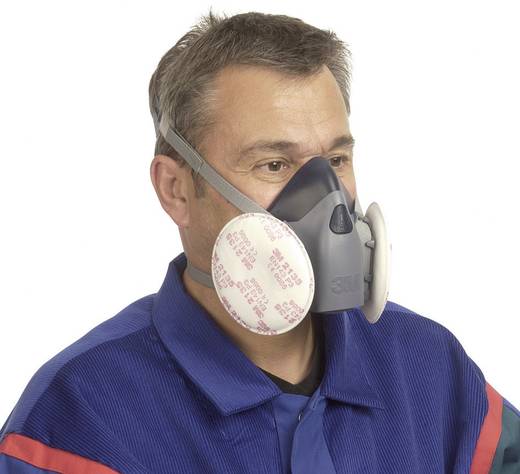
[2] https://assets.tooler.de/cimage/700x700/media/catalog/produc... [note: outer particle filter isn't installed in this picture, it would go under the translucent hood and is about the size of a Leibniz keks [3]

Here, every 2 years, cars must legally be examined in a "controle technique", like an exam which controls several aspects of a vehicle.
I wonder if those fumes are legal, and I really wonder if people can manage to cheat at that exam, because I think I'm noticing an epidemic of those fumes.
How can I really be expected to ride a bike next to cars like this? I'd rather spend time in a tram or bus than expose my lungs to this.