The predicted number is much closer to around 650 ppm, and that's assuming no change.
In reality, things like solar technology have massively gone down in price over the last couple decades, and are only continuing to reduce in price.
We will likely see 2-3 degrees of warming, but no credible scientist is making the predictions that you seem to be making.
If there is no change in CO2 emission, then yes we might restrict the total damage to 650 ppm. But "no change in CO2 emission" doesn't mean "business as usual", it means a moratorium on all kinds of expanding industrial activity.
Not only are CO2 levels increasing, but CO2 emission rates are increasing. Hell, the first derivative of CO2 emission rate was also increasing until the past couple of years, a minor but happy development that could easily snap back. "Business as usual" means an exponential curve.
Solar powered industry is still a far-off pipe dream. Even if it only takes 30 years to replace all energy sources with sustainable alternative, in 30 years huge damage will have been done. We cannot afford to just shrug and say the problem will just solve itself.
https://www.co2.earth/images/widgets-in-site/climate-interac...
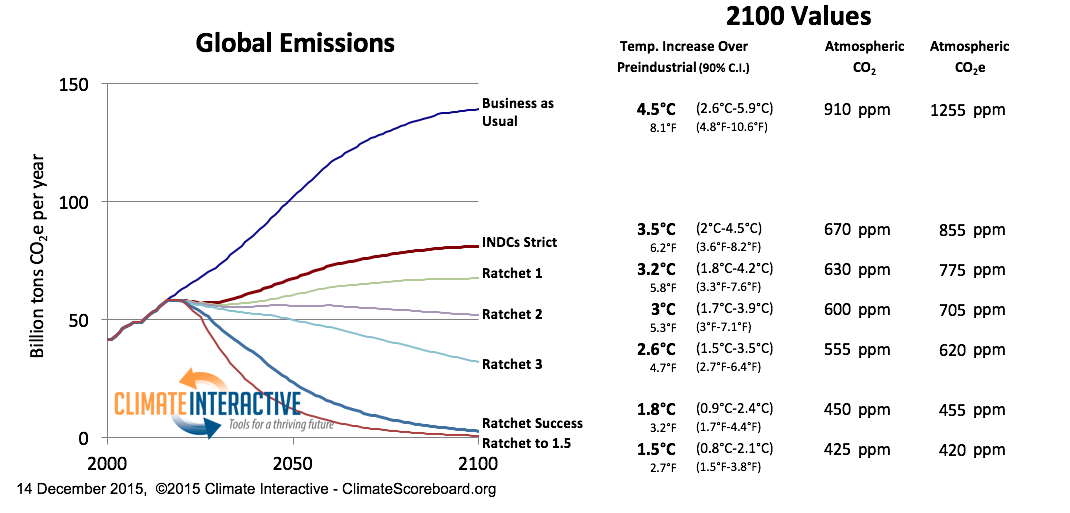
As predicted by the scientific consensus and the intergovernmental panel on climate change.
Disagreeing with them on this is no different than being a climate change denier, TBH.
The right thing to do is listen to the opinions of the experts, and this is what the experts believe and is the scientific consensus.
Though solar and other non-carbon energy sources are coming down in price, world energy needs are outpacing them. Out CO2 emissions are increasing, not decreasing. I doubt that we'll see 1000 ppm by the turn of the century, but if the "no change" projection is 650 ppm then by simple matter of inference, due to increasing CO2 output, we should be higher than that.
Why? Because if solar power and others, continue to go down in price, as they are doing now, then solar ect will be cheaper than coal.
From a purely economic stand point, countries will eventually just stop burning coal, because the alternatives are just flat out cheaper, even when you ignore the costs of global warming.
That point in time, when alternatives are just straight up cheaper than coal, isn't too far away.
The trouble is that countries are not purely rational, and do not factor in all externalities.