That said, I still don't personally own a truck, borrowing them as needed. An all-electric model of good quality would be pretty tempting to me.
But trailers are widespread and gardening/furniture shops provide them either for free or for a very low price.
Canadian here who drives a truck in the snowy mountain roads, I'm pretty confused by this. Why do you say they are not good? There is nothing I'd rather be in than an F350 with studded tires and four-wheel drive on the highway when the road conditions go bad.
But there is another problem with trucks. It rains a lot in Norway especially on the west coast and in mountains. And it really sucks to load-transport-unload without the roof under the rain. Most trailers here are with the roof for this reason.
On your last point, are truck canopies not common in Norway? Something like this: https://canopy-world.com/
Canopies are really rare. What is typical is vans or cargo vans in all sizes. That is, something with a roof and front-wheel drive. As roads here are good, there is little point in high-rised cars. And on icy roads or with snow good winter tires are much more important than 4WD.
Minimal maintenance, largely stored sitting idle, no cleaning required. You don't even need to unethically deem your workers as contractors.
Trailers have a capacity advantage though. Sometimes the shit you're moving simply won't fit in a large pickup truck. In those cases though, having a truck with sufficient power to tow that trailer is still handy...
The only thing you need is practice. The next time you use a trailer, take it to a big WalMart parking lot during a slow time and play around with it a little bit. You'll get a feel for where the "fulcrum" is, and start using your mirrors to steer. This isn't an impossible task. All the semi truck drivers you see on the road have to get really good at this in order to pass their CDL, and lots of them never backed up a trailer before they took the course.
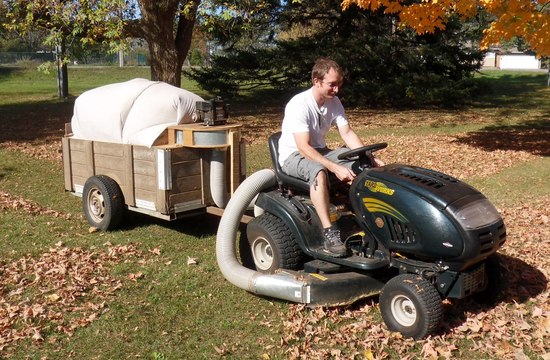
My main point though is mass market trailer rental to the general public will probably never be very popular. Most people have never attempted to back up a trailer before and at least the first few times they attempt it the chance they'll jackknife it is pretty high.
But backing up! Its like pushing a rope. And I had to get the rear of the wagon within 1ft of the target - an old tire with a grain auger's business end in it, so I could unload.
Yes, every time I park it. It is much easier to learn how to back with a trailer than to learn how to drive
Sheet materials and long materials up there no problem, everything else in the boot.
https://www.harborfreight.com/1195-lbs-capacity-48-in-x-96-i...
At $350, not having to share a utility trailer with careless drivers seems quite attainable.
The light trucks have BUMPERS that actually work; so, can bump into something, push another truck, maybe by accident hit a deer some night, all with little or no damage. With no bumpers, lots of little bumps would need $1000+ for body repairs.
So, as a result, light trucks are functional, rugged, and comparatively simple and easy to maintain. I.e., light trucks get rid of the nonsense luxury stuff I don't need, can't use, don't like, don't want, don't want to pay more for when I buy, and most of all don't want the cost and Excedrin headache #498,293,991 of maintenance.
These trucks are much the same year after year, aren't "all new", and, thus, have a lot of the bugs, design errors, bad corrosion problems, and bad part kinks worked out. As soon as a seller claims "all new" I'll have to conclude the seller had a lot of problems with their models for the last several years and walk out saying "Maybe I'll see you again in 10 years.". "All new" may be good for Paris fashions, but I don't want it in a vehicle.
These trucks have solid rear axles, usually with stiff leaf springs -- that is, RUGGED with no problems with alignment, weak bushings, etc.
I like Ford and Chevy because they are made with parts readily available, from Ford, Chevy, or third parties, all over the US at relatively low prices now and for decades into the future, use English wrench sizes, and are well understood by a huge fraction of US mechanics.
My next vehicle will be a light truck from Ford or Chevy even though I will rarely make good use of the bed in the back.
For a vehicle I want a solid, mechanical tool, functional, rugged, durable, easy to maintain. As soon as a seller mentions luxury, I'm gone. Yup, like Jay Leno, I like blue jeans, too.
Typically can get a list of the possible options and dealer's price for each, develop a list of just what want with the dealer's cost, and then take an afternoon and do a search for a dealer who will give you the best price. Start with offers a bit below dealer's cost, try all the dealers, increase by maybe $100 and iterate. Or, maybe a little faster, try a binary search.
Then pay them a small amount and have them place the order, wait about six weeks, and then get what you wanted. I did just this for the last four new cars I bought -- worked fine.
Of those four, I got two muscle cars, a high performance luxury car, and an SUV. The SUV is my favorite. NO MORE luxury cars. Next time, a light truck.
And I've never understood the appeal of SUVs. For under half the price you can get a Dodge Caravan that will actually hold a full sheet of plywood.
Agree. I was saying why a Ford 150 is called a light truck, right, because the 350, etc. are larger.
> And I've never understood the appeal of SUVs. For under half the price you can get a Dodge Caravan that will actually hold a full sheet of plywood.
The SUV I bought was a Chevy Blazer. At the time on the same chassis there was a pickup version. I hoped that it would be more rugged than a passenger car. Partly it has been. I wish it had been still more rugged and done a LOT better on corrosion protection.
It will be curious to see how all the brands stack up corrosion wise in the next few years.
I guess GM couldn’t stomach using an aluminum bed after the 2016 ad campaign against ford.
For a steel bed, get something to protect against corrosion, and for an aluminum bed get something to protect the aluminum if it is too soft.
As a tangent, if you go far enough out in the wilderness, having a truck makes some sense. You might have to drive a couple hours to the nearest store in some remote parts of the US that I've visited, and I can't imagine making the trip more than a couple times a month at most- and you may have to haul a load up and down several (potentially icy) mountains. However, I don't think that's why most people own trucks. It's a fashion thing, the same reason people drive most other $50k cars around.
They claimed to like trucks for the convenience. Being able to throw stuff in the back and not have to think about whether it will fit in a car. While I do understand this advantage, it would only help me 2-3 times a year, and I aim to optimize for the 95% of daily driving.
There is definitely a social and fashion element to it too, just like there is with any brand/type of vehicle.