Customer demand is not smooth. I will buy precisely 0 SSDs at prices > $125 per 1T drive, and I will suddenly buy 4 as soon as the price drops below there. There are thousands to millions of other customers will scattered plot points around that area, but while you can draw a smoothed graph over them and be reasonably correct, they do not actually represent a mathematical law.
Further - Information is imperfect and markets, for all their elasticity, are only trending towards efficiency.
This all assumes you're arguing in good faith. This in itself is an unreasonable assumption - Your last, mocking line seems to belie it. As does this line.
OP was talking about 10 year lags! Please read the whole thread in context.
https://static.seekingalpha.com/uploads/2017/9/24/9577541-15...
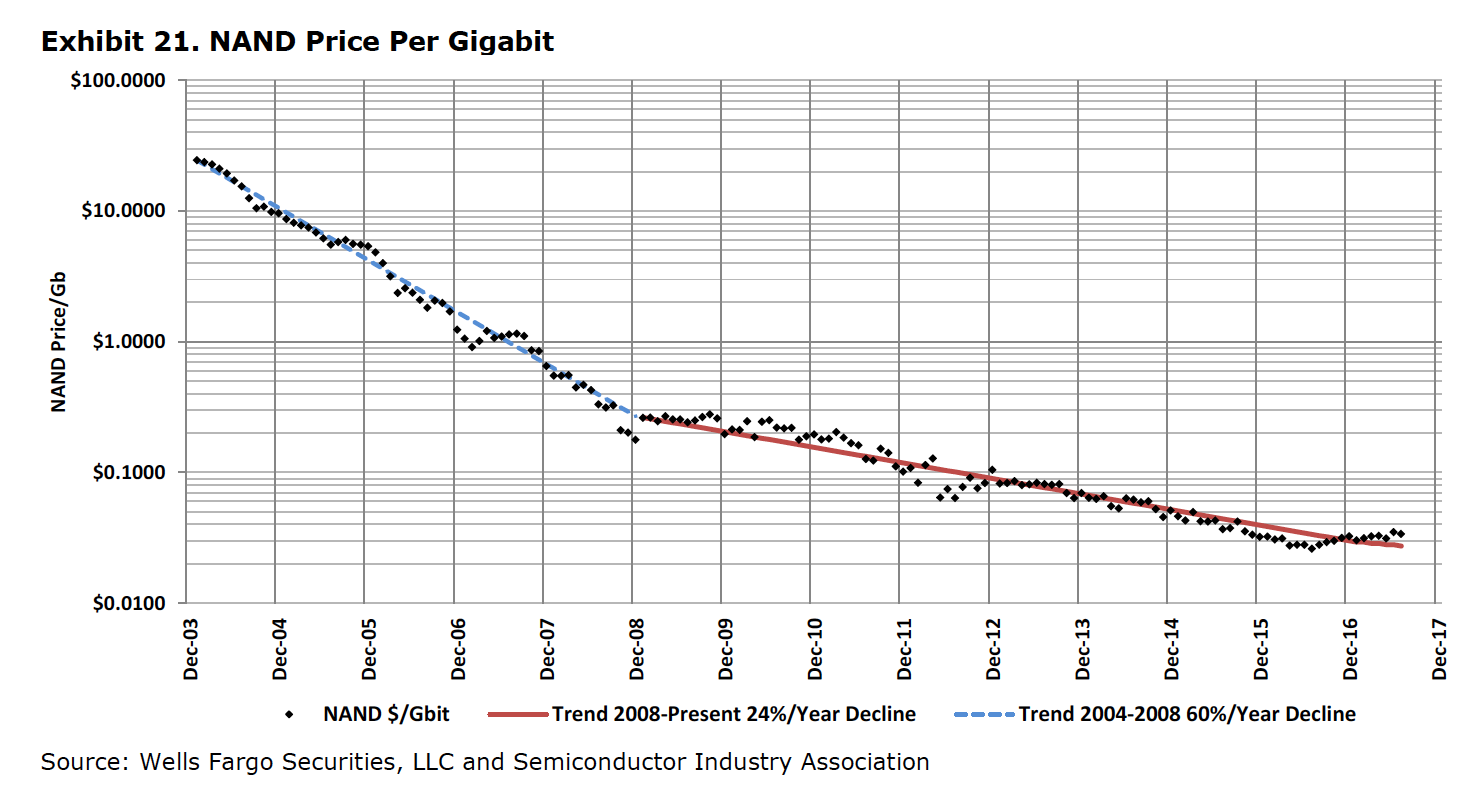
Samsung et al do build new fabs, but at a significant lag to demand for logistic and risk-mitigation reasons.
But if it is not the case, and lowering your price only wins you _some_ but not all customers, then there is no reason to expect that the price point that balance gaining new customers vs selling each product for less will be equal to the marginal cost and not above.
Suppose it costs -- and I am making this up -- $10 to produce the first 1000 units, but only $1 after that.
Suppose people are charging a lot of money, say $50 for a unit.
Won't you increase production to try to capture that demand.
After that, because you have increased production you enjoy economies of scale, and the price comes down.
If you are the only producer, you have no incentive to come down, but if there are other producers you will want to undercut them. In this case, you will bring down your price to gain more market share.
Please help us understand what we are missing with your shrewd understanding of supply and demand curves.