A 1% decrease on $50,000 income is going to be less than the same percentage decrease on $500,000.
Of course, you could argue that "progressive" tax take care of that, but it only serves to drive away a portion of high meet with individuals to the point where tax revenue generally doesn't change much anyway while it can actually increase the overall burden on lower income earners.
Better solution: goodbye income tax.
Much like open source software where individual usage is free, only consumption/sales and corporate taxation has any legitimacy now.
Businesses need a commerce-positive, safe environment for such activity. In order to attract that, no income tax is an excellent incentive. Businesses, which are fictitious entities, support the services needed to entice localized growth; as population grows, so does business activity and revenue, thus tax revenue for services as well.
Of course, any system is prone to corruption filling the power vacuum so eventually it would fail. However, so long as individuals are as unencumbered as possible, people can opt out rather than continue to be abused.
Additionally, taxes serve as a psychological leash and intellectual substitute. Financial/investment education is virtually non-existent in the US and it's generally misguided or even wrong in some instances. If individuals are coddled and promised to be taken care of, they become unprepared for difficult situations.
Let a dog be a dog and let a person be a person, not a slave.
Untrue; consider, e.g., the adoption of EITC if it didn't already exist. It's a pre tax decrease, but wouldn't benefit the wealthy (in first order effects) at all.
Or abolishing payroll tax and transferring equivalent amounts into the various trust funds out of general revenue, a pre tax decrease that would slightly benefit the wealthy (because Medicare tax), but disproportionately benefit those whose income was primarily from labor, which isn't the wealthy.
None of that changes the fact that tax breaks will be greater in absolute numbers for wealthier individuals than for those earning less. Play games to fudge numbers so all is not equal as much as you want - those with resources avoid participating in socialistic wealth redistribution.
No income tax is far simpler. Do you know what the cost for enforcement of individual income tax is? Hint: think astronomical.
Go after about 140 million individuals vs working with approximately 28 million businesses? Do you think business or individuals are more professional? Who had the bright idea to create such a logistical nightmare?
You can keep working with an insane system if you want but people with resources do what people without resources would eventually do in the face of direct taxation, whether financially or physically - leave.
I do know what the cost of enforcement of individual income tax is, at least in a sane system with effective witholding and most people not submitting stupid tax returns every year: about 1.25% of money raised (https://publications.parliament.uk/pa/cm201012/cmselect/cmtr..., table 7).
And the simpler you make the system the cheaper it is (this is NOT flat rates - calculating graduated taxes on income is basically free) - you can see this from the "National Insurance Contributions" line on the same table, which is an effectively zero-complexity additional income tax which costs a third of a percentage point of money raised.
So not astronomical. Really quite efficient.
I like how you've pointed out the amount relative how much theft^H^H^H^H^H "tax" revenue is brought in rather than the absolute amount of:
£3,673,797,000
That's pretty astronomical to me. I'm sure you'll find other ways to break it down and try to refute but it still doesn't change the waste of time taxation incurs.
My stance will not change from the perspective that income tax is more destructive to low-income earners than it is to the wealthy, and that it drives away wealth.
Let's just settle this as "we won't agree" since I have more productive things to spend my time on than arguing over what shouldn't exist in the first place. Pray for Brexit or go down with socialist Europe.
Further, paying capital gains at say 50% on 10% returns for 20 years is better than paying 0% capital gains on 6% returns for 20 years.
When capital gains are taxed as income the whole chunks of the monetary system go away.
Take the recent corporate tax cut, which made companies flush with cash. Companies could invest that in 4 main buckets: pay down debt, invest in growth (r&d or acquisitions), pay out bonuses to workers or buy back stock/declare dividends.
Let's say the company has 1,000 employees and gets $1 million in new cash flow from the tax cut. They have little debt and no direct acquisition targets so they are now deciding between giving all employees a $1,000 bonus or buying back $1 million worth of stock.
Since bonuses are taxes at regular income rate and dividends/capital gains are taxed at 15%, the tax efficient way to put that money to use is through buybacks or dividends. The people making the decision are likely executives with high salaries (income tax rates) and large stock portfolios. They will only pay 15% tax on those dividends compared to the bonus option where they would likely pay at the highest income bracket.
Who gets the short end of this dynamic? Workers who helped create that revenue, but can't afford to buy enough stock to get $1,000 of benefits. The tax code has disincentived the company from rewarding its employees in favor of rewarding its investors. Again, people who are already wealthy tend to be the investors rather than those who typically labor for their income.
Then rational investors will avoid risker share investments in new companies it will reinforce the position of incumbents who will be forced to pay out more in dividends and become bond proxies.
So, it's going to be rational with a 0 or 50% capital gains rate with some portion of your portfolio. Further, increasing capital gains makes it harder to keep up with inflation thus pushing people to make riskier investments.
PS: Try modeling a portfolio of bonds with different yields and risk premiums vs different tax rates including inflation.
Investors will seek alpha wherever they can get it. If there is a flight into "safer" investments, the market would adjust and the returns of those "safer" investments would fall. If investors want alpha returns, they will take risks. This is a fundamental truth of investing.
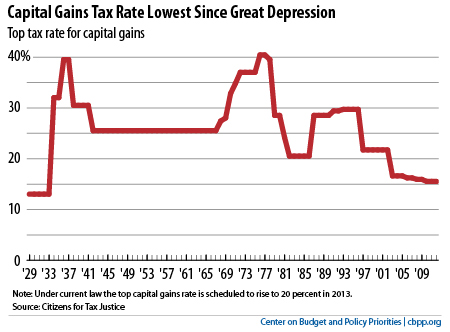
Are the incumbent's positions not reinforced in today's environment? There are 3,618 publicly traded companies today compared to 6,407 in 1987 [1]. Is that a sign of positive competition? Today's capital gains rate is the lowest since the Depression [2]. Yet, entrepreneurial activity is at generational lows [3].
[1] https://www.bloomberg.com/view/articles/2018-04-09/where-hav...
[2] https://www.cbpp.org/sites/default/files/thumbnails/image/ca...
[3] https://money.cnn.com/2016/09/08/news/economy/us-startups-ne...
(Note, this is not to express an opinion on the GP!)
If this moves some money into these underdeveloped areas, after a 10 year stock market bull run, then great. Most of the investments will go to zero, but the ones that don't might have a good impact for the people living there.
https://streeteasy.com/building/235-adams-street-brooklyn/14...
Even worse, the zones are chosen by governors and the rules for selecting them are extremely lax.
I know enough about the local politics of where I grew up to know that at least one of the OZs makes literally no sense and is 100% a kickback to a major gubernatorial donor.
Are there actual numbers somewhere?
some of the zones are legitimate opportunities. A lot of them -- and the ones most likely to attract investment -- make it patently clear that this is a low-risk give-away.
(I'm a socialist in part because of the market's inability to effect change, such as investment in OZs, which doesn't have a sufficient monetary reward but has significant societal reward. Some people call this a "market failure")
But why is that better? Why have a massive inefficient government spend a vast sum of money when instead it can just defer some tax collection, letting these investors take the risk and optimize for success?
Where money is being thrown around by government, in general, there are laws in place to make sure that money doesn't flow into the bureaucrats pockets somehow. But to do that, they add layers and layers of checks and processes. The side effect is that they're not very fast.
And then there's the issue of not having attracted the hungriest talent on average, due to not offering very good salaries, because of the whole avoiding looking corrupt thing.
And then there's the whole personal motivation of private investors to profit, whereas government investors have no such motivation (if they're not corrupt). So there's just no very good motivation to do a great job.
There's a whole slew of reasons they don't make very good investors relative to private investors.
The market is highly regulated in large part due to the notion that "manipulation" occurs (spoiler: it does, but manipulation always fails on its own eventually and the crash is typically made worse by regulators). Restrictions are made on who can invest, when and how much to the point where it's not a surprise that average wage earners avoid doing so - most of the worthwhile options are only for millionaires or higher. No wonder so many think the markets don't work - they can scarcely be considered markets!
Allow people to be educated and learn how to handle their finances rather than being protected from all danger to the point of being locked out, and you'll have informed individuals capable of handling their own affairs. Let Johnny touch the stove to see that it's hot and he'll learn right quick!
Socialism just wants to save everyone from themselves without looking in the mirror and realizing how dysfunctional it is itself. Forced collectives self destruct; voluntary cooperation survives and thrives, but it takes effort and time instead of a quick fix.
This is some extreme oversimplification of 1-human behavior and 2- how easy is it to teach people immediate need denial for long term benefit. No matter how many times you tell people the parable of the ant and the grasshopper, it's still just a story. It's not how the human mind works (generally).
On the inverse end, I could point out how every "self made man who didn't need help from nobody and just smarted his way to the top" was likely helped in countless circumstances that have nearly nothing to do with his direct actions. Humans are great at creating narratives, regardless of whether there is actual causality.
Socialism wants to save everyone from a biased, unfair, inequitable system, understanding that a herd is stronger than an individual and that spreading risk across the board means fewer catastrophic events for the individual. The goal is to lower the upper limit and raise the lower limit. It's not an attempt to pander to poor foolish baby people who can't do a finances for themselves, it's saying that there's no reason for a civil society to allow some to suffer debilitating hardships at the hands of a system they were forced into through circumstance alone while others reap unjust rewards. It's not perfect, but leaving "the free market (tm)" alone and not regulating leads to slavery and child labor and private paramilitaries protecting corporate kings as the past has shown.
I do agree that it is easier to be lazy and obtain instant gratification than delay it for great reward but it can be learned by anyone if the cushy safety net of socialism is removed. Everyone has something that motivates him to become greater than what he is now; it's just a matter of discovering what that is - often he has to find it himself. One-size-fits-all socialism destroys this freedom.
>every "self made man who didn't need help from nobody and just smarted his way to the top" was likely helped in countless circumstances that have nearly nothing to do with his direct actions
Correct: nothing happens in isolation. However, mindset greatly changes the likelihood of an outcome. Without being able to cultivate and learn outside of indoctrination institutions, the world would be static and soulless.
>The goal is to lower the upper limit and raise the lower limit.
This is the core: give those whom are lazy a cushy retirement and shackle people who dream big so they can no longer fly.
Slavery and child labor comes from power vacuums that are created by control freak communists/Marxists/socialists who keep things from changing and improving. The rest go along because change can be scary and we all want stability. A face of true evil is the deception that we all must be equal - we are not. We have borders, both conceptual and physical - doors on our homes and personal space that we want respected; yet socialism cries that borders are bad and we need to take care of everyone regardless of our own situation... and let's use other peoples' money to do it since we don't have any. Crabs in a bucket.
I know you mean well because I was in your shoes after the dot-com collapse. The difference is that I've seen the hypocrisy - there is no perfect system but socialism is a slow, agonizing death.
No thanks. Any society that does that is not free or fair, it is hell.
You don't need socialism, that's a crazy stretch. All that's needed is proper guardrails and regulation to ensure safety and prosperity.
also it is irrelevant, as every single listed company will benefit from it, making no stock differentiation in price.
And, of course, the 401k/pension plan, or company that the 401k/plan owns, could easily invest in the OZ if they so desired, if it made financial sense separately from the individual tax break.
[1]https://www.barrons.com/articles/opportunity-zone-funds-to-d...
Granted there are other regulatory issues that will limit a lot of this activity to accredited investors (via Reg D private placements), but OZ regs have nothing to do with a persons net worth or income.
As other posters have commented, the benefits are three fold - deferring your gain until the end of 2026, a 10% step up in basis on the gain if you hold for 5 years, an additional 5% step up if you hold for a full 7 years, and an exemption on tax for the appreciation of the assets you've invested in if you hold them for 10 years.
Here's a link to an ebook we just put out if anybody has interest in reading how it will work in the real estate space - https://www.realcrowd.com/blog/2018/10/the-real-estate-inves...