If your $ per kWh is something ridiculously low like $0.002 you can economically electrolyze h2o to pure hydrogen.
The surface area of the ship, don't care about that. A 20x20km area of the Mojave desert covered in super low cost PV can provide the power needed.
This is the same economy of scale thing as a solar powered car. If you were to theoretically cover every square cm of a Tesla model S in high efficiency PV, and let it sit in the sun all day, it might take a week or more to collect the 95kWh needed to charge it fully. But if the PV is somewhere else on rooftops or otherwise-useless arid land, connected to the grid, you can plug your car in to a 240V 30A socket in your garage and charge it every day.
This is not nothing. It's roughly as much power as a redlined sports car engine. It might be sufficient to fight the worst ocean currents, since propulsion power scales so frighteningly faster than speed.
https://www.maritime-executive.com/editorials/the-future-ult...
It would also make sense, with larger ships, to just implement the nuclear tech we already have.
IANA(nuclear scientist) but I imagine that it has to do with the lack of nuclear engines available for the commercial market, which is due to nuclear technology being restricted by export controls and the like. Keeping nuclear engines and fuel out of the hands of others is much simpler when they're only on military ships with armories and soldiers, basically impossible on unarmed, undefended commerical shipping vessels.
Do correct me if I'm wrong ...
And a sports car is what, 3,000 pounds? A container ship is something like 200,000 tons. I guess they can power a redlining sports car engine when out to sea but not a whole lot else.
A Maersk Triple E has two up-to-30MW-each engines and a design speed of 19 knots. You'd scale down speed by a factor of 12 to achieve 1.6 knots (0.8m/s), and out of that you would get to scale down power by a factor of 144 to meet your ~400kw solar power endowment.
The question is whether you can cross the most powerful currents, and at 1.6 knots you would certainly need to be cognizant of them to stand a chance, but you could ford them in the manner of fording a river: Get pushed downstream a bit, but cross the highest velocity area perpendicular.
http://www.aoml.noaa.gov/phod/gdp/images/climatology.jpg
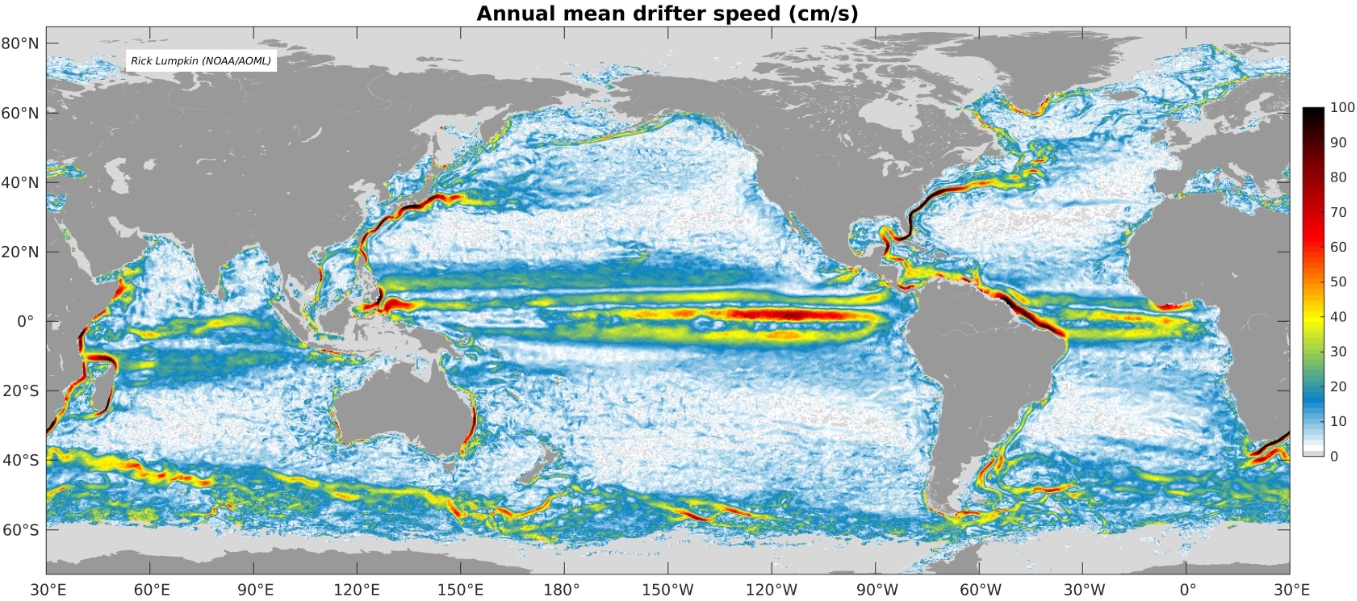
The Maersk Triple E and huge bulk carriers are practically worst-case-scenarios for solar, because there's so much ship to displace water under every square meter of solar. A smaller lighter catamaran is likely to find itself with dramatically higher speeds, albeit not linearly higher with hull depth, since a longer waterline is more efficient.
I'm not suggesting this is practical. I think massive nuclear powered cargo ships capable of high speed is a hell of a lot more practical in a post-carbon world. But again: it's not nothing.
A big cargo ship's engine can be 25000kw. The biggest wind turbines (750') generate about 8000kw. So.. three of them? The ship would need to be 1500 feet long just to make room. But the wind isnt constant. Five turbines? Bridges might be an issue.
It's the square-cube law in operation. It also applies to solar. The only application of solar mounted on a transportation vehicle that makes any sense is those ultra-light unmanned planes that cruise above 60,000 feet.
Solar is just nowhere near good enough compared to the needs of a massive ship like this.
Wind would maybe work, but then remember that a turbine would effectively slow you down as you'd be pushing against the air.