I haven't really ready anything on this most recent set of vulnerabilities and AMD.
Yes spectre type issues effect many ranges of processor (including AMD), however everything shown to date indicates that its very difficult to exploit.
There are a large number of Intel only issues like meltdown and the L1 cache attack that are much more severe, and much easier to exploit.
With 4 execution units, 4 processes run at a time, and they all get swapped out every scheduling tick (losing all their cached lines). OTOH each process gets a full measure of cache to use during its slice.
With 8 execution units, 8 processes "run" at a time, they interleave based on stalls and CPU resources, and the OS doesn't need to reschedule anything every tick (so they hopefully keep their cache lines hot). But each process gets a half measure of cache to use.
In reality, code tuned to use a full measure of cache will be better off matching the number of processes to the number of execution units available, so you'd run half the number of processes with HT disabled. And cache-tuned code tends to fall off a performance cliff when it exceeds cache available, so it may easily run more than twice as fast, depending on the work.
The win from HT depends on most code not being tuned to full measures of cache, and having a lot of memory stalls or other heterogeneous work that other work can fit into. And most code is like that. Cache tends to have a declining marginal return - you have to add exponentially more cache to avoid cache misses - https://en.wikipedia.org/wiki/Power_law_of_cache_misses .
¹ For example in SPECvirt_sc2013 the patch reduces performance by 31% (https://www.servethehome.com/wp-content/uploads/2018/08/Inte...) 31% is unheard of for a security patch! It's a difficult security-speed tradeoff that businesses must carefully consider.
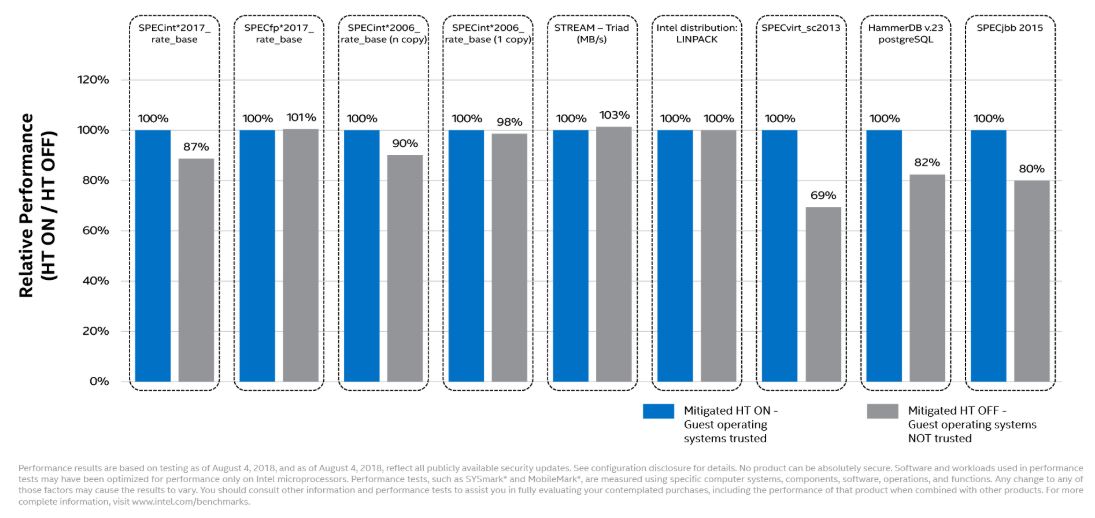
Give intel some time to cope with this newest set of vulns, see if they can find a way to re-enable hyper threading safely, and if they can't and are still advertising hyper threading, then start going after them.
It does not. The fundamental difference between AMD and Intel CPUs in all these faults is that AMD does all permissions checks eagerly before returning results from memory, while when speculating, Intel defers them until speculation is resolved.
This does not mean that AMD escaped all of it, because some of the attacks (eg, spectre variant 1) do not cross a protection boundary that permissions checks would catch.
https://marc.info/?l=openbsd-cvs&m=152954666609919&w=2
While no AMD issues are known at present. OpenBSD will have it disabled by default. How about other operating systems, I wonder?
The major win (whether AMD intended it or not) is that AMD cpus don't speculate loads until page permissions have been verified. Intel fires off the speculation immediately. That is one of the primary side channels underlying many of the attacks.
Intel has been actively muddying the waters with FUD to get people to think AMD is just as vulnerable. Please don’t buy into that. Intel is far more exposed. The subsequent slowdowns are more severe.
Microarchitectural differences. They are, after all the same architecture, i.e. x86-64.
/pedantic
Edit: https://www.amd.com/en/corporate/security-updates
> 8/14/18 – Updated: As in the case with Meltdown, we believe our processors are not susceptible to these new speculative execution attack variants: L1 Terminal Fault – SGX (also known as Foreshadow) CVE 2018-3615, L1 Terminal Fault – OS/SMM (also known as Foreshadow-NG) CVE 2018-3620, and L1 Terminal Fault – VMM (also known as Foreshadow-NG) CVE 2018-3646, due to our hardware paging architecture protections. We are advising customers running AMD EPYC™ processors in their data centers, including in virtualized environments, to not implement Foreshadow-related software mitigations for their AMD platforms.
For those on AMD platforms, how do you disable software mitigations for Foreshadow? Is this automatically done by browsers, operating systems and hypervisors?