I don't understand why people insult the Greek so much in this thread. Yes, the Greek state wasn't very correct, but you can make many arguments, say for example that it behaves MUCH better than the Italian state. But ... Germany can't punish Italy the same way, that would have caused a crash.
Greece is a small player in the EU that got into trouble. Almost all small players got into trouble in the same period. Many big players got into trouble too (Italy and even France both had the same issue). Greece got destroyed, made an example of, because it was the first small player to face an acute cash problem (technically Italy was actually the first, but Italy can't be made an example of safely), the rest was saved ... Let's please just stop pretending there's anything just about this situation.
Also: Greece (nor the other small players) will not recover:
https://tradingeconomics.com/greece/government-bond-yield
Greece's economy is "growing" at 1.7%. Interest on it's 10Y debt (that it can't pay now) is 4.3% ... It's total debt level is pretty much 185%. That means that, on average, for Greece to save itself, taxes need to rise by 1.85 * (4.3% - 1.7%), or about 5% per year.
5% per year tax rise. With an economy, in a huge global boom, growing at 1.7%.
So I'll just add to that : may God have mercy if there is even the mildest of recessions.
And the thing the whole of the EU is ignoring that the basic problems of Greece are all EU wide. Of course, they still have more of a runway, but total inability to pay for social security and pensions is not exactly a problem of Greece alone ... And the demographic disaster playing out in Europe is absurdly bad.
And despite the rhetoric coming out of Hungary, Europe as a whole already has net-negative immigration. All of Eastern Europe, not just Greece, is losing population at an absurd rate. Moldova went from 4 million people to ~2.6 registered people (there are reasons to suspect the real number is even lower than that). But despite all the complaining, immigration into Europe is drying up and will flip into net-emigration in a few years, unless something drastic changes. For "natives" there are absurd levels of emigration even in the richest of West-European countries. The Netherlands has been losing 1.2% per year of it's native Dutch for >10 years now, with the numbers slowly rising, currently just shy of 2% per year. When immigration dries up, which isn't too far away, that will be the net population growth in Europe. And there are 2 economic relationships that we can prove have held for thousands of years. Here's one: less people, less economy.
Countrysides emptying out of people is no longer a problem faced by inner Spain exclusively, it's clearly visible in Wales, in Westphalen, in the Ardens, in Friesland ... it's everywhere and while it can't yet be described as catastrophic there (in Spain, it is catastrophic), it's rapidly getting worse and I simply don't see a realistic option of living there and neither does anyone I know. That's anecdotal, I know, and I sure hope that means it's wrong. But I fear it's not.
The future is not bright for Europe. All of Europe will be Greek in something like 10-15 years.
1. Greece did not live above it means. It did not have more debts than other countries in the EU zone, countries that did not crash 2. Greece would have been fine it it had not been forced to destroy its economy with an austerity program
> They lived way above their means
You probably are german, because that is a BILD/CDU slogan. It's very hard to qualify what that is supposed to mean. A country can not "live above their means". It can have too much debts. That wasn't the case here.
"Living about their means" is what happens when their debt levels grow exponentially:
https://2.bp.blogspot.com/-7KXHAuORi4w/TbS897oFTGI/AAAAAAAAA...
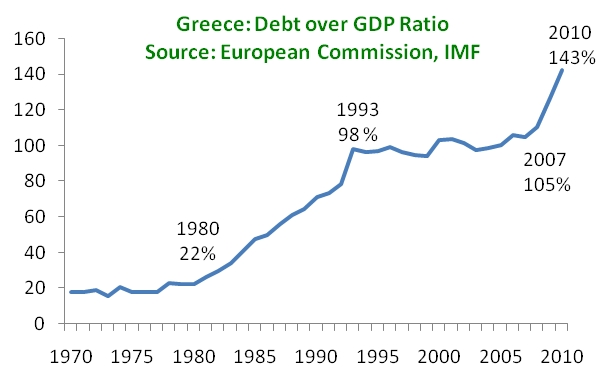
in what world do you think this is sustainable? The US can get away with huge amount of debts because they have the dollar, which the most trusted international currency for virtually every commodity trade. Other countries don't have that luxury.
On the other hand, do you know who didn't know nothing about it? Greek people, particularly young people who are now in their 20s and 30s, and can't find a job to live as proper human beings (>30% youth unemployment). Yet, you look like you enjoy this. I, just, wish you will never face something like that in your future.
They can blame their parents and grandparents who voted for stupid and corrupt politicians. You don't need to look very far.
Its not the size of the debt or the deficit that matters but what its spent on.
Take a look at pre-2009 retirement ages, number of employees in the public sector and the wages in the public sector.
Take a look at this graph (and read the article it comes from): https://en.wikipedia.org/wiki/Greek_government-debt_crisis#/...

1. After Greece entered Eurozone in 2001, their already large debt exploded. They had 4-14% yearly deficit - they clearly "lived way above their means".
2. In 2011 Greece themselves declared that they can no longer service their debt, e.g. they defaulted. In this sense they had "more debts than other countries in the EU zone" and they clearly would not "have been fine it it had not been forced to destroy its economy with an austerity program". If there was no bailout, they would default on their debts and their economy would totally collapse (think Venezuela style). This also goes against you claim that "[a county] can have too much debts. That wasn't the case here."
3. Greece government was until 2011 reporting fraudulent financial statistics in order to hide true extent of debt, also employing the help of international banks. Some actions were clearly fraudulent (cross currency swap at fictitious rates).
4. Greece asked other (mainly EU) countries to help her, the result was a massive reprogram of their debts (basically they got low interest rates and reprogrammed debts to 30-50 years, something you do not get at financial markets).
5. Greece negotiated a 50% "haircut" on debt owed to private banks in 2011, which amounted to a €100bn debt relief. Most affected were EU banks (Deutsche bank, BNP Paribas, etc..). So there were private entities that actually lost money on Greece. This pretty much dispels the claim that they were a victim of neoliberalists and/or capitalists.
6. Also, it's a totally false premise that a country can not "live above their means".
The leftist agenda has been to portray Greece as a victim of capitalism and/or neoliberalism. This was mostly dispelled by facts, and I rarely see this kind of propaganda in 2018.
The reality is that Greece put themselves in this situation and international community (especially EU) stepped way out of their way to help them, except offering them a massive write-off, which if happened, would be IMO a grave mistake.
It was both capitalist governments that created the crisis and capitalist governments that tried to remedy it (no government has moved away from a market economy and privatizations since the late 80ies, including SYRIZA). We Greeks are 100% absolutely right to blame capitalism and/or neoliberalism. It was a capitalist/neoliberal system that created the crisis and a capitalist/neoliberal idea (austerity) that utterly failed to remedy it (it has been almost 20 years since the crisis and there is not an end in sight).
You don't seem to realize there is such thing as "personal responsibility". Nobody forced the Greeks to borrow way more money than they could ever hope to repay. The Greek government created its own problem and hoped to get away with it. There's no world where you can make it the fault of someone else.
I never said that. The Greeks voted for such a system, I never said they didn't. But you can't say that this "leftist agenda" as you call it is wrong. It is the system that we had/have (and voted for, sure) that created and failed to solve the problem. Any leftists with this agenda are not wrong.
No one in Greece is trying to shift the blame (except for some fringe conspiracy theorists from the extreme right). That Greeks are looking for someone to blame is a popular EU myth.
The modern standard is IPSAS or equivalents which consider what matters - the market value of the debt.
https://ftalphaville.ft.com/2016/06/09/2161851/what-if-greec...
They turned themselves into a different country by borrowing Euros at German market interest rates while their previous interest rates for borrowing were at 16% before they joined the Eurozone. They lived way above their means for more than 10 years, what did they expect for a country that has virtually no industry?