Bike lanes in sidewalks work in beaches because bikers tend to drive at a comfortable cruising speed. Daily commuters usually bike in the ~15-25mph range in a city (and a lot faster in suburbs and country roads); that speed is dangerous for pedestrians. You are also disregarding turns and intersections, where it's much more convenient to stop as little as possible.
The solution to bike lanes is physically separated lanes that don't give lazy car drivers free parking space and don't penalize cyclists for traffic, but still allows them to move to the roads when there aren't many cars as in [1].
[1] https://assets.publishing.service.gov.uk/government/uploads/...
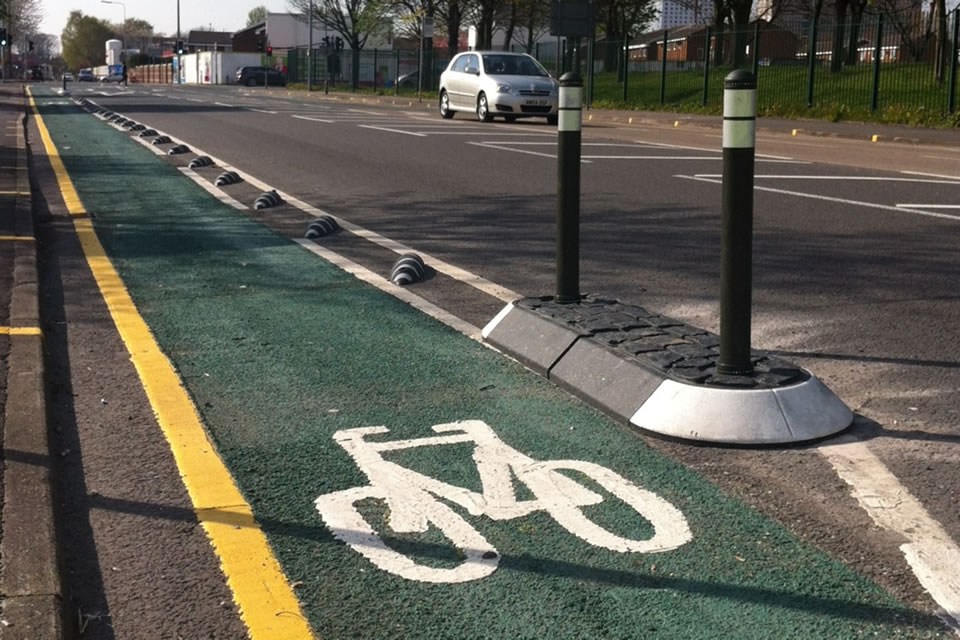
I think technically in many jurisdictions, bikes are to be treated as vehicles. Whether or not they're always treated that way is up for debate (and vice versa), but it may explain also partially why things were done that way.
This doesn't include putting the bikes on the same grade as the sidewalk, but that's a relatively minor difference once you already have parked cars separating you from car traffic.
I know some people get annoyed that it's slightly slower, but you avoid some seriously dangerous situations.
And there are a number of ongoing projects. See: https://www.seattle.gov/transportation/projects-and-programs...
I do agree, but the bike lanes in a city CBD need to serve a different purpose from those at the beach.
The city bike lanes have a lot of commercial traffic (bike couriers) and people commuting, mostly adults, so they are travelling faster and "with intent".
The bike lanes at the beach are for leisure and are much, much slower, without the urgency. A lot more kids on bikes too.
- Cars will make turns that cross your protected bike path and with parking in the way, a bike's already minimal visible cross section is reduced even more.
- Bikes need to make left turns which is difficult when there are parked cars in the way.
- Pedestrians will happily walk everywhere in your bike lane (oblivious to your bell ringing due to headphones), regardless of whatever paint you delineate the two areas.
In areas with these kinds of bike lanes, I generally ride in the street with the cars. It's safer and faster.
Proper turning/bike lane design and prioritized space for cyclists takes good care of this. In lighted intersections, stagger the lights so bikes have priority.
>" Bikes need to make left turns which is difficult when there are parked cars in the way."
Make bikes do hook turns (https://en.wikipedia.org/wiki/Hook_turn) instead of using the cars' left turn lanes. It's significantly safer and doesn't require bikes to cross traffic lanes.
>"Pedestrians will happily walk everywhere in your bike lane (oblivious to your bell ringing due to headphones), regardless of whatever paint you delineate the two areas."
Delineate with a curb instead of just a line, to make the separation clear.
At the one intersection I'm most familiar with, a separate bike light almost always results in the driver becoming confused and causing a near crash. I've learned to wait a few seconds to avoid being hit.
> Make bikes do hook turns (https://en.wikipedia.org/wiki/Hook_turn) instead of using the cars' left turn lanes. It's significantly safer and doesn't require bikes to cross traffic lanes.
That takes signficantly longer, as you're guaranteed to sit through at least one signal phase. Again at my favoritist intersection ever, hook turns are what are marked but only newbie bikers use this technique. Everyone else just takes their chances doing something radical so they're no better off.
When I was there, I kept walking in the bike lane by accident and ended up upsetting some cyclists.
the cheaper, easier, and move obvious solution is to simply pour a curb separating the bike lane and the car lanes. you don't have to raise the whole bike lane up to sidwalk level, just 6" at the edge. and that's what many cities are doing.
When I was handed the license, my instructor told me "congratulations, you are now invisible".
You have to ride as if everyone is simultaneously oblivious to your presence and out to run you over all the time.
Bike lanes are a disaster, probably one of the biggest mistakes in road design and planning.
The basic idea was sound, but it was done the wrong way. Everywhere you see a bike lane, that should've been the concrete sidewalk extended into that area with a painted stripe separating pedestrians and bicycles. Go to a beach and you can see the correct implementation. Our sidewalks are simply not wide enough.
What we have now is a cheap and bad solution. Nobody on bikes, scooter, etc. wants to be just a thin painted stripe away from cars that can kill them. But they are forbidden from sidewalks because they are too narrow.
The right way to add bike lanes would've been to extend the sidewalks into the road (where the current bike lanes are) by pouring concrete there. Full protection from cars, wide enough for pedestrians and bicycles, scooters, etc.
It's not too late to fix this, the bike lanes are there. Cities just need to spend the money to expand the sidewalks there. If they do this, there's potential for a true revolution in non-car mobility in the US.