Then how did the crushed barrier get crushed before the Tesla hit it? Clearly, the stretch of road is unsafe enough to trick humans drivers (and, clearly, Tesla should improve).
The most likely scenarios I can think of would be not paying attention and drifting into the barrier, attempting to avoid a car merging into the lane (and not paying enough attention), or being struck by another car and being forced into the barrier.
https://techcrunch.com/wp-content/uploads/2018/03/screen-sho...
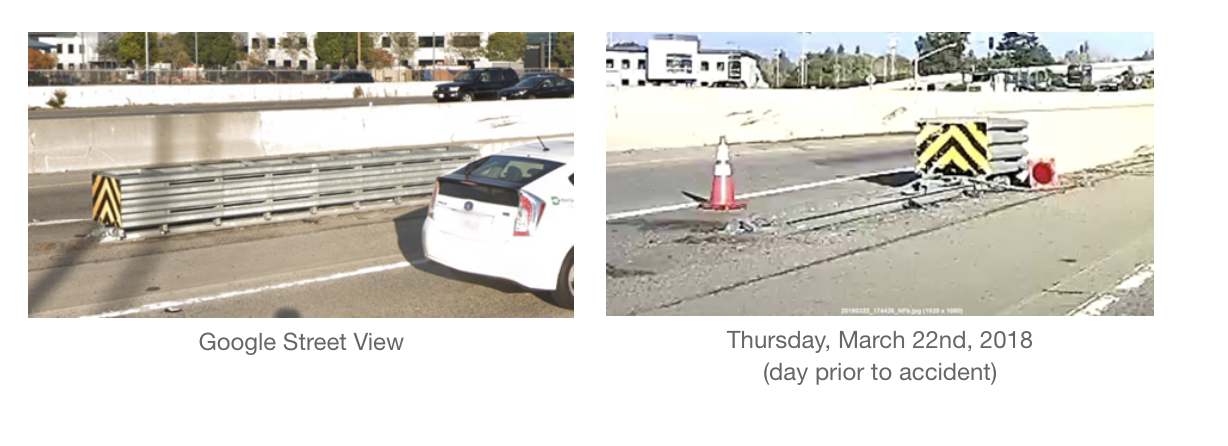
Though of course that doesn't explain why it didn't recognize the barrier as something it should avoid at all costs. Unless perhaps something to the left confused it and made it think there was an obstacle there, too, thus causing it to think it was going to crash regardless. If so, maybe it did try to brake at the last second?
https://techcrunch.com/wp-content/uploads/2018/03/screen-sho...
I think 3d mapping the surrounding world correctly using multiple cameras (what humans are doing) is more generalizable.
Reminds me of a scene in "La grande vadrouille" where a motorcyclist is killed on a mountain road because he was following the dotted line and the painter had gone to the side of the road to take a break.
Also, that's an immense pothole!
... well you certainly aren’t from southeast Michigan, that’s for sure.
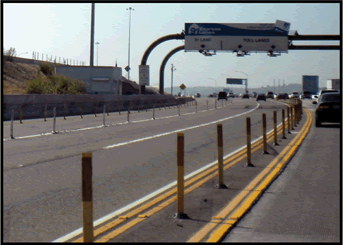
The divider is from the fast lane no less.
There's a spot just like this in Houston on 610 East. HUUUUUUGE flyover as the HOV lane spends about a half mile merging into the left lane of 610 (nice fat fast freeway, they need the runway). A guy had thought the flyway would be a safe place to park his car and wait for a tow. Safe enough that he was sitting on the hood of his car. Sure as shit the Challenger in front of me got confused, cut into the flyaway thinking it was a lane, hit the disabled car, and sent the guy flipping up into the air a good 10, 15 fit. Fucked up accident.
Anyway point is after the accident I was talking to the driver of the Challenger, trying to calm him down (kept saying "holy shit I fucking killed that guy!") and other that shock he was sober as a duck. He got bloodtested and everything, clean. In court he said he just got confused and thought it was a lane.
LONG STORY SHORT human error mang, human error. Still not sure why a car was able to do it.
They have those same white lines leading into intersections and people cross that shit all the time. People speed.
The vehicle should have at the very least stopped short of the road obstruction. But we don't yet know what led up to being in that lane, I was hoping the article in the OP would have taken us through it. Instead I'm getting the feeling this was a catastrophic software failure. Without more transparency on the issue, despite what Tesla may prefer I don't think I have any choice but to feel uncomfortable.
A piece of software that mistakes that wedge for a lane in broad daylight has no business being deployed on the road, in my opinion.
any healthy human would not deliberately drive into the barrier
The worst such crash I've ever seen was barely 2 miles from there, on northbound 85 near Fremont Ave. There is a soundwall that comes to a connection point where a wall segment is directly perpendicular to the freeway. For some reason, the guardrail had a gap there almost exactly the width of a vehicle.
A few years ago, a vehicle veered off the right shoulder and perfectly threaded the gap, into the wall at full speed. It was compressed to maybe 5 feet long.
[1] http://abc7news.com/automotive/exclusive-i-team-investigates...
I'm sure that out of the 1.25 million annual automobile-related deaths, plenty of drivers were paying attention and still did stupid things similar to this accident.
Humans do exceedingly stupid things all the time because they stop paying attention, even momentarily (or subconsciously).
We put big lights on the back of cars that light up when they brake. And yet, despite a driver looking direct at a huge object with two lights, that rapidly grows larger right in front of them, does not always prevent a collision. Or even a chain of collisions. I don't get on the road much, and yet even I've seen a ton of accidents that are baffling and can only have been the result of a driver not paying attention for a bit.
I'm reminded of how in quite a few places removing signs and lights actually improved safety because it forced drivers to stay aware instead of 'driving on autopilot', so to speak.
I think that's the real issue here. The more we outsource our attention to a machine, the more important it is that said machine does MUCH better than we humans do. Especially if a mistake can be deadly.
But I wouldn't be surprised if, indeed, technically this accident could've happened just as easily by a non-autopilot car where the driver had a little 'micro-sleep', got distracted by something in his field of view, mistakenly thought he was on a lane and didn't notice the (let's be fair) ridiculously bad markers that were the only way to tell that part of the 'gray' stuff in front of him was in fact a wall of concrete.
I mean, just look at the image: https://imgur.com/a/iMY1x . Half of what makes the barrier stand out is the shadow!
All that said I might sound more argumentative than I am. I do agree with most of your comment.
"this isn't an average accident statistic, a lapse in attention or evasive maneuvering. "
"That's not a mistake a healthy human will make."
Almost every driver thinks they're significantly better than average. Few are.
If a human driver's lapse of attention causes a similar crash, how much less of a tragedy is it just because we can less ambiguously blame the victim?
My opinion is that the statistics compare just fine.
Actually, about half of drivers are better than average.
true. here’s the location (post #62)
https://teslamotorsclub.com/tmc/threads/model-x-crash-on-us-...
but the average person in the US anyway is not a good driver. i very often see people get aurprised at the lane ending at that exact spot. they should put a rumble strip leading up to it.
So, my question is, is it fair to compare AP to a human driver paying attention or is it more fair to compare it to an average driver.
I mean that just for the sake of argument. In this specific case, NTSB or someone should ban AP. It is so obvious what’s about to happen there, an AP should do what a driver should do which is take the ramp whether it’s a wrong turn or not. So many a-holes try to squeeze in last second (oops) when they should just take the damn exit or miss the damn exit as the case may be. What AP did here is what a poor and panicked driver would do and that’s just not acceptable.
So, I thought it wasn't all that clever in the first place to try and marry the risks of getting electric cars into the market with the risks of telling the extremely wealthy that they didn't need to hold the damn steering wheel.
This statement is meaningless circular logic. You can handwave away any incident with a human driver by saying he wasn't "healthy".
A human pilot has intentionally driven an airplane full of passengers into the ground with full control because he wanted to kill himself. The airline believed he was "healthy".
Tesla's statement is not clear on this at all.
If that was the case, they would have said so. Their vagueness here is telling.
If one system is steering the vehicle into things that the other system would, in most conditions, reliably avoid, it bears some discussion.
The only reason a human drives into that barrier is if they swerve to avoid something or are otherwise not properly paying attention (texting, etc.).
There's no good reason for the autopilot to have hit that barrier.
The mental gymnastics going on in these comments attempting to absolve Tesla of any responsibility are truly next-level.
Again, not absolving Tesla, just being realistic about the capabilities of human drivers.
Either:
A) The autopilot could not see a concrete barrier in its path. B) More likely, and as the story reports, it WAS aware of the danger but didn't do anything.
Either case is at least worth discussing, no?
What I think they fail to address, especially in this case, is that the autopilot did something a human driver who was paying attention would never do. Autopilot does a great job of saving people from things even a wary driver would miss, much less a negligent one, but the fatal accidents that occur in statistics are not from people who are fully watching the road missing the fact that there's a concrete barrier with yellow safety markings directly in their path, and hitting it head on for no good reason (e.g. evasive action because of another driver, etc, oh a stupid last-minute "oh crap that's my exit").
I want autopilot to succeed, and I want Tesla (and Musk) to succeed, and for the sake of their public image they have to realize that this isn't an average accident statistic, a lapse in attention or evasive maneuvering. It's a car that seemingly plowed right into a concrete barrier while still under complete control. That's not a mistake a healthy human will make.